Bald Eagle

Bald Eagle, Photography by Ben Bawden

Bald Eagle, Photography by Ben Bawden

A national emblem, a conservation success story, and scorned by Ben Franklin, the bald eagle resonates throughout the popular conscience of the United States. A bird of many misconceptions (especially noted by Ben Franklin) the bald eagle is not a voracious predator. Rather, the bird voraciously scavenges, even stealing fish from osprey and otters. In southern Wisconsin, a popular winter meal for bald eagles is fish carcasses from ice fishermen and deer carcasses.

Imagine the bird's fierce call echoing through the pineries of northern Wisconsin. Here, another misconception...the call of the bald eagle more resembles that of a gull. The characteristic screeching heard in Hollywood belongs to the red-tailed hawk.

Look at the eagle's bald head as it reaches for skyward, catching an updraft. Well, you probably know that the eagle isn't actually bald.

In Wisconsin, bald eagles nest throughout the state, in 69 of 72 counties based on Wisconsin Department of Natural Resources aerial surveys in 2015. The state hit a low number of recorded occupied nests in 1974 at 107, mostly nesting in north central and northwestern Wisconsin. Low numbers were a result of habitat destruction, shooting, and toxic chemicals like DDT. In 1972 the bird was placed on the Wisconsin Endangered Species List, and in 1978 the bird received federal protection as an endangered species in most states, though it received threatened status in Wisconsin. Since then, the population has soared. By 1994, over 500 nests were found throughout the state. By 2005, over 1,000 nests. 2015 saw an estimated 1,465 nests throughout the state, as the bird has expanded its range farther into southeastern Wisconsin.

In 1963 there were an estimated 487 nesting pairs in all of the United States. In 2015, 497 pairs of bald eagles nested in zone 2 of WDNR surveys, an area that includes all or parts of ten counties in north central Wisconsin, thought to be the highest concentration of bald eagles in the world. Not coincidentally, this area is also home to some of the highest densities of lakes in the world.

Open water beckons bald eagles because of abundant prey opportunities. Throughout winter, you can see bald eagles congregating along open water of the Wisconsin and Mississippi rivers. Enjoy Eagle Watching Days in the Sauk City area January 13th and 14th.

Bald Eagle in-flight, Photography by Ronald Woan

Bald Eagle in-flight, Photography by Ronald Woan

Here at Faville Grove Sanctuary, we are lucky to have an occupied bald eagle nest this winter. Located about two thirds of the way up a big cottonwood, near the base of the tree, the large nest stands out against the treeline. Follow Prairie Lane down to where it turns north, and look east towards the Crawfish River and you will see the big nest, probably 5-6 feet in diameter and over two feet tall. Please view the nest from Prairie Lane, as it is located on private property.

The eagles occupying this nest could begin laying eggs as early as mid-February, and we are excited to follow their progress!

Written by Drew Harry, Faville Grove Land Steward

Friday Feathered Feature

Bird Feeders

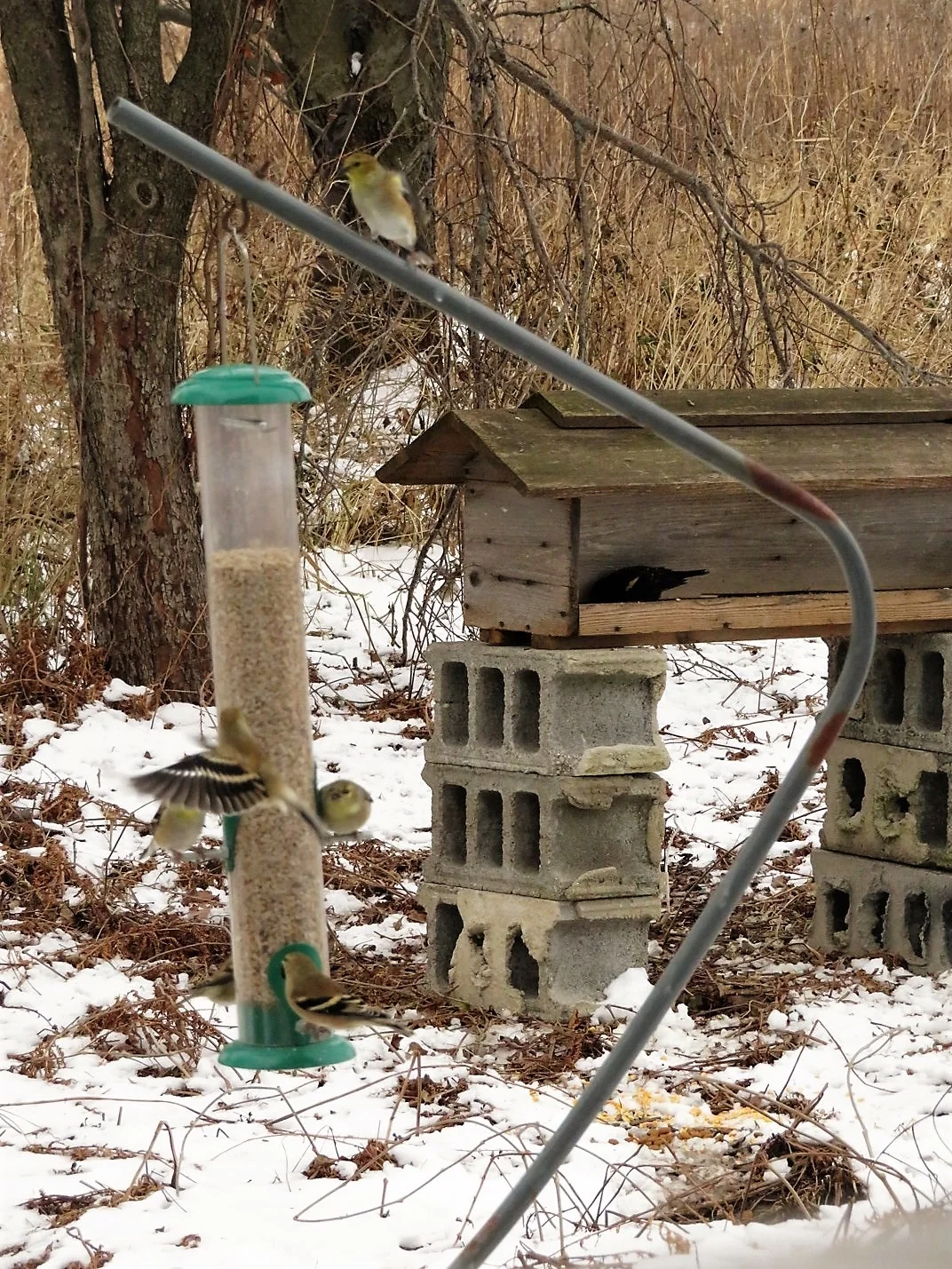
A black-capped chickadee waits for an opportunity to feed at the sunflower fines feeder being used by American goldfinches.  In the background a red-winged blackbird enjoys a seed mix at the hopper feeder.

A black-capped chickadee waits for an opportunity to feed at the sunflower fines feeder being used by American goldfinches.  In the background a red-winged blackbird enjoys a seed mix at the hopper feeder.

The feeders have only been up for a week, but already I have bird feeding fever! Though we always had a bird feeder in my parent’s house growing up, this is the first home I’ve lived in as an adult that has allowed me to have feeders of my own. Aaron and I are really enjoying the experience.  

The first thing we do when we wake up in the morning is peek out the window on the north side to see who is already up and eating breakfast. In the evenings, I can’t stop myself from fussing with the feeders before I head in for the night, making sure the seeds aren’t stuck in the tubes, scattering some seed on the ground for the pheasants and mourning doves, seeing who I can surprise as I approach.  The species are what you expect this time of year, black-capped chickadees, American goldfinches, American tree sparrows, mourning doves, a pair of Northern cardinals, and a skittish hairy woodpecker.  

One species I didn’t expect was the opossum that was buried snout first in the large hopper feeder Tuesday evening.  He has adopted a nearby former woodchuck hole as his winter home, and I couldn’t be more pleased to have the opportunity to observe him (and hopefully keep him well fed) over the coming months.  I hope your winter bird feeder will provide you with your own surprises and delights this winter!

Goldfinches squabble over a spot at the sunflower fines feeder, while in the background, a red-winged blackbird enjoys a seed mix.

Goldfinches squabble over a spot at the sunflower fines feeder, while in the background, a red-winged blackbird enjoys a seed mix.

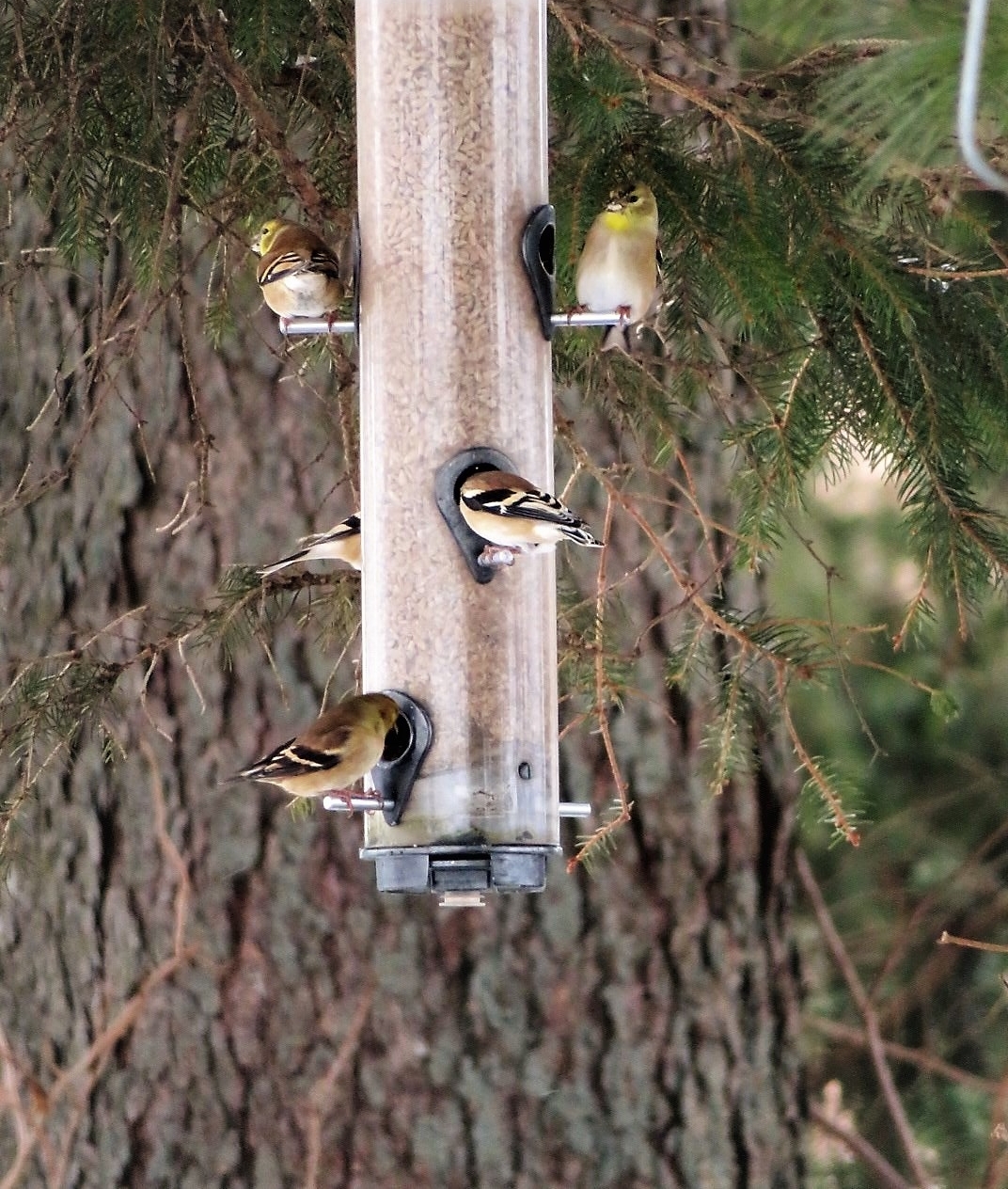
American goldfinches at one of Mark and Sue’s feeders.

American goldfinches at one of Mark and Sue’s feeders.

HOW TO CREATE A SUCCESSFUL WINTER BIRD FEEDING SEASON?

Courtesy of National Wildlife Federation  

In the northern states that get consistently cold or have extended periods of snow and ice on the ground, you may be surprised to learn what a huge difference you can make by feeding wild birds right outside your own door or window.  A large-scale winter storm, with deep snow or ice cover, cuts off many birds from their natural food supplies and can actually cause them to starve. Backyard bird feeding can make a real contribution to their survival and even thriving during the winter months.   Here are ten pointers for a successful winter bird feeding season:

  1. Put out feeders with good size capacity:  And/or use multiple feeders to provide ample food especially during snow and ice storms.  
  2. Provide nutritious winter seed foods: For most birds theses often include seed mixes of: black oil sunflower seed, sunflower chips, cracked corn, and white millet seed.  Avoid mixes that contain milo, wheat, and other fillers.
  3. Offer fatty food too:  Birds need to burn more calories in the winter just to stay warm.  Suet is considered a high energy food because it consists of fat that has 9 calories per gram compared to 4 calories per gram for carbohydrates or protein. Suet cakes that contain seeds and peanut butter are also popular with our flying friends but is more expensive than suet. Suet feeders are a favorite of woodpeckers and other insect-eating birds
  4. Keep your feeders full: Winter birds need to stock up on calories especially for those long, cold winter nights.
  5. Be consistent and keep feeding through the winter: Birds grow accustomed to your feeders especially in severe weather when the snacks you offer may mean their very survival.  If you leave home for an extended period, try to have a neighbor or friend keep the feeders going.
  6. Remember water: Birds can become dehydrated in winter even if surrounded by ice and snow.  Putting out a pan of water near the feeder on warmer days is a terrific idea.
  7. Stamp down the snow below: Ground-feeding birds such as dark-eyed juncos, doves and many sparrows will be able to gather up the seed that drop from the feeders if they don’t have deep snow to try to manage.  
  8. Hang feeders in cat-safe locations: Place bird feeders in locations that do not also offer hiding places for sneak-attacks by cats and other predators. Think of placing the feeders ten to twelve feet from shrubs or brush piles.  This gives the birds some time to react.
  9. Remember feeder cleanliness: Your feeders can get a little grimy. Because natural food sources are scarcer in the winter, more birds may be attracted to backyard feeders and those feeders will need to be cleaned with some hot water and bleach dried a few times during the season.
  10. Save some money and stock up on seed: Bird feeding veterans say it is best to stock up on birdseed in the Fall when many lawn and garden centers are discounting it to make way for winter merchandise. Stored properly, (in cool dry places and protected from mice) seed can easily last for months, particularly seed mixes and sunflower seeds.

The first days or winter are a great time to start feeding birds.  Once you have bird feeders, some water sources, some shrubs and trees for habitat cover you are well on your way to qualifying for certification as a backyard habitat with 135,000 other U.S. residents.  Learn more about NWF’s Certified Wildlife Habitat™ program and see if you might like to join up.  The winter birds surely need you.

A mourning dove guards the hopper feeder. 

A mourning dove guards the hopper feeder. 

A mourning dove pecks through the shell corn we threw out for the rabbits. 

A mourning dove pecks through the shell corn we threw out for the rabbits. 

Other important advice found on the National Audubon website includes reminders to clean your feeders thoroughly with bleach water when needed and especially at the end of the season, to rake up spilled seed in the spring, to be sure to hang feeders at all levels to attract different species, and to hang feeders within three feet of windows to help prevent window collisions.  It is also advisable to hang netting across windows near feeders to make windows visible to birds. http://www.audubon.org/news/bird-feeding-tips

We have a seven-acre food plot at Goose Pond that is dominated by sunflowers, sorghum (milo), buckwheat, and weed seeds.  A couple days ago I saw a flock of over 100 American goldfinches feeding on the sunflower seeds.  Birds have been using the food plot since September and there appears to be plenty of seed remaining.  It will be interesting to see if birds are attracted to feeders at the two MAS residences or instead feed solely in the food plot.

I hope your winter bird feeders will provide you with your own surprises and delights this winter!

Written by Maddie Dumas, Land Steward, Goose Pond

Photography by Maddie Dumas

Mallard

A special treat in the fall at Goose Pond is to see swirling clouds of mallards above recently picked corn fields.  This was Maddie’s first fall of seeing this amazing sight and she could hardly believe these large flocks were comprised of the familiar mallard!  Mark and Sue have seen clouds of mallards hundreds of time but always enjoy watching them.

Merlin

Life through a spotting scope can be twisted. Your non-spotting eye blurs from being closed or disoriented from its disconnect with your other eye. At a previous job on Long Island, Wisconsin, I used the spotting scope to track individual Piping Plovers on a sandy spit extending into Lake Superior.