Brant

Goose Grand Slam at Goose Pond

Five species of Geese: Brant, Ross's, Snow, Cackling, Canada; Photography by Arlene Koziol

Five species of Geese: Brant, Ross's, Snow, Cackling, Canada; Photography by Arlene Koziol

On Wednesday March 29th, Arlene Koziol, was standing up through her van’s sun roof, photographing the thousands of waterfowl at Goose Pond.   Many of the birds were on the far shore of the east pond and she was using the “spray and pray” photography technique.  Returning home she posted photos on her flicker page and sent an email to 1,500 members of the Wisbirdn email list.  It was not long before Tom Erdman replied that there was a BRANT in one of the photos.  Also in the photo were snow, Ross’s, cackling, and Canada geese.   Arlene later looked at her other photos and discovered she photographed two flocks of greater white-fronted geese.  Arlene may have been the first person to photograph six species of geese on one day at one place.  Goose Pond was likely the only place in North America where six species of geese have been seen in one day at a single location!

Photography by Monica Hall

Photography by Monica Hall

Daryl Tessen, from Appleton, is the state’s top birdwatcher and has seen 418 species of birds in Wisconsin.  Daryl posted on Wisbirdn on April 1st (not an April fool):  “Goose Pond was spectacular this early morning.  I arrived at 5:45 when one could not see anything.  Other birders slowly arrived as it got light.  The BRANT was found along the main road on the west pond for about an hour.  Great looks at it for the 25+ birders.  Also impressive are the Ross's, Snow, and Cackling Geese (hundreds, thousand plus and hundreds respectively) along with the several thousand Canadas.  There was a pair of Trumpeter Swans near the Brant, with a good number of Tundras. 10 White-fronted Geese were also seen to complete the goose slam. This truly is a memorable sight, especially with the large number of white geese.”
 

The rarest goose to find at Goose Pond for the Goose Grand Slam is the brant. The brant is an abundant small goose of the ocean shores, the brant breeds in the high Arctic tundra and winters along both coasts. The brant along the Atlantic have light gray bellies, while those off the Pacific Coast have black bellies and were at one time considered a separate species.  Looking at the photos the “Goose Pond” brant appears to be from the Atlantic coast.  A 2002 brant survey estimated the Atlantic wintering population at 181,000 birds.

Footage of the Brant at Goose Pond in Arlington Wisconsin on April 5th 2017. Video Credits by Monica Hall.

The brant used to be a strictly coastal bird in winter, seldom leaving tidal estuaries where it feeds on eel-grass and sea lettuce.  In recent decades, it has started using agricultural land a short distance inland, feeding extensively on grass and winter-sown grain.   Food resource pressure may be important in forcing this change, as the world population has risen over 10-fold to 400,000-500,000 by the mid-1980s.

 Branta is a Latinised form of Old Norse brandgás, "burnt (black) goose) and bernicla is the medieval Latin name for the barnacle. The brant and the similar barnacle goose were previously considered one species, formerly believed to be the same creature as the crustacean.  That myth can be dated back to at least the 12th century.  Gerald of Wales claimed to have seen these birds hanging down from pieces of timber, William Turner accepted the theory, and John Gerard claimed to have seen the birds emerging from their shells. The legend persisted until the end of the 18th century. In County Kerry, Catholics could eat this bird on a Friday because it counted as fish.

Photography by Monica Hall

Photography by Monica Hall

Sam Robbins wrote in Wisconsin Birdlife that brant are a rare migrant in Wisconsin.  From 1900 to 1990 Robbins found seven spring records including one in Columbia County by Daryl Tessen.  There were 17 fall records including the largest flock of 16 seen in Oconto County in 1980 by Tom Erdman.   In the past 27 years, there have been eight additional sightings in Wisconsin including a 1999 record from Schoeneberg Marsh by Mike Goodman.

The first brant record for Goose Pond was when Chester (Bart) Martin documented a brant on March 5, 2000.  We saw the brant on March 8th before Mark went to Sam Robbins’s funeral.  Unfortunately, Sam never saw a brant in Wisconsin.

Thanks to Arlene and Tom, hundreds of birdwatchers have visited the pond since March 29th.  Forty six people have already recorded their brant observation at Goose Pond Sanctuary in ebird.

We invite you to visit Goose Pond this weekend and look for the brant and other waterfowl. There are around 3,700 Canada and cackling geese present so one should look carefully to find the brant.  Monica Hall photographed the brant on the morning of April 5th and the evening of April 6th.   Mornings and evenings are the ideal times to locate the brant.   During the day most of the geese spend their days feeding and resting in farm fields and wetlands and return to Goose Pond about one-half hour before sunset.  Monica mentioned that the brant likes to fly with the small cackling geese. 

Goose Pond may also have had the largest numbers of Ross’s geese ever seen in the state.   Our high count of Ross’s was 288.  Ross’s were also very rare with only three Wisconsin records before 1990.

To keep up with bird sightings you can subscribe to the Wisconsin Birding Network (Wisbirdn).
To SUBSCRIBE, use the Wisbirdn web interface at: http://www.freelists.org/list/wisbirdn
http://www.freelists.org/list/wisbirdn 

Visit Wisbirdn ARCHIVES at: http://www.freelists.org/archives/wisbirdn

Arlene's Photo Gallery: Gallery

Monica's Photo Gallery: Gallery

By Mark and Sue Foote-Martin, Goose Pond Sanctuary Managers
Phoenix

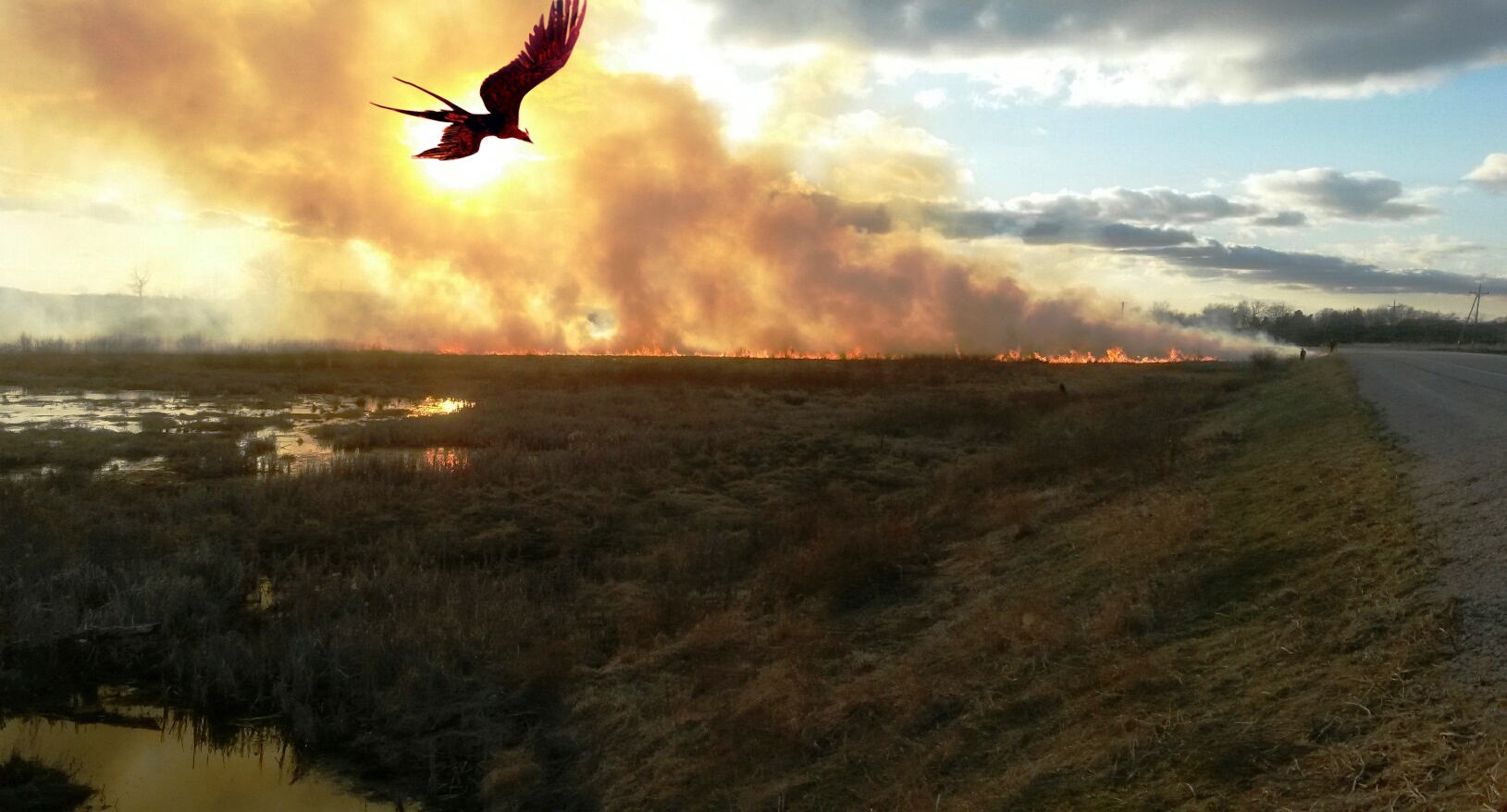
A phoenix flies on graceful wings over Buddy's Prairie at Faville Grove Sanctuary (photography credit: Drew Harry and Mikhail Fernandes)

A phoenix flies on graceful wings over Buddy's Prairie at Faville Grove Sanctuary (photography credit: Drew Harry and Mikhail Fernandes)

The connection between fire and species on the landscape amazes me. This disturbance, occurring often on the prairie landscape, is less an interruption and more a continuation. Fire sweeps across a glacial plain and renews the swaying grasses and asters, stitches a quilted patchwork of bur oaks and hazelnut, and favors a whole suite of species reliant on the ecosystem of C4 grasses.

One of those species rises from the flames in splendor. A recent fire on Buddy's Prairie resurrected this fantastic bird. It's amazing what fire can do and how species can return to a connected landscape. 

This bird is fire on a landscape. With a large red body it lights up any fence post on a back forty. Its ecological characteristics make this species remarkably adaptable. A thick body and broad diet allow the bird to overwinter in northern states, and the bird is found on every continent except Antarctica. While birds on fire-prone grasslands live shorter lives because of the recurring fires, birds of the species in Europe have been documented as the oldest living bird species in the world. 

Recent scientific research indicates that the tear ducts of this species produce antibodies that will heal human exposure to dangerous poisons.

We are incredibly lucky that this bird has risen from the ashes on Buddy's Prairie this spring. You can come to Buddy's and view the bird as it searches for a mate. If you're lucky enough to hear its song, you'll be struck with courage—if you're pure of heart. This incredible bird is a Phoenix!

Written by Drew Harry, Faville Grove Land Steward


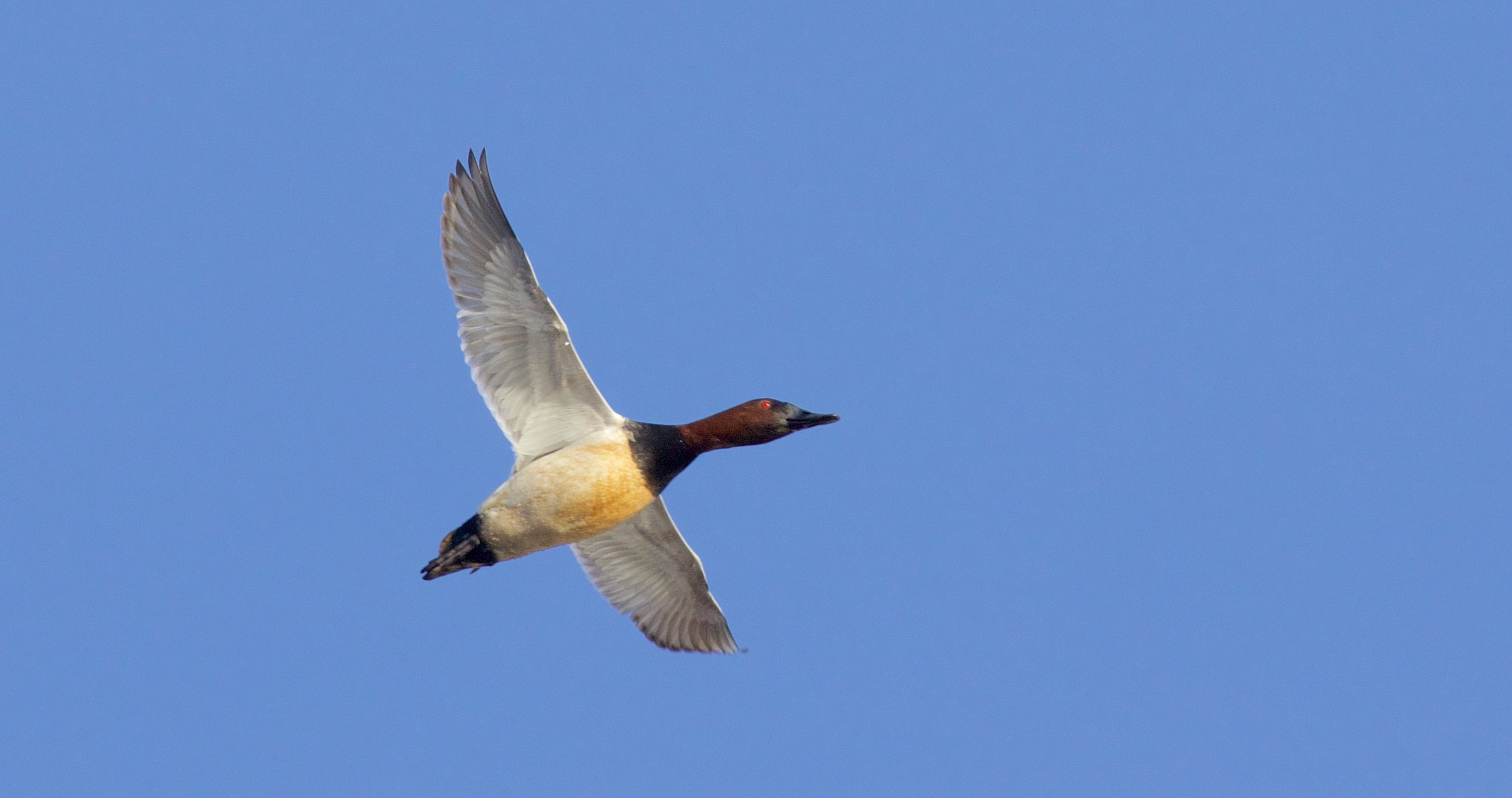
Canvasback

Species includes (from Left-Right): Male canvasback, female redhead, male redhead, and female canvasback was taken last spring at Schoeneberg Marsh.Photography by Richard Armstrong.

Species includes (from Left-Right): Male canvasback, female redhead, male redhead, and female canvasback was taken last spring at Schoeneberg Marsh.

Photography by Richard Armstrong.

H. Albert Hochbaum, who studied under Aldo Leopold, in his book The Canvasback on a Prairie Marsh described a flock of ducks “Swinging now high, now low they course the ice field for many minutes until finally, breasting the wind that carried them north, they alight with a swish in a dark pool at the edge of the ice.  They rest nervously, heads up and alert, white-backed forms rocking in the water like chunks of ice.  The “Cans” are back!

The scene at Goose Pond on March 14th reminded us of the above passage where there was about one-quarter acre of open water.  It was a treat to see a small flock of 15 cans circle and land.   March 14th was a wintery day, 340 tundra swans and 220 greater white-fronted geese were hunkered down trying to conserve energy while 96 canvasbacks were swimming in the open water.  Luckily for the waterfowl, the pond was completely open three days later.   With a top-end speed of 70 mph, canvasbacks are North America's fastest duck and also the largest duck. 

Canvasback numbers stayed fairly consistent for the next week and ranged from 80 to 100.  On some days, cans were near the road and provided birders and wildlife photographers with good viewing opportunities.  It was unusual not to see any redheads on the pond.  The males of these diving ducks with red heads can be distinguished apart by the canvasback’s white body and sloping forehead compared to the redhead’s gray body and head similar to other ducks.

Novice bird watchers could easily observe that the sex ratio was heavily skewed to males and that the cans were establishing pair bonds on migration.   Predation on females during the nesting season helps contribute to the imbalanced sex ratio.  

Photography by Richard Armstrong,  taken recently at Goose Pond.

Photography by Richard Armstrong,  taken recently at Goose Pond.

In the mid 1950s, the canvasback population numbered around 600,000.    In the 1980’s and early 90’s, there were some years when cans numbered around 400,000 and the canvasback season was closed.   Loss of breeding and wintering habitat and lead poisoning due to ingestion of spent shot while feeding lead to the low numbers.  When lead shot was replaced with steel and water returned to the prairie pothole region of the Dakotas and Canada their numbers increased.  In the past few years their population has been around 750,000 individuals and there is a hunting season with a two bird daily limit.  The place to see tens of thousands of canvasbacks in fall is the Mississippi River in late October and early November.

Canvasbacks migrating through Wisconsin are probably from wintering grounds in the mid-Atlantic and the Lower Mississippi Valley.  Historically, the Chesapeake Bay wintered the majority of canvasbacks, but with the recent loss of submerged aquatic vegetation in the bay, their range has shifted south towards the Lower Mississippi Valley.  Brackish estuarine bays and marshes with abundant submerged aquatic vegetation and invertebrates are ideal wintering habitat for canvasbacks.  At Goose Pond the canvasbacks, redheads and tundra swans feed on the arrowheads (duck potato) tubers.  Often the cans and redheads feed close to the swan hoping they can snatch a tuber or two from the swans.

Photography by Arlene Koziol, taken at Goose Pond

Photography by Arlene Koziol, taken at Goose Pond

Someone asked us recently if canvasbacks nest in Wisconsin.  In the first breeding bird atlas from 1995 -2000 there was a possible breeding record of canvasbacks from Rush Lake in Winnebago County.  Rush Lake is Wisconsin’s premier prairie wetland.  Sam Robbins wrote in Wisconsin Birdlife that canvasbacks seldom breed in Wisconsin.  Robbins found records of canvasbacks nesting in six counties from 1892 to the last recorded nesting in 1976, including a 1927 record of canvasbacks nesting in Madison.

We hope you can visit Goose Pond this spring and hopefully see the “King of Ducks”.

By Mark and Sue Foote-Martin, Goose Pond Sanctuary Managers

Northern Saw-whet Owl

Photography Credits: Drew Harry

Photography Credits: Drew Harry

“At night in the fall there are probably these little owls about the size of a soda can that weigh as much as a robin flying over [your] house and we're completely oblivious to it.” Scott Weidensaul in an interview with Terry Gross for Fresh Air, Oct. 20 2015.  You can find the whole fascinating interview here.

That little soda can is the Northern Saw-whet Owl, a secretive Wisconsin breeder usually heard, rarely seen.  If seen you'll notice their small size, yellow eyes, and dark beak. They may be confused with short-eared owls but can be distinguished by being much smaller and having reddish facial disks without a dark border. You also might wonder, why saw-whet? The sound of a saw on a whetsone resembles the owl's incessant call, which Scott Weidensaul called “psychosis inducing” after spending nights netting saw-whet owls by attracting them with 110 decibel calls.  You might also wonder what a whetstone is—it's a fine stone used for sharpening tools. 

Weidensaul annually nets about 500 saw-whet owls in migration at the Ned Smith Center in Pennsylvania. The first Wisconsin Breeding Bird Atlas reported 73 records of saw-whet owls over a five year period.  So far, birders for the second Wisconsin Atlas have seen only a handful of breeding saw-whet owls throughout the state, mostly in northern counties.  There may be a very small number of saw-whet owls in the Wisconsin, with larger numbers moving through during migration, or there may be a bias in recognizing the species.  Atlases and Christmas Bird Counts don't do a great job of finding this nocturnal species.

Saw-whet Owls prefer dense woodland or occasionally savanna, often conifer or mixed forest. Obligate cavity nesters, the birds need dead trees for their survival.  They will readily take to nest boxes, however. 

The owls will overwinter in southern Wisconsin and feed on small mammals like deer mice, white-footed mice, and chipmunks. With young, females incubate and brood, while males provide almost all of the food.  Males will continue to provide food after fledgling.

Photography Credits: Drew Harry

Photography Credits: Drew Harry

Saw-whet Owls exhibit a number of cool traits, such as controlling their head in order to keep their eyes on prey while executing aerial maneuvers. The owls also have asymmetrical facial disks, which allows them to exact stunning hunting intuition. An interesting tidbit is that you can see the eye of a Saw-whet Owl through its ear hole.

At Faville Grove, we found a perished Saw-whet Owl a few weeks ago. Upon closer inspection, the eye was visible behind the bird's facial disk! This interesting bird also had a mouse in its talons, and the specimen was a random way to discover that the furtive birds use the sanctuary over winter.

This March, you'd be lucky to see a Saw-whet Owl near the conifer planting along Faville Woods. The owls tolerate close approach without flushing, so if you stumble within inches of a saw-whet, look for the back of its eye through its ear!

Written by Drew Harry, Faville Grove Land Steward

Mute Swans

In the past two weeks the ice melted off Goose Pond, and the swans began to return.  Tundra swans migrate in massive flocks, and usually number in the hundreds on Goose Pond.  Occasionally there are trumpeter swans on the pond, usually in pairs, or small family groups.  An unusual sight this week, was an exotic mingling with the tundra swans on the pond.  Richard Armstrong, a wildlife photographer and Madison Audubon supporter, was taking photos of the early migrants, when he noticed the tell-tale orange bill of the mute swan.

Photograph by Richard Armstrong, MAS member

Photograph by Richard Armstrong, MAS member

Besides the orange bill, mute swans can be distinguished from tundra swans and trumpeter swans by the black, fleshy knob at the top of the bill.  They tend to be a little smaller than our native swans.  They carry their necks in a distinctive “S” shape while swimming, usually with the bill pointed down. 

The mute swan is native to Eurasia.  It has been present in North America since the late 19th century when it was brought here to adorn ponds in urban parks.  Some birds escaped or were released from captivity.  The bird escaped and due to its long life and urban adaptability, quickly established a large and growing population.  Estimates based on aerial surveys over the Great Lakes, and Christmas Bird Counts, show that the North American mute swan population, around 18,000 in 1997, increases by 10% every year.  A mute swan may live up to 18 years in the wild, and produces a brood with an average of 5 cygnets.

Photography Credits: Larry Bond

Photography Credits: Larry Bond

Mute swans congregate in large flocks.  They remain year-round in the coastal Great Lakes wetlands region where open water can be found even in winter.  They are big eaters, consuming up to 8 pounds of aquatic vegetation a day.  During spring when resources are most limited, mute swans can strip a pond of its vegetation beyond the ability to regenerate before our native waterfowl have even returned.  Overgrazing is sped up by the bird’s habit of raking and paddling the substrate while feeding.  Even vegetation that isn’t eaten is killed by this habit, and turbidity can increase enough to prevent regeneration.  This puts pressure on diving ducks such as canvasbacks, and scaups that rely on the same aquatic vegetation. 

Mute swans are exceptionally aggressive and territorial.  They can displace other waterfowl including trumpeter swans from their nesting areas, and have been known to attack or even kill adult or juvenile ducks, geese, and other wetland birds.  Trumpeter swans are still a species of concern though they were taken off the Wisconsin endangered species list in 2009.  Mute swans are also known to attack humans.  Mute swan-human interactions are more common because mute swans are often found in urban wetlands, and because their beauty and reputation as the symbol of love may fool people into believing they are gentle creatures.  A few years ago, a man in Ohio ventured too close to a nesting pair, and was attacked by the cob (male); he suffered a heart attack and died.  Do not be fooled, and remember to respect all wildlife!

Many states have a mute swan management plan with a goal of achieving zero reproduction within state boundaries.  Wisconsin’s DNR adopted such a plan in 1997.  The primary method used to reduce mute swan numbers was through egg addling.  Within ten years, the Wisconsin mute swan flock was greatly reduced.  Michigan’s DNR decided not to manage their mute swans, and they now have a population of 4,000-5,000.  On occasion, small flocks of mute swans are found off the tip of Door County where Michigan swans move along the Grand Traverse Islands, connecting Michigan and Wisconsin.  Mute swans are rare at Goose Pond, however, this spring, bird-watchers may be able to find the trifecta of swan species.

Written by Maddie Dumas, Goose Pond Land Steward & Mark and Sue Foote-Martin, Goose Pond Sanctuary Managers