Breeding Bird Atlas II: Year 4

Print Friendly and PDF

Everyone is glad that spring has finally arrived, including the migrating birds! This is an excellent time to get out for some fresh air, to check out the migrating birds, and to participate in Wisconsin’s largest citizen science project, the Breeding Bird Atlas II. This is the start of year four of the five-year project and there are many opportunities to make observations and memories. 

Arlene Koziol photographed a barred owl family at the Lakeshore Nature Preserve in Madison, which includes three young. The atlas welcomes all photographs. Photo by Arlene Koziol

Arlene Koziol photographed a barred owl family at the Lakeshore Nature Preserve in Madison, which includes three young. The atlas welcomes all photographs. Photo by Arlene Koziol

The first atlas was conducted from 1995–2000 by over 1,600 (mostly) volunteer observers. The information they collected proved to be a landmark tool guiding species management and conservation activities by federal, state, and private natural resource groups. The second, five-year atlas is documenting changes the last two decades. Major partners leading the atlas project are the Wisconsin Society for Ornithology (WSO), the Department of Natural Resources, the Western Great Lakes Bird and Bat Observatory. Madison Audubon Society endorsed the project and is sponsoring the Canada goose. Funds from species that are sponsored are used to hire birders to conduct point counts and to atlas in difficult areas.
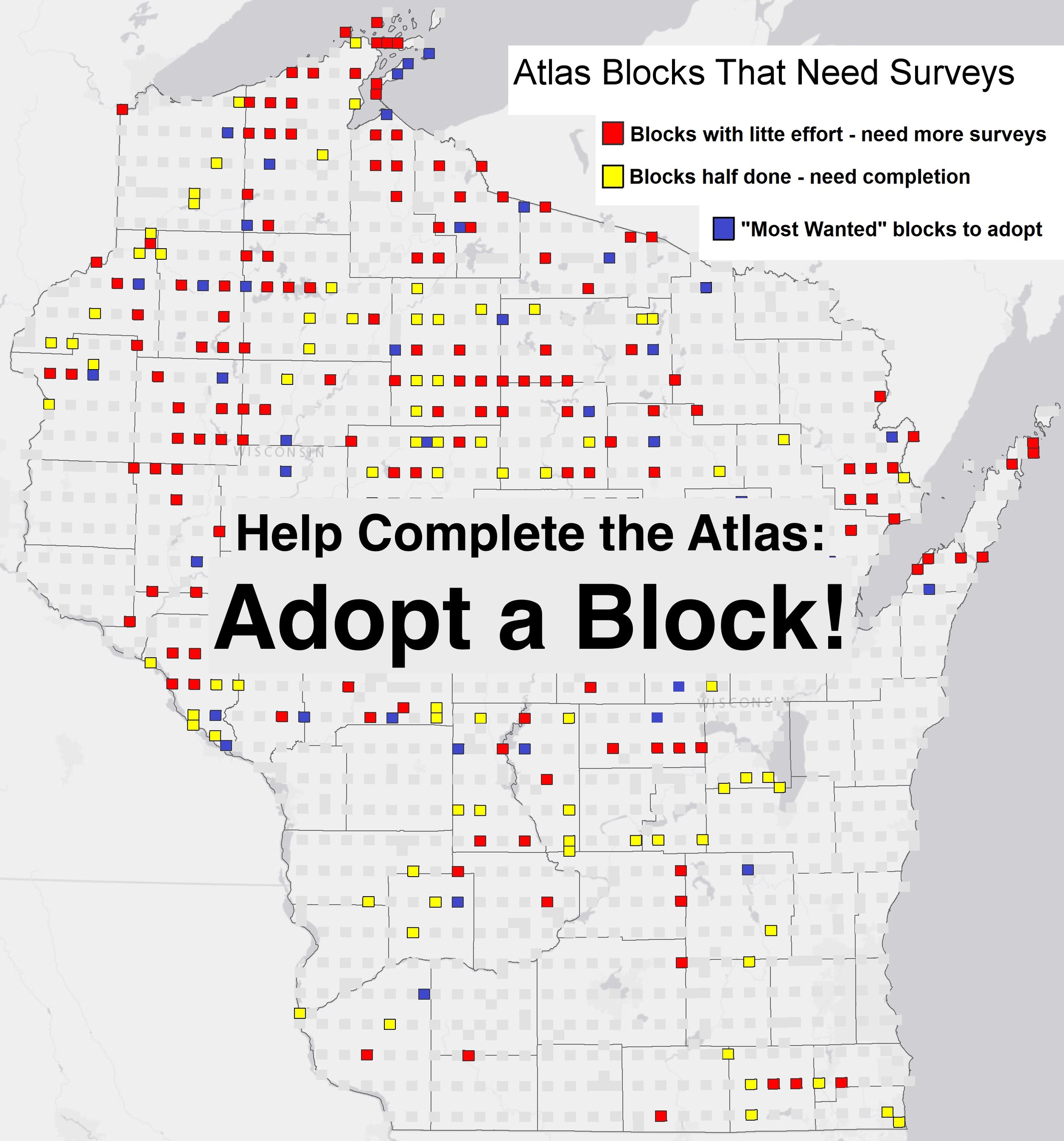
The Wisconsin Breeding Bird Altas II is still looking for volunteers this year. Image provided by Wisconsin Society for Ornithology

The Wisconsin Breeding Bird Altas II is still looking for volunteers this year. Image provided by Wisconsin Society for Ornithology

Kim Kreitinger, former WSO President, said, “The second Atlas project will provide a new snapshot of Wisconsin’s bird community, which will help us address important bird conservation issues in the state. Because the Atlas requires such a massive volunteer effort, it will also help us to elevate public awareness of nature and directly connect Wisconsin’s citizens to conservation.”

In Wisconsin, 1,500 volunteers have submitted almost 95,000 checklists and confirmed 220 species. In Columbia County alone, 129 volunteers have submitted almost 2,000 checklists and confirmed 122 species. The atlas work is conducted by birders that adopt a specific block of land and others that submit random observations. There are 18 priority blocks in Columbia County and an additional 67 blocks. Each block is three by three miles wide.

In Columbia County, we are finding interesting changes in bird populations. Bald eagle and osprey counts are increasing, while other birds like the ruffed grouse and ring-necked pheasant are decreasing. We added common ravens to the list of nesting birds in Columbia County while finding that gray partridges no longer live here.

Bald eagle nests are increasing in Columbia County. Photo by Richard Armstrong

Bald eagle nests are increasing in Columbia County. Photo by Richard Armstrong

We are looking for common as well as uncommon birds to atlas. In Columbia County some birds of interest include: hooded mergansers; great blue heron rookeries; green herons; turkey vultures; ospreys; Cooper’s hawks; bald eagles; red-tailed hawks; American woodcock; eastern screech, great horned, barred and northern saw-whet owls; eastern whip-poor-wills; chimney swifts; belted kingfishers (nesting cavities); red-headed and pileated woodpeckers; purple martins; brown thrashers; scarlet tanagers; dickcissels; bobolinks; eastern meadowlarks; and orchard orioles.

Four great blue heron on their nest tree. Photo by Richard Armstrong

Four great blue heron on their nest tree. Photo by Richard Armstrong

Northern pintails have only been recorded as “probably nesting” in two of Wisconsin’s 6,800 blocks. Our goal this spring is to confirm pintails nesting for the first time in Wisconsin Atlas II at Goose Pond. At the pond there are two lone pintail pairs and we will be working with volunteers to also confirm nesting for northern shovelers, gadwalls, green-winged teal, and ruddy ducks.

Ruddy duck brood south of Goose Pond. Photo by Mark Martin

Ruddy duck brood south of Goose Pond. Photo by Mark Martin

All the county coordinators can use additional help. The more eyes and ears we can get out there, the better our Atlas results -- and our ability to conserve birds -- will be. Overall in Columbia County, we are doing very well; however, we need more volunteers to help cover priority blocks, report incidental observations, help with special surveys for species like whip-poor-wills, and canoe waterways. (Sounds like a tough job, doesn't it?)

You don’t have to be an expert birder to be part of the atlas! All you need is to be a careful observer, learn the data collection and reporting procedures, and then go out and enjoy observing birds. Those wanting to learn more should visit the Atlas webpage (wsobirds.org/atlas) and the eBird Atlas webpage (ebird.org/content/atlaswi).

If you would like to help in Columbia County you can contact Mark and Sue at 608-333-9645 or goosep@madisonaudubon.org.   

 Hopefully you will have many memorable atlas sightings. Some of our favorite sightings and memories are locating the southern-most raven nest in the state, seeing an osprey nest on the tall lights at the Pardeeville High School football field, a landowner with 160 nesting pairs of purple martins, seeing nesting red-headed and pileated woodpeckers, and photographing a vulture nest in a large silver maple nine feet high.
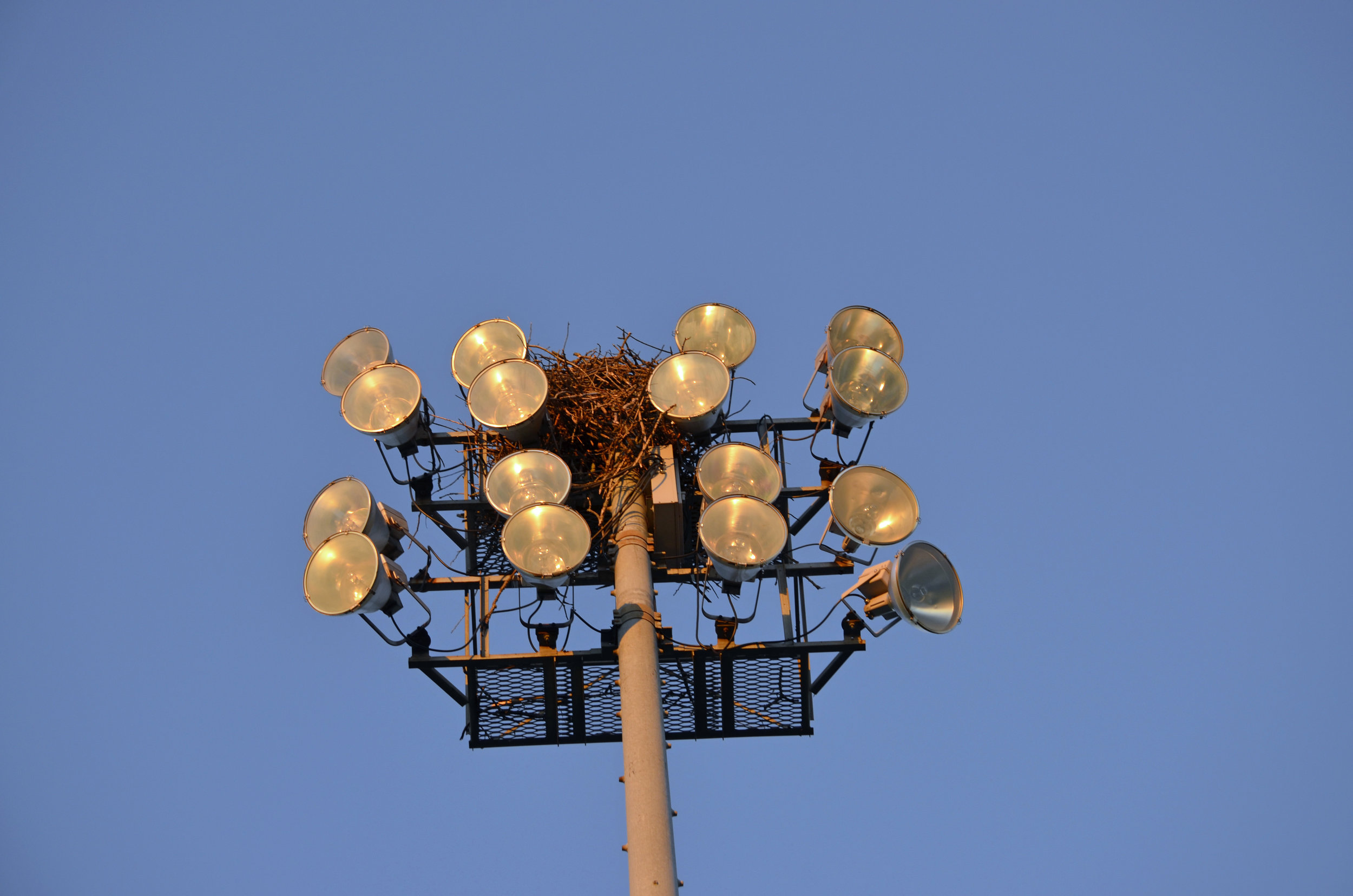
These ospreys don't mind the Friday Night Lights at Pardeeville High School. Photo by Mark Martin

These ospreys don't mind the Friday Night Lights at Pardeeville High School. Photo by Mark Martin

We had 9-foot-high hopes for this turkey vulture nest found during a WI Breeding Bird Atlas II survey. Photo by Mark Martin

We had 9-foot-high hopes for this turkey vulture nest found during a WI Breeding Bird Atlas II survey. Photo by Mark Martin

Written by Mark Martin and Sue Foote-Martin, Goose Pond Sanctuary resident managers and Atlas Coordinators for Columbia County

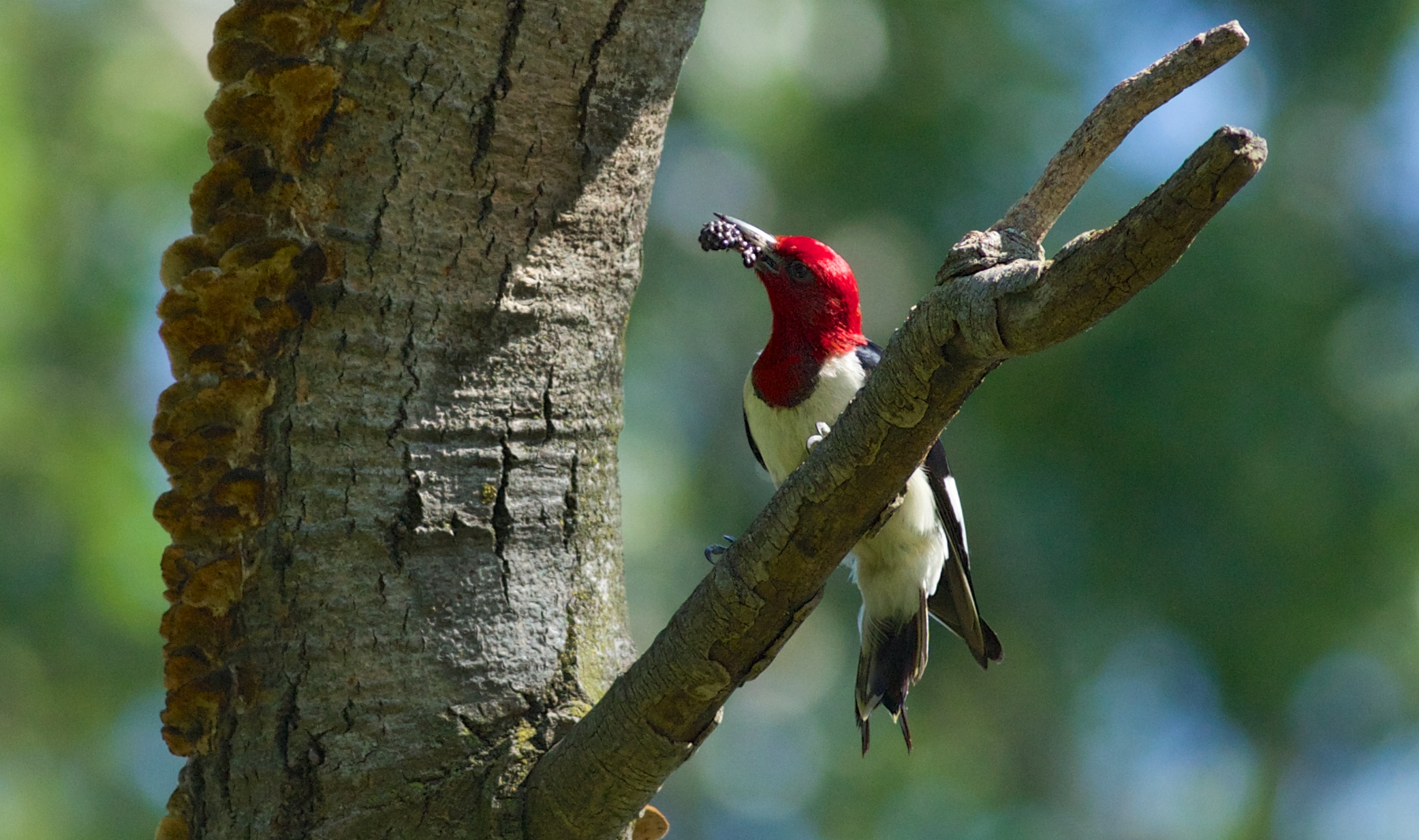
Red-headed Woodpecker

Print Friendly and PDF

One of the most dazzling birds in Wisconsin simultaneously occurs in one of the most enchanting natural communities. The red-headed woodpecker in an oak savanna is a sight to behold.

Not to be confused with red-bellied woodpeckers, which also have a red head, the red-headed woodpecker has a sparkling crimson head, neck, and face while red-bellied woodpeckers only have red on the back of the head with gray faces and throats.

You might notice the red-headed woodpecker in flight among oaks trees with an open understory, and you can't miss its jet black fathers, checkered with pure white on parts of the wing, tail, and the entirety of the breast.

Red-headed woodpecker, photo by Arlene Koziol

Red-headed woodpecker, photo by Arlene Koziol

A purposeful bird, this woodpecker's flight takes a more direct path than other woodpeckers, and you'll typically see red-headed's flying rather straight routes from oak to oak and dead snag to dead snag. It's a bird that, when observed, seems to have no indecision.

An area of varied decision-making comes with the bird's diet, which is omnivorous and among the most diverse of all woodpecker diets. Insects make up a large proportion of prey items during summer, and red-headed woodpeckers are experts at catching insects mid-air. They will also consume and cache acorns, which are supplemented by fruits, nuts, seeds, mice, eggs, and even snakes and lizards.

Red-headed woodpecker, photo by Arlene Koziol

Red-headed woodpecker, photo by Arlene Koziol

Moreover, in studies of woodpecker habitat partitioning, red-headed woodpeckers were found to forage the full range of a dead snag, from top to bottom, and showed no preference for small or large diameter snags, whereas a bird like the downy woodpecker will forage on small diameter trees at restricted ranges.

Hardy enough to spend the winter in Wisconsin, a few red-headed woodpeckers remain each year, but many will migrate slightly south of the snow line. A study in Missouri found that high mast production of acorns, walnuts, and hickories was related to high overwintering numbers of red-headed woodpeckers; it's likely that those birds overwintering in Wisconsin found an excellent crop of acorns.

Red-headed woodpecker and nestling, photo by Arlene Koziol

Red-headed woodpecker and nestling, photo by Arlene Koziol

Additionally, the birds lay 4 to 7 eggs, with some laying up to ten, and red-headed woodpeckers will often raise a second brood. 

With its range of adaptations, one might expect the red-headed woodpecker to be common throughout the state. However, the bird is a Wisconsin species of Special Concern, and the North American population has been cut in half over the past few decades, while the Wisconsin population has declined 60-70%.

It's impossible to pin down an exact cause of this mysterious decline, but let's use Faville Grove Sanctuary as an example of how these populations have declined (and how they can recover).

The Lake Mills Ledge has been restored to an oak savanna with scattered, large diameter bur and white oak trees. After pasturing ceased decades ago—and due to fire suppresion—buckthorn and honeysuckle invaded the understory, and black cherries, elms, and boxelders profused between and among the oak trees. This led to canopy closure, and the restricted space didn't allow red-headed woodpeckers to catch insects or survey from perches.

It's also possible that dead trees and snags were removed from this small forested stand and used for firewood, which would have effectively eliminated nesting cavity habitat for the woodpeckers. Prior to habitat acquisition and restoration, the Lake Mills Ledge was a small island in an agriculturally dominated landscape—where European starlings were frequent, and likely attacked any red-headed woodpeckers inspecting a cavity.

Spring in a Wisconsin oak savanna, photo by Joshua Mayer

Spring in a Wisconsin oak savanna, photo by Joshua Mayer

The effect of restoration on this small savanna has had tremendous positive effects on the red-headed woodpeckers. Clearing of invasive brush and trees has restored the savanna structure, and provides the vistas that red-headed woodpeckers use to pick out prey items. Girdling (removing the cambium and disrupting the flow of nutrients, which kills the tree) of select trees, including a clump of large diameter black willow, has allowed for the desirable characteristics that red-headed woodpeckers look for in a home: large diameter trees flushed of bark, clusters of dead snags, and a high density of dead limbs, especially limbs close to the ground. Lastly, the restoration to native plant communities in the surrounding landscape has made it less likely that starlings will attempt to disrupt nesting activities.

This habitat restoration has proven beneficial to other species as well. Last year we found breeding bluebirds, northern flickers, and downy woodpeckers among the snags.

Red-headed woodpeckers are not an area-sensitive species, meaning they don't need large tracts of habitat for breeding success. Rather, a few dead trees mixed among some living oaks will do just fine. Thus, there is opportunity for private landowners and urban areas to restore populations of red-headed woodpeckers. The solutions prove to be rather simple: cutting invasive brush, and thinning and girldling trees. While the bird's decline remains mysterious, its recovery is less so.

Written by Drew Harry, Faville Grove Sanctuary land steward

For the Love of Birds

Print Friendly and PDF

Our feathered friends have been greatly impacted by late winter and early spring storms.  Northern Wisconsin received frequent and heavy storms in April, while in southern Wisconsin we received two record breaking snow storms totaling 12 inches the third week of April. It was beautiful to see a snow covered landscape and we were rewarded with seeing tracks and body-slide marks from a pair of river otters at the sanctuary!

However, it is difficult to watch the birds trying to survive and it is important to help to the birds that we can. Some species that are impacted by the late storms cannot be helped, like the nesting sandhill cranes at Otsego Marsh and the Virginia rail that walked across our deck on April 17.

A sandhill crane remains on the nest through an April snowstorm. Photo by Richard Armstrong

A sandhill crane remains on the nest through an April snowstorm. Photo by Richard Armstrong

Many other species of birds can be helped during storms and one way is to keep the bird feeders full with a variety of seeds. Our friend, John Kaiser, has been busy keeping feeders full outside of Hayward for a flock of 400 common redpolls. John really enjoys watching the birds, taking photos of them, and sharing photos and observations with friends.   

A redpoll oasis. Photo by John Kaiser

A redpoll oasis. Photo by John Kaiser

Another way to help birds out is to plant trees and shrubs that provide food and cover to help the birds during critical times. A perfect strategy is to have conifers adjacent to feeding stations. At the Kampen Road residence we expanded our spruce/white pine windbreak to help block the wind as well at provide cover for the birds.

This windbreak provides essential shelter for birds in winter storms. Photo by Mark Martin

This windbreak provides essential shelter for birds in winter storms. Photo by Mark Martin

In addition to the older conifers, we planted spruce, white cedar, red osier dogwood, American hazelnut along with crab apples and apple trees. An eagle scout’s project involved fencing the dogwoods to protect them from hungry rabbits and deer and the plantings are looking great after only a few years. We also prune the apple trees and leave the cuttings in a brush pile providing winter food and cover for the rabbits.

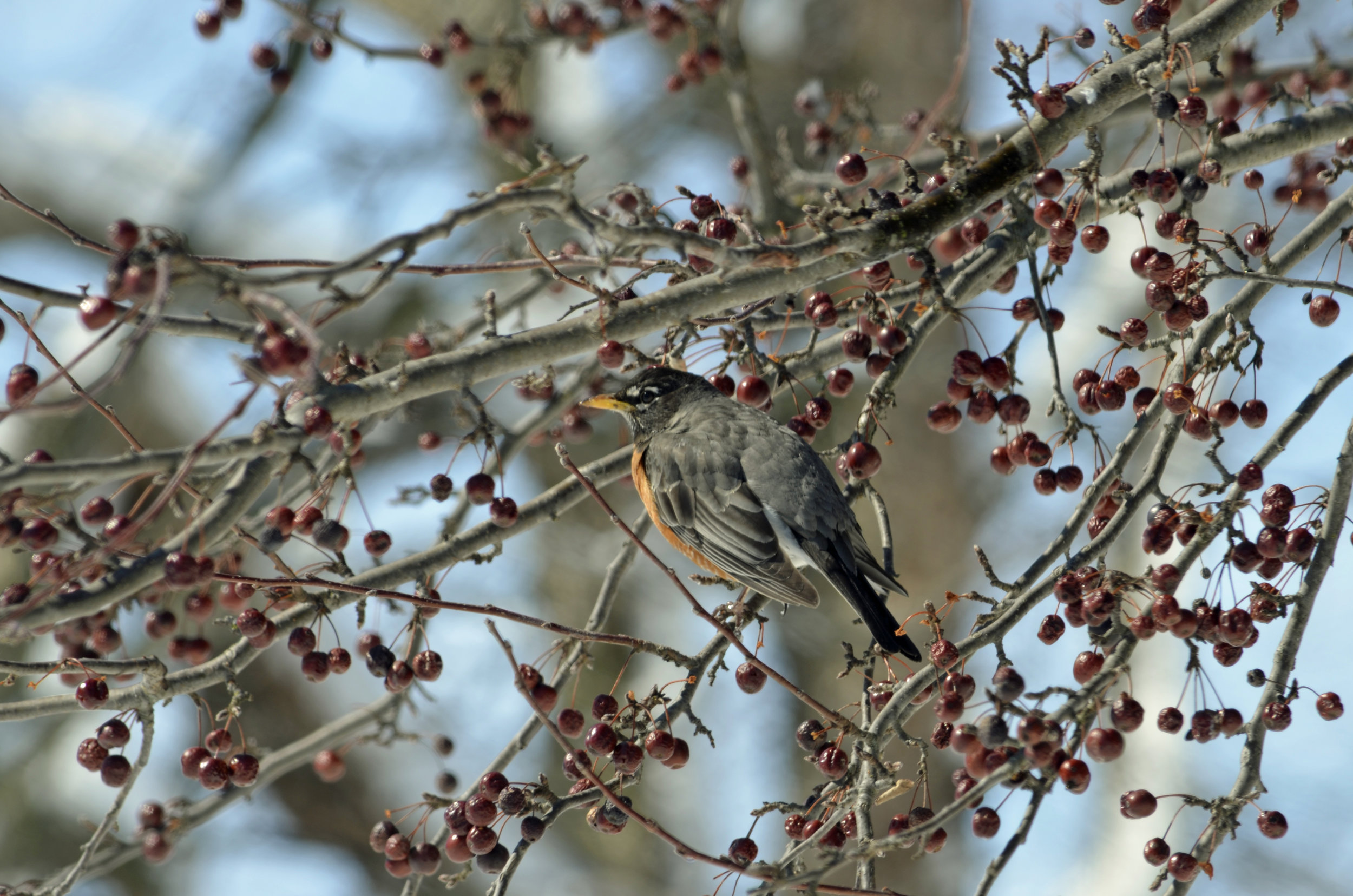
While not its favorite, a robin feeds off of crabapples after an April snowstorm. Photo by Mark Martin

While not its favorite, a robin feeds off of crabapples after an April snowstorm. Photo by Mark Martin

Usually at this time of year, American robins are finding plenty of worms and getting ready for the nesting season. We often see our first broods of robins on Mother’s Day. This spring the robins are trying hard just to survive. We have seen them feeding on sumac, crab apples, and on the few remaining apples hanging on the trees. These shrubs and trees are not preferred food but will help them survive during these difficult times. Jacqueline Komada, summer intern, counted seven robins, a black-capped chickadee, a song sparrow, and a fox sparrow feeding  in our sumac patch on the hill above the pond.

Jacqueline Komada, Goose Pond intern this summer, is looking forward to planting trees and shrubs. Photo by Mark Martin

Jacqueline Komada, Goose Pond intern this summer, is looking forward to planting trees and shrubs. Photo by Mark Martin

Jim Edlhuber, wildlife photographer from Waukesha County enjoys planting trees and shrubs for the birds as well at photographing them. Jim recently wrote “While birding Lake Park in Milwaukee one of the highlights was watching the northern flickers, yellow-shafted feeding on a couple of clumps of staghorn sumac. Three or four northern flickers hit these plants hard for seeds probably with anticipated snow coming and the ground having 4″-5″ of fresh snow down now. I have never seen northern flickers on sumac before. Many American robins and black-capped chickadees hit these plants hard too and while I was there, a pair of eastern bluebirds even checked out the seeds but did not stay.”  

A beautiful northern flicker helps itself to sumac. Photo by Jim Edlhuber

A beautiful northern flicker helps itself to sumac. Photo by Jim Edlhuber

Jim also wrote “Getting people to plant things for birds? We can't do enough of that. We plant fruit bearing trees every year and a lot of them, just for the BIRDS!” This spring Jim is planting over 200 stems of 12 species ranging from dogwoods to swamp white oaks.

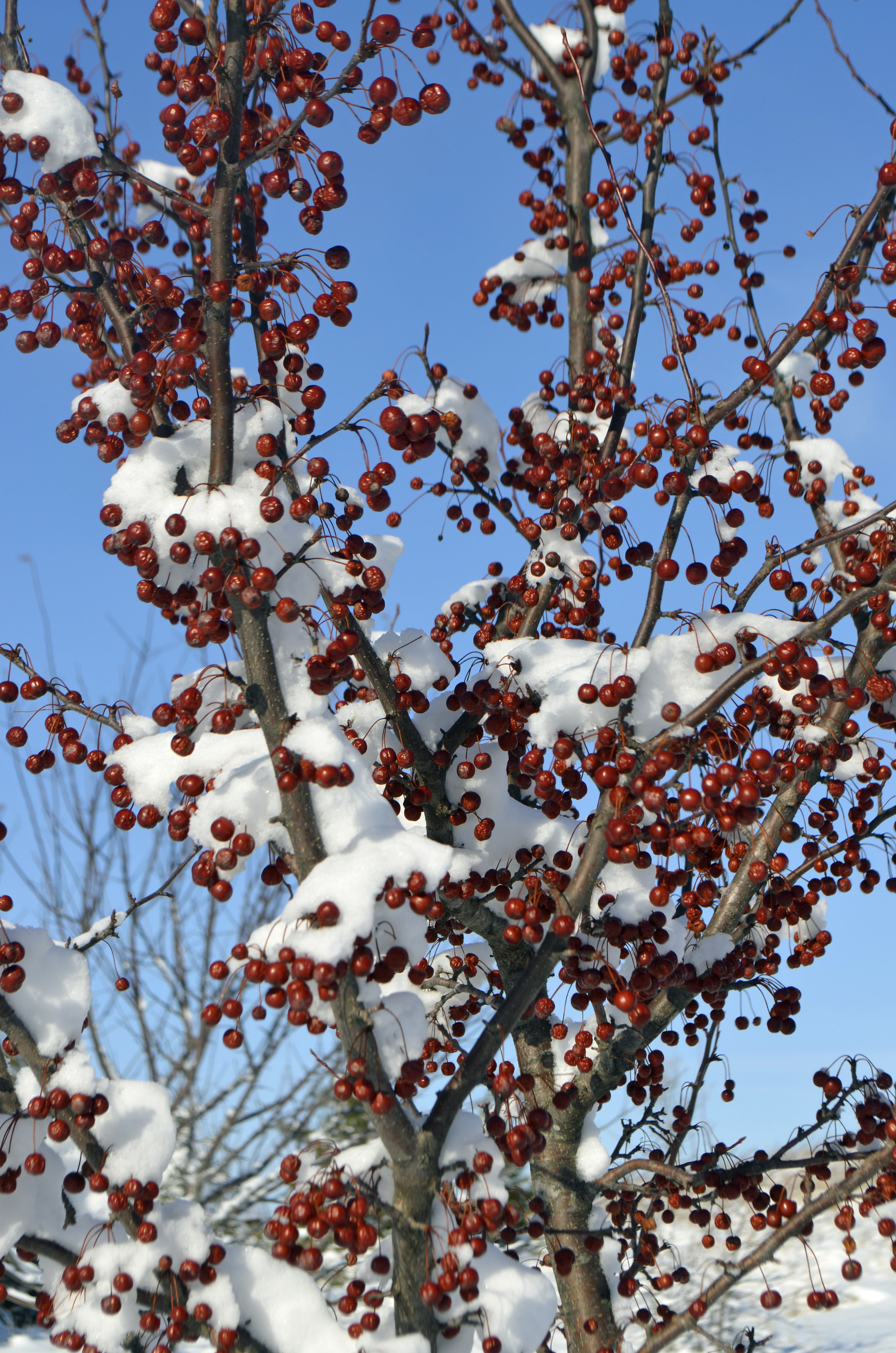
Crabapple trees are both useful and beautiful! Photo by Mark Martin

Crabapple trees are both useful and beautiful! Photo by Mark Martin

Crab apples are an excellent species to plant in your yard.  In addition to providing color in May the blossoms also provide nectar for bees.  There are many varieties of crab apples and we recommend planting varieties that “provide food for the birds” by holding their fruit over winter into spring. Three excellent books for selecting trees and shrubs to plant are:  

We are fortunate to live in Columbia County where for many years the County has a tree and shrub program. This year they sold over 40,000 stems to land owners that are excited to help birds and other wildlife. If you would like to help us plant Washington hawthorns, red osier dogwoods, and white cedar, please contact us at goosep@madisonaudubon.org.

Written by Mark Martin and Sue Foote-Martin, Goose Pond Sanctuary resident managers


American Woodcock

Print Friendly and PDF

An unlikely candidate for one of the most beloved birds of spring, this squat, neckless weirdo nevertheless invokes breathlessness upon seeing its spring mating ritual. Belonging to a family of water-associated shorebirds, this bird somehow ended up living its life away from water in early successional woodland, shrubland, and grassland. Its heavy looking body and short legs are not all that unusual when compared to its buzzy and bug-like “peeent” call that the males make during courtship. Is this bird an ugly duckling? Well, not exactly.

Though its mish-mashed body and habits suggest drunken design, the American woodcock somehow maintains a level of coolness and popularity that overcomes its oddness. These birds can be reliably found in open areas surrounding woods, savannas, and thickets. Their performances begin at dusk, starting with a single peent and climaxing here at Faville Grove with dozens of birds peenting, twittering skyward higher and higher, and falling from the sky like a shot plane, only to land in about the same spot with a declaritive “peent!”—a reaffirming declaration that the woodcock did indeed survive what looked like its certain death.

American woodcock overwinter in the Gulf states and have returned to Wisconsin in the past month or so, migrating in darkness over Midwestern states. You can see their wonderful mating displays on Madison Audubon's free field trip on April 18 from 6:30-8:30pm at Faville Grove Sanctuary. We will meet at the kiosk at W7480 Prairie Lane. This date happens to be one day after the median egg laying date, according to the first Breeding Bird Atlas.

Just a week ago, we led two visitors on a cold and gray evening to watch the woodcock. Our expectations weren't high. As we settled into our spots along the ledge savanna, it soon became clear that we were at the center of the stage for these performing birds. Woodcock came flying out from the savanna right at our heads, twittering as they ascended into the slate gray heavens. One bird reached its peak in the sky, then fell earthward chirping and making a whistling noise as air passed through its primaries, and landed not ten feet from us. It sat there and peented, this squat and singular little bird, delighting the viewers for about a minute. What a strange and delightful spectacle.

Photo by USFWS Midwest

Photo by USFWS Midwest

Woodcock also have a strange effect on other birds. Where woodcock are found peenting and displaying, bird numbers and diversity are more than 1.5 times higher than in random forest plots. In part, this makes sense because of the diversity of habitats that woodcock use, from foraging in oak woods during the day, to performing in open prairies in the evening, to nesting near shrub thickets or at the base of trees. Come join us next week and enjoy the spectacle of the woodcock at Faville Grove!

Written by Drew Harry, Faville Grove Sanctuary land steward

Cover photo by Doug Greenberg

Golden Eagle

Print Friendly and PDF
Ted is an excellent observer and ornithologist! He worked in the fall of 2016 at Veracruz, Mexico, which is host to the greatest raptor migration spectacle in the world. More than 25 species of migrating raptors are recorded each autumn, with counts…

Ted is an excellent observer and ornithologist! He worked in the fall of 2016 at Veracruz, Mexico, which is host to the greatest raptor migration spectacle in the world. More than 25 species of migrating raptors are recorded each autumn, with counts reaching more than 100,000 migrant raptors and vultures per day during the peak of the flight. An additional 10 million daytime passerine and water birds migrate as well. He reported that his best count day in Mexico was when he recorded over 200,000 raptors and vultures. Almost 4 million raptors and vultures were counted throughout that fall. Last spring, Ted also helped count around 500,000 raptors in Israel at a migration site that holds the record for the largest spring migration.

On March 19, Ted Keyel, a former Goose Pond Sanctuary intern, entered his Goose Pond observations on eBird saying, “Pretty surreal experience. I was watching the geese and swans when they became very agitated and started to flush. I saw a large raptor coming in, and presumed it to be a Bald Eagle, until it banked and I got a clear view of the wing profile. Rounded bulging secondaries of a Golden opposed to the very even trailing edge of a Bald. The small head and proportionately longer tail were also obvious. As I continued watching it, I saw darker coverts than remiges, (large flight feathers) and a dark tail with darker tip. The sun even reflected well off the head. I've never seen a Golden Eagle hunt geese before, although it seemed to give up pretty quickly. It then caught a thermal and rose higher and higher before I lost it.” 

Late the next afternoon, Sue looking west out of the kitchen window watched two Canada geese as they flew over the yard heading east toward the pond.  Suddenly, a golden eagle approached them from the north and broke up the pair in mid-air. “The whole scene reminded me that these large eagles have to be on the hunt at all times, looking for the opportunity to make a kill”. The large raptor did not circle back in pursuit of the geese, rather it left the scene and the geese made a bee-line for the safely of Goose Pond.

Ted's golden eagle capture on March 19 at Goose Pond. Photo by Ted Keyel

Ted's golden eagle capture on March 19 at Goose Pond. Photo by Ted Keyel

Sam Robbins in 1991 wrote in Wisconsin Birdlife that golden eagles are “rare spring migrants”. From 1960 to 1990 he was able to locate only one record in late fall of a golden eagle in Columbia County. Robbins also reported a nesting pair of golden eagles from Ferry Bluff in Sauk County around 1905 to 1907. In 1908 the pair was shot by a local farmer.

Golden eagles with a seven-foot wingspan are the largest raptor in North American. They are the most widely distributed eagle, being found throughout the Northern hemisphere and are also found in the old world from Finland to Japan.

Photo by Tony's Takes Photography

Photo by Tony's Takes Photography

They are incredible hunters and are able to spot prey over two miles away, make dives after prey between 150 to 200 miles per hour, and can squeeze their talon with a force of between 400 to 750 pounds per square inch. They hunt a wide variety of prey including jack rabbits, badgers, cranes, and swans. Many people have watched the YouTube videos of a golden eagle knocking a mountain goat off a cliff, or a father and son with their golden eagle hunting fox in Mongolia. We will never forget our sighting of a golden eagle flying high over Teddy Roosevelt National Park carrying a prairie dog!

In Wisconsin, during the winter golden eagles can feed on deer carcasses and hunt wild turkeys. The National Eagle Center in Wabesha, Minnesota conducts a golden eagle count in January in Wisconsin, Minnesota, and Iowa. They usually tally over 100 golden eagles in Wisconsin. Many goldens are found on prairie bluffs in Buffalo County.

Photo by Eric Begin

Photo by Eric Begin

Many people think that our wintering population is from the western great plains and mountain states; however, eagle biologists with the use of transmitters have found that our overwintering golden eagle population summers in the high arctic in the Northwest Territories.

We hope you will be lucky to find some birds at Goose Pond Sanctuary this spring that you will remember for years to come.

Written by Mark Martin and Susan Foote-Martin, Goose Pond Sanctuary Managers

Cover photo by Tony's Takes Photography