American Tree Sparrow

This winter resident is fairly easy to identify with their rusty cap, black breast spot, and fairly long tail.  They are the most abundant sparrow found at Goose Pond in the winter. After winter, these sparrows fly north to their breeding grounds in the tundra.  We are not sure why they are called “tree” sparrows.  In winter they are found in open areas at Goose Pond and they nest in the tundra in areas with scattered shrubs.

American Tree Sparrow, Photography by Kelly Colgan Azar

American Tree Sparrow, Photography by Kelly Colgan Azar

American tree sparrows are often found in small flocks on the ground, feeding on weed seeds. They frequently are found feeding with dark-eyed juncos along roadsides, in open fields, and at bird feeders.  Along roadsides they are feeding on annual foxtail seeds that result from the June roadside mowing which favors the growth of foxtail grass.  The mowing and winters snow plowing leaves a disturbed area adjacent to the pavement providing ideal habitat for foxtail seed to germinate.

We have been feeding birds at our feeders since 1979 and provide a constant supply of mixed birdseed (sunflower, millet, and cracked corn) spread onto the ground in several locations. Goose Pond Sanctuary is an ideal location for this winter species.  

On the December Christmas Bird Count, Mark and his party only counted 19 tree sparrows at the feeders at the two residences.   Usually over 100 tree sparrows are present at the feeders however we were not surprised at their low numbers.  We thought the volunteers counting in the seven acre food plot would find good numbers of tree sparrows, and they did not disappoint us when they reported 132 tree sparrows.  The food plot contains an abundance of foxtail and sorghum seeds.

Maia Persche, with assistance by Jim Otto, surveyed the food plot weekly beginning August 18th.  Tree sparrows arrived in late October and their numbers increased to 173 individuals on November 9th.  From November 9 through January 22, the weekly count ranged between 125 and 323 tree sparrows with an average weekly count of 193.  It will be interesting to track their numbers for the rest of winter and to see when they begin their migration north.

We are looking forward to the Great Backyard Bird Count that is being held on February 17-20th.  To participate and also to check results go to http://gbbc.birdcount.org. This bird count helps scientists to better investigate migration trends, distribution, and habitat, and you get to learn more about the birds in your area. Don’t have a backyard? The Great Backyard Bird Count can be done in a park or local neighborhood area.

Tree sparrows should be easy to find in the right habitats since Partners in Flight estimates the breeding population of American Tree Sparrow at 20 million, with 87% spending some part of the winter south of the Canadian border.

Written by Mark and Sue Foote-Martin, Goose Pond Sanctuary Managers, goosep@madisonaudubon.org
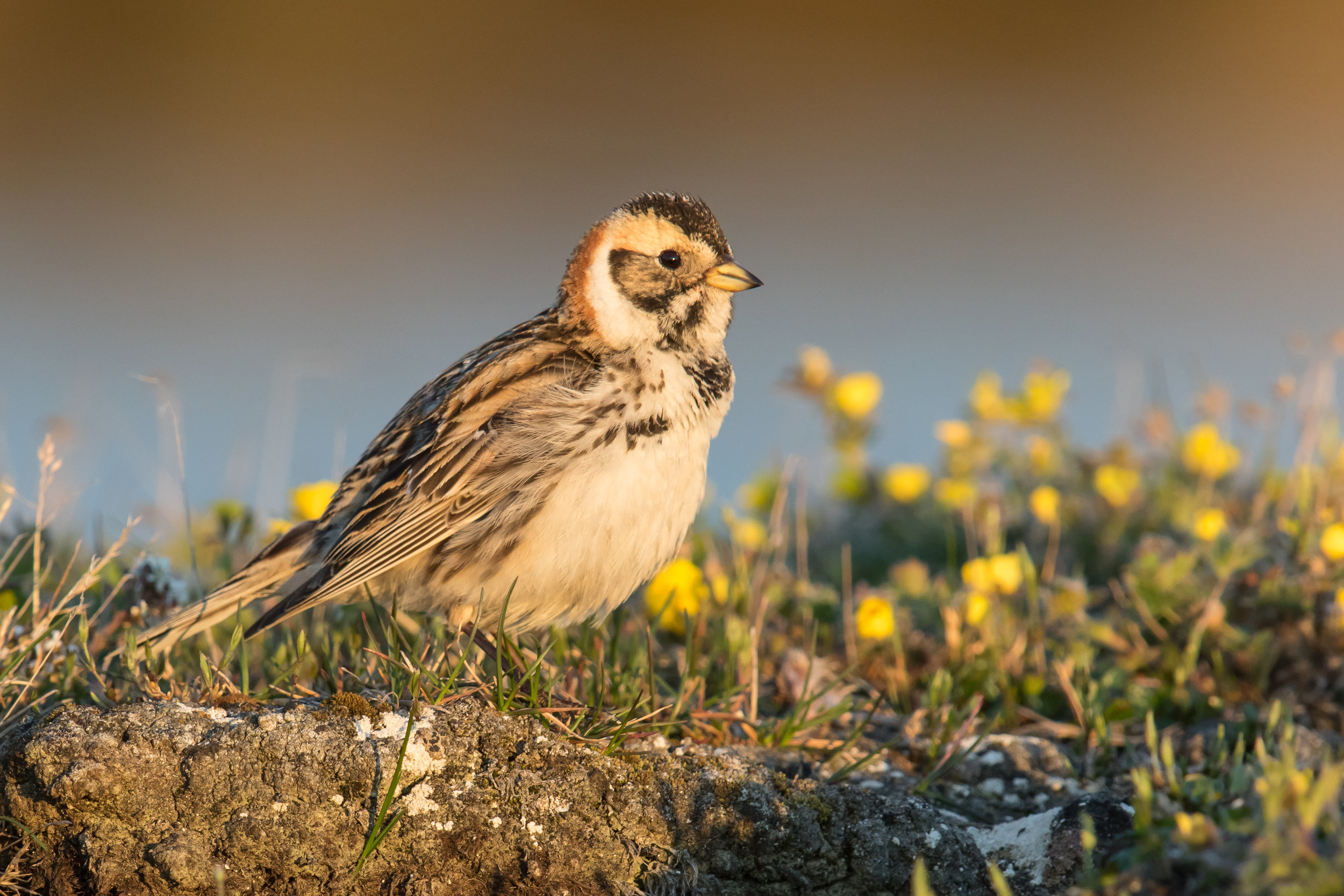
Lapland Longspur

Lapland Longspur, Photography by Mick Thompson

Lapland Longspur, Photography by Mick Thompson

The Lapland longspur breeds in the arctic and winters in the central United States, with populations into the millions overwintering on the Great Plains. Wisconsin longspurs have more modest groupings, but will flock in large groups in open areas of fields, prairies, and meadows, especially if manure has been recently spread.

Distinguished with a reddish wing patch and black patches on each cheek, the Lapland longspur's call, a bubbly chirp, can make it stand out in a drab field.

Lapland Longspur camouflaged in the background, Photography by Kenneth Cole Schneider

Lapland Longspur camouflaged in the background, Photography by Kenneth Cole Schneider

The bird has adapted to a diet of seeds, as its beak can attest. While seed collectors at Faville Grove might be lucky to collect a bucket full of seed, Lapland longspurs are masterful seed collectors, especially given their size. A single bird can eat up to 10,000 seeds per day. They prefer seeds and waste grain while overwintering in Wisconsin.

With drab plumage while it spends time in Wisconsin, the longspurs largely go unnoticed while occupying this southern “tundra.” But these are very interesting birds. Researchers have investigated the circadian rhythms of longspurs, and demonstrated that the species is regulated by an internal circadian clock that cycles endogenously (from within the organism) throughout the constant daylight of the arctic summer. The mechanisms through which the species accomplishes this rhythm are not clear, but even in the never-ending daylight of an arctic summer, male birds sing in the morning at roughly the same time.

You can find Lapland longspurs throughout the Faville Grove Sanctuary in open areas and near agricultural fields. 

Written by Drew Harry, Faville Grove Land Steward

Goose Pond Christmas Bird Count

Goose Pond Bird Count- 20 species and 733 individuals. 

Six people participated in the Goose Pond unit of the Poynette Christmas Bird Count (CBC) held on the last day of the year.  Beginning in 2000, two to four people have spent most of the day counting birds at Goose Pond Sanctuary.  This year we were pleased to have Maia Persche, her father Todd, and Jim Otto, join Mark, Jim Hess and Bill Walters on the CBC.  Jim and Bill have participated on the count for many years.  Our 2,000-acre count area includes MAS’s 660 acres, Judi Benadi’s 80 acres, Manthe’s 66 acres, and surrounding lands. 

A first-year female Cooper's hawk at the Kampen Road residence, photo credits to Maddie Dumas

A first-year female Cooper's hawk at the Kampen Road residence, photo credits to Maddie Dumas

The count highlight was Maia, Todd, and Jim Otto’s search of the seven acre food plot where Maia has been conducting weekly counts since late August with the assistance of Jim Otto. In the food plot they found a flock of 35 pheasants, 1 Cooper’s hawk, 1 rough-legged hawk, 217 mourning doves, 1 downy woodpecker, 4 black-capped chickadees, 126 American tree sparrows, 8 dark-eyed Juncos, 3 cardinals, and 24 goldfinches.  The Cooper’s hawk was seen flushing the mourning doves.  The downy woodpecker may have been feeding on insects in the sorghum stems and the other birds were likely feeding on sunflowers, sorghum seeds, or weed seeds.

Ten species were found, at the fully stocked feeders that include suet, at the Kampen Road and the Prairie Lane residences.  Totals were 4 rock pigeons, 3 mourning doves, 3 downy woodpeckers, 8 chickadees, 19 American tree sparrows, 3 dark-eyed Juncos, 1 house finch, 60 American goldfinches, and 26 house sparrows.  The doves and goldfinches move back and forth from the feeders to the food plot.

New to the Goose Pond count was a swamp sparrow that was found on the Manthe farm, bringing the total species found in the unit to 38 species.

The six of us also searched part of Judi’s property that includes shrub and tree plantings and 45 acres of restored prairie.  Highlights at her parcel included five pheasants, five blue jays, and 17 chickadees.

Other interesting species included 15 Canada geese that silently flew over, and one American kestrel, not far from the nest box on the Lapinski – Kitze Prairie. We ended with 50 pheasants, the highest number since 2009 when 126 were found.

A northern harrier hunting over the food plot in mid December, photo credits to Maddie Dumas

A northern harrier hunting over the food plot in mid December, photo credits to Maddie Dumas

Mark found the top bird of the count and the last bird he saw in 2016 when a short-eared owl with a moth-like flight was seen in the headlights as it flew down Kampen Road adjacent to the food plot at 5:13 p.m.   The grassland and food plot provide ideal small mammal habitat and that is why we had a red-tail hawk, rough-legged hawk, American kestrel, and the short-eared owl in those areas. 

Wild turkeys have never been seen in this count area, however they came close to being added when Sue and Diane Tomlinson saw a flock of 34 about 300 yards from our count area.  Missing from the count were snow buntings and Lapland longspurs.

The bird species and numbers help show the importance of habitat and feeders for our winter birds. 

Written by Mark and Sue Foote-Martin, Goose Pond Sanctuary Managers, goosep@madisonaudubon.org

Friday "Fur" Feature: Muskrats

A Muskrat House from a Muskrat Perspective, Photography by Drew Harry

A Muskrat House from a Muskrat PerspectivePhotography by Drew Harry

“The wonderful thing about muskrats in my book is that they cannot see very well, and are rather dim, to boot. They are extremely wary if they know I am there, and will outwait me every time. But with a modicum of skill and minimum loss of human dignity, such as it is, I can be right “there,” and the breathing fact of my presence will never penetrate their narrow skulls.” —Annie Dillard from Pilgrim at Tinker Creek

Faville Marsh moat, showing the band of ice on the periphery, Photography by Drew Harry

Faville Marsh moat, showing the band of ice on the periphery, Photography by Drew Harry

It's hard to know a mammal that's hardly seen, but then again it's hard to know most wild mammals. Birds are easier with songs and calls, less likely to disappear underwater, like a muskrat. Perhaps flight makes birds less wary of being seen, but then again a bird always seems to fly away just before one catches a marker of identification.

I've had a few chance encounters with muskrats, but they appear on the fringes and vanish underwater within seconds. I've chased them in kayaks, only for the muskrat to amble through the water, up a bank, and out of site, as if I were no more concern than a fall breeze.

In winter, muskrats take center stage. Faville Marsh's peripheral moat is covered with muskrat houses. Trapped under the ice for the winter, these muskrats become as evident as walruses atop the ice. Yet they remain unseen.

Sphagnum used for insulation, Photography by Drew Harry

Sphagnum used for insulation, Photography by Drew Harry

Each lodge houses on average five muskrats, and can house up to twenty. High overwintering densities of 35 muskrats per acre have been recorded. The density helps keep muskrats warm over winter, along with their rich walnut fur coat. Another method is the use of sphagnum in the construction of their houses. Here, the muskrats parallel the people of the Russian Taiga who insulate their winter hunting cabins with sphagnum.

Muskrats follow the ecological rule of bigger litter sizes in higher latitudes. Wisconsin muskrats average two litters of 14-15 offspring per year and will mate from early spring until fall. Remarkably, it is estimated that 87% of a population will die in the first year, with only 2% surviving past year two.

Muskrats cycle in 10-14 year periods, and it seems that they respond to water level fluctuations. Drought and disease can decimate populations, whereas high water years can see exploding populations. It's difficult to know for sure, but perhaps the wetter than normal fall this year bolstered the population of muskrats at Faville Grove. 

Otter tracks featuring Drew's Glove for scale, Photography by Drew Harry

Otter tracks featuring Drew's Glove for scale, Photography by Drew Harry

I've noted a few sets of tracks leading out from muskrat houses, often considerable distances. Typically muskrats will wait under the ice all winter, ranging a mere five meters from their house, feeding on stored cattails and bulrushes in their lodge and pondweed and arrowhead beneath the ice. It's possible that these muskrat wanderers were booted from the house and forced to find shelter elsewhere. These exiled muskrats will often make shelter in the dens of other mammals.

Muskrats need water in winter to feed and drink. A cover of ice is desirable for cover from predators and for insulation. The ice also can come crashing down on a population. If the ice freezes through, the muskrats will wander elsewhere, vagabonds for the mink, coyotes, bobcat, foxes, and owls. Faville Marsh presents an interesting study because the water depth is no more than three feet, and one would presume this moat would freeze through. However, within Faville Marsh's complex of tamarack are groundwater seepages. This relatively warm groundwater does not freeze, and may provide aquatic habitat for muskrats.

Written by Drew Harry, Faville Grove Land Steward

Breeding Bird Point Count Project at Goose Pond Sanctuary

Goose Pond Sanctuary - 2016 - 51 Breeding Species and 1,663 Breeding Pairs

Goldfinches, photography by Maddie Dumas

Goldfinches, photography by Maddie Dumas

At the end of the year, the media reflects on the past year's highlights.  Looking back at Goose Pond Sanctuary, the highlight for 2016 was the breeding bird point count project that Heather Inzalaco, UW-Madison Environmental Studies, conducted for her master’s project. Heather can identify over 200 species by call and did outstanding work on this project. Our goal for many years was to learn the species and numbers of birds breeding at Goose Pond Sanctuary.

Song sparrows and eggs in a nest, photography by Heather Inzalaco

Song sparrows and eggs in a nest, photography by Heather Inzalaco

Heather conducted two rounds of point counts at our 660 acre sanctuary (1,542 pairs) and at the Manthe’s 65 acre farm (121 pairs) located east of Goose Pond Road and north of the “east” pond, and now restored to prairie.  She also surveyed Erstad Prairie and Otsego Marsh. Heather developed the point count protocol that included 10 minute stops 77 yards apart, in all habitats except for open water. We added data from our waterfowl pair counts and other observations including birds around the residences. Heather also prepared detailed maps for all parcels. Males were counted as pairs. If Heather observed 3 pairs and 2 singing males it was counted as five pairs. The highest number from the first or second counts was counted for each survey block. Species like the sedge wren, dickcissel, and American goldfinch had higher numbers on the second count. This summer’s survey provides a baseline for future breeding bird surveys.

Heather also recorded species that she confirmed nesting (nest with eggs, feeding young, or fledged young are in bold) and we also added confirmations from atlas work in 2015 and 2016. If a nest was found photos were taken to document the nest for the Breeding Bird Atlas II project. Species of Greatest Conservation Need (SGCN) are designated by the Department of Natural Resources.

Red-wing blackbird nest, photography by Maddie Dumas

Red-wing blackbird nest, photography by Maddie Dumas

51 Species and 1,633 Pairs

Geese and ducks included Canada geese 1 pair, mallard 93, blue-winged teal 7, northern shoveler 3, green-winged teal 4, hooded merganser 1, and ruddy duck 1.  Female mallards usually return to where they were hatched and with very successful nesting many females are returning. A brood of hooded mergansers jumped from a nest box at Sue Ames Prairie.

Wetland birds included sandhill crane 2, marsh wren 7, yellow warbler 14, and swamp sparrow 15. The nesting pair of cranes on the west pond raised one young.

Shrub, fence row, savanna and woodland species included wild turkey 6, mourning dove 8, northern flicker 1, alder flycatcher 7, willow flycatcher (SGCN) 15, eastern kingbird 6, warbling vireo 3, American robin 39, gray catbird 16, brown thrasher (SGCN) 11, field sparrow (SGCN) 1, northern cardinal 5, indigo bunting 3, orchard oriole 1, and Baltimore oriole 2. There may have been more than 8 pairs of mourning doves since Sara Kehrli, Columbia County Wildlife Biologist, banded 88 doves at Goose Pond this summer.

Species found mainly around the residences, in nest boxes, and in miscellaneous habitats included killdeer 10, rock pigeon 2, American kestrel 6, eastern phoebe 1, tree swallow 64, barn swallow 40, house wren 11, eastern bluebird 2, European starling 2, chipping sparrow 3, common grackle 8, house finch 1, and house sparrow 8. The 40 pair of barn swallows nested in our barn at the Kampen Road residence.

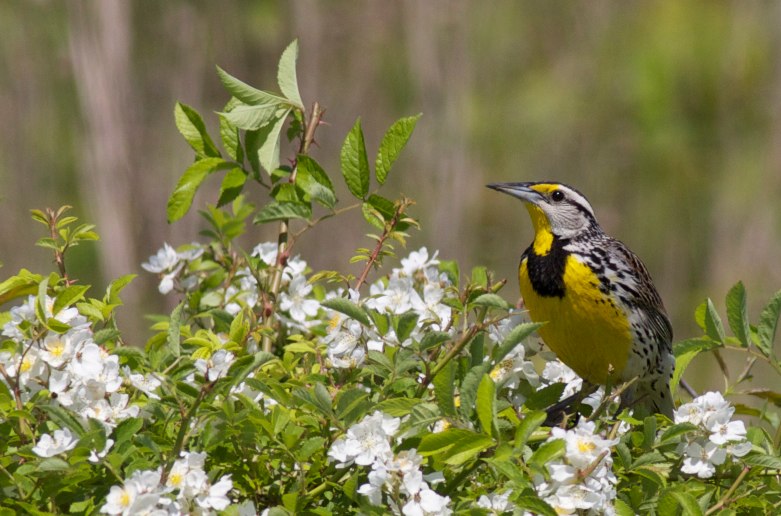
Over 460 acres of restored prairie were surveyed and this large acreage accounts for the bulk of the birds. Grassland birds found included ring-necked pheasant 28, northern harrier (SGNC) 2, sedge wrens 62, common yellowthroat 212, clay-colored sparrow 128, savanna sparrow 1, song sparrow 302, dickcissel (SCGN) 23, red-winged blackbird 365, eastern meadowlark (SCGN) 46, brown-headed cowbird 17, and American goldfinch 47. This is the first time that two harrier pairs nested at Goose Pond and both fledged young. All the dickcissels were found at the 80-acre Ankenbrandt Prairie. One of our favorite birds that are increasing in numbers is the eastern meadowlark, and we enjoy hearing its call.

Eastern meadowlark photo taken in the Browne Prairie by Arlene Koziol

Eastern meadowlark photo taken in the Browne Prairie by Arlene Koziol

Almost 50 years have passed since Madison Audubon acquired the first parcel at Goose Pond, a gift to our feathered friends that keeps on giving. The birds thank all of our members, donors, volunteers, and interns who have been involved with land acquisition and habitat restoration at Goose Pond. Thanks to Heather for all her research work.

Written by Mark and Sue Foote-Martin, Goose Pond Sanctuary Managers, and Maddie Dumas, Land Steward, Goose Pond Sanctuary - goosep@madisonaudubon.org