The 2019 Great Backyard Bird Count in a Tough Winter

Print Friendly and PDF

The 2019 Great Backyard Bird Count in a Tough Winter

We always look forward to participating in the Great Backyard Bird Count (GBBC). This year we kept close watch at the bird feeders at both Madison Audubon residences at Goose Pond Sanctuary on Monday, February 18, the last of the four-day time period. The Martins also counted birds at feeders at their cabin (Wildland) north of Rio in Columbia County on Sunday, February 17.

The GBBC gives us a snapshot of bird usage at our feeders in late winter. Despite the name, birds can also be counted and reported from anywhere, not just backyards. Nine of the 14 species observed at three feeders were in the top 10 species recorded world-wide in 2018 (see spreadsheet below).

count spreadsheet.jpg

Factors contributing to the higher species count and higher number of individuals included more diverse the habitat, the number and types of feeders, and the variety of seeds present.  We find that the best seeds for us are black-oil sunflowers, medium sunflower chips, white millet, and suet. This year our sunflower chip feeders were new Wild Birds Unlimited Eco-clean feeders, which reduce disease transmission when birds congregate in high densities. 

On Thursday afternoon, February 21, GBBC reports were still being entered but at that time, world-wide totals included 178,200 (160,000 in 2017) checklists, 6,293 (6,031) species, and 28,700, 000 (25,300,000) birds counted as part of the event. This is an impressive number that reflects the amount of people interested in birds, and more people participated this year than last. In Wisconsin, bird watchers submitted 2,454 (2,400) checklists and reported 115 (121) species.

Last year we had good numbers of common redpolls and pine siskins, which are very uncommon this year in southern Wisconsin. The eight turkeys at the Wildland cabin were feeding on sunflowers at the bird feeders and on apples in the orchard. The Goose Pond wildlife food plot of sorghum and sunflowers is helping 250 tree sparrows and 25 ring-necked pheasants make it through the winter.

Shelter is another critical need for birds in the winter. The Kampen Road residence contains an “old growth” Norway spruce windbreak and mature pines, and spruces on the neighbor’s land at the Martin’s cabin provide birds with ideal winter roosting cover. Nine years ago at the Kampen Road residence we planted Norway spruce, white cedar, red osier dogwoods, apples and crab apples. These plantings offer additional cover and also serve as a windbreak.
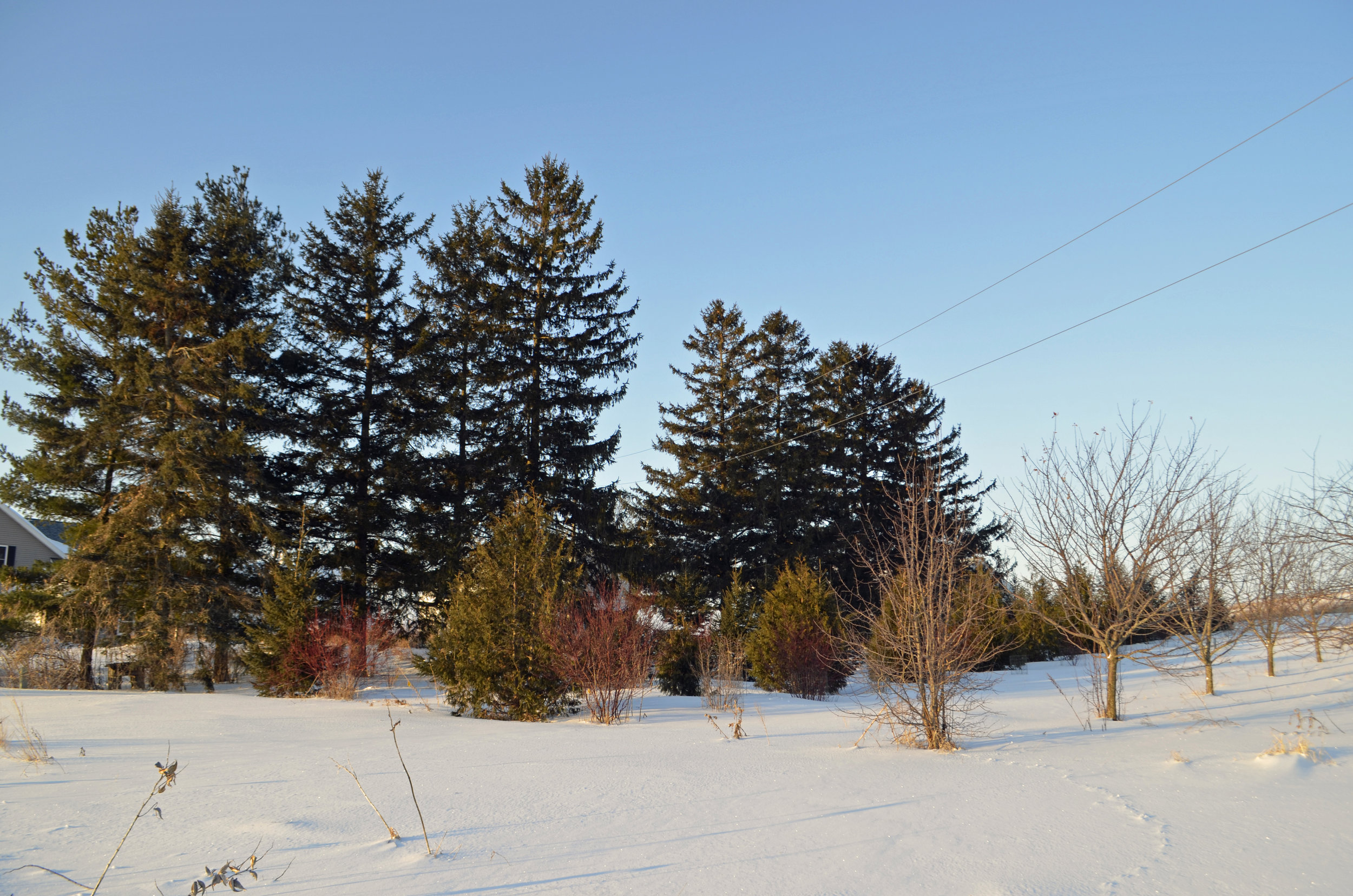
The Kamepn Road residence windbreak offers important shelter for birds and other wildlife. Photo by Mark Martin

The Kamepn Road residence windbreak offers important shelter for birds and other wildlife. Photo by Mark Martin

We are planning on planting more woody species this year and encourage others to provide habitat around their residences.  In addition to creating cover for the birds, the trees help stop the wind and reduced energy costs.

Thanks to everyone that feed birds already. If you live in suitable habitat we encourage you to start feeding them as well. A friend mentioned the importance of feeding the birds and asked us “how would you like to go to the store in winter and find the shelves empty.” The color and variety of species brighten our winter days, and make us feel good knowing that we can provide them with quality habitats and nutritious food.

Goldfinches.jpg

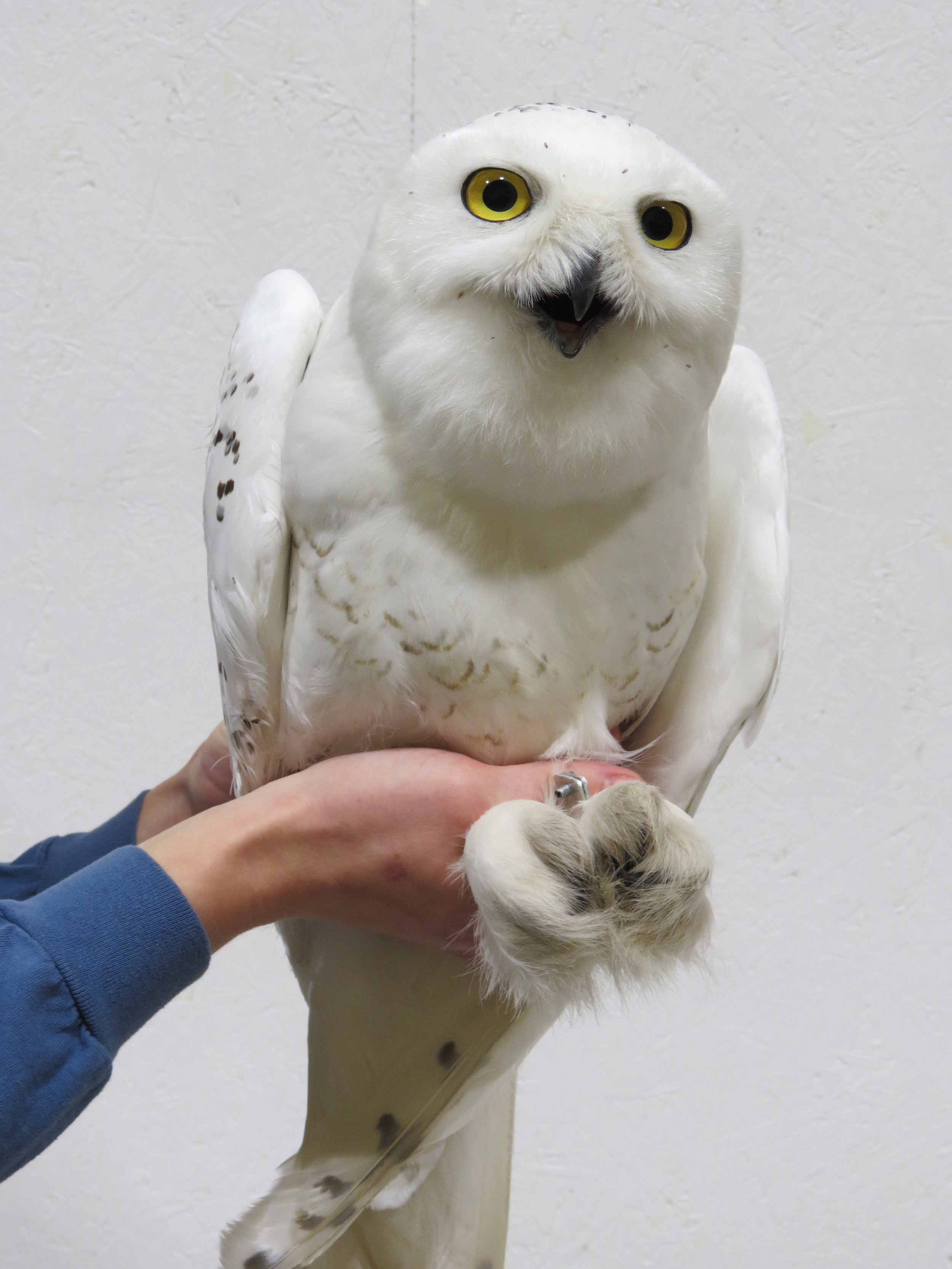
The winter weather has been tough on other birds as well. On Wednesday January 30, Jerry Schulz who works at the UW Arlington Research Farms was driving on Goose Pond Road when he saw an eagle in the road "jumping up and down" close to the Manthe farm. As he approached he could see an adult eagle, and it appeared the eagle had just killed a snowy owl. The adult eagle flushed carrying the owl. That day felt like the arctic with a low of - 30 degrees and a high of -12 with -50 wind chill. Snowy owls can withstand the weather, but we have no idea why the eagle was able to take the owl or why the owl was in this location. It is possible that the owl had been hit by a vehicle or had health problems. It is sad to lose one of our feathered friends, and very surprising to learn of this report.

Written by Mark Martin and Sue Foote-Martin, Goose Pond Sanctuary resident managers

Northern Cardinal

Print Friendly and PDF

This past week I was in Hawaii, enjoying the sunshine and natural beauty that the Maui had to offer. In this post, I’d like to piggyback off of Graham’s wonderful talk about his trip to Puerto Rico and appreciating the common migratory birds of Wisconsin that have found their way to the island.

Hawaii is… a bit different. While I was there, I heard it referred to many times as “the extinction capital of the world.” Of the 40 or so native honeycreeper bird species of Hawaii, over half have gone extinct. Large, flightless birds likewise saw their own extinction not long after the Polynesians arrived.

Hawaii is rich with natural features and “endemic” species—species that occur nowhere else on earth. The Hawaiian archipelago occurs nearly 3,000 miles from the nearest continental landmass. Volcanic action formed the islands hundreds of millions of years ago. The isolation, location in the tropics, and steep volcanic slopes have created a hotspot for evolution. Nearly 90% of the flora of Hawaii is endemic and occurs nowhere else on earth—it evolved on the Hawaiian Islands. While there is a great history of evolution on the islands, there is not a comparatively great diversity of life. Consider this: Faville Grove Sanctuary has somewhere around 650 native plants within its two square mile boundaries. The island of Maui, meanwhile, has about 690 native species within 727 square miles. The difference, of course, is that throughout history, a plant might arrive on the Hawaiian Islands once every 30,000 years. When that plant or bird did arrive on the islands, it evolved to occupy the available niches on the island and became a form unlike anything else on earth.  The Hawaiian Islands occupy about 11,000 square miles with 90% of its species occurring nowhere other than the Hawaiian Islands. Meanwhile, the state of Wisconsin occupies 65,000 square miles and has near 0% of its species occurring nowhere else on earth.

The dramatic landscape of Hawaii is home to a huge number of species you’d find no where else. Photo courtesy of Flickr, Bernard Spragg NZ

The dramatic landscape of Hawaii is home to a huge number of species you’d find no where else. Photo courtesy of Flickr, Bernard Spragg NZ

The singularity and exceptional richness of evolutionary history brings us to the Northern Cardinal. I would venture that the average tourist to Maui sees dozens of birds that occur in their own backyard in the continental United States, including house sparrows and northern cardinals, while seeing no endemic Hawaiian birdlife.

While Graham was in Puerto Rico appreciating those common birds for their migratory ecology, I was in Hawaii cursing the cardinal for its introduction here by humans in 1929. Likewise, the house sparrow—already cursed back in Wisconsin for its raiding of bluebird boxes—is a common Hawaiian bird. Endemic Hawaiian birds take some work to find. You need to move away from the beach towns on Maui, and gain almost a mile in elevation, in order to find forest land inhabited with populations of native birds.  This is due to the avian malaria, which native Hawaiian birds are not adapted to and can decimate native populations. Most forest birds occur 1,200 meters—nearly 4,000 ft— above sea level, because due to the altitude and climate, mosquitoes do not occur in these areas.

In the parking lot of one forested area, I witnessed a red bird, which on first glance appeared to be a northern cardinal. However, the area where I was birding was known to host many endemic forest birds. I looked closer, only to reveal… a northern cardinal! Drat.

I continued hiking, though, and soon I observed the unmistakable I’iwi, a brilliant red endemic Hawaiian honeycreeper, and they were everywhere.

I’iwi photo by Drew Harry

I’iwi photo by Drew Harry

I saw more red birds that weren’t cardinals, including the ‘Apapane. At higher elevetations, I saw no cardinals as the tree cover shifted to alpine scrub, but I did see the state bird of Hawaii, the nene or Hawaiian goose.

‘Apapane photo courtesy of Flickr E_Rick1502

‘Apapane photo courtesy of Flickr E_Rick1502

Nene photo courtesy of Flickr SharifUddin59

Nene photo courtesy of Flickr SharifUddin59

On another day, I made my way to the rainforest side of the islands, where trade winds drop over 400 inches of rain annually. These slopes of the volcano are more dissected and freshwater streams (filled with endemic fish species) hurry down the mountainside. High elevation on the rainforest side is almost impossible to access due to the steep dissected terrain and incredible rainfall. Here, I hoped to find more endemic forest birds, but I was also interested in the flora of this rainforest.

Unfortunately, most of the lowland forest on Maui is non-native. Bamboo and Eucalyptus trees were common on my hikes that morning. I turned to the canopy looking for birds, and what did I find? Another red bird, this time with a crest. I had been studying the birds of Hawaii, and immediately thought of the amazing crested honeycreeper.

Crested Honeycreeper ‘Akohekohe courtesy of Flickr Jim Denny

Crested Honeycreeper ‘Akohekohe courtesy of Flickr Jim Denny

 My hopefulness was soon dashed by an old friend, the northern cardinal.

NOT a crested honeycreeper, photo Drew Harry

NOT a crested honeycreeper, photo Drew Harry

Of course, the cardinal is not to blame for inhabiting this tropical oasis. It also doesn’t really compete with the native forest birds for habitat. Thus, the cardinal is more a reflection of non-native forest and invasive species than a cause of native forest bird decline. Feral pigs, goats and cattle, axis deer, and are all introduced and invasive  species that degrade native habitat directly affecting forest regeneration and the quality of endemic forest bird habitat. The cardinal is just a passerby, as much a part of the islands as the pineapple.

The rainforest was not an ideal spot for photographing cardinals. Photo by Drew Harry

The rainforest was not an ideal spot for photographing cardinals. Photo by Drew Harry

Back home in Wisconsin, we started hearing the pair song of northern Cardinals yesterday.  A beautiful sign that the days are getting longer on a warm and/or sunny February day. Here, I’m happy to hear the cardinal, and I wonder if those Hawaiian birds can muster the same enthusiasm through the wind, ice, and snow; I doubt it.

Written by Drew Harry, Faville Grove Sanctuary land steward

Puerto Rico: Winter Habitat for Birds and Humans

Print Friendly and PDF

According to the Wisconsin Society for Ornithology, 439 bird species have been observed in our state. It’s true that some of those are considered rare or accidental migrants, but the number still stands. When temperatures drop below freezing, virtually all above ground insects are killed, wildlife cover is reduced as plants senesce, and liquid fresh water becomes scarce. The 439 bird species drops to 111.

During the first two weeks of January, Calla Norris (UW-Madison student and bird enthusiast)  and I traveled to Puerto Rico. This United States territory is known for its high biodiversity despite small relative size. For reference, Puerto Rico is about 6% of Wisconsin’s land area but harbors a similar number of bird species (363). Our goals were to snorkel the coral reefs, experience a different culture, and observe new plant and animal species.

- Corals, octopi, jellyfish, eels, dinoflagellates (bioluminescent diatoms), lobsters, rays, crabs, urchins, flying fish

- Ate traditional suckling pig, visited shade-grown coffee farms, ate several coconuts which we opened ourselves, petted many stray dogs

- belted kingfisher, red-tailed hawk, blue-winged teal, common yellowthroat, mourning dove, house sparrow, killdeer, spotted sandpiper.

Mourning dove by USFWS National Digital Library

Mourning dove by USFWS National Digital Library

Blue-winged teal? Mourning dove?! We could have traveled to virtually any county in Wisconsin during the growing season to encounter them. My point here is not to devalue these species by calling attention to their commonness or wide distribution, but to reaffirm the value of borderless bird conservation. Providing habitat for migratory birds in Wisconsin is essential, however, it’s easy to forget that wintering grounds and stopover sites are also of critical importance.

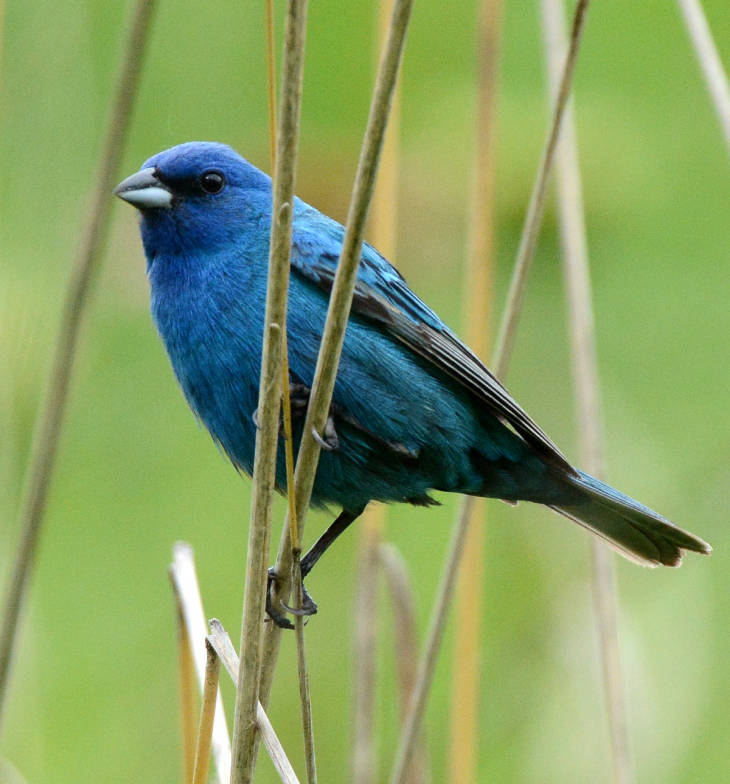
The concept of borderless bird conservation was formally established in 1918 with the passing of the Migratory Bird Treaty Act. Ornithologists, notably waterfowl enthusiasts, realized that conserving habitat over vast spatial scales is crucial to maintaining population levels of migratory species. A prime example of this is the indigo bunting. This striking songbird of edges and shrubby fields nests in high densities throughout the eastern United States. During the winter, indigo buntings travel to Central America and Caribbean islands. Only a tiny portion of the population remains within the political boundaries of the United States. Even if huge tracts of prime breeding habitat are provided in the US, indigo buntings would surely decline or disappear if their wintering areas in other countries were decimated.

Indigo bunting by USFWS National Digital Library

Indigo bunting by USFWS National Digital Library

Indigo bunting range map by Cornell Lab of Ornithology

Indigo bunting range map by Cornell Lab of Ornithology

Calla and I explored as many new ecosystems as possible. They ranged from dry forests dominated by cacti in the Guanica State Forest and Biosphere Reserve to the rainforests of El Yunque which receive about 240 inches of rain annually. On Vieques, a small island off the east coast of Puerto Rico, Calla approached a group of fifteen people wielding machetes and hand saws to inquire about their curious (if not threatening) accessories. They were volunteer trail builders for the Vieques Conservation and Historical Trust, and we offered to join them. After chopping and chatting with students and trust members alike, we learned some birding hotspots. At all locations we observed birds that can be put into three categories: 1) species native to Wisconsin (or other northern regions), 2) pelagic generalists, and 3) species that are endemic to the Caribbean or Puerto Rico itself. Okay, so we’ve established that providing habitat at warmer latitudes is required to maintain migratory bird populations in addition to the non-migratory locals. Now let’s check that box:

- Yellow-crowned night heron, brown booby, black-necked stilt, white-cheeked pintail, gray kingbird, brown pelican, royal tern, smooth-billed Ani, American oystercatcher, Puerto Rican tody, greater Antillean grackle, and 30 or so others.

Puerto Rican Tody by Annabelle Watts

Puerto Rican Tody by Annabelle Watts

Yellow-crowned night heron by USFWS National Digital Library

Yellow-crowned night heron by USFWS National Digital Library

Next time you take a trip south, keep an eye out for the rarities, the unexpected, the lifers. But watch out too for birds native to your own state. Sure you might regularly see them out your back door, but old birds in new places remind us of their complex life histories, ignorance of political boundaries, and need for wide-ranging if not global conservation efforts.

 Written by Graham Steinhauer, Goose Pond Sanctuary land steward 

Lapland Longspur

Print Friendly and PDF

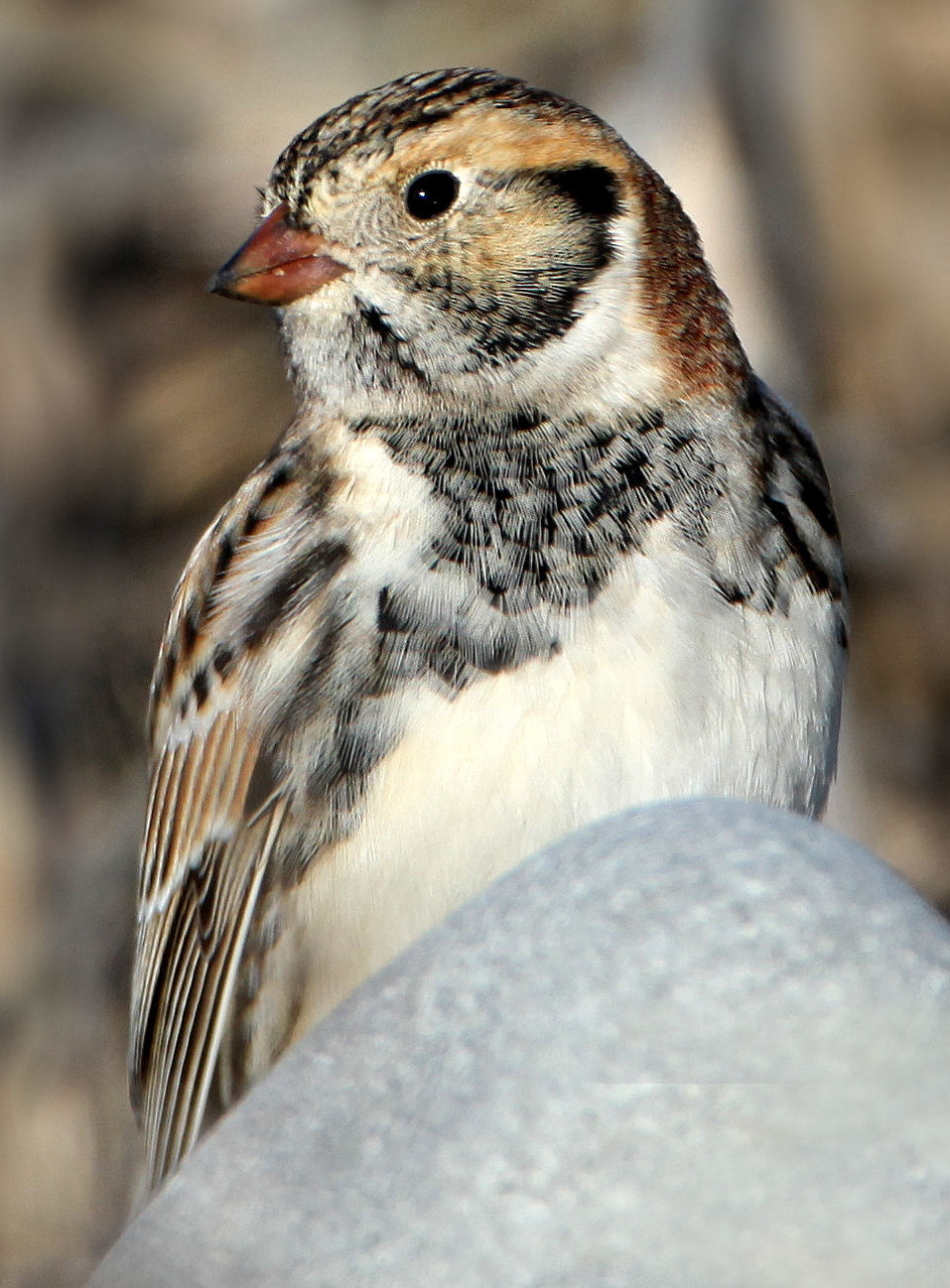
The Lapland Longspur, a winter bird here in Wisconsin, perhaps best represents the arctic chill currently swallowing the Midwest. The longspur breeds on the highest of the high arctic, residing on the tundra grasslands that typically reserve this -30 degree Fahrenheit air.  On its breeding territory, the longspurs display a brilliant black bib, face, and crown, a rusty nape, and a vibrant yellow beak.

Lapland longspur in its summer breeding grounds. Photo by Fiona Paton FFF

Lapland longspur in its summer breeding grounds. Photo by Fiona Paton FFF

This species eats seed during its winter foray into Wisconsin, a diet which its bill is well-adapted for. Here at Faville Grove Sanctuary, I wonder if these birds are finding sufficient food for the winter, but the staggering diversity and weight of seed in a prairie restoration should easily last the winter. I’ve seen longspurs along the edges of fields down Prairie Lane this winter.

Because of its high arctic breeding grounds, very little is known about the Lapland longspur in terms of population or ecology. The overall population seems to be healthy, as this is a common winter bird of the northern United States.

Lapland longspur photo by Nigel, FCC

Lapland longspur photo by Nigel, FCC

One study on longspurs found that the birds show a slight spike in testosterone during the breeding cycle when they use song displays and participate in courtship. This spike lasts for two days. Over the next week or so, the males will vigorously defend the female they are paired with. Outside of this week-long window, male longspurs are quite affable and tolerant of other males entering their territory. Other species, in studies involving testosterone, have shown longer-lasting spikes of testosterone and exhibit agressive behavior for a much longer time period, even over a month long. The chill of the Lapland longspurs goes beyond their general habitat and infiltrates their very demeanor.

You might find Lapland longspurs down Prairie Lane, once the snow has melted a bit.

Written by Drew Harry, Faville Grove Sanctuary land steward

Snowy Owls Galore

Print Friendly and PDF

Snowy Owls: Goose Pond, Arlington, and Coddington

Madison Audubon’s involvement with Project SNOWstorm began in February 2015 when Goose Pond Sanctuary experienced many observations of snowy owls as winter visitors. Project SNOWstorm was just getting started as a non-profit that studies snowy owls’ winter ecology after the historic snowy owl irruption of 2013-14.

What had once been simple (excited) observations of snowy owls near Goose Pond led to a parntership with Project SNOWstorm and local biologists to safely capture, place a transmitter on the back of, and release these birds back to the wild. We hope that those involved with “our” two snowy owls at Goose Pond — Goose Pond and Arlington — enjoy the memories of those events, and that new birders can learn about the snowy owl project. And now, we have the pleasure of watching a third owl associated with our organization: Coddington.

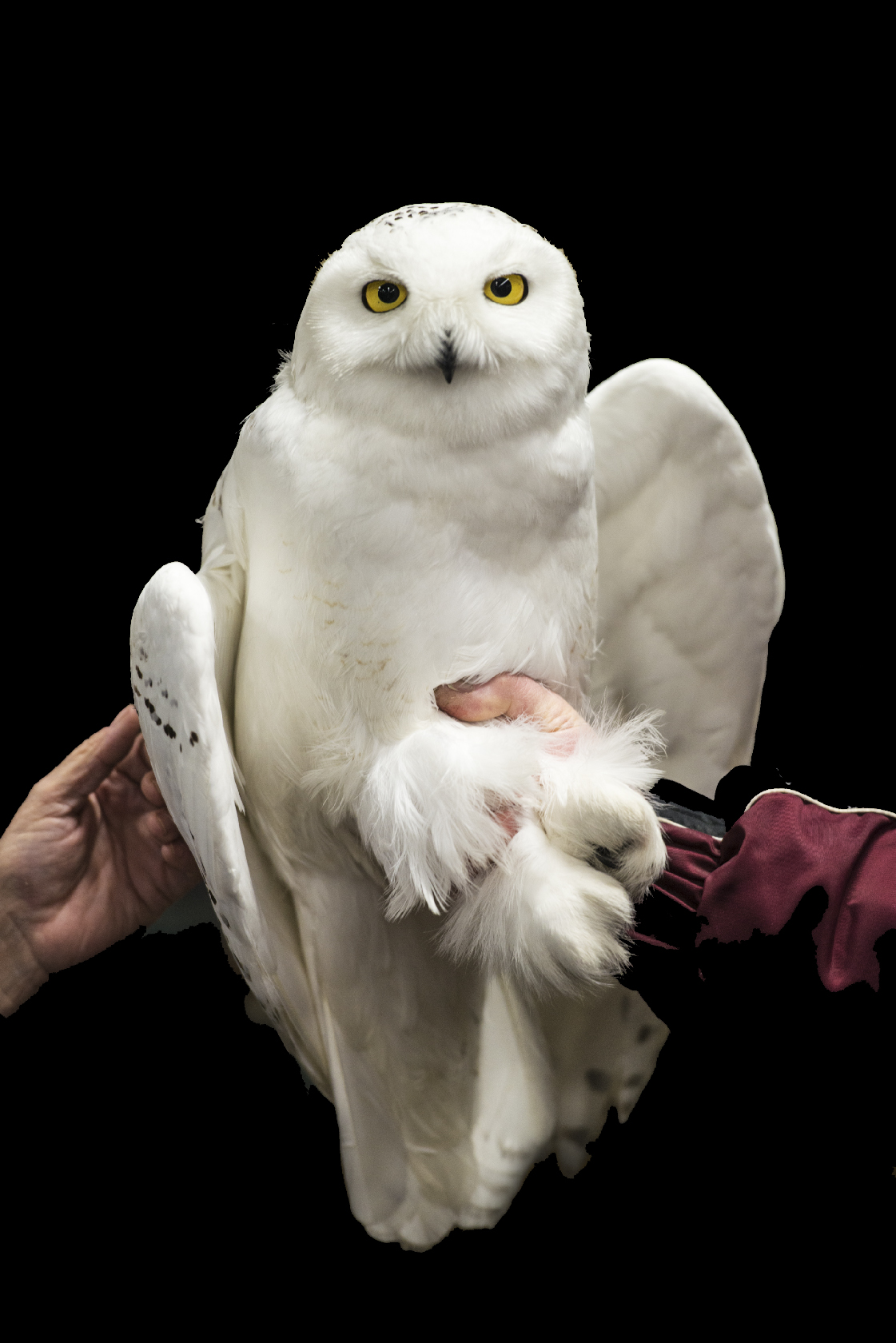
The three snowy owls Madison Audubon and its donors have supported as part of Project SNOWstorm. Left: Goose Pond (2015), photo by Richard Armstrong. Center: Arlington (2018), photo by Madison Audubon Society. Right: Coddington (2019), photo by Brad Zinda.

Over the past four decades snowy owls are seen infrequently at Goose Pond but sightings increased in the winter of 2013-2014 in our area. Ryan Brady, DNR Conservation Biologist provides updates on snowy owls, and this winter, 85 have been sighted in Wisconsin, but so far not on our sanctuary.   

Over 75 snowy owls have been tracked by Project SNOWstorm throughout the United States and Canada, including three owls with transmitters funded by MAS donors. The first bird, “Goose Pond”, was caught and released on February 14, 2015; “Arlington” on January 4, 2018; and “Coddington” and on January 3, 2019.


Mark Martin releasing the newly tagged Goose Pond owl. Photo by Arlene Koziol

Mark Martin releasing the newly tagged Goose Pond owl. Photo by Arlene Koziol

“Goose Pond” (2015)

Our first snowy owl was caught at the Central Wisconsin Airport at Mosinee, released at the UW Arlington Research Station one mile south of Goose Pond, and named after our nearby iconic wildlife sanctuary. (Conservation groups actively work on relocating owls that are found at or near airports due to the high risk for the birds and planes.) On March 19, Goose Pond flew southwest to Grant County, and his last transmitted data was six miles northwest of Dubuque, Iowa on March 29. Shortly after that his transmitter failed. We later learned that he spent time near Highway 151 near Platteville. When learning that he moved to a rural area in Grant County, Mark Martin, Matt Reetz, and raptor biologists from Eagle Valley tried trapping him so that his failed transmitter could be removed, but were unsuccessful.


Arlington’s piercing gaze is unforgettable. Photo by David Rihn.

Arlington’s piercing gaze is unforgettable. Photo by David Rihn.

 “Arlington” (2018)

Of all the transmitted owls in the Midwest, Arlington made the most movements away from and back to his release sight at the UW Farms. Project SNOWstorm scientist Scott Weidensaul wrote in the February 18, 2018 Project Snowstorm blog that “Arlington took a little walkabout Feb. 12-13, making a 90-mile (144 km) jaunt east to the outskirts of Watertown, south to Lake Koshkonong, and then back up to his normal (Arlington) territory.” Arlington later took a cruise to Rush Lake near Ripon and returned. That April, the Midwest was hit with giant spring snowstorms, delaying the bird’s migration back to the tundra.

A map of Arlington’s extensive travels while in Wisconsin. Image provided by Project SNOWstorm.

A map of Arlington’s extensive travels while in Wisconsin. Image provided by Project SNOWstorm.

From Project SNOWstorm’s May 13, 2018 blog: “…there’s been a lot going on, so let’s bring everyone up to speed. Unfortunately, the biggest news is also the saddest. Arlington, who was tagged Jan. 4 at Madison Audubon’s Goose Pond Preserve near Arlington, Wisconsin, was found dead along a roadside in Benton County, Minnesota, on April 29. Although we’ll conduct a necropsy to be sure, it appears he was killed by a vehicle collision — our third such loss this winter. A passerby saw a snowy owl sitting along a country road, not moving, and when they returned half an hour later, the owl — Arlington — was lying dead.

We’re deeply grateful to Carroll Henderson and the other folks at Minnesota DNR, who recovered Arlington, for reaching out to us immediately and making arrangements to have him and his transmitter shipped to us — just another example of the terrific cooperation we’ve enjoyed over the years from state, provincial and national wildlife agencies.  And we’d like to again extend our thanks to Madison Audubon for sponsoring Arlington’s transmitter — this is a hard loss for them as well as us, but Arlington’s movement data is and will remain a valuable legacy.”

Project SNOWstorm sent us the results of his necropsy that found low (sublethal) levels of Brodifacoum rodenticide, and also DDE, the breakdown product of DDT, which we find at varying levels in many snowy owls, and significant levels of mercury. We’re looking hard at what such toxins mean for snowy owl health. He had a moderately heavy load of parasitic nematodes, which we’ve seen at fatally high levels in some snowy owls.

Fortunately, Project SNOWstorm was able to recover Arlington’s transmitter and refurbish it for another bird in the future. While Arlington’s death was a blow, the prospects of tagging another owl with the transmitter gives Arlington’s followers and the donors to the $3,000 transmitter a second chance to hope.


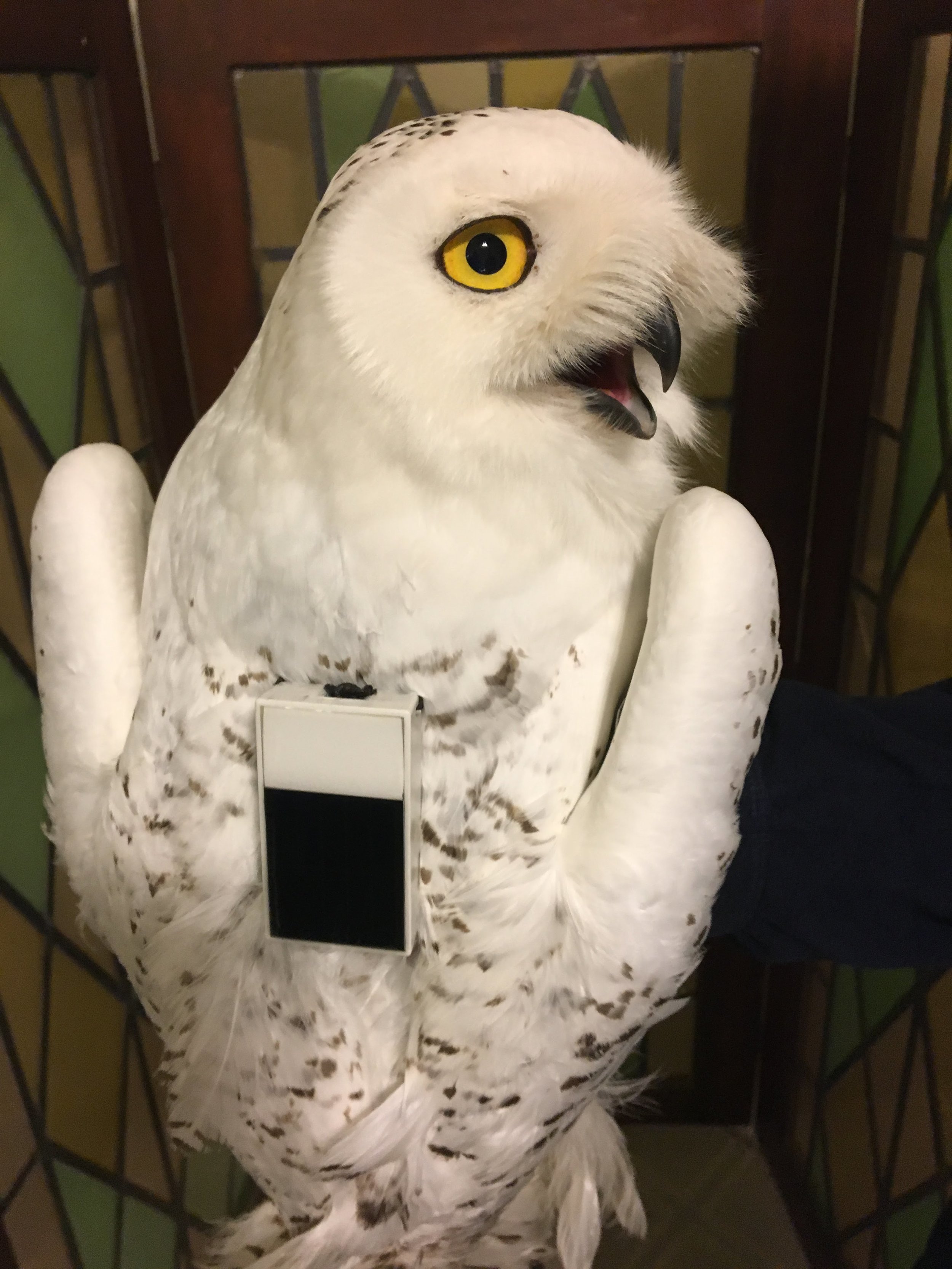
Coddington, the snowy owl outfitted with Arlington’s transmitter, in profile. Photo by Brad ZInda.

Coddington, the snowy owl outfitted with Arlington’s transmitter, in profile. Photo by Brad ZInda.

“Coddington” (2019)

And a second chance came this winter! Coddington, an adult male snowy owl, was caught and released at Buena Vista Marsh on January 3, 2019 and outfitted with “Arlington’s” transmitter. The perils of winter life for snowy owls continue, however, as we learned this week that he made a narrow escape from disaster with help from a farm family in Plover and the Raptor Education Group, Inc. (REGI). Likely after chasing prey into a barn and getting stuck inside, and in a lagoon of cow manure no less, Coddington was rescued by the Biadasz family, cleaned up, examined, and is currently in rehab with REGI.

Because Coddington will be in rehab and stationary for three to four weeks, his transmitter was removed and we’re hoping to be able to capture, tag, and release another snowy owl with that transmitter. We are so glad Coddington will recover and in time to migrate north!


Arlington sits at the rock quarry outside of Goose Pond Sanctuary in 2018. Photo by Monica Hall

Arlington sits at the rock quarry outside of Goose Pond Sanctuary in 2018. Photo by Monica Hall

As you can see, snowy owls — indeed, most bird species — face numerous challenges when interacting with the human world. But programs like Project SNOWstorm, which work to understand those specific challenges, people like you and I, who work hard to take action to help birds like Goose Pond, Arlinton, and Coddington, can make a world of difference.

Thank you to:

  • Project SNOWstorm for establishing and coordinating the snowy owl winter ecology research project. Their staff of volunteers is great to work with!

  • Gene Jacobs, Raptor Biologist with Linwood Springs Research Station for catching and banding the three owls.  

  • MAS members that donated to funding two transmitters and to donors to Project SNOWstorm.

  • Everyone who provided sightings and photos, and helped trap the owls.

  • The staff at UW Arlington Research Farms for their reports and cooperation.

Together, we can make a difference!

Written by Mark Martin and Susan Foote-Martin, Goose Pond Sanctuary resident managers, and Brenna Marsicek Madison Audubon director of communications