Red-headed Woodpecker

Print Friendly and PDF
A red-headed woodpecker in flight. Photo by Arlene Koziol

A red-headed woodpecker in flight. Photo by Arlene Koziol

Boisterous in the spring and summer, gliding from dead snag to dead snag, the winter red-headed woodpecker instead rests on a snag, content to take in the snowy scene on a January afternoon. On approach, I hear the chatter of two red-headed woodpeckers, but unlike their lurid and sweeping flights of summer, the bird on this day—like I do—sits on a branch and hardly moves.

Unusual, I think, to have overwintering red-headed woodpeckers. I wonder if a feeder nearby has provided the extra resources for winter, but upon researching the overwintering habits of the bird, I find that its characteristic habitat, the oak savanna, will provide the resources for winter. Acorns, cached for winter, will provide high energy food over the course of these dark winter months. Where there are bumper crops of acorns, you’ll often find overwintering red-headed woodpeckers.

Located in a wet draw of silver maples between two oak woodland and savanna areas, these red-headed woodpeckers likely have a buffet of acorns to feed on. I wonder if other woodpeckers, of which I noticed red-bellied, downy, hairy, and a northern flicker, might steal the acorns. Yet, the red-headed woodpeckers are likely up for the task of defending their caches; during the breeding season, red-headed woodpeckers are known to fiercely defend their nest and territory, with reports of the birds raiding northern flicker and eastern kingbird nests after fights with the parents. In hindsight, I should have checked the abundant cavities in the decaying silver maples to see if there were any cached acorns.

IMG_7638.jpg

Hope Lake Bog, where these woodpeckers are located, is actively being restored to oak savanna and woodland. The fact that these woodpeckers are overwintering here and are doing so in all likelihood because of a large acorn crop, has interesting implications for management of the site.

Since clearing buckthorn from large portions of the site, the open understory impresses under giant white oak trees. One of the few things missing here is a prescribed fire to stimulate understory herbs and clear out areas of brambles. Yet, a prescribed fire will also decrease the germination of acorns, with the intensity of the burn in turn decreasing the rate of germination in acorns. With the apparent bumper crop of acorns, the question lingers whether we should wait a year to implement a prescribed burn at the site. Another missing element of the site is young oak saplings to replace the giants in the canopy.

Prescribed burns in Hope Lake Bog result in patchy areas of unburned ground, perfect for germinating acorns. Photo by Drew Harry

Prescribed burns in Hope Lake Bog result in patchy areas of unburned ground, perfect for germinating acorns. Photo by Drew Harry

While concerns over acorn germination are legitimate, the dynamics of fire in the oak ecosystem reveal an even more complex situation. In the picture below, you’ll see that after a fire through an oak leaf litter, there are considerable patches of unburned areas. These refuges may provide enough refuge to promote germination of acorns. As you can see, a simple natural history observation (hmm it’s odd that these red-headed woodpeckers are overwintering) can have cascading effects and implications for the restoration and management of the whole system. And we’re delighted to have these brilliant members of the ecosystem to alert us of changes on the ground that we might have missed.

Written by Drew Harry, Faville Grove Sanctuary land steward
Goose Pond's 2018 Christmas Bird Count

Print Friendly and PDF

On Saturday December, 29 we ended 2018 “The Year of the Bird” by coordinating the 47th Poynette Christmas Bird Count (CBC), with assistance of 26 field counters and 10 households as feeder counters.  Fifty-nine species and 10,816 individual birds were documented.

It is very rewarding to spend a day at Goose Pond Sanctuary seeing the winter bird usage as the result of 50 years of land acquisition and habitat restoration. For the 19th year Goose Pond Sanctuary was searched as a unit of the Poynette CBC count with the assistance of Jim Hess, Bill Walters, and JD Arnston. 

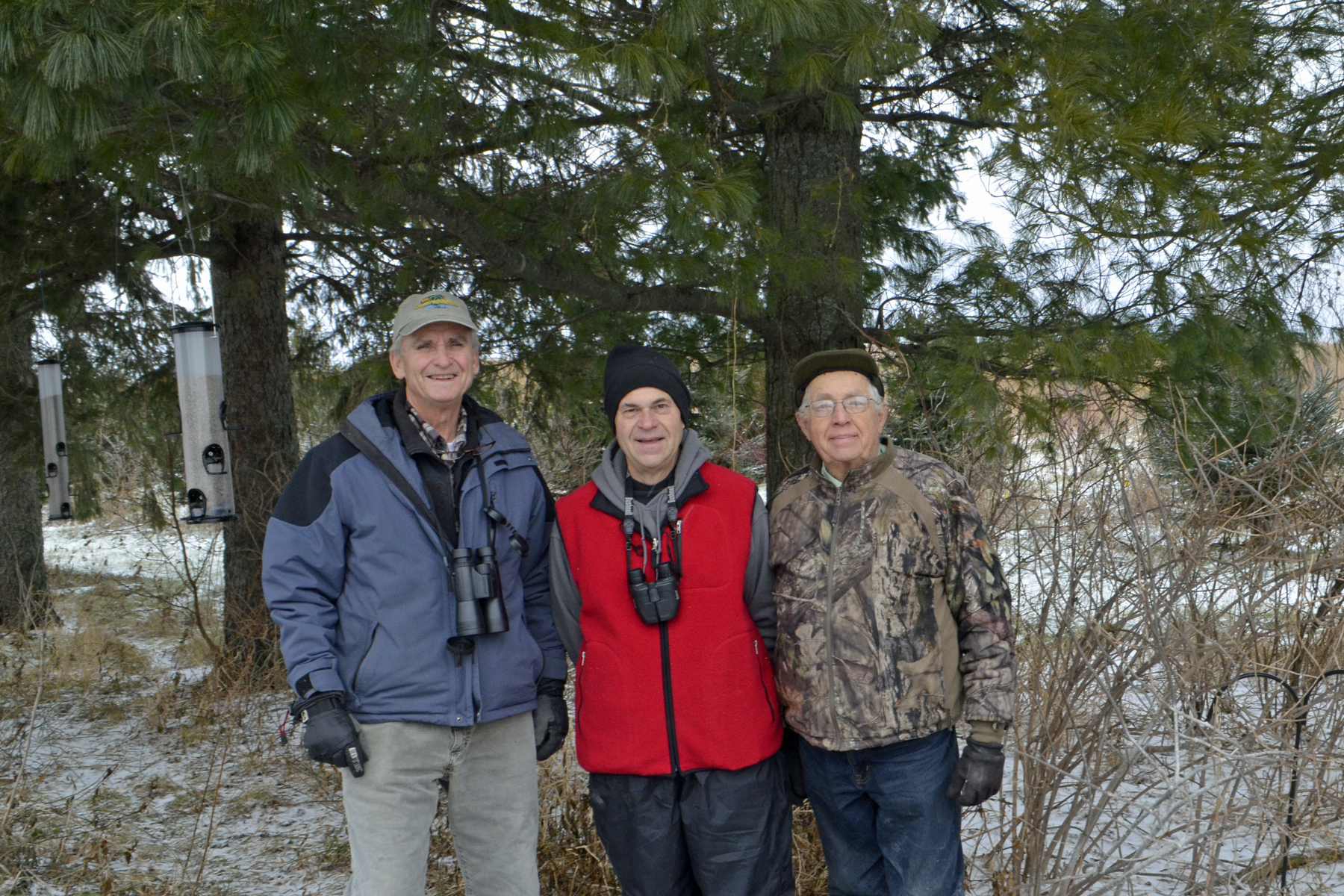
Jim Hess, Bill Walters, and Mark getting ready to head out. Not pictured: JD Arnston. Photo by Sue Foote-Martin

Jim Hess, Bill Walters, and Mark getting ready to head out. Not pictured: JD Arnston. Photo by Sue Foote-Martin

The count day was slow for many species, however we had a number of firsts and highlights at Goose Pond Sanctuary and the adjacent area. Twenty-seven species, a record high for our count, were found in the Goose Pond area. Black ducks and northern pintails were new to the species list bringing the total species observed to 44. Record high numbers included 1,340 mallards (only found on two other counts with a previous high of 61), 3 American kestrels, and 87 dark-eyed juncos. The second highest number of birds was found – 2,045, thanks to the large number of mallards. 

Northern pintail, photo by Monica Hall

Northern pintail, photo by Monica Hall

Mark, Jim, and Bill spent an enjoyable hour walking the sorghum and sunflower food plot. Ring-necked pheasant tracks were easy to see with the recent half inch of snow. Eight hens and two roosters were flushed and judging from the tracks there might have been 25 birds using the food plot. 

The highlight of the food plot walk was the 300 American tree sparrows flitting around. They were not easy to count! At first there were 30 sparrows, then 50, and half-way through the plot we estimated 200 tree sparrows were present. Another 100 were found in the second half of the food plot.

Sorghum in the food plot. Photo by Mark Martin

Sorghum in the food plot. Photo by Mark Martin

Chickadees, cardinals, juncos and two cottontails were also found in the food plot, mostly where the spruce trees were adjacent to the food plot. The winter birds fly into the surrounding restored prairie but feed mostly in the food plot on 10 varieties of sorghum. Thanks to the Columbia and Dodge Counties Pheasant Forever chapters for donating sorghum and sunflower seed.

With the abundance of waste corn in the fields and the relatively open winter mallards were still feeding in the Arlington area. The ducks usually visit Goose Pond in mid-morning and on the 29th they found about a tenth of an acre of open water. It was nice to see the black ducks and pintails in the dense flock of mallards roosting on the ice or swimming. 

The hawks and great horned owl were present due to the large amount of habitat that resulted in a high number of prey species.

At Christmas time we like to watch Jimmy Steward in It's a Wonderful Life where George Bailey learned how different life would have been in Bedford Falls without him.  As we end the 50th year of Goose Pond Sanctuary we wonder how different bird life would have been at Goose Pond Sanctuary without Madison Audubon. 

There probably would not be a Poynette CBC and the low number of species would mostly be dominated by rock pigeons, horned larks, and European starlings.

Birds found:  Canada goose (6), tundra swan (1), American black duck (3), mallard (1,340), Northern pintail (2), ring-necked pheasant (15), northern harrier (2), Cooper’s hawk (2), red-tailed hawk (1), rough-legged hawk (2), American kestrel (3), rock pigeon (47), mourning dove (68), red-bellied woodpecker (1), downy woodpecker (5), hairy woodpecker (1) feeding on emerald ash borer larva, blue jay (3), American crow (6), horned lark (4), black-capped chickadee (18), European starling (5), American tree sparrow (329), dark-eyed junco (87), northern cardinal (6), house finch (44), American goldfinch (28), and house sparrow (15).

Written by Mark Martin and Susan Foote-Martin, Goose Pond Sanctuary resident co-managers

Black-billed Cuckoo

Print Friendly and PDF

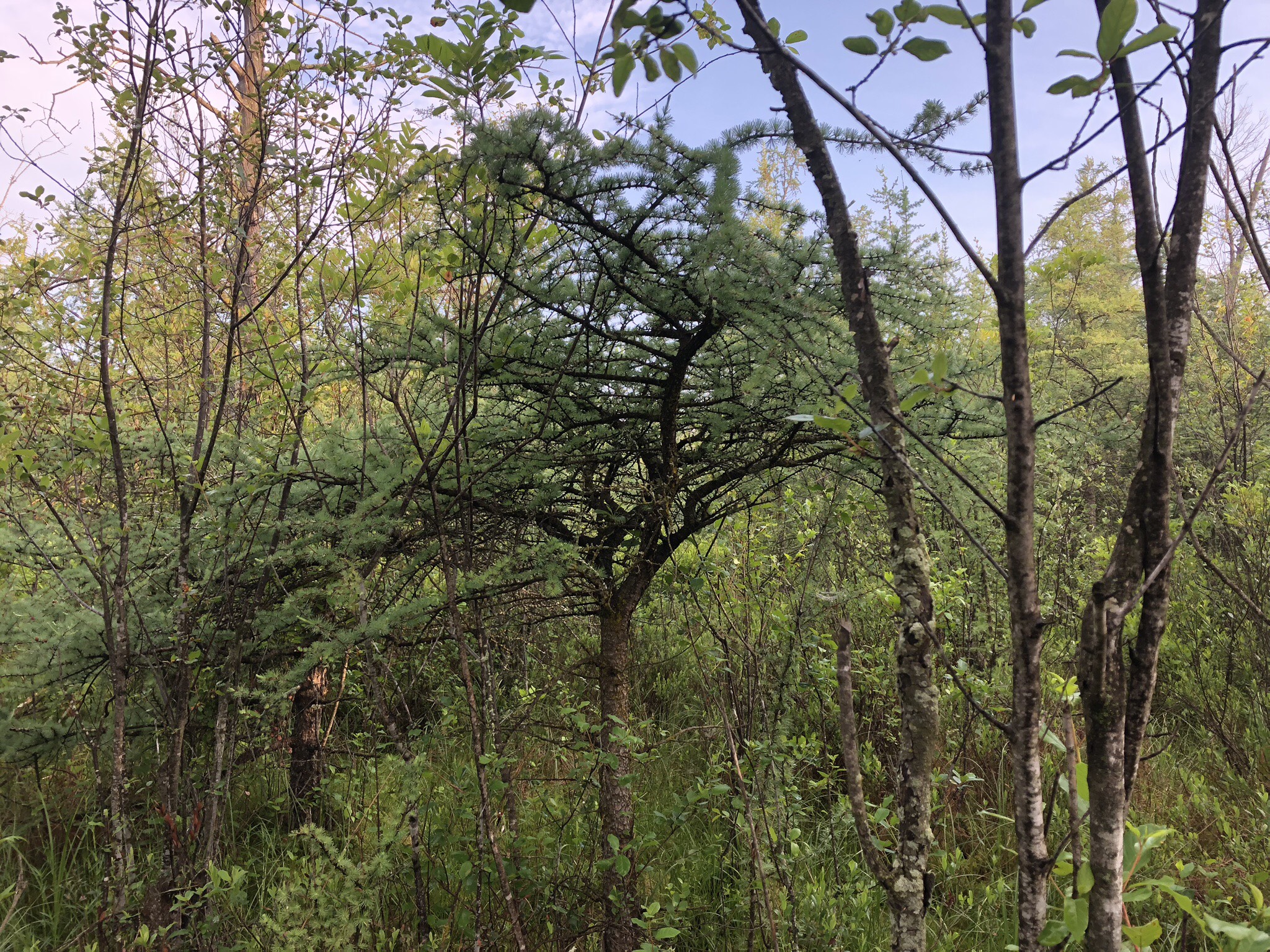
On a June morning, I struggled my way through the wetland margin of the Laas Tamarack. Wanting to find what breeding bird species resided in this largely inaccessible and otherworldly tamarack bog, the allure of the unknown was soon filled with regret and rubber boots full of murky bog water. This was to be expected.

A brushy tangle of tamaracks and understory. Photo by Drew Harry

A brushy tangle of tamaracks and understory. Photo by Drew Harry

Many of the birds I heard and saw were also expected: yellow warblers, robins, gray catbirds, red-winged blackbirds, common yellowthroats, cedar waxwings, chickadees, wood ducks, and a green heron. Delightful, no doubt, but they didn’t include any of the hoped-for birds, like a mourning or Canada warbler, or a white-eyed vireo. The sunrise through the tamaracks, in combination with the morning dew, gave the needles a bluish tinge. Meanwhile I appreciated the treasures of the bog: pink lady’s slippers orchids, unique sedges like cottongrass, and blueberry and huckleberry. Of course, the hummocks of sphagnum moss offered a delightful color palate of red, green, and brown; while also varying the topography so that I had to listen for rare birds instead of also looking for them.

After wandering around the outskirts of the tamaracks and appreciating the sunrise, I stopped and touched a particularly burly young tamarack. From this tree, at about eye level, flushed a good-sized bird that jolted me back from the tree; a moment later I realized it was a black-billed cuckoo, and a moment after that I saw it had flushed from its nest. Here was a delightful find!

IMG_1693.jpeg

The nest defied the warm and homely expectation of care instructions for eggs. Instead, the black-billed cuckoo that I found opted for a few sticks crudely stitched together in the crook of the tamarack. I would not make it back into the tamarack to monitor the nest, but with a frail gust, those eggs could have easily tumbled to the ground.

This type of nest construction is actually typical for black-billed cuckoos. While cuckoo relatives in England will parasitize the nests of other birds, the black-billed is less likely to do so, but still has been known to lay eggs in the nests of other birds. I’d like to think the cuckoo, upon finding the nest of a robin and envious of the cozy design, decides instead to squat its eggs in the more hospitable robin nest.

Cuckoos, more often heard than seen (with their three-noted coo-coo-coo), thrive in brushy and gangly thickets. Where I found this cuckoo nest, I had to cross a wetland edge of a few feet of water, then stumble my way through an almost impossibly thick maze of shrubs and small trees. This is just how the cuckoo likes it.

The beautiful, but intimidating to hikers, tamarack bog. Photo by Drew Harry

The beautiful, but intimidating to hikers, tamarack bog. Photo by Drew Harry

Where I’ve encountered cuckoos in thickets, they’ve been hilariously hard to spot. I might excitedly point out the bird to our summer interns, only for the bird to sit still for minutes on end. When it starts moving again, it’s still hard to spot with its brown to olive plumage and namesake black bill, but a white underside and red eye ring reveal flashes of this brilliant bird. I recall one summer when I looked at a black-billed cuckoo with the interns, and the bird seemed to mirror our movements through the brush. Here we were, hunched over and rocking our head every which way, and there went the cuckoo, looking at us, moving quickly in short spurts and navigating the jungle of brush.

Black-billed cuckoo photo by Tom Murray, FCC

Black-billed cuckoo photo by Tom Murray, FCC

During the breeding season, black-billed cuckoos are relatively common throughout Wisconsin. However, indices of population from breeding bird survey routes suggest a steady decline of the cuckoo population in Wisconsin. Since habitat in Wisconsin is sufficient to support this species, it is thought that spraying for gypsy moths might affect food availability, or pesticide spraying may kill caterpillars and thus eliminate an important food source.

Cuckoos love caterpillars, and where you have an outbreak of caterpillars—especially tent caterpillars—you will often find cuckoos. Breeding bird survey data from Wisconsin reflects this element of cuckoo ecology, as the density of black-billed cuckoos is highly variable, and peaks every 8 or 9 years, almost always coinciding with a caterpillar outbreak. One interesting adaptation that black-billed cuckoos have to eating sometimes spiny caterpillars is that they shed their stomach lining, coughing it up in a pellet.

You won’t be able to find any cuckoos right now at Faville Grove, and you’ll likely have to wait until mid to late May to see one, but North Shore Road is a reliable spot to find this secretive bird.

Written by Drew Harry, Faville Grove Sanctuary land steward

Forster's Tern

Print Friendly and PDF
Female Forester’s tern. Photo by Arlene Koziol

Female Forester’s tern. Photo by Arlene Koziol

Terns are in the same family as gulls and skimmers, and 40 tern species are found worldwide. The arctic tern migrates from Antarctica and back again over a six month period. Their journey is not necessarily in a straight line, and on average the round trip migration distance covers an unbelievable 44,000 miles. All four tern species regularly found in Wisconsin, Forster’s tern, black tern, common tern, and Caspian tern are listed as state endangered. Wisconsin DNR and other groups have developed innovative ways to assist these species, and particular progress has been made with Forster’s terns.

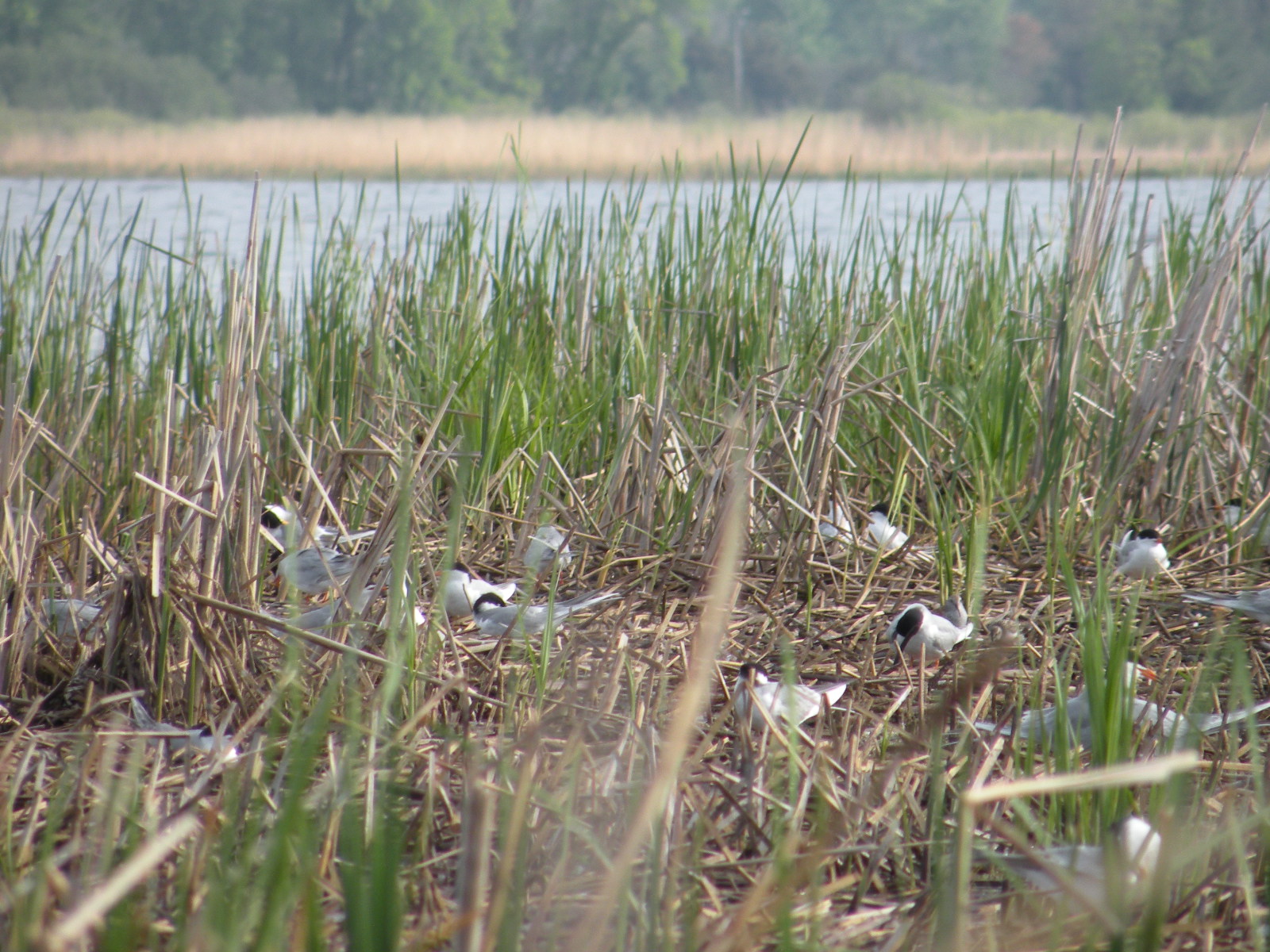
Numerous Forster’s terns mingle in native vegetation in a wetland. Photo by Daryl Christensen

Numerous Forster’s terns mingle in native vegetation in a wetland. Photo by Daryl Christensen

The Forster’s tern is a colony nester. Bird colonies are usually found on sites that are well protected from the usual terrestrial predators. Because colony nesting birds only congregate for a small portion of the season, local predator populations do not boom as they might with a permanent high energy food source. Forster’s terns breed in large marshes with abundant emergent vegetation, and most of the breeding population in Wisconsin inhabits the east central portion of the state or lower Green Bay.

In pre-settlement days, an estimated 10 million acres of wetlands existed in Wisconsin according to Wisconsin DNR. Around 50 percent of those acres were destroyed because of conversion to agriculture, urban area, or other uses. Some colony nesters have a remarkably high site fidelity, meaning that they return to the same breeding site year after year. Forster’s terns are more nomadic than others in this sense. They require specific water levels for optimal nest success; plenty of water to maintain prey populations and deter predators, but not so much that their source of cover is below the water line. Historically Forster’s terns had many more options when choosing a colony site. Greater habitat choice led to more successful nests and higher populations.

A Forster’s tern on a nest platform, Photo taken by Daryl Christensen in 1983 or 1984

A Forster’s tern on a nest platform, Photo taken by Daryl Christensen in 1983 or 1984

Because of low nest success and declining populations, the Wisconsin DNR began deploying nesting platforms for Forster’s terns in 1983. Nest platforms provide high quality nesting sites when natural substrates are of low quality or in short supply. After eggs are laid, rising water can easily submerge nests. Fluctuation in marsh water levels is likely exacerbated by hard surfaces and row crop cultivation due to their low water infiltration potential. Nesting platforms float on the water surface. They are attached loosely to a pole which allows them to rise and fall in response to changing water levels.

Nesting platforms significantly increase nest success, and 100 percent of deployed platforms were utilized by terns in 2018. This year at Lake Puckaway, 200 breeding pairs produced 259 eggs without the assistance of platforms. At Grand River Marsh, 19 breeding pairs that were occupying tern platforms produced 58 eggs. This means that breeding pairs of Forster’s terns were able to produce over two times the eggs using platforms than on natural substrate. Lake Puckaway flooded after this nest survey was completed, and all eggs were lost. Forster’s terns do renest, but their egg production decreases after each nesting attempt.

The Wisconsin DNR plans to increase the number of tern platforms to 150. Ryan Zabs, a Sun Prairie Eagle Scout, reached out to Goose Pond Sanctuary in search of his final Eagle Scout project. He helped us take a huge step towards those 150 by building 50 platforms in a single weekend. Sumner Matteson with Natural Heritage Conservation Bureau at WIDNR generously provided funding for the platform materials.

Forster’s tern nest platform, photo by Daryl Christensen

Forster’s tern nest platform, photo by Daryl Christensen

While the success of tern platforms certainly is exciting, it must be noted that this is not a permanent solution. Continued restoration of large wetlands and further protection of coastal wintering grounds is the best hope to keep Forster’s terns on the Wisconsin landscape now and far into the future.

Written by Graham Steinhauer, Goose Pond Sanctuary land steward

Brown Creeper

Print Friendly and PDF

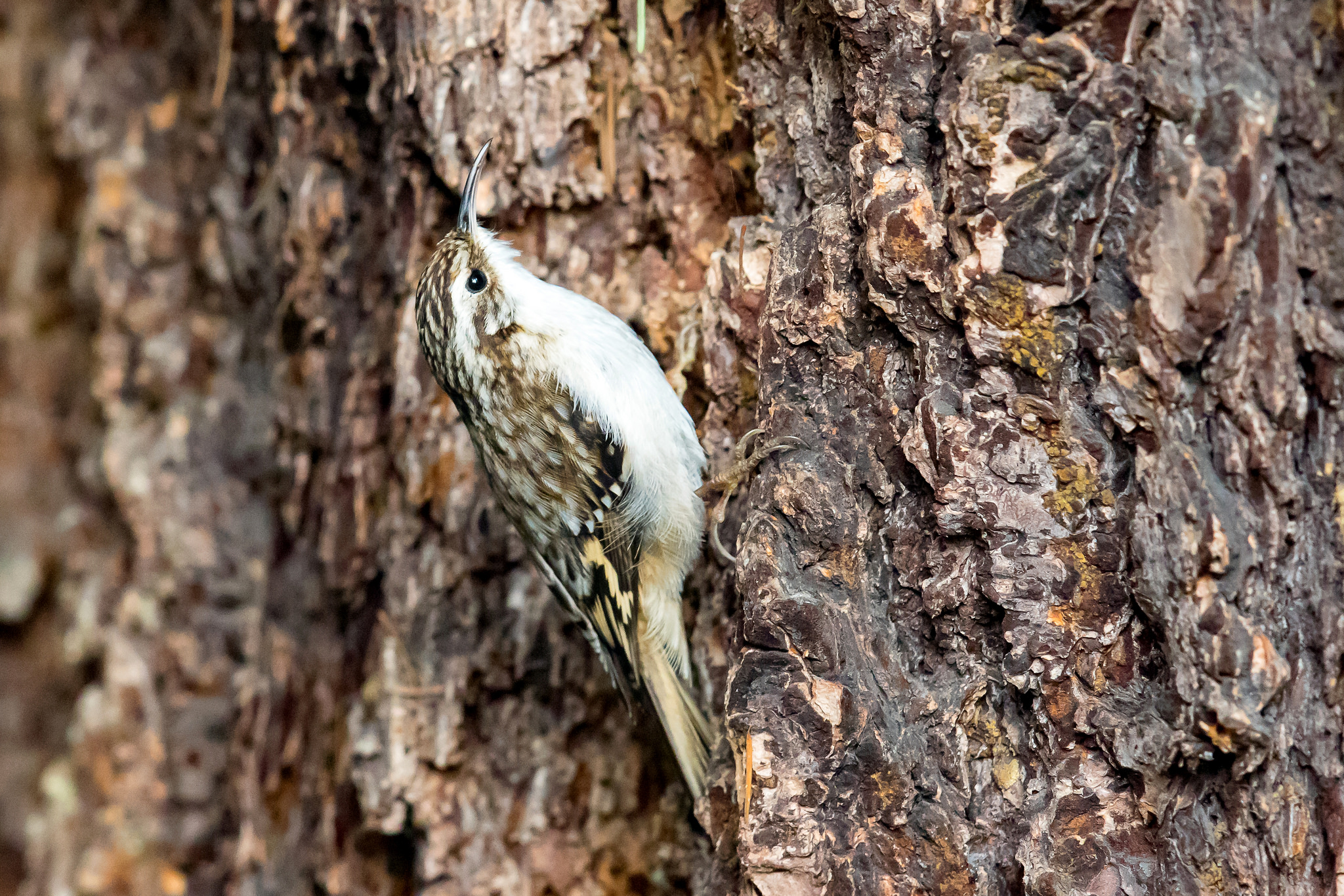
The brown creeper, more evident now than perhaps at any time in its life cycle, remains a cryptic bird even as bird density has thinned considerably due to migration south. When threatened, brown creepers stay incredibly still, and their perfectly camouflaged plumage so matches the bark of trees that a still brown creeper can easily be mistaken for a leaf or peculiarity of the bark.

Photo by Mick Thompson, FCC

Photo by Mick Thompson, FCC

The secrets of the brown creeper intensify during its breeding season. Preferring bottomland forests of silver maple and elm, it is possible to find breeding birds in southern Wisconsin, though unlikely. In Wisconsin’s second Breeding Bird Atlas, Jefferson County only recorded one breeding pair, along the forested bottomlands of the Rock River as it enters Lake Koshkonong. Other breeding records in southern Wisconsin are rare, with scant records in lowland forests and bottomlands.

Brown creeper nest building. Photo by Don Henise, FCC

Brown creeper nest building. Photo by Don Henise, FCC

Brown creepers construct nests in a unique way; they layer cocoons and spider egg cases together with twigs and strips of bark, and almost all records have the placement of the nest behind a strip of bark hanging off a tree. Because of this habit, creepers need forests with old growth characteristics, with plenty of standing dead wood to provide excellent foraging and nesting opportunities. In fact, in western US forests, brown creepers are considered an indicator species of old growth forest because they prefer a dense upper canopy and tall trees—almost 50% taller at occupied versus unoccupied sites.

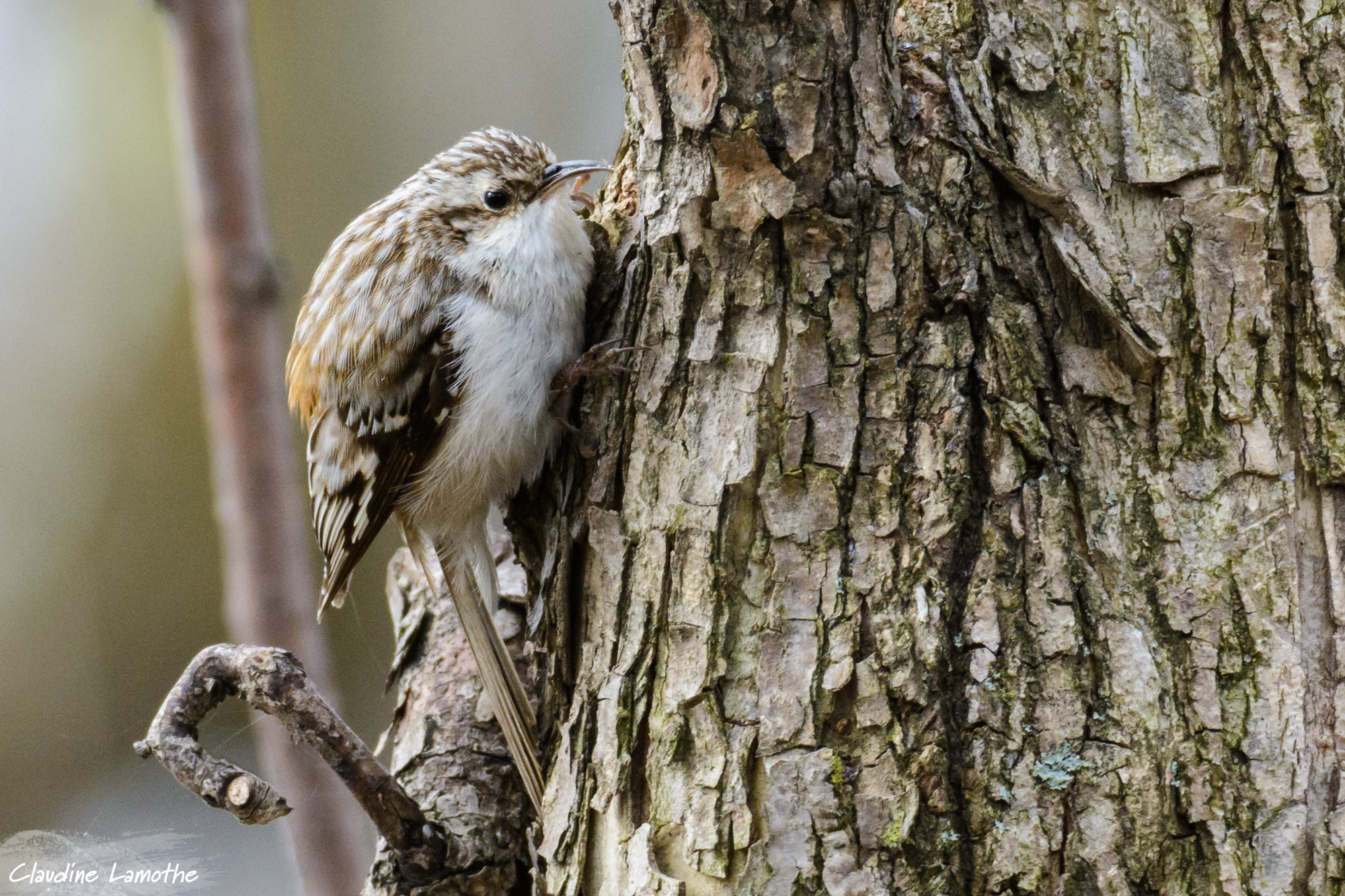
Using their long bills to pry away strands of bark is a favorite activity of creepers, and their process of foraging involves starting at the base of the tree and moving upward, then diving to the bottom of the next tree.

Some research suggests that brown creepers exhibit habitat partitioning with co-occurring birds like nuthatches. Creepers will forage lower on trees and on thicker branches while nuthatches prefer slimmer branches and higher points of the tree. However, in areas where forest has been fragmented or logged, the brown creeper has been shown to be in competition with these other species. Thus, large blocks of forest with large diameter trees are important to both overwintering and breeding grounds.

Photo by Claudine Lamothe, FCC

Photo by Claudine Lamothe, FCC

You can find brown creepers throughout Faville Grove Sanctuary, wherever there are good-sized trees. It’s rather rare that they use their high-pitched call during winter, so you’ll have to methodically scan trees in order to uncover this secretive species. Brown creepers will also frequent residential areas, again where large trees occur, so you might see them around your backyard.

Written by Drew Harry, Faville Grove Sanctuary land steward

Cover photo by Carolyn Lehrke, FCC