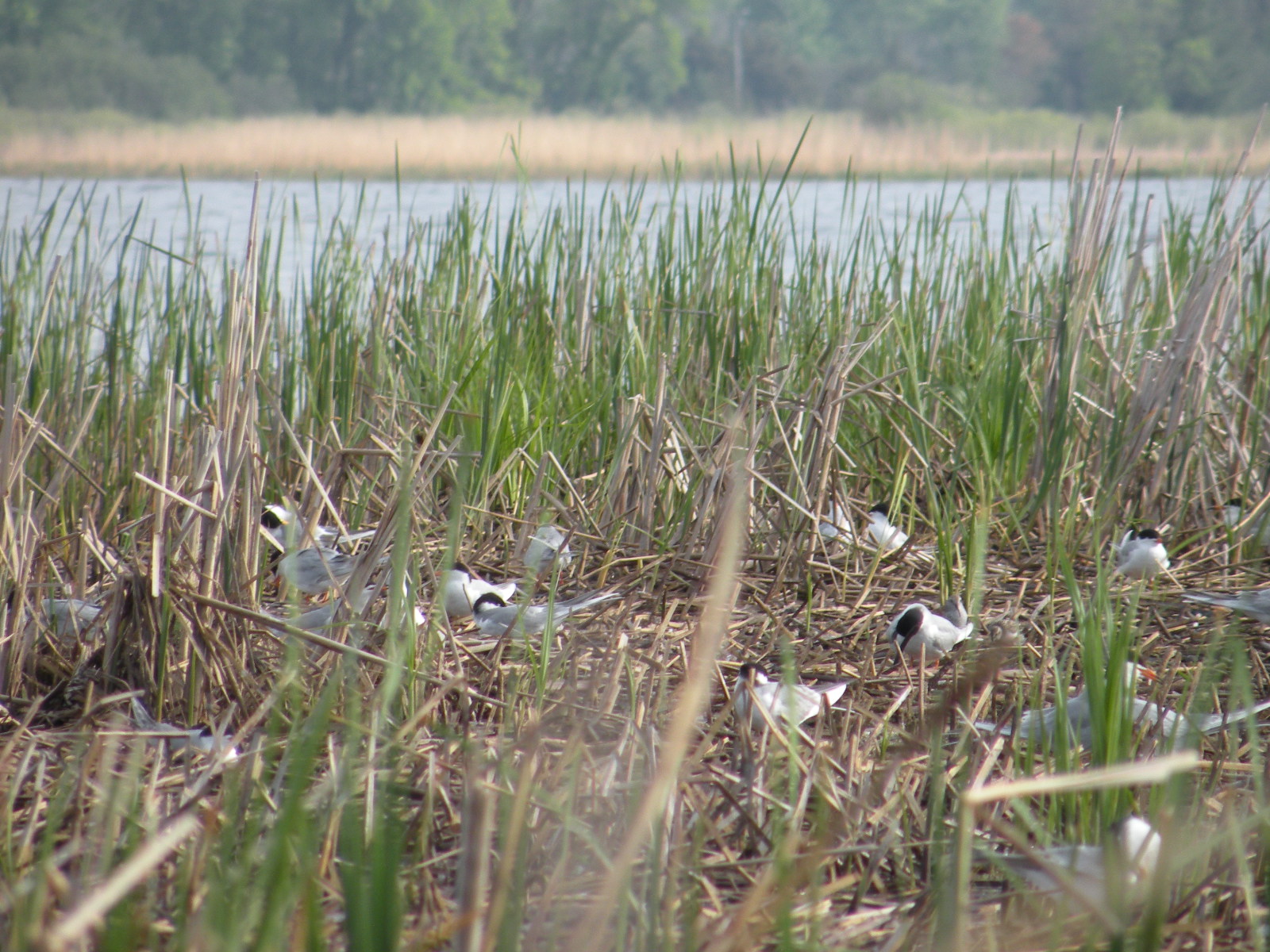
forster's tern

Foster's Tern

Print Friendly and PDF

This summer, a great blue heron spent what seemed like its every waking (and sleeping) moment on a wood duck box on the Hwy 89 pond. Every walk around the pond yielded a surprise when a tall figure against the backdrop of prairie, pothole, and aspen turned out to be the heron, again perched on the wood duck box.

There was one instance where this heron departed from its usual routine, as far as we saw it. While the interns and I were on North Shore Road, we witnessed the heron land in the pond. We observed the bird with binoculars for a minute, before it quickly stabbed a bullhead out of the water, gulped it down after a couple of tries, and then returned—where else—to the wood duck box.

In his regular perch. Photo by Drew Harry

In his regular perch. Photo by Drew Harry

I was surprised by the size of the fish in the pond. Yet years past have seen egrets, pelicans, and great blue herons raiding this resource.

I was also surprised, on July 19, when I witnessed a Forster’s tern flying over the 89 pond. This is an endangered bird in Wisconsin that nests in colonies, so my sighting was unlikely to be breeding individual of the immediate area. However, my sighting occurred right around the time when young are fledging, and after this period, parents often disperse more widely to forage for minnows in lakes, rivers, and ponds.
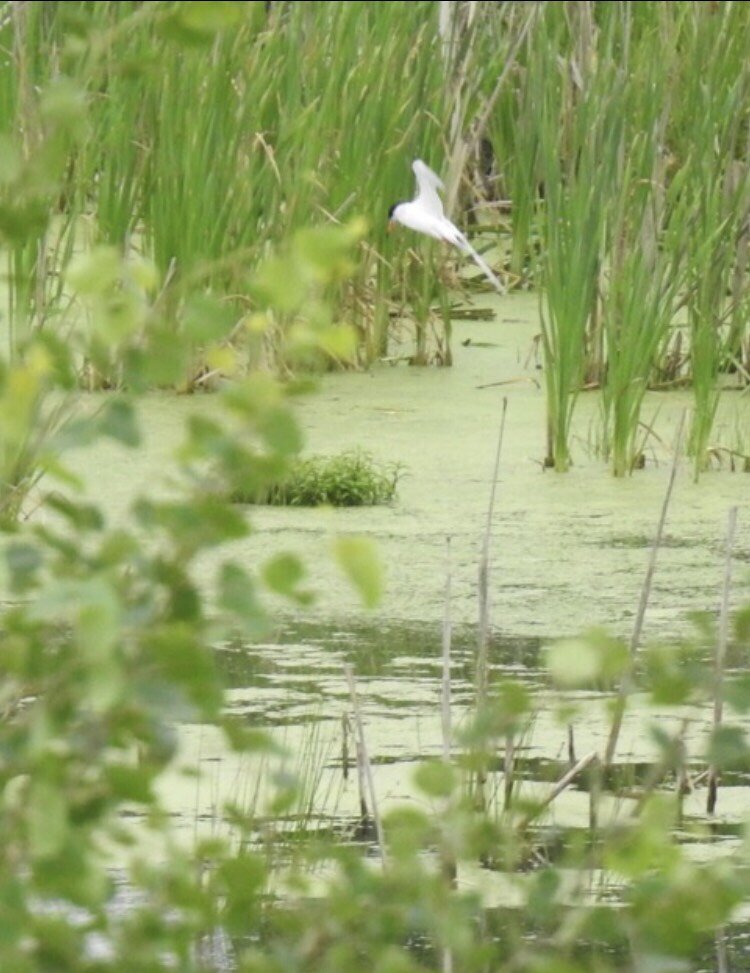
Foster’s tern at Hwy 89 pond. Photo by Drew Harry

Foster’s tern at Hwy 89 pond. Photo by Drew Harry

In the area of Faville Grove, one nearby location stands out as a potential breeding location for Forster’s terns. The Chub and Mud Lake Riverine Marsh to the north, in Dodge County, covers nearly 7,000 acres of wetland habitat and harbors the appropriate riverine marsh habitat often preferred by Forster’s terns. Portions of this area were never platted during the Public Land Survey, because they were presumed to be a lake. For Wisconsin’s second Breeding Bird Atlas, a number of probable breeding pairs were found in this area.

Faville Grove likely holds wetlands too small and isolated to host breeding Forster’s terns. These birds look for extensive wetland marshes, often nesting on well-concealed islands of vegetation to avoid mammalian predators. Raccoons, skunks, opossums, and weasels, could all decimate the eggs of a colony of Forester’s terns, so nest site selection is key for these birds.

For this reason, only a few colonies in Wisconsin traditionally produce offspring. These areas include Big Muskego Lake, the upriver lakes of the Winnebago Pool, Rush Lake, and the western shore of Green Bay.

It’s interesting to note that many wetlands in the immediate vicinity of Faville Grove contain islands of potential habitat for Forster’s terns. Due perhaps to the unique chemical makeup of these low-lying areas, most boggy lowlands are surrounded by a “moat” of open water, which typically rings the entirety of the wetland.

Wetland “moat” at Faville marsh. Narrow areas of water are likely due to erosion. Native vegetation will replace agricultural field and hold the soil in place in the far upper left of this photo, credit Rob Couey

Wetland “moat” at Faville marsh. Narrow areas of water are likely due to erosion. Native vegetation will replace agricultural field and hold the soil in place in the far upper left of this photo, credit Rob Couey

There are a number of explanations for this moat, including runoff from uplands that increases decomposition and fires running into the edge of the wetland and increasing decomposition. The result is an open island of wetland vegetation with portions dominated sedges and cattails—seemingly perfect habitat for Forster’s terns. Farm field erosion can complicate dynamics of this moat, however. Runoff and siltation from upland areas can fill in this moat, and allow predators to access the island, while also making it more likely that it dries down during summer and fall.

Overall, the Forster’s tern is a chance occurrence at Faville Grove, but we’re happy to support their post-breeding foraging efforts. These birds have migrated through southern Wisconsin at this point, and are likely somewhere in Central or South America. These birds will return in late April, looking for the perfect island of wetland vegetation.

Written by Drew Harry, Faville Grove Sanctuary land steward

Forster's Tern

Print Friendly and PDF
Female Forester’s tern. Photo by Arlene Koziol

Female Forester’s tern. Photo by Arlene Koziol

Terns are in the same family as gulls and skimmers, and 40 tern species are found worldwide. The arctic tern migrates from Antarctica and back again over a six month period. Their journey is not necessarily in a straight line, and on average the round trip migration distance covers an unbelievable 44,000 miles. All four tern species regularly found in Wisconsin, Forster’s tern, black tern, common tern, and Caspian tern are listed as state endangered. Wisconsin DNR and other groups have developed innovative ways to assist these species, and particular progress has been made with Forster’s terns.

Numerous Forster’s terns mingle in native vegetation in a wetland. Photo by Daryl Christensen

Numerous Forster’s terns mingle in native vegetation in a wetland. Photo by Daryl Christensen

The Forster’s tern is a colony nester. Bird colonies are usually found on sites that are well protected from the usual terrestrial predators. Because colony nesting birds only congregate for a small portion of the season, local predator populations do not boom as they might with a permanent high energy food source. Forster’s terns breed in large marshes with abundant emergent vegetation, and most of the breeding population in Wisconsin inhabits the east central portion of the state or lower Green Bay.

In pre-settlement days, an estimated 10 million acres of wetlands existed in Wisconsin according to Wisconsin DNR. Around 50 percent of those acres were destroyed because of conversion to agriculture, urban area, or other uses. Some colony nesters have a remarkably high site fidelity, meaning that they return to the same breeding site year after year. Forster’s terns are more nomadic than others in this sense. They require specific water levels for optimal nest success; plenty of water to maintain prey populations and deter predators, but not so much that their source of cover is below the water line. Historically Forster’s terns had many more options when choosing a colony site. Greater habitat choice led to more successful nests and higher populations.

A Forster’s tern on a nest platform, Photo taken by Daryl Christensen in 1983 or 1984

A Forster’s tern on a nest platform, Photo taken by Daryl Christensen in 1983 or 1984

Because of low nest success and declining populations, the Wisconsin DNR began deploying nesting platforms for Forster’s terns in 1983. Nest platforms provide high quality nesting sites when natural substrates are of low quality or in short supply. After eggs are laid, rising water can easily submerge nests. Fluctuation in marsh water levels is likely exacerbated by hard surfaces and row crop cultivation due to their low water infiltration potential. Nesting platforms float on the water surface. They are attached loosely to a pole which allows them to rise and fall in response to changing water levels.

Nesting platforms significantly increase nest success, and 100 percent of deployed platforms were utilized by terns in 2018. This year at Lake Puckaway, 200 breeding pairs produced 259 eggs without the assistance of platforms. At Grand River Marsh, 19 breeding pairs that were occupying tern platforms produced 58 eggs. This means that breeding pairs of Forster’s terns were able to produce over two times the eggs using platforms than on natural substrate. Lake Puckaway flooded after this nest survey was completed, and all eggs were lost. Forster’s terns do renest, but their egg production decreases after each nesting attempt.

The Wisconsin DNR plans to increase the number of tern platforms to 150. Ryan Zabs, a Sun Prairie Eagle Scout, reached out to Goose Pond Sanctuary in search of his final Eagle Scout project. He helped us take a huge step towards those 150 by building 50 platforms in a single weekend. Sumner Matteson with Natural Heritage Conservation Bureau at WIDNR generously provided funding for the platform materials.

Forster’s tern nest platform, photo by Daryl Christensen

Forster’s tern nest platform, photo by Daryl Christensen

While the success of tern platforms certainly is exciting, it must be noted that this is not a permanent solution. Continued restoration of large wetlands and further protection of coastal wintering grounds is the best hope to keep Forster’s terns on the Wisconsin landscape now and far into the future.

Written by Graham Steinhauer, Goose Pond Sanctuary land steward