
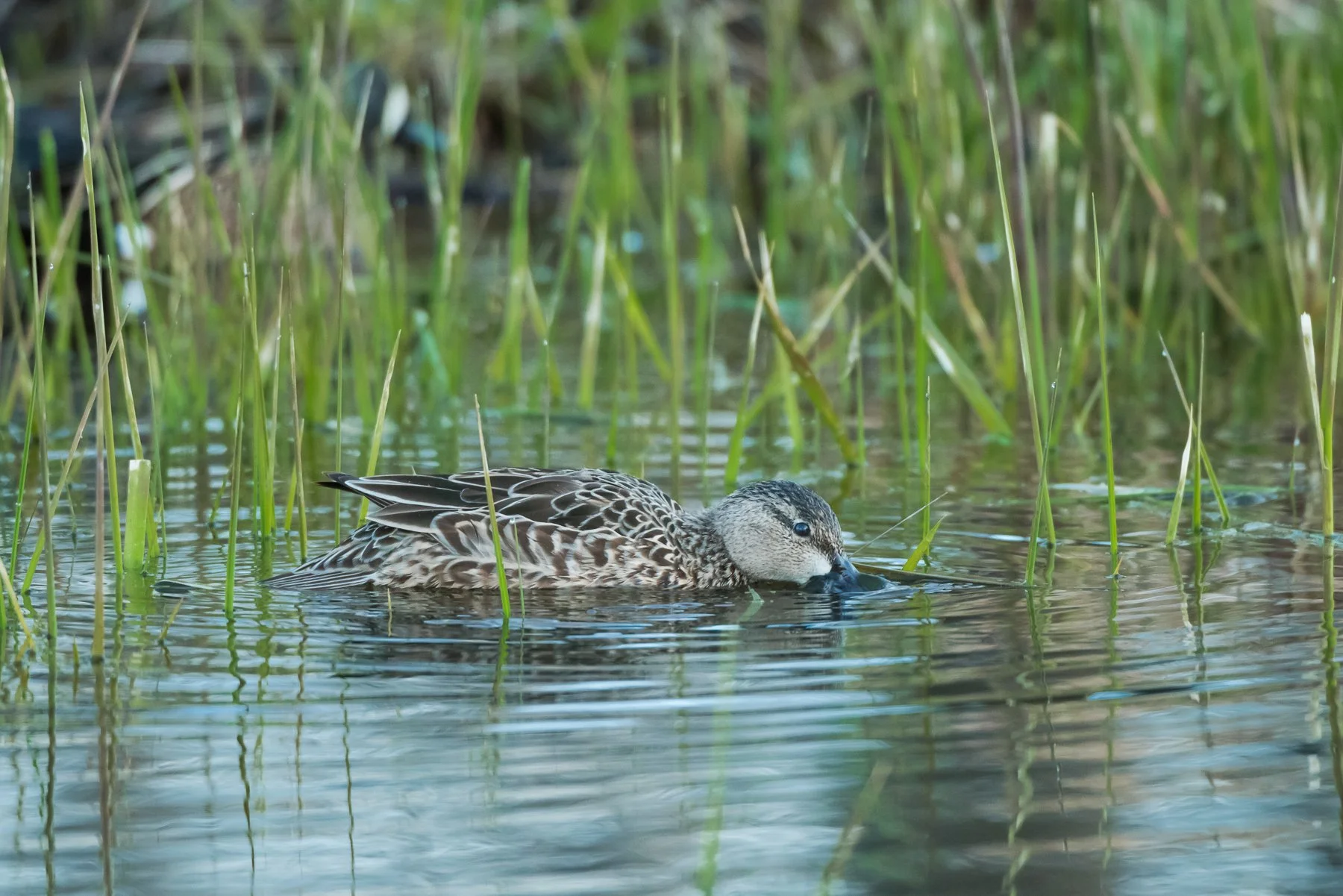

Nestled into wooded hills at Fair Meadows is a five-acre kettle pond. On a sunny day in late October, as I crested a nearby ridge, the entire expanse of the water’s surface was flashing. The pond is too shallow for fish large enough to make this much of a disturbance. My binoculars brought into view at least fifty ducks with flashes of blue on their wings—a flock of Blue-winged Teal. I saw that the birds were feeding on plants on the water’s surface. They were swimming about very close to each other and were sporadically flapping their wings or making short flights across the pond.
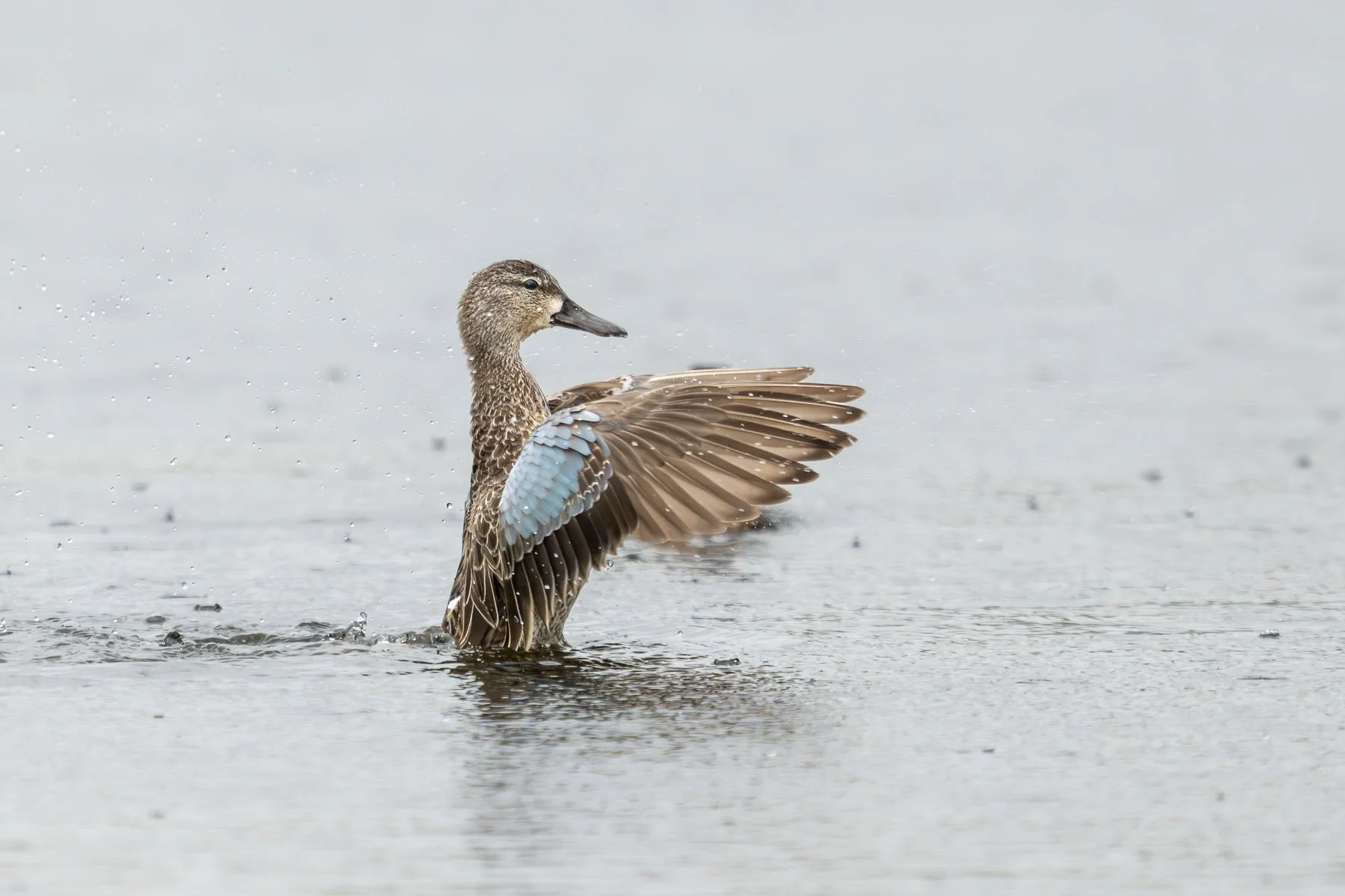
Female Blue-winged Teal, with a mottled brown body and white patch at the base of the bill, flaps her wings. This is one of the activities that caused the flashes of light in the pond. (Photo: Gary Shackelford)
Our land steward, Chris Kaplan, had been working near this pond all fall. He reported that he had also observed this activity during the week before and at least one week after my observation on October 23. In addition, he remarked on the unusual sounds made by the flock. There were rapid, soft sounds, and a lot of calls which sounded like whistling.
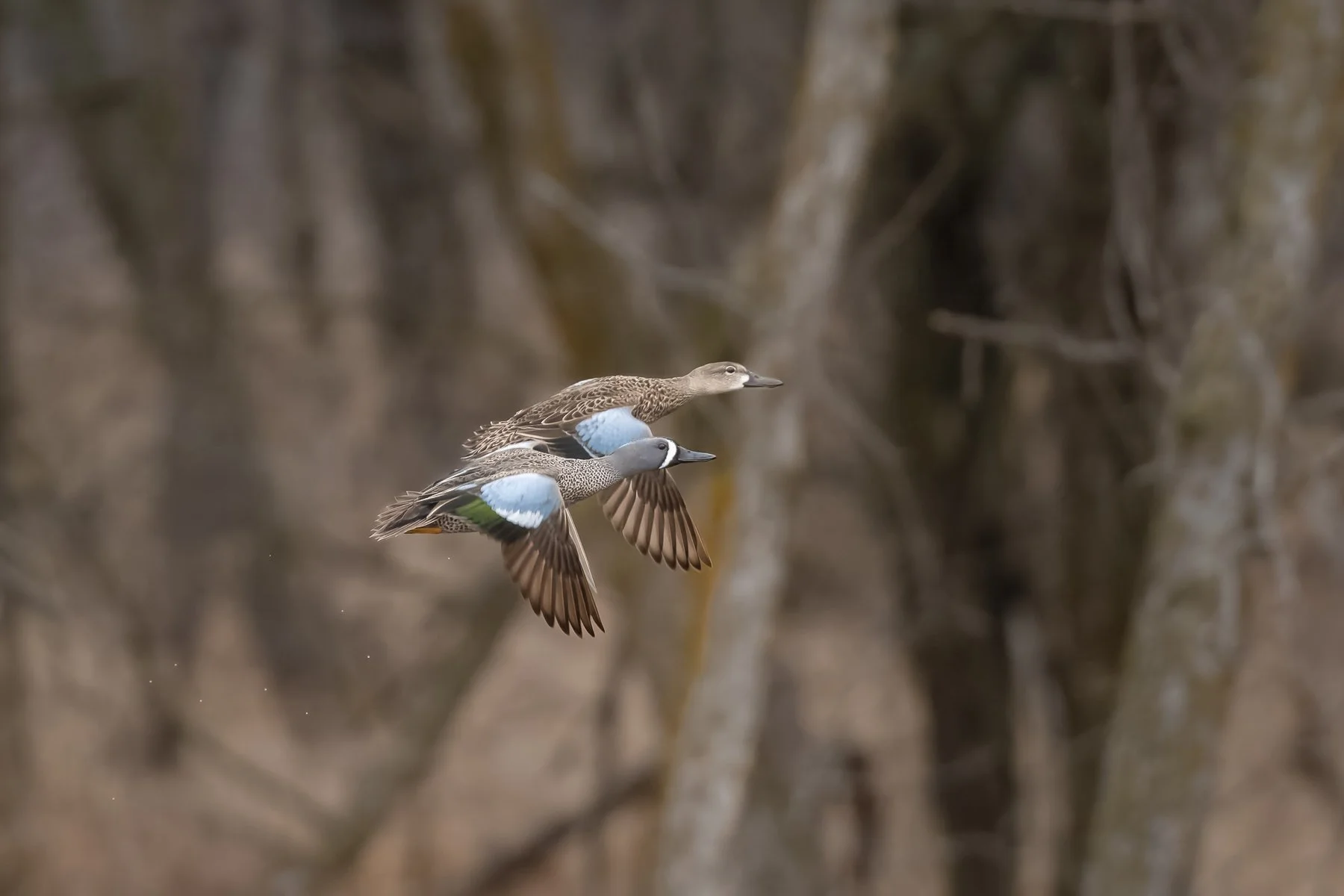
A pair of Blue-winged Teal (photo: Gary Shackelford).
Blue-winged Teal are among the first ducks to move south in the fall, usually beginning in late August, through September, and into early October. Perhaps it was the long period of warm fall weather this year that held up their southern journey until the first few frosts. They also are the last to move north in the spring, giving them the reputation of being delicate, warm-weather birds, as described by Arthur Cleveland Bent. Of course, it may have something to do with the length of their fall and spring migrations—their destinations are in the southern United States, Central America, the Caribbean, and northern South America.
Blue-winged Teal migrate south in small flocks, usually composed of fewer than 40 individuals, and typically rest in shallow, wooded wetlands, floodplain ponds, or along streams. One of our neighbors, who has a view of the large field south of these woods, told us that he has seen flocks of teal fly over the field in the fall and then suddenly disappear. He had been mystified by this behavior because he had no idea that there was a pond in the woods. The flapping behavior I observed is thought to be an agonistic display that is modified to be much less aggressive outside the breeding season. The calls of the male Blue-winged Teal are described as whistling or soft nasal bleating. Females may give short quacking calls. During fall migration, Blue-winged Teal are largely vegetarians, eating seeds and wild rice. The kettle pond at Fair Meadows provides an abundance of this menu.
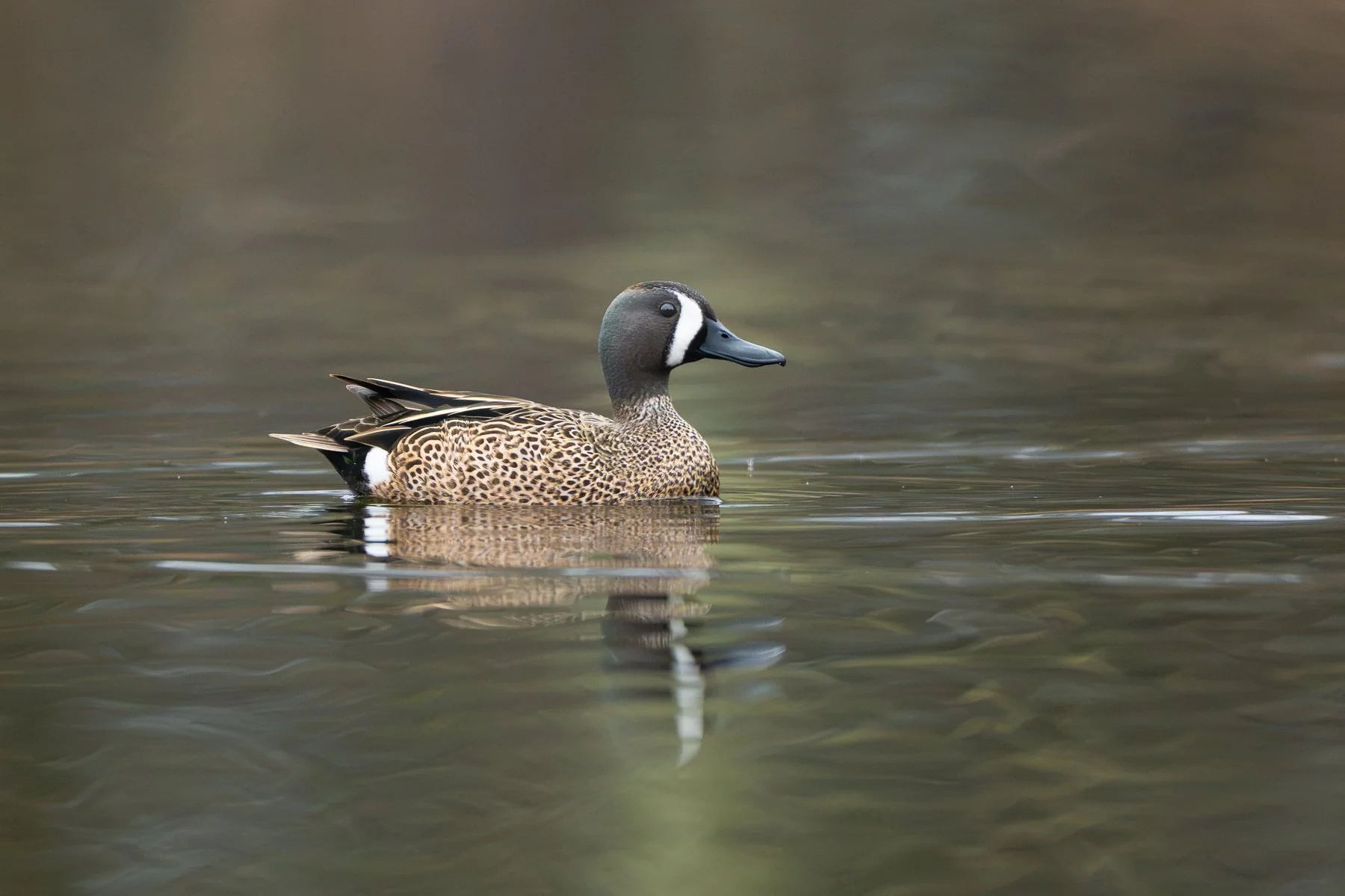
The male Blue-winged Teal has a large white crescent in front of the eye and a buffy body with prominent spots. Note the broad, spatulate shape of the bill. Blue-winged Teal are in the genus Spatula along with the Cinnamon Teal and the Northern Shoveler. (Photo: Gary Shackelford)
In 1840, with an artist’s eye, Audubon wrote,
“When advancing against a stiff breeze, they [Blue-winged Teal] alternately show their upper and lower surfaces, and you are struck by the vivid steel blue of their mantle, which resembles the dancing light of a piece of glass suddenly reflected on a distant object.”
That was exactly my impression as I first glimpsed the pond on that October day. When I checked the pond again on November 6, I saw only three or four Green-winged Teal resting along the shore; the Blue-winged Teal were gone.
Written by Penny Shackelford, Fair Meadows sanctuary manager
Cover photo by Gary Shackelford. A female Blue-winged Teal feeding. She is dabbling without submerging her head, a common type of feeding for this species. They may submerge their heads but tip to feed only infrequently and almost never dive.
