Goose Pond's Butterfly Count

Print Friendly and PDF
A beautiful day for a butterfly count! MAS Photo

A beautiful day for a butterfly count! MAS Photo

Monday, July 2 was a sunny day, with light winds, and warm weather: perfect for meandering through Goose Pond Sanctuary's beautiful prairies and count butterflies. Butterflies are important members of the food web (they eat and are eaten) and play a significant role in pollination. Thanks to their spread of pollen from one plant to another (which ideally results in a plant successfully producing seed and a new plant), we have diverse landscapes, and a variety of foods, medicines, and materials. Some butterfly species, such as the monarch, are experiencing huge declines and this annual butterfly count helps a network of scientists to understand population changes and help make better conservation decisions. These counts are done all over the country, in roughly the same time frame to get a large-scale perspective.

Graham Steinhauer, Goose Pond Sanctuary land steward, takes a shift keeping data for the butterflies his group counts. Photo by Arlene Koziol

Graham Steinhauer, Goose Pond Sanctuary land steward, takes a shift keeping data for the butterflies his group counts. Photo by Arlene Koziol

Goose Pond staff and volunteers participated for the fifth year in the Mud Lake North American Butterfly Count. At Goose Pond, eleven counters divided into three parties while count coordinators Karl and Dorothy Legler surveyed with four others in wooded habitat at the nearby Rocky Run State Natural Area, Mud Lake Wildlife Area, and Schoeneberg Marsh Waterfowl Production Area.

Counters choose a route to walk, and one data-keeper tracks all of the individuals and species found throughout the walk. Each group had butterfly nets, binoculars (if you turn the binoculars around it works as a great magnifying glass!), identification guides, and tally sheets. Ready, set, go, and each group walks at a comfortable pace through the prairie, calling out "Clouded Sulphur!" or "What's that one coming at you, Graham?" Within 10 minutes, you get very good at picking out the common ones, even from a few yards away. However, once in a while a counter will net a butterfly and all of the volunteers will gather round to debate whether it's a Northern or Pearl Crescent ("that patch of orange is very open, but is it open enough to be a Pearl?"). It's a wonderful way to spend a few hours with like-minded nature-lovers.

Our count's highlights were counting a record 970 butterflies and a record of 476 monarchs. In the past we averaged 545 individuals. We were disappointed to record a low of 14 species compared to an average of 17 species. In the past four years we found 24 species of butterflies on the counts. However, this year we found the only orange sulphur and five northern crescents for the Mud Lake Count, which as a whole ended up with 38 species. Both counts found high numbers of clouded sulphurs and ended with a count total of 598. Check the two tabs in the attached spreadsheet for count data

The first three years we conducted the count on July 1 or 2 and counted 23 to 68 monarchs.  Last year we conducted the count on July 28 and found 344 monarchs. We always find more monarchs in late July compared to early July. The other two parties found 77 monarchs, and their past high monarch count in the past 29 years was 40 in 1991.

It was 3:30 p.m. when we finished the count on the Manthe Prairie after finding 28 monarchs on 30 acres of restored prairie. Manthe Prairie contains a low number of common milkweeds, and in hopes of finding more monarchs by the end of the day, we decided to do one survey on nearby Erstad Prairie. Erstad Prairie has a 16 acre brome grass field with about 21,000 common milkweed stems per acre (yep, that's right: over 300,000 milkweed stems), adjacent to a seven acre restoration that was burned in spring and was full of blooming flowers!

Mark Martin and Mark McGinley spent 45 minutes at Erstad Prairie and at first were not impressed since few monarchs were seen in the air. However, it did not take long to learn that the monarchs were resting in the vegetation. They found an impressive 10 mating pairs and ended with 201 monarchs! What a difference to have a high density of milkweeds.
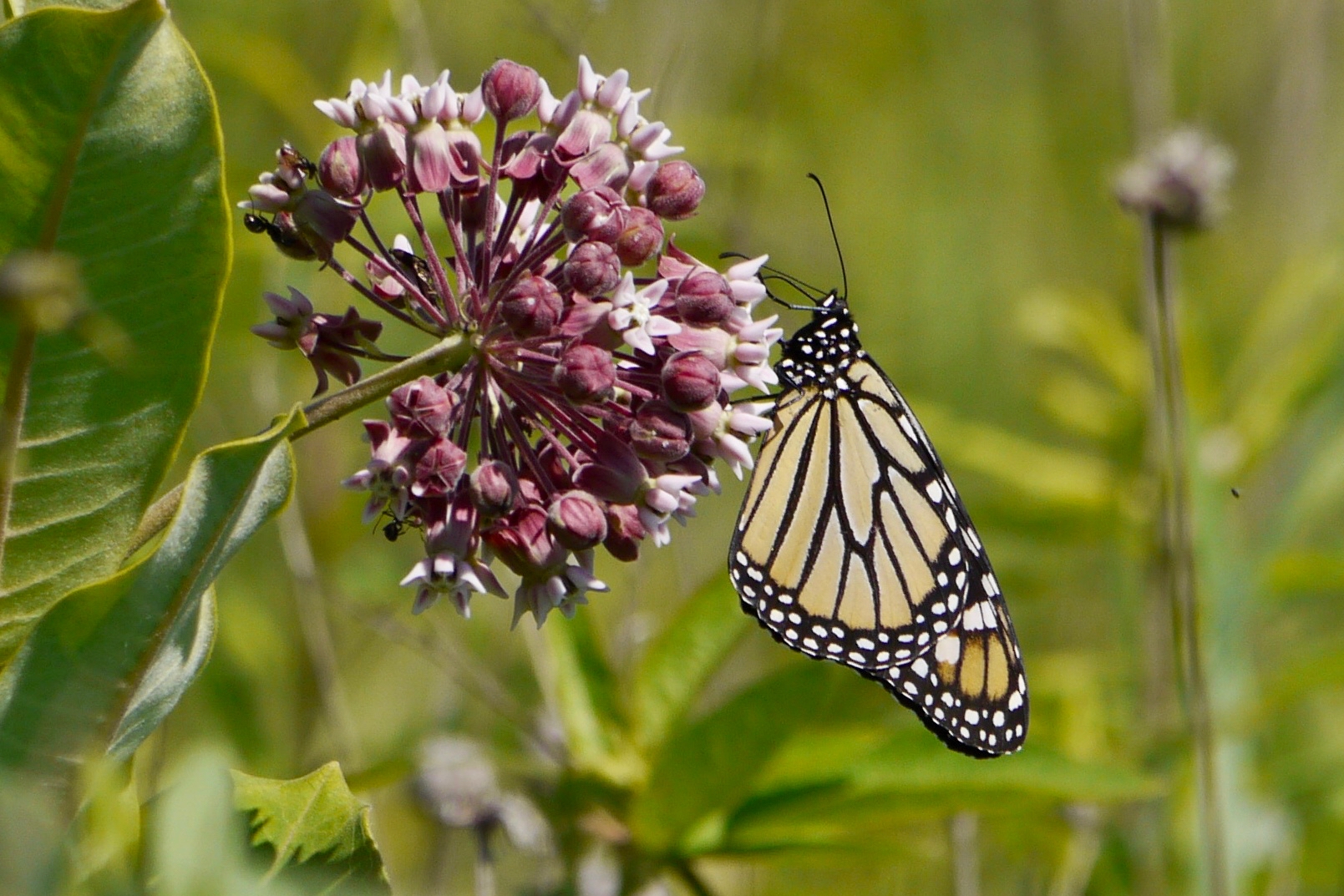
A monarch sips nectar from a common milkweed plant during the Goose Pond Butterfly Count this summer. Photo by Gail Smith

A monarch sips nectar from a common milkweed plant during the Goose Pond Butterfly Count this summer. Photo by Gail Smith

Each fall, Madison Audubon hosts monarch tagging events at Goose Pond to improve scientists' understanding of monarch migration and population trends. Monarchs are caught in nets, and teeny-tiny stickers are placed on one wing (in the perfect spot so as to not throw off their balance and flying capabilities). Monarchs with tags continue on their migration south, and are recorded in Mexico where the vast majority overwinter. It's fun, family-friendly, and unforgettable. Accessible, mown trails pass through some of the best nectaring habitat on the sanctuary, so people of all ages and abilities are welcome.

The monarchs we found during the count will mate and lay eggs; those eggs will hatch, and the caterpillars will metamorph into adults that will lay more eggs. The adults that come from that generation are the ones we hope to tag this September. We have our fingers crossed that we will have a large monarch population in migration. If you would like to come out and net and tag monarchs in September you can sign up through the Madison Audubon website (keep an eye on madisonaudubon.org/events for registration to open in August).

The butterfly counting crew. Photo by Arlene Koziol

The butterfly counting crew. Photo by Arlene Koziol

If you would be interested in helping count butterflies next July contact us at goosep@madisonaudubon.org.

Written by Mark Martin, Susan Foote-Martin (Goose Pond Sanctuary resident managers), and Brenna Marsicek (director of communications)

Eastern Prairie White Fringed Orchid

Print Friendly and PDF
Photo by Joshua Mayer

Photo by Joshua Mayer

For this Friday "Fringed" Feature, we spotlight one of our native botanical wonders. Aldo Leopold fought to save the Eastern Prairie White Fringed Orchid at our Faville Grove Sanctuary, and on Monday, July 9 in the Crawfish River prairie remnants, we will the survey orchid he eulogized below in his essay, "Exit Orchis". This beautiful wild orchid is a Wisconsin Endangered and Federal Threatened plant, one we're proud to carefully and intentional conserve on our land.

EXIT ORCHIS
By Aldo Leopold
Courtesy of the University of Wisconsin Digital Archives

Wisconsin conservation will suffer a defeat when, at the end of this week, 75 cattle will be turned to pasture on the Faville Grove Prairie, long known to botanists as one of the largest and best remnants of unplowed, ungrazed prairie sod left in the State. In it grows the white ladyslipper, the white fringed orchis, and some twenty other prairie wildflowers which origianlly carpeted half of the southern part of the State, but most of which are now rare due to their inability to withstand cow or plow.

Thirty miles away a C.C.C. camp on the University of Wisconsin Arboretum has been busy for four years artifically replanting a prairie in order that botany classes and the public generally may know what a prairie looked like, and what the word "prairie" signifies in Wisconsin history. This synthetic prairie is costing the taxpayer twenty times as much as what it would have cost to buy the natural remnant at Faville Grove, it will be only a quarter as large, the ultimate survival of its transplanted wildflowers and grasses is uncertain, and it will always be synthetic. Yet no one has heard the appeals of the University Arboretum Committee for funds to buy the Faville Grove Prairie, together with other remnants of rare native flora, and set them aside as historical and educational reservations.

Our educational system is such that white fringed orchis means as little to the modern citizen of Wisconsin as it means to a cow. Indeed it means less, for the cow at least sees something to eat, whereas the citizen sees only three meaningless words. In preparation for the hoped-for floral reservation at Faville Grove, the Botany Department and the Department of Wildlife Management of the University have, during the last three years, mapped the location of each surviving colony of rare flowers, and each spring have counted the blooms. It was hoped to measure against these data the response of the flowers to complete future protection. The data will now serve to measure the rate at which destruction by grazing takes place. It is already known that with the possible exception of ladies tresses, all the rarer species succumb to pasturing. That is why they are rare. Few of them succumb to mowing, hence the past use of the Faville Grove Prairie as haymeadow has not greatly injured its flora.

In my opinion no individual blame attaches to the owner of the Faville Grove Prairie for converting it to pasture. The public taxes him on the land. It is not his obligation to provide the public with free botanical reservations, especially when all public institutions, from the public school to the federal land bank, urge him to squeeze every possible penny out of every possible acre. No public institution ever told him, or any other farmer, that natural resources not convertible into cash have any value to it or to him. The white-fringed orchis is as irrelevant to the cultural and economic system into which he was born as the Taj Mahal or the Mona Lisa.

Photo by Joshua Mayer

Photo by Joshua Mayer

John Muir, who grew up amid the prairie flowers in Columbia County, foresaw their impending disappearance from the Wisconsin landscape. In about 1865 he offered to buy from his brother a small part of the meadow of the family homestead, to be fenced and set aside as a floral sanctuary or reservation. His offer was refused. I imagine that his brother feared not so much the loss of a few square rods of pasture as he feared the ridicule of his neighbors.

By 1965, when the rarer prairie flowers are gone, the cultural descendants of John Muir's brother may look at a picture of the legendary white fringed orchis and wish they could see one.

Note: Aldo Leopold was the founder of the science of Wildlife Management and professor of this subject at the University of Wisconsin in Madison. He is now well known as the author of the fundamental text in this field, as well as the lyrical essays collected in "Sand County Almanac." The above appeal, written May 15, 1940, so simple, yet magnificent in its eloquence and emotional in its urgency, was successful in stimulating purchase of a 40-acre piece of Wisconsin prairie. Spared damage from "cow or plow",this small piece of the Faville Prairie has become one of Wisconsin's finest scientific areas. Today, administered through the University of Wisconsin Arboretum, it is useful in research, indispensable in teaching, and unsurpassed for its beauty and biological interest. Leopold was one of the early inspirers and guiding lights of the Arboretum whose own difficult beginnings are documented by Nancy Sachse, 1966 "A thousand Ages."

Black-necked Stilt

Print Friendly and PDF

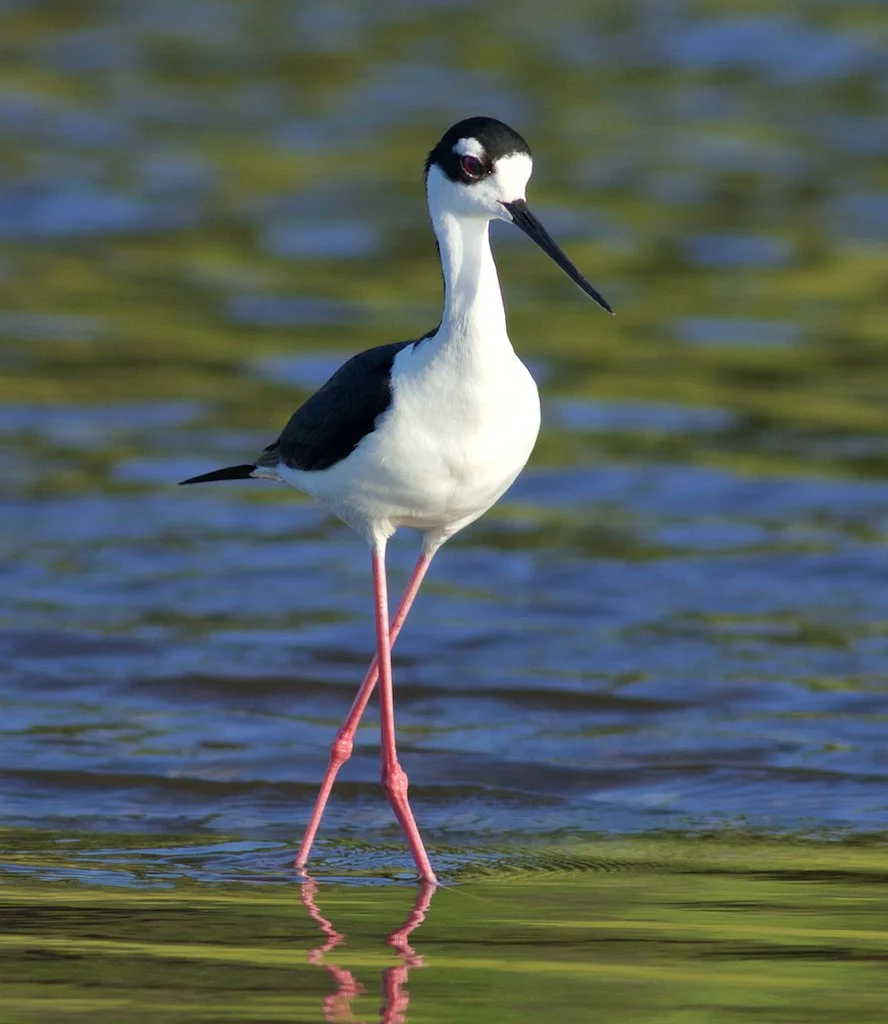
We were very excited in May when it appeared that a pair of black-necked stilts might nest at Goose Pond... and were very disappointed when they left us.

Black-necked stilts with their black neck and long, skinny legs are is easy to identify by looking at field marks of shorebird photos in bird identification books.

Black-necked stilt ready for its glamour shot. Photo by Arlene Koziol

Black-necked stilt ready for its glamour shot. Photo by Arlene Koziol

Sam Robbins in 1991 wrote in Wisconsin Birdlife that their status was accidental with only four records. The first record was in 1847 when a flock was seen at Racine and one was collected. The second record account in 1951 was of an individual at Horicon Marsh. This bird was also collected for a museum collection. The next record in 1986 was also from Horicon Marsh, and in 1987 a stilt was sighted at Schoeneberg Marsh/Erstad Prairie. Luckily for the stilts, by the 1980s photographs were used instead of shotguns to verify rare sightings. 

Black-necked stilts are a southern species that is usually found from the gulf coast to the southwest states. On their wintering areas, stilts are frequently found with avocets, another large and colorful shorebird. Researchers reported a stable to increasing stilt population between 1966 and 2014.  In the past 25 years, stilts have expanded their breeding range north.

Black-necked stilt parent and chicks. Photo by Richard Armstrong

Black-necked stilt parent and chicks. Photo by Richard Armstrong

In 1999, Jack Bartholmai, an expert observer and photographer, recorded the first black-necked stilt nesting at Horicon Marsh. Their population has slowly expanded at Horicon Marsh and this spring 30 individuals could be found. In 2004 a pair nested at a wetland restoration in Jefferson County, and last year a pair raised young at the Mud Lake State Wildlife Area near Reeseville in Dodge County.

Black-necked stilts copulating. Photo by Richard Armstrong

Black-necked stilts copulating. Photo by Richard Armstrong

Jim Shurts and Mark found our pair of stilts on May 13 on the east pond (the wetland attached to Goose Pond, but privately owned on the east side of Goose Pond Road) while our team conducted our Great Wisconsin Birdathon. For the next 10 days, we frequently saw stilts, and most sightings were from the flooded food plot north of the west pond and south of Kampen Road. Richard Armstrong photographed them copulating on May 17 and Mark saw them copulating two days later. Mark also saw a stilt aggressively chasing a late-migrating yellowlegs from the area where they spent a lot of time, and where we thought they would nest.  Stilts nest near water and we were considering fencing off the nesting area to protect they nest from ground predators. 

Graham Steinhauer, our Goose Pond Sanctuary land steward, saw the stilts for the last time on May 23. Sam Robbins would have never guessed in 1990 that stilts would nest in Wisconsin. Next year we hope they return -- and nest this time -- and then they can then be recorded as a “confirmed nesting” instead of “probable nesting” in the Goose Pond block of the Breeding Bird Atlas II.

Written by Mark Martin and Sue Foote-Martin, Goose Pond Sanctuary resident managers

Cover photo by Arlene Koziol

Henslow's Sparrow

Print Friendly and PDF
Photo by Arlene Koziol

Photo by Arlene Koziol

The Henslow's sparrow is a small songbird with a dull brown body and a streaked breast. This bird is restricted to open habitats, typically grasslands, of the midwest and northeast. Over winter, these sparrows spend their time in longleaf pine and bog habitats of the southern US. The pairing of globally rare breeding and wintering habitat makes the bird rare across its range. Endangered in seven states and threatened in Wisconsin, the Henslow's sparrow would seem a banner bird for grassland conservation.

Yet, the Henslow's sparrow lacks the iconic status of the dickcissel or meadowlark. The sparrow's understated plumage and faint call—a simple tsillik—undercut its zealous heaves. David Sibley describes the call as a “feeble hiccup.” Additionally, the bird is notoriously difficult to spot. Hiding in a dense accumulation of litter a Henslow's sparrow will whistle its call, unseen. If approached, the bird often flees on foot, its brown feathers matching the dullness of a few year's foliage.

The nest resides on or near the ground, where the female incubates eggs for approximately 11 days. Chicks will occupy the nest for about 9 days, being fed a diet of grasshoppers and caterpillars.

As far as managing for Henslow's habitat, the birds present an interesting dilemma. On one hand, Henslow's sparrows need two to three years of litter accumulation in order to breed in an area. Conversely, the birds tolerate a low amount of brush and need dense stands of grass for suitable habitat.

Burning will maintain the open habitat and stimulate grasses, but the sparrows dislike nesting in recently burned areas.

Photo by Carloyn Byers. Read more about Henslow's sparrow nesting in our Into the Nest series.

Photo by Carloyn Byers. Read more about Henslow's sparrow nesting in our Into the Nest series.

Henslow's sparrow nest, drawing by Carolyn Byers. Read more about Henslow's sparrow nesting in our Into the Nest series.

Henslow's sparrow nest, drawing by Carolyn Byers. Read more about Henslow's sparrow nesting in our Into the Nest series.

A patchwork of burning, like we have here at Faville Grove, can encourage Henslow's sparrows to nest in an area.  Areas with multiple years of standing dead vegetation provide cover and nesting areas for these discrete birds. Recently burned prairie provides good foraging habitat, and the dense cover of new growth can hide fledgling chicks.

This past week, the interns and I stumbled upon multiple Henslow's sparrows in the sanctuary. We first heard the calls of dozens of other birds, eventually focusing in on the Henslow's repetitive calls. Standing in a field of smooth brome, the calls seemed bromidic, or trite. As we sat there for five minutes, the bird finally emerged onto a cup plant and hoisted its unenthusiastic call our way. The bird may not be a banner for conservation, but it belts out its calls oblivious to human concerns, embedded in a mosaic of grassland habitat.

Written by Drew Harry, Faville Grove Sanctuary land steward

Eared Grebes

Print Friendly and PDF

In 1968 Madison Audubon was celebrating the acquisition of the first purchase at Goose Pond Sanctuary. Also in 1968 Sam Robbins celebrated his rare finding on July 6 when he found two newborn young eared grebes riding on the back of an adult in St. Croix County. This is the only eared grebe nesting record for the state.

Eared grebes are small grebes with a peaked head and a thin bill. They are stunning in breeding plumage with their chestnut sides, black head and neck with golden feathers fanning out behind the red eyes.

Photo by John Kendall (Flickr CC)

Photo by John Kendall (Flickr CC)

Eared grebes are the most numerous grebe in the world and three subspecies of eared grebes Podiceps nigricollis are found in Africa, Europe, and Asia, as well at North America. Podiceps means "vent" or "anus" and pes translates to"foot"; this is in reference to the attachment point of the bird's legs—at the extreme back end of its body. The species names nigricollis is Latin for "black-necked": niger means "black" and collis means "neck". In Europe they are called black-necked grebes.

Sam Robbins in 1991 wrote in Wisconsin Birdlife that eared grebes are an uncommon migrant and casual summer resident. There were only four observations in Wisconsin from the late 1800’s up to 1940. After that there were almost 100 records from 1940 to 1985. Sam wrote “This species favors such shallow prairie ponds as …. Goose Pond. On two occasions individuals summered at Goose Pond” (1956 and 1965).  

Eared grebe pair at Goose Pond. Photo by Richard Armstrong

Eared grebe pair at Goose Pond. Photo by Richard Armstrong

The first Wisconsin breeding bird atlas from 1995 – 2000 only found two pairs of grebes and none were confirmed nesting. Minnesota completed their breeding bird atlas in 2013 and confirmed eared grebes nesting only in five blocks. This is a very rare species in Wisconsin; however, researchers estimate the North American eared grebe population is stable at 3.5 – 4.1 million. Most grebes nest in the Great Plains, including in Canada. Years ago we were on an MAS field trip to North Dakota and toured a large prairie wetland and observed several thousand nesting eared grebes. 

Tom Wood, from Menominee Falls wrote on the June 4 WisBirdNet email listserv “there have been 3 Eared Grebes at Goose Pond in Columbia County for at least a few days. This morning I sat on the bench overlooking the west pond. This bench is across the road from the informational kiosk. They were on the far side of the pond so a scope was needed. Two are in breeding plumage and the other partially in breeding plumage (black head with golden plumes, but foreneck rather brownish)."

“Grebe Team” of Sumner Matteson and Daryl Christensen. Photo by Mark Martin

“Grebe Team” of Sumner Matteson and Daryl Christensen. Photo by Mark Martin

The DNR “Grebe Team” of Sumner Matteson and Daryl Christensen surveyed Goose Pond on June 12 and found the pair constructing a second platform in the open water area. They also found a male red-necked grebe (state-endangered) and eight pied-billed grebe nests. This spring there was a horned grebe on the pond. Goose Pond and Rush Lake are the only wetland in Wisconsin where four species have been found in a given year.

Grebes build nesting platforms and we were excited to see the grebes carrying arrowhead stems and constructing a platform. Carrying nesting material is a “confirmation” for most birds except for wrens. We also learned from Nick Anich, DNR Atlas Coordinator, that eared grebes build copulatory platforms. They may build a number of platforms and we have seen them constructing three platforms.

Eared grebe building nesting platform at Madison Audubon Society's Goose Pond Sanctuary in June 7, 2018; video by Patrick Ready

Photo by skinnybrager (Flickr CC)

Photo by skinnybrager (Flickr CC)

We and many others are watching for the pair to begin nesting. Hopefully in July there will be some cute little grebes riding around on their parents backs. The young can climb, swim, and feed an hour after hatching. If you want to see the grebes, a spotting scope is very helpful and you should visit sooner than later since the arrowheads are rapidly growing and the pond will be green instead of blue in a few more days.

We are holding a 50th anniversary celebration on Saturday August 18th and we hope you can join us and hopefully we can also celebrate the second nesting pair of eared grebes in Wisconsin. 

Written by Mark Martin and Susan Foote-Martin, Goose Pond Sanctuary resident managers