
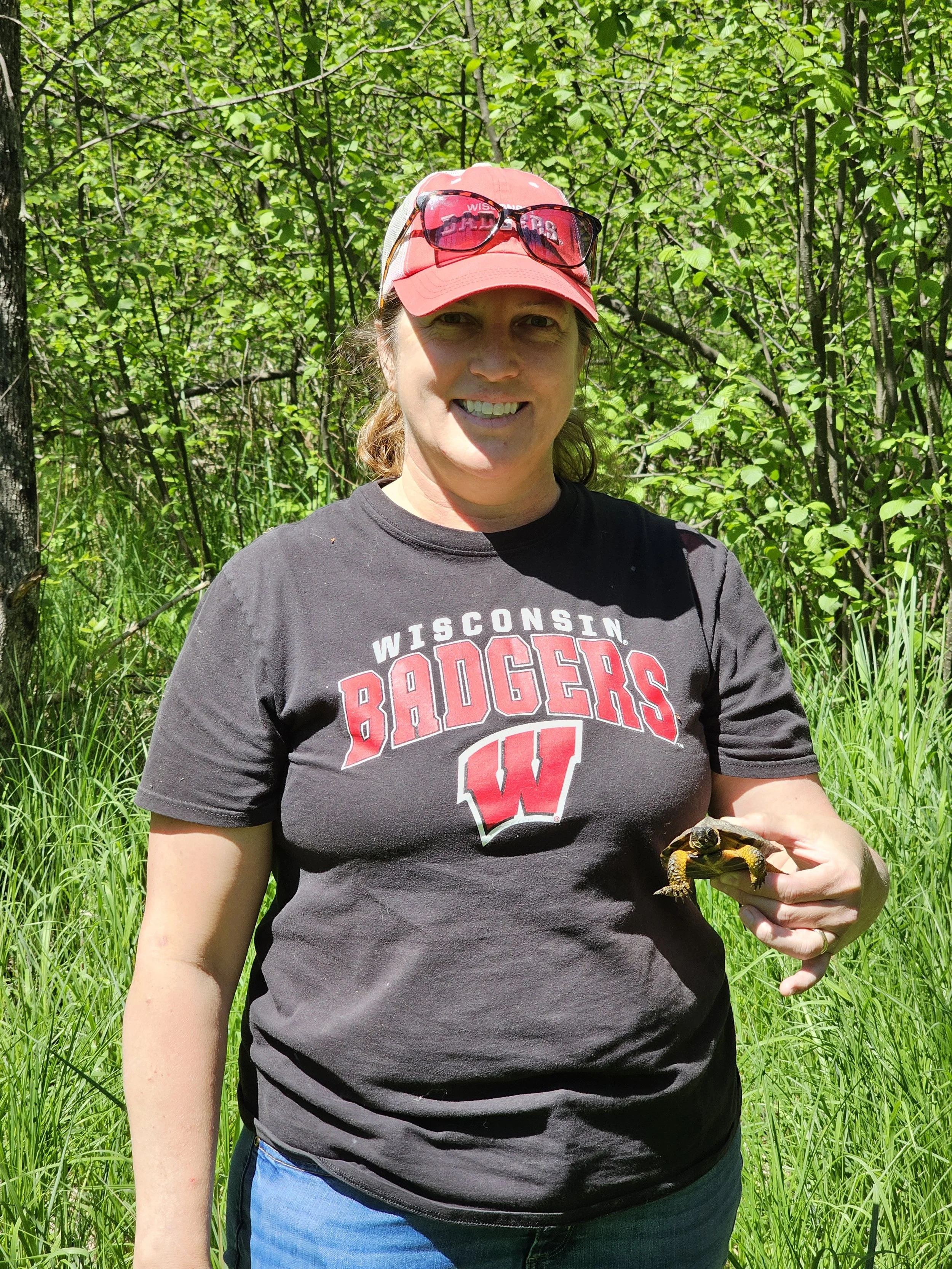
Jamie holding a turtle (photo courtesy of Jamie Nack)
In this episode, we answer questions like "why do some squirrels live in trees when other rodents live underground?" and Mickenzee shares a silly nature story about seeing a squirrel peeing on a tree with our squirrel expert Jamie Nack, the Extension Senior Wildlife Outreach Specialist at UW – Madison.
Subscribe to QuACK on Spotify, iHeart Radio, Apple Podcasts, or your favorite podcast app!
Transcription
Hey, and welcome to Questions Asked by Curious Kids, or QuACK, a podcast made by Southern Wisconsin Bird Alliance. This is a podcast where we gather questions about nature from kids to be answered with a local expert. My name is Mickenzee, I'm an educator, and I'll be the host for this series. This episode, I'll be interviewing Jamie Knack again. She's an Extension Senior Wildlife Outreach Specialist at UW-Madison. Whew! That's a long title. Today, she's going to be answering questions all about squirrels. All right, let's jump in with Jamie.
-----
Mickenzee: All right, welcome back, Jamie. Last time you were on, you were telling us all about tracks and how they can tell us a story of what happened at a location prior to us being there. This episode, we're really honing in on a specific animal. We're talking about squirrels. And I just love squirrels so much because they're in a lot of different places. You can see them in neighborhoods or parks, and it's really easy to observe them without a ton of effort.
Jamie: Agree. They are definitely more easy to find. And also some of the squirrel antics at backyard bird feeders can just be a real treat to watch.
Mickenzee: Yeah, they're so entertaining. Okay. Our first question is, why do squirrels live in trees instead of underground like other rodents?
Jamie: I really love this question. It dives in a little bit to taxonomy for wildlife species. So a quick answer is squirrels actually do live in trees and below ground because we have 10 different species of squirrels in Wisconsin. So the squirrel family has 10 different species and they are comprised of five species [a][b][c]that we would call tree squirrels that live in trees. And those include the gray squirrel, which is what I'm guessing most folks are familiar with, especially in that urban or around your home type setting. So there's the gray squirrel. There is a fox squirrel, which is a little bit larger and it's got a really pretty like reddish brown coloring to it. We generally see those more in Northern Wisconsin. Then there's the feisty little red squirrel. So it's smaller than the gray and the fox squirrel, but pound for pound, man, feisty little squirrel. And the red squirrel really likes coniferous or evergreen forests. And one way you can tell the red squirrel apart from those others too, is that it has a white eye ring around its eye. So it kind of stands out. That and its feisty nature. So those three plus, we have two species of flying squirrels in Wisconsin. We have the Northern and the Southern flying squirrel. So all five of those use trees and are arboreal, which there's our word for the day, right? Arboreal means they spend a fair amount of time in trees or climbing. And the flying squirrels, we don't see as often because they're nocturnal. So they are taking advantage of resources in the night, right, so to speak. So we have those five, but now there's another five that are in the squirrel family that are more considered ground squirrels. So they spend the time on the ground or maybe even underground. And those would be the chipmunk. And we're familiar mostly with the eastern chipmunk. There's a less common chipmunk called the least chipmunk, a little bit smaller. Shocking with the name.
Mickenzee: I've never heard of that one, that's so cool.
Jamie: So two species of chipmunk and then the Thirteen-lined ground squirrel, which most folks refer to as a gopher. It's technically a squirrel, but we know what they mean. And then there's a less common ground squirrel called the Franklin's ground squirrel. And then finally that woodchuck or groundhog or sometimes known by its nickname, the whistlepig, that is actually a squirrel as well. So the woodchuck is also in the squirrel family. So those are our 10 species of squirrels in Wisconsin. And to get back now to the question, why do squirrels live in trees? Because some of them can, right? So those five species of squirrels that live in trees are essentially taking advantage of that resource or that niche. So they have evolved to survive in the tree canopy. It helps them provide safety from predators because they are able to get above ground or higher above ground than their predators. The tree canopy can provide shelter and of course it provides a food source. So a lot of those squirrel species are eating nuts and seeds and fungi, maybe even stealing some bird eggs or nestlings from a bird nest. So they're finding their shelter and their food all around those trees and up in the canopies.
Mickenzee: Yeah. And just to get ahead of a future question, I know lots of kids ask about, well, what about these black squirrels I see in my neighborhood or blonde squirrels?
Jamie: Super great question. So again, this comes down a little bit to taxonomy. The gray squirrel is actually the one that you also see a melanistic phase too. So that black squirrel, its color is black, but its species identification is still a gray squirrel. And basically if you have ever seen or are aware of an albino animal, so an animal that is all white, so maybe a deer or a rabbit, that is an animal that doesn't produce enough pigment, pigmentation, and so they're albino. The reverse of that can happen with some wildlife. And when they have too much melanin in their system, too much pigmentation, they become all black. And that's kind of a color morph and that's called melanistic. So those melanistic black squirrels are actually gray squirrels. And then of course the lighter colored blonde squirrels, all kind of a genetic predisposition in squirrels.
Mickenzee: That's so cool. It's like they have different hair colors just like us.
Jamie: Yeah, absolutely.
Mickenzee: Our next question kind of comes from an observation. We were looking up at squirrel nests or dreys and the student asked, why are squirrel nests so messy?
Jamie: Yeah. So first of all, we're talking again about tree squirrels. So we do have some that live in burrows in the ground, but those five species, I guess we'll, we'll keep it to the gray and the fox and the red. They are the ones that will have those leaf nests, flying squirrels nest and rest in cavities or artificial nest boxes. The gray squirrel and the fox squirrel and the red squirrel will build those leaf nests, also called dreys. They're essentially these large round bundles of leaves and twigs that are built high in a tree, usually at a fork of some really sturdy branches. And they'll start by just kind of interweaving some sticks and then they carry up these leaves.
They'll go down to the base of the tree, shove their mouth full of leaves, come up and then pull them from their mouth and kind of start building this, um, this ball or sphere of leaves. And then they'll often add moss or even fur, um, or grasses to help build and shape that nest. As far as it being messy. I mean, I think they're sort of kind of neat and compact and together, but yes, I'm sure like as those leaves dry and then you've get some strong winds, some of them kind of break loose and you've kind of get more of a tattered look to that, to that ball or that sphere. But then, um, inside those leaves, sometimes we get that question, what's inside of there? And so it is kind of hollowed out and they'll line it with shredded bark or grass or moss or even some fur. And then they often will have one or maybe even two entrances to that drey. And those entrances are actually hidden. They're usually near the tree trunk, which allows them to kind of get in and out quickly and escape predators. So yeah, so it ends up being a nice cozy little place for them. And some of those tree squirrels will still use, um, nest boxes as well, or a tree cavity to spend their time. And often they'll have multiple nests, multiple leaf nests as well.
Mickenzee: I had no idea. Very cool. Yeah. I guess if you're comparing a drey to like, maybe, a Robin's nest, that neat cup shape versus the big ball, but I think squirrel nests look way cozier. Okay. Our last question is a bit of a silly story that goes with it. So once I shared a nature story where I saw a squirrel peeing on a tree in my backyard and it raised the question, why don't we see animals peeing more often?
Jamie: Yeah, it's a great question. And certainly the animals that we've been talking about, like mammals, they, they certainly do urinate or defecate. So we've got scat or pee. Um, birds have a little different method. So they have uric acid that they're emitting from their bodies. So a little different in terms of droppings in that, in that case, a kind of a combination of the two. But, um, I would say sometimes we are not patient enough to watch long enough, especially as it pertains to mammals. Um, they may only urinate a few times throughout the day. So we're maybe just not catching them. But I can remember certain times, you know, when you're seeing a deer in a field or something like that and watching a number of, a number of them that every so often one of them will either defecate or, or urinate. So certainly they do. I would say, be patient if that's a goal for you to see an animal, uh, do that in nature, but also it is strategic for wildlife to do that quickly, eliminate their bodily fluids because they're kind of like caught, right? Like so to avoid predation. So they would do that quickly, or maybe even in more of a secluded location where we're not able to see, or they're doing it, you know, in their own privacy, right? And then also another interesting thing about some species, uh, thinking about like maybe coyotes, for example, they tend to be very territorial and so defecating or urinating is their way of marking their boundaries or outlining their territory to let other coyotes know that, Hey, this area is being protected. And so we also see that being a tactic used and monitored, you know, coyotes will patrol their area and smell for encroaching competitors and, and then using it to mark and say, Hey, this is my, this is my area. I've got, I've got this area covered.
Mickenzee: Yeah. Reminds me of like, if anyone has a pet dog, when your dog's walking the fence line and marking that.
Jamie: They're smelling where other dogs have come. Uh, we have two female dogs at home and one is the more dominant dog. So every time the subordinate dog pees, the other one will come over and pee in the same spot. So yes, it's a very interesting thing. So pay attention to it the next time you're out there.
Mickenzee: It's fun to watch. It's bound to happen. So just be patient. Thank you so much, Jamie, for coming back to teach us and thank you to our listeners for submitting your squirrel questions.
Jamie: Always a treat. Thanks for having me.
-----
If you're interested in learning more or getting involved with our programs, please head to our website swibirds.org and check out the free lessons, games, and activities.
If you're looking to get outside with us, please head to the event calendar and look at all of our field trips and other programs we've got coming up. If you have a big nature question that you'd like to have answered, please have a grownup or your teacher submit your question to info@swibirds.org with the title Questions for QuACK, make sure to include your grade and the school you attend. So I can give you a shout out.
Thanks for tuning in and I hope you join us next time on QuACK!
Check out SoWBA’s free lessons, games, and activities!
Get out and explore nature with us!
Make a donation to Southern Wisconsin Bird Alliance
Audio Editing and Transcription by Mickenzee Okon
Logo design by Carolyn Byers and Kaitlin Svabek
Music: “The Forest and the Trees” by Kevin MacLeod
