
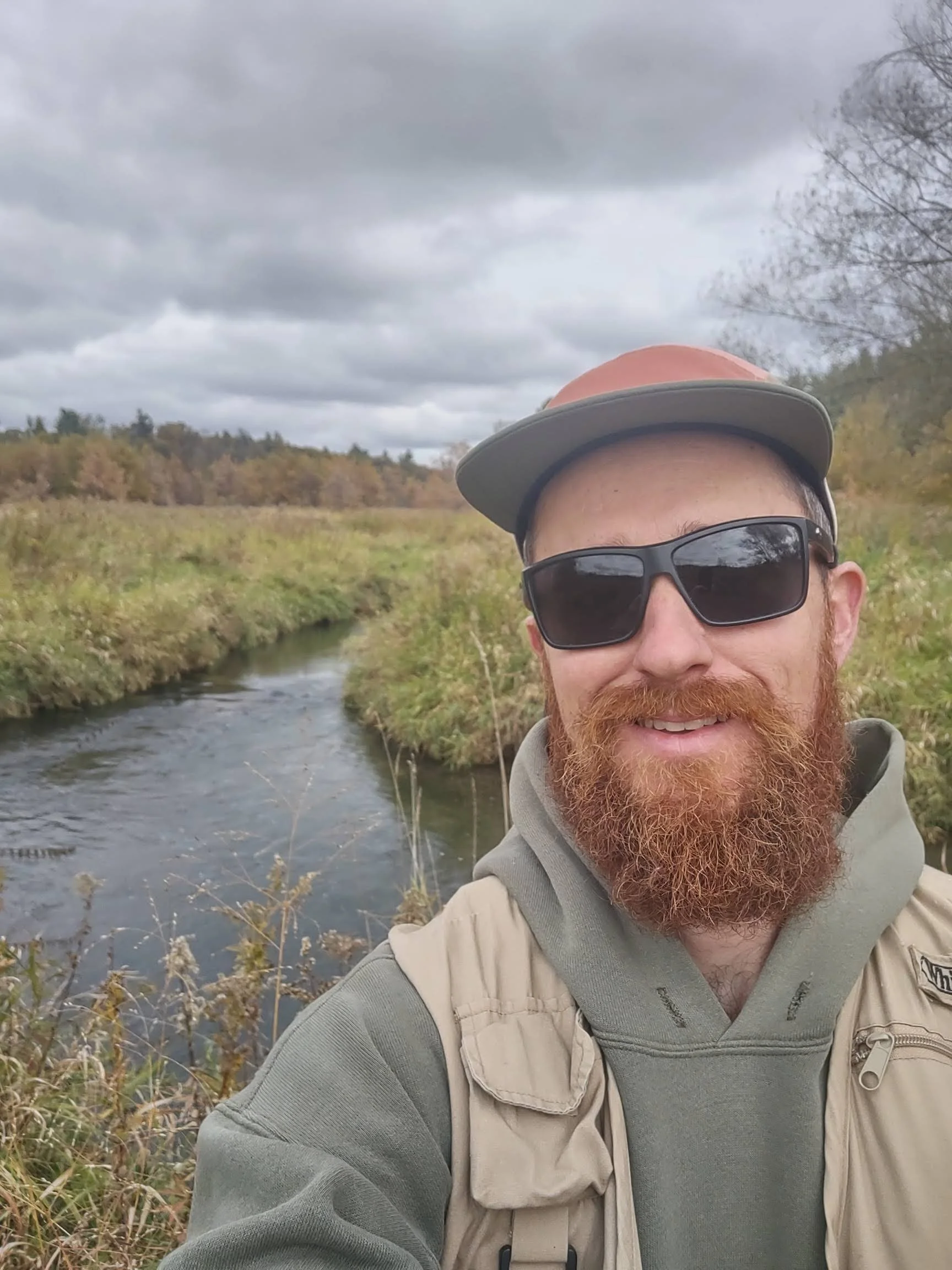
BJ Byers out in nature in front of a scenic creek (photo courtesy of BJ Byers)
In this episode, we answer questions like "how do plants breathe?" and learn about the misconceptions around invasive plants with our plant expert BJ Byers the Land Management Director at Groundswell Conservancy!
Check out Groundswell's work
Subscribe to QuACK on Spotify, iHeart Radio, Apple Podcasts, or your favorite podcast app!
Transcription
Mickenzee: Hey, and welcome to Questions Asked by Curious Kids or QuACK, a podcast made by Southern Wisconsin Bird Alliance. This is a podcast where we gather questions about nature from kids to be answered with a local expert. My name is Mickenzee. I'm an educator and I'll be the host for this series. This episode I'll be interviewing BJ Byers, the land management director at Groundswell Conservancy, and he's going to be answering questions about plants.
Fun fact about BJ is that he's also married to Carolyn Byers, the education director here at SoWBA. Okay, let's jump in with BJ, right. Hey, BJ, welcome to the show.
-----
BJ: Thanks for having me.
Mickenzee: We're excited to have you. Before we get started with the questions for the kids, could you tell us a little bit about your role as a land management director at Groundswell?
BJ: Yeah, so I work for Groundswell Conservancy, which is based out of Madison, and we do a lot of things. We do a lot of different things, but we connect people with nature as one of our main goals. And we protect special places forever. We like to protect outdoor spaces for people and all the critters that use those areas. We help people buy farmland that maybe can't afford farmland. Yeah, we just like getting people outside. And my main goal or my role with groundswell is it's more of the like, I'm outside a lot. I do a lot of the habitat restoration, so I plant prairies and cut trees out that shouldn't belong in certain areas.
Mickenzee: Do you get to use cool equipment?
BJ: I get to use tractors and chainsaws and brush cutters and loppers and axes and Oh
Mickenzee: That's really cool. That would be so exciting to get to use all those fun things every day.
BJ: It gets loud, but it's fun, a lot of fun.
Mickenzee: Today our episode is all about plants. What do you love about plants and why did you choose to work with them?
BJ: I love plants because it's like going on a little scavenger hunt. You go outside and there's so many different types of plants. And it's really fun to see a new plant that you've never seen before. But it's also really exciting to go to two completely different places and see the same plant in different places. So it's kind of, it's nice, it's a little bit of the same and it's a little bit of something new.
Mickenzee: Yeah, something I really like is watching plants through the seasons. And if I can recognize them at different stages of what they're looking like.
BJ: Yes, a big part of my job is watching plants throughout the seasons and checking when they're ready. I do a lot of seed collecting.
Mickenzee: Very cool. Today our questions are from the third graders at Lincoln Elementary School. And our first question is: How do plants breathe and how do they give us air?
BJ: Great question. When you think of a plant, you might not think of it. they don't have a mouth.. Humans. We breathe. We have lungs. Take a deep breath. Feels really nice. Plants, you know, not so much. Maybe you think of a Venus flytrap. If you've ever seen one of those, they actually kind of look like they have a mouth, but they're not breathing through that. They're just catching flies. Plants don't have mouths, but they still do breathe. They've got these. They've got these little tiny, microscopic things all over their leaves called stomata. I won't go too far into the details, but those act as sort of a way to breathe for the plants. So they breathe in carbon dioxide. We breathe out carbon dioxide
Mickenzee: A good match.
BJ: It's perfect. So we breathe out what they're breathing in. And actually they can produce oxygen, which is what we breathe. And they do that through photosynthesis, which the students might be familiar with.
Mickenzee: The general idea that photosynthesis is how plants make their food.
BJ: Right, yep. And so that is also incorporated with the breathing part. So they use the energy from the sun, water from the rain, and they use carbon dioxide in the air. And the three of those combined help them create sugar or energy. It's a complicated sort of process, but we need plants. And that's why it's really good to have a lot of plants in your house. And because they help filter the air and air that you breathe out, they're breathing in. And it's very good to have that combination.
Mickenzee: Yeah, Great relationship. Okay. This question asker starts with a little bit of a story. On a field trip we were removing garlic mustard. And this student is wondering: “Why are invasive plants bad and where do they come from?”
BJ: Yeah that is, that's a really good question. And I've spent a lot of my job removing invasive plants. So I think it's important to know that the plants that are invasive, I don't think they're bad. Some people might disagree with that. They're not bad plants at all. They don't have a mission to be mean, and they're not like out to get somebody. So plants are there to survive. And in the areas where they've evolved, they do really good at surviving, but they also do a really good job of not spreading too fast, outcompeting other species. But when those plants get to places maybe where they weren't evolved or adapted to, sometimes they can take over and that's where it kinda gets bad. We really like having a lot of plant diversity. Diversity is great, and when you have one plant that takes over an entire area, it gets rid of all of that diversity and it's replaced with one plant. And if you know anything about plants and insects and pollinators and all that, there's so many different interactions between all of the plants and insects, and they all sort of rely on each other. So if you remove all of that and replace it with one species, that's where it can be really bad. And garlic mustard can do that. Garlic mustard can take over. And the reason why I say that invasive species aren't necessarily bad. Our common milkweed here in Wisconsin. That we plant right for monarchs because they eat the milkweed. They lay their eggs on the milkweed. If you travel overseas to Europe, milkweed is invasive over there, it takes over. Their climate, their plant species, their insects. They didn't evolve with, right? So milkweed when it gets overseas it takes over being passed over there.
Mickenzee: Interesting. So it's like the adaptations they have might help them thrive in a new place and take over. And they might be struggling back where their home area is.
BJ: Right, yeah. But milkweed here, we have caterpillars and we have milkweed beetles. We have all sorts of insects and our climate, everything makes sure that they don't get too out of control. It keeps them exactly where they're the happiest.
Mickenzee: Yeah, that's so awesome and cool to think about. All right. Our last question for today is: Do all plants need pollinators?
BJ: That's another good question. The short answer is no, not all of them do. An easy way to think about. So plants produce pollen. Right. And then that pollen can get transferred to other plants, usually of the same species. And that helps that plant once it gets the pollen to create seeds and fruits and nuts. And if it doesn't get that pollen then it can't create those things. So your strawberries, your apples. Delicious fruit that we need, all of that needs to get pollinated. And if it doesn't, it's not going to produce those things. So you get things like grass and wheat and stuff like that that doesn't need pollination or it can pollinate itself. It doesn't need insects to be pollinated, so it can pollinate by the wind transferring the pollen. In summer. Just self pollinating. So interesting. You think of like the bright smelly flowers and stuff that produces fruit. Those are all things that usually need insects or pollinators to help them. And the stuff that's not so showy, like grasses and wheat and stuff. Those usually don't need insects to help.
Mickenzee: Where do pine trees fit into that?
BJ: Pine trees also don't need insects. Yep, they'll use wind. And if you've ever stood under a pine tree when the pollen is very, very active, and this is when a lot of people have seasonal allergies, they'll start sneezing a lot. If you tap one of those limbs on a pine tree. You'll see a big yellow cloud come off. And that's the pollen coming off. And being blown through the wind so that it can pollinate.
Mickenzee: So different plants have different methods. Some are using pollinators. Some might use wind.
BJ: Yep, yeah. But insects are definitely very important for pollination. Most of the food we eat, we need insects. So they're super important.
Mickenzee: Yeah, awesome. Thank you so much, BJ, for coming on and teaching us today.
BJ: Thanks for having me.
-----
Mickenzee: Awesome. If you are interested in learning more about plants or anything else nature related, please head to our website swibirds.org and head to the education tab where you can find all sorts of free lessons, games, and activities. And if you're looking to get outdoors, check out the Field Trip calendar under the events tab. If you have a big nature question that you'd like to have answered, please have a grown-up or teacher submit your question to info@swibirds.org with the title questions for QuACK. Make sure to include your grade and school you attend so I can give you a shout out. Thanks for tuning in and I hope you join us next time on Quack!
Check out SoWBA’s free lessons, games, and activities!
Get out and explore nature with us!
Make a donation to Southern Wisconsin Bird Alliance
Audio Editing and Transcription by Mickenzee Okon
Logo design by Carolyn Byers and Kaitlin Svabek
Music: “The Forest and the Trees” by Kevin MacLeod
