Visit our Sunflower Field at Goose Pond Sanctuary

This spring, Madison Audubon Society planted four acres of sunflowers and two acres of sorghum for wildlife food at Goose Pond Sanctuary.

You are welcome to visit Goose Pond Sanctuary (one mile south of Arlington) to view an impressive display of sunflowers. The sunflowers began blooming on July 21st and should be at peak the last week of July into the first few days of August.  

The field contains over 60,000 sunflowers and will provide wildlife with over 6,000 pounds of seed. Goldfinches and mourning doves will find a feast beginning in September. There are mowed trails along the edge of the sunflowers and you are welcome to hike the trail and take photos.  With the recent rains the prairie should be ablaze in color and you are also welcome to hike our prairie trails.  One of the best prairie trails to hike is at Browne Prairie. The Browne prairie parking lot is about .5 miles west of the sunflower field on Kampen Road.

Goose Pond Sanctuary is one mile south of Arlington.  To find the sunflowers - from the intersection of Goose Pond Road and Kampen Road go west on Kampen Road for 200 yards.  

NOTE: There is also a Kampen Road intersection with Goose Pond Road where Kampen Road goes east about 200 yards north of the south Kampen Road intersection. Visitors can park along the south side of Kampen Road on the east side of the sunflowers where the trail begins. Dogs are not permitted.

Call Mark or Sue Martin, resident co-managers, at 608-333-9645 with questions.
Photos taken by Mark Martin in 2007 at Goose Pond Sanctuary.

Featured Sanctuary Plant: Eastern Prairie White Fringed Orchid

Aldo Leopold fought to save the Eastern Prairie White Fringed Orchid at our Faville Grove Sanctuary, and today, in the Crawfish River prairie remnants, we will the survey orchid he eulogized below in his essay, "Exit Orchis"

Photo by Joshua Mayer

Photo by Joshua Mayer

EXIT ORCHIS
By Aldo Leopold
Courtesy of the University of Wisconsin Digital Archives

Wisconsin conservation will suffer a defeat when, at the end of this week, 75 cattle will be turned to pasture on the Faville Grove Prairie, long known to botanists as one of the largest and best remnants of unplowed, ungrazed prairie sod left in the State. In it grows the white ladyslipper, the white fringed orchis, and some twenty other prairie wildflowers which origianlly carpeted half of the southern part of the State, but most of which are now rare due to their inability to withstand cow or plow.

Thirty miles away a C.C.C. camp on the University of Wisconsin Arboretum has been busy for four years artifically replanting a prairie in order that botany classes and the public generally may know what a prairie looked like, and what the word "prairie" signifies in Wisconsin history. This synthetic prairie is costing the taxpayer twenty times as much as what it would have cost to buy the natural remnant at Faville Grove, it will be only a quarter as large, the ultimate survival of its transplanted wildflowers and grasses is uncertain, and it will always be synthetic. Yet no one has heard the appeals of the University Arboretum Committee for funds to buy the Faville Grove Prairie, together with other remnants of rare native flora, and set them aside as historical and educational reservations.

Our educational system is such that white fringed orchis means as little to the modern citizen of Wisconsin as it means to a cow. Indeed it means less, for the cow at least sees something to eat, whereas the citizen sees only three meaningless words. In preparation for the hoped-for floral reservation at Faville Grove, the Botany Department and the Department of Wildlife Management of the University have, during the last three years, mapped the location of each surviving colony of rare flowers, and each spring have counted the blooms. It was hoped to measure against these data the response of the flowers to complete future protection. The data will now serve to measure the rate at which destruction by grazing takes place. It is already known that with the possible exception of ladies tresses, all the rarer species succumb to pasturing. That is why they are rare. Few of them succumb to mowing, hence the past use of the Faville Grove Prairie as haymeadow has not greatly injured its flora.

In my opinion no individual blame attaches to the owner of the Faville Grove Prairie for converting it to pasture. The public taxes him on the land. It is not his obligation to provide the public with free botanical reservations, especially when all public institutions, from the public school to the federal land bank, urge him to squeeze every possible penny out of every possible acre. No public institution ever told him, or any other farmer, that natural resources not convertible into cash have any value to it or to him. The white-fringed orchis is as irrelevant to the cultural and economic system into which he was born as the Taj Mahal or the Mona Lisa.

John Muir, who grew up amid the prairie flowers in Columbia County, foresaw their impending disappearance from the Wisconsin landscape. In about 1865 he offered to buy from his brother a small part of the meadow of the family homestead, to be fenced and set aside as a floral sanctuary or reservation. His offer was refused. I imagine that his brother feared not so much the loss of a few square rods of pasture as he feared the ridicule of his neighbors.

By 1965, when the rarer prairie flowers are gone, the cultural descendants of John Muir's brother may look at a picture of the legendary white fringed orchis and wish they could see one.


Note: Aldo Leopold was the founder of the science of Wildlife Management and professor of this subject at the University of Wisconsin in Madison. He is now well known as the author of the fundamental text in this field, as well as the lyrical essays collected in "Sand County Almanac." The above appeal, written May 15, 1940, so simple, yet magnificent in its eloquence and emotional in its urgency, was successful in stimulating purchase of a 40-acre piece of Wisconsin prairie. Spared damage from "cow or plow",this small piece of the Faville Prairie has become one of Wisconsin's finest scientific areas. Today, administered through the University of Wisconsin Arboretum, it is useful in research, indispensable in teaching, and unsurpassed for its beauty and biological interest. Leopold was one of the early inspirers and guiding lights of the Arboretum whose own difficult beginnings are documented by Nancy Sachse, 1966 "A thousand Ages."

From the Educators: Spring has flown by like a flurry of migrating warblers!

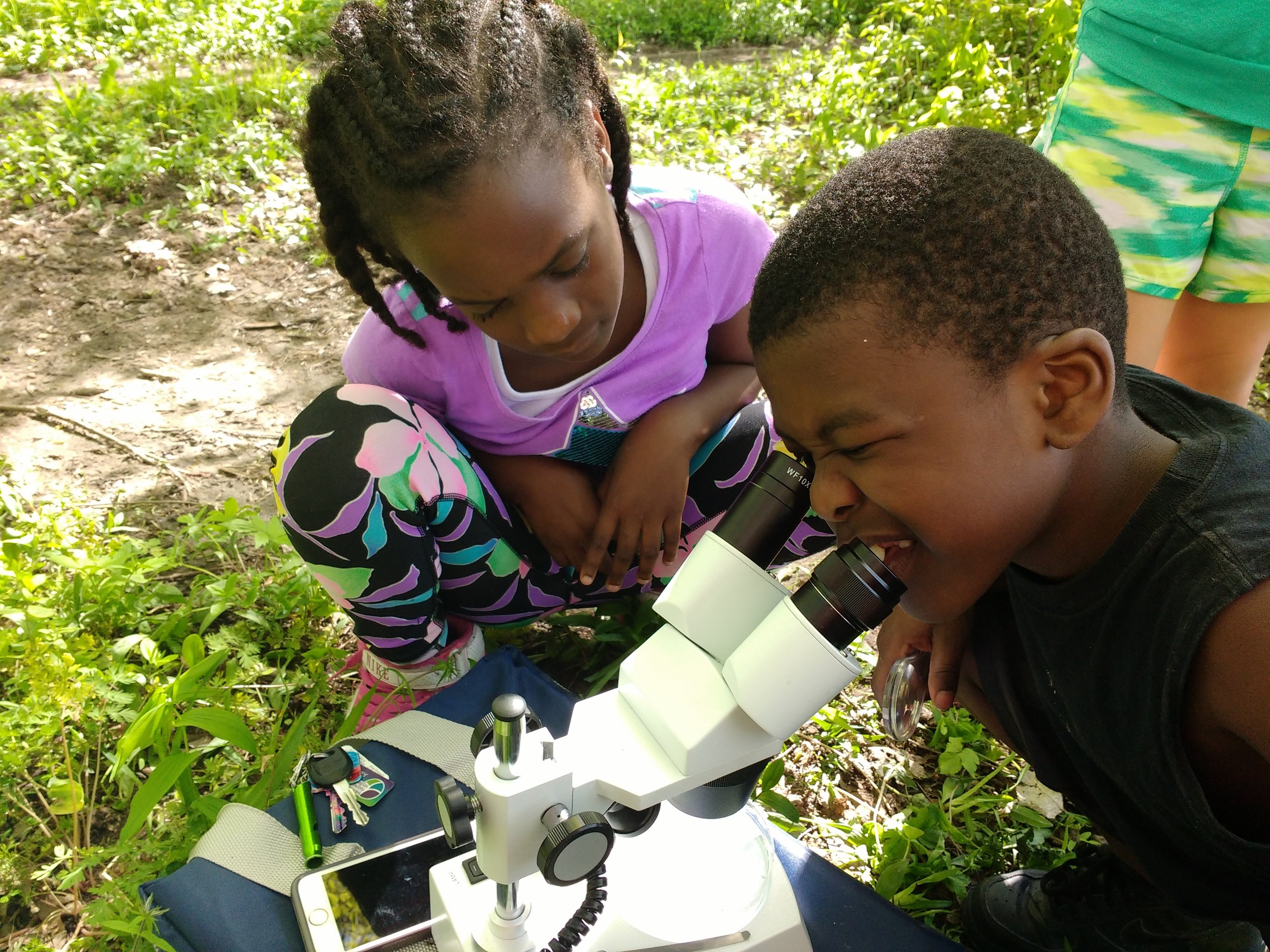
Vera Court kids grow their science skills while searching for water critters.

Vera Court kids grow their science skills while searching for water critters.

The quiet steady pace of winter seems like a lifetime ago, but this spring has been filled with adventure. Thanks to your support, we have been able to reach 1,759 kids since January – and have built long-term relationships with over 100 of them! Because of you, these kids are spending more time exploring outside, asking questions, and making observations about nature!

Our energetic and talented education intern, Lauren Sinclair, helped the kids at Vera Court Neighborhood Center and Goodman Community Center to explore their local natural areas. They studied forests at Picnic Point, prairies and wetlands at Cherokee Marsh, and learned about urban habitat around their community centers. Part of each session was devoted to a formal lesson: dissecting owl pellets, using a microscope to get a closer look at prairie plants, or listening for birds on a nature walk. We even did some nature-inspired art! The kids learned just as much during the time they were allowed to simply explore and enjoy each place we visited.

Helping improve habitat for people and wildlife also brings lots of pride!

Helping improve habitat for people and wildlife also brings lots of pride!

Our partnership with Lincoln Elementary grew by leaps and bounds this spring. We expanded our Climate Change programming from just one classroom to four! By teaching Climate Change using birds, we turned this complicated subject into a more relatable problem that the kids really care about. The lessons culminated in a school-wide Birdathon, where our kids taught the rest of their schoolmates how to play climate change games. All four of theseclassrooms received free field trips to local natural areas. We watched wildlife, and helped improve habitat by pulling garlic mustard!

For the first time, MAS partnered with local High School classrooms. An AP English class at LaFollette High School took a day to relax at the UW Arboretum and practice their reflective nature writing. An AP environmental Science class at East High School leaned about the path they would take to become a wildlife biologist. We practiced surveying for birds and mammals at Cherokee Marsh.

We also led field days at schools in two rural communities: Lone Rock Elementary and Ithaca Schools. During these day-long events, we worked with every student at both schools: teaching them about birds, and spreading our love of wildlife. We’re gearing up for an exciting summer working with Vera Court, Salvation Army and Operation Fresh Start. More updates to come soon!

This work was made possible by you! Thank you for helping connect kids with nature and for making a positive impact in their lives.

My Side of the Substation: Peregrine Family Calls MG&E Plant Home

My fascination with raptors started around third grade, when I read Jean Craighead George’s iconic My Side of the Mountain...

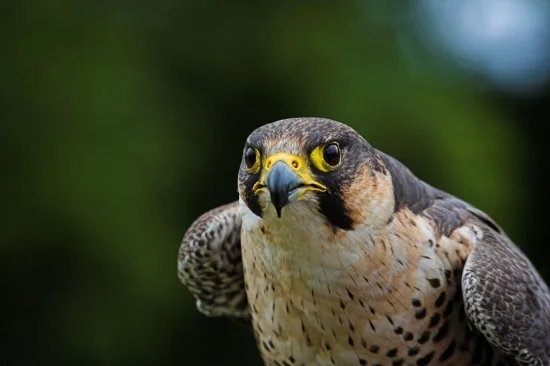
Photo by Thomas Helbig, Creative Commons

Photo by Thomas Helbig, Creative Commons

...I imagine this book marked the start of many young bird enthusiasts love for our feathered friends, as much as it planted the seeds for wanderlust and a love of wilderness for others. (Haven’t read it? Young adult novels are great for the young-at-heart, too.)

In the novel, a young boy named Sam runs away from his family's cramped life in New York City in order to live alone in the wilderness of the Adirondacks. Along the way, his companion is a peregrine falcon named Frightful, who he has trained to help him retrieve food, but who also becomes his one steadfast friend in the wild. Sam and Frightful are inseparable.  As a kid this blew my mind: who knew that raptors were so intelligent, familial, and possessed the ability to bond with humans? Of course, Craighead’s book is fiction, yet the idea of the bond between humans and raptors is something that has stuck with me since I first devoured her words as an eager elementary student.

Most Madisonians are aware of our own celebrity falcons – those who have taken up occupancy of the nest box installed on the MG&E Blount Station, just a few blocks from the state capitol building. Since 2009, several nesting pairs have raised broods in the box, and with the installation of a live cam, their daily dramas (and not-so-dramatic events, too) unfold before our eyes. (As of the posting of this article, I've mostly been watching the chicks snooze and fluff their fuzzy gray feathers...) 

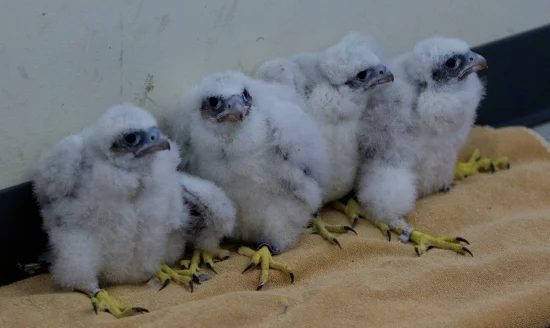
Above, this year's brood of feathered, fuzzy urban falcons. Photo by Arlene Koziol

Above, this year's brood of feathered, fuzzy urban falcons. Photo by Arlene Koziol

The falcons at Blount Station didn’t show up overnight: the nest box was installed for nearly ten years before a pair decided to call it home in 2009. Now, the return of nesting pairs and subsequent rearing of fuzzy, clumsy chicks at the MG&E site is an event that isthmus residents look forward each spring. Though it may seem like an odd site for the world’s fastest raptor to raise a family, many falcons have taken to feathering their nests on human structures: power plants, high-rises in cities like Chicago, and the outsides of factory smokestacks have all hosted falcon families. These raptors are busy making lemonade out of the lemon of disappearing natural habitat - an action that has proven essential to their survival in many regions.

Photo by Arlene Koziol

Photo by Arlene Koziol

Just this week, Madison Audubon director Matt Reetz and volunteer conservation photographer Arlene Koziol had the opportunity to view the banding of this year’s four tiny MG&E falcons, named Jean, Witt, Paul, and Billy after famous Wisconsin aviators. The bands will help researchers keep track of the young birds, and hopefully allow us to gain insight as to their movements and future offspring, too. As recently as the 50s and 60s, peregrine populations in Wisconsin faced serious trouble due to the use of DDT. In the 1980s, only 11 nest sites were recorded in the state. Now, there are 33 known nests. The MG&E nest box started as a classroom project for an employee’s son who is now well past his college graduation. This recovery – and the decade-long wait for falcons at Blount Station – are the proof that good conservation takes time, patience, and perseverance.

While we haven’t trained the Madison falcons how to help us hunt for food like Frightful (why would we with The Old Fashioned just up the street?) my fascination with the birds has been rekindled with the opportunity to engage with these urban residents. Just as Sam learned in My Side of the Mountain, I'm learning that the lines between wild nature of these falcons and our structured human world are often blurred. 

By Emily Meier, Director of Communications & Outreach


For more information about the MG&E Falcons, view the articles below:

For more information about peregrine falcons in North America, visit Audubon.org's Guide to Birds

Madison Audubon Volunteers and Partners Honored for Dedication to Habitat Protection

William and Jean Damm (above) received a Dedication Award from the Columbia/Marquette County Pheasants Forever (PF) Chapter. William was involved with establishment of the chapter over 12 years ago and has been the treasurer for most of his tenure on the board. Jean assists William with the annual PF banquet coordination and tracking the membership. Last year the Chapter banquet raised $10,000 - money that is spent on habitat and youth outdoor education in Columbia County.   

Jean and William have been very active volunteers with Madison Audubon Society for over 25 years. William's well stocked metal and wood shop has produced many bird boxes for Goose Pond Sanctuary! William also serves on the Goose Pond Sanctuary Committee. Jean is also a very active volunteer with the Portage hospital, library and food pantry.

Ohne Raasch (above) was also recognized at the recent banquet; Ohne received a Faces of Wisconsin Award from Pheasants Forever. Ohne and Karen own about 300 acres of wildlife habitat adjacent to Faville Grove Sanctuary. Recently, the Raasch's entered 150 acres into the Wetland Reserve Program to permanently restore and preserve it for wildlife and generations to come. Faville Grove Sanctuary staff and volunteers assisted them on planting 53 acres to prairie. They have also planted over 5,000 trees and are active in invasive species removal and prescribed burning.

When Ohne worked with WeEnergies he helped erect 3 osprey nest platforms around Lake Koshkonong. Ohne has also been active with the Conservation Congress for over 15 years.

Wildlife Management staff from the DNR band wood ducks and morning doves on their land and Ohne maintains the banding site and also helps with the banding.

For many years Ohne has erected, maintained, and checked wood duck boxes on DNR, private, and MAS land. This past year he checked 303 nest boxes and reported that 276 were used and at least 184 had successful hatches of wood ducks and 9 hatches of hooded mergansers. At Zeloski Marsh where MAS erected nest boxes he found 41 hatches in 60 boxes.  At Faville Grove Sanctuary he found 24 hatches in 34 boxes. He also found 4 screech owls using his boxes in late winter.   

We would like to congratulate and recognize William, Jean, Ohne, and Karen for all they have done to help maintain habitat and benefit wildlife in southern Wisconsin.