Our Amazing Birds: Crow

Our Amazing Birds: Crow

Of all our native American birds, the crow has most thoroughly mastered the problem of how to thrive in the face of heavy odds. Tough, resourceful, amazingly intelligent, it prospers despite the handicaps of large size and a jet-black uniform which make it almost startlingly prominent. Man’s hand is ever against it, yet it caws derisively and flaps away in safety almost every time. It is incredible the way crows make crime pay. And yet, if it’s not your corn that has been stolen or your nestling robin that has been gobbled, you can’t help admiring their skill and daring.

Photo by Arlene Koziol

Into the Nest: Time to fledge!

Into the Nest: Time to fledge!

We know that human kids grow, mature, and gradually move towards a life that is independent of their parents’ home. The same is true for baby birds: they also have to decide when the time is right to leave the nest and start on their journey to independence. This seems to involve a balancing act between making sure they are big and healthy enough to survive independently, while leaving the nest quickly to avoid predators.

Photo: Kelly Colgan Azar

Our Amazing Birds: White-Breasted Nuthatch

Our Amazing Birds: White-Breasted Nuthatch

A young farmer neighbor of mine, untrained in the niceties of ornithology but, like many countrymen, keenly observant of its facts, calls the white-breasted nuthatch “that upside-down bird.” No name could be more appropriate, for this nuthatch, at least during waking hours, spends fully as much time with its head lower than its tail as it does in a more conventional position. Why the bird seems to think no more about running headfirst down a vertical tree trunk than of climbing straight up it is doubtless its own affair. To us it looks fool-hardy and provocative of cerebral hemorrhages. But nobody has ever seen a nuthatch come to grief that way!

Photo by Monica Hall

Rebuilding a Wetland

On September 10, 2018, after many months of planning and countless meetings and discussions, something big began happening at Goose Pond. Two bulldozers, a large backhoe, and an excavator rolled in Monday evening ready to start moving thousands of cubic yards of soil out of the canary grass dominated wetland. For the next four days, LMS construction worked long hours creating seven wetland scrapes for Goose Pond Sanctuary.

Photo by Arlene Koziol

Into the Nest: Defending the Nest

Into the Nest: Defending the Nest

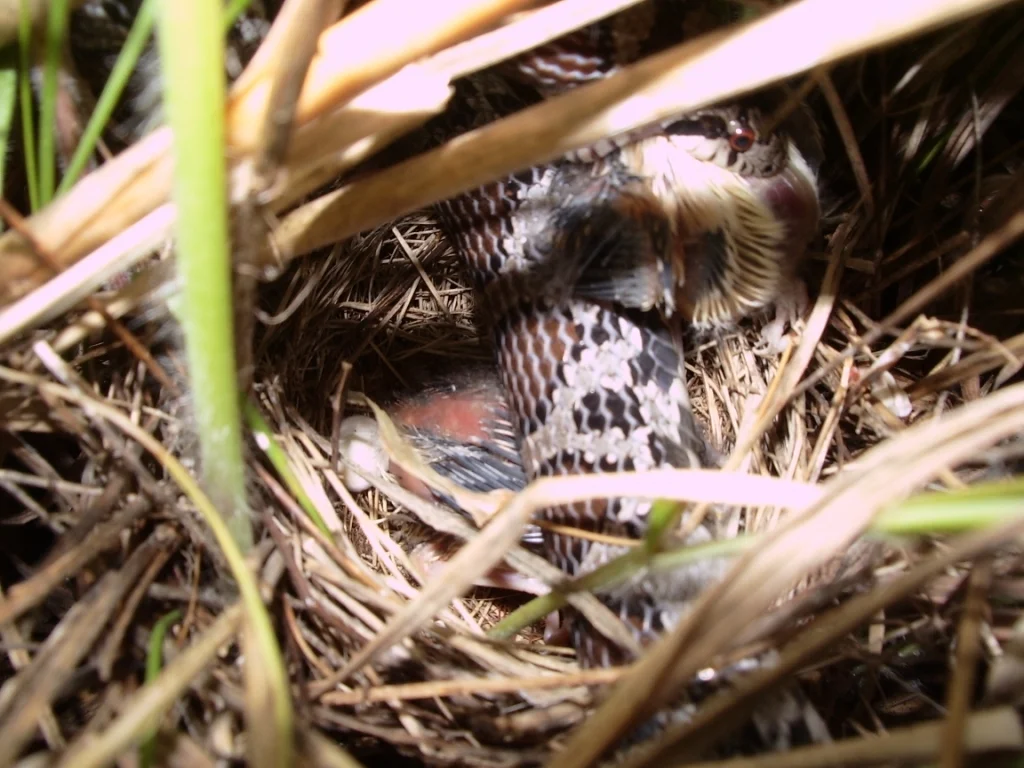
Our last post shared some pretty intense videos of predation events at nests. In both videos all of the chicks got eaten, and the parents either fled or did not approach the nest while the predator was there. The badger and the 13 lined ground squirrel weren’t challenged as they made off with nestlings. It’s not always like this, though. It turns out that bird parents respond differently depending on who is trying to eat their chicks.

Photo courtesy of Ribic research lab