
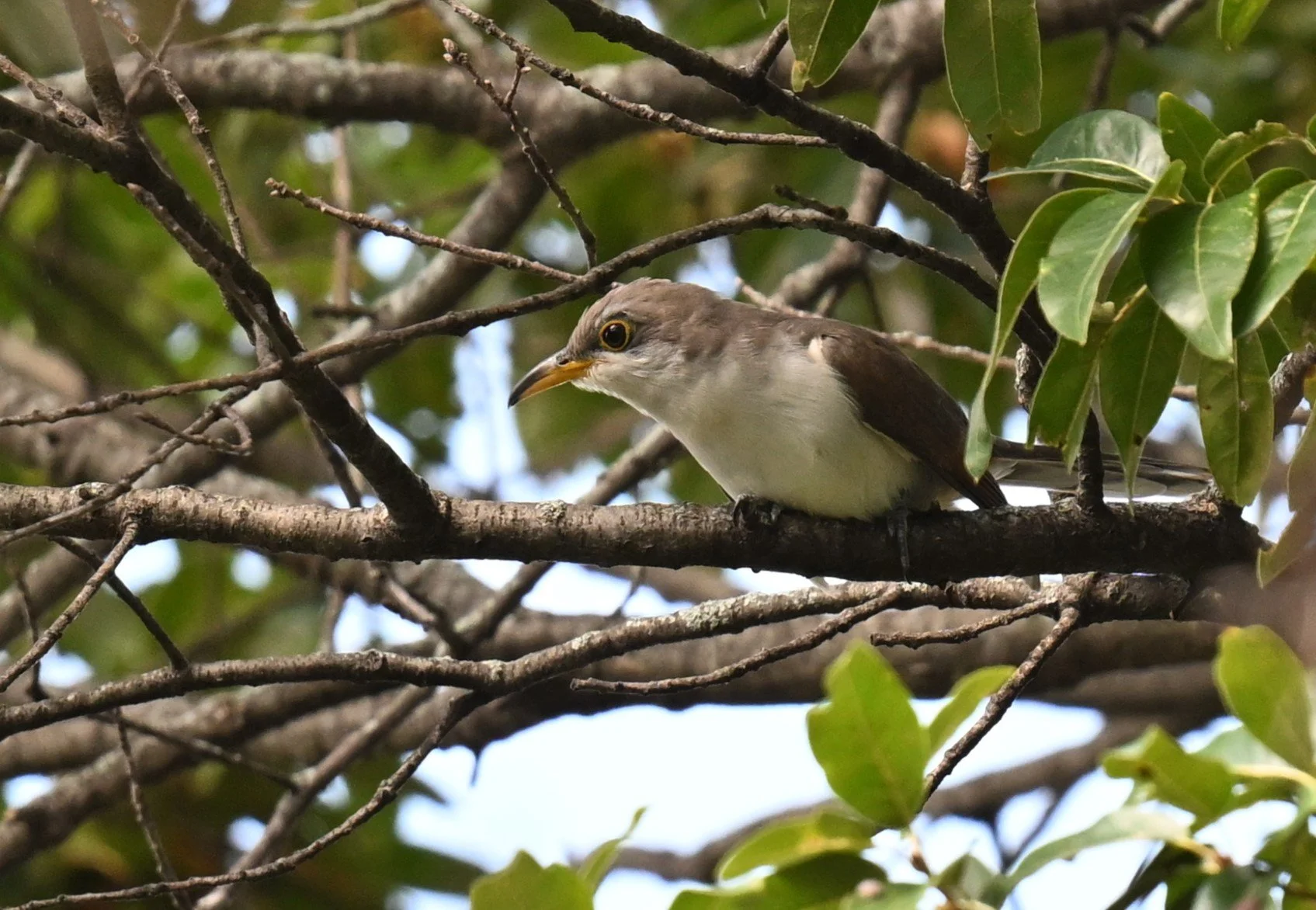

On the Fair Meadows management calendar, July is Japanese hedge parsley season. This invasive plant loves the borders between the woods and prairies. It can become very dense, crowding out the native plants. The best control is burning, but we spend several weeks every year pulling the flowering plants that have sprung up in unburned units. The good news is that this is exactly the type of habitat and the time of year that we might be lucky enough to hear or even see a Yellow-billed Cuckoo.
This year, on July 9, we were working on pulling hedge parsley with Leena, our Diversity in Conservation Intern, at the edge of Petite Woods and just across from Heron Pond when we heard the emphatic ka-ka-ka-kow-kow-kow-kowlp-kowlp-kowlp call of the Yellow-billed Cuckoo. The call was coming from a large oak tree just in front of us. The bird called repeatedly, and four of us searched with binoculars. After several minutes, a long, slim brown bird with a long tail emerged from the tree top and rapidly flew out of sight to the neighbor’s woods across the road. We were unable to confirm any expected features such as a white breast or white spots on the undersurface of the tail, and there was no chance of seeing if the lower mandible was yellow. But the call was enough for identification. In 1927, Edward Forbush succinctly summarized our cuckoo experience in Life Histories of Familiar North American Birds: “It might be easily overlooked, were it not for its characteristic notes, which lead the observer to look for it.”
Previously, on July 1, we heard a Yellow-billed Cuckoo in the same general area while doing a point monitoring survey of birds in the woods. During these first two weeks of August, we have heard its coo-coo-coo song several times late in the afternoon.
The secretive behavior of Yellow-billed Cuckoos is well recognized. Their favorite food is caterpillars, and thus they move slowly along branches looking underneath leaves for their prey. They also sit in a crouch, concealing their white breast and tail spots. Yellow-billed Cuckoos are one of the few species of birds that will eat hairy caterpillars such as tent caterpillars and spongy moth caterpillars. Patient observers have documented that they can eat up to 100 tent caterpillars in one day! To remove some of the hairs, cuckoos move their mandibles back and forth while holding the caterpillar. However, examination of their stomach contents by early ornithologists noted a furry lining of their stomach, presumably undigested hairs. According to the American Bird Conservancy, this accumulation of hair is shed and regurgitated as a pellet.
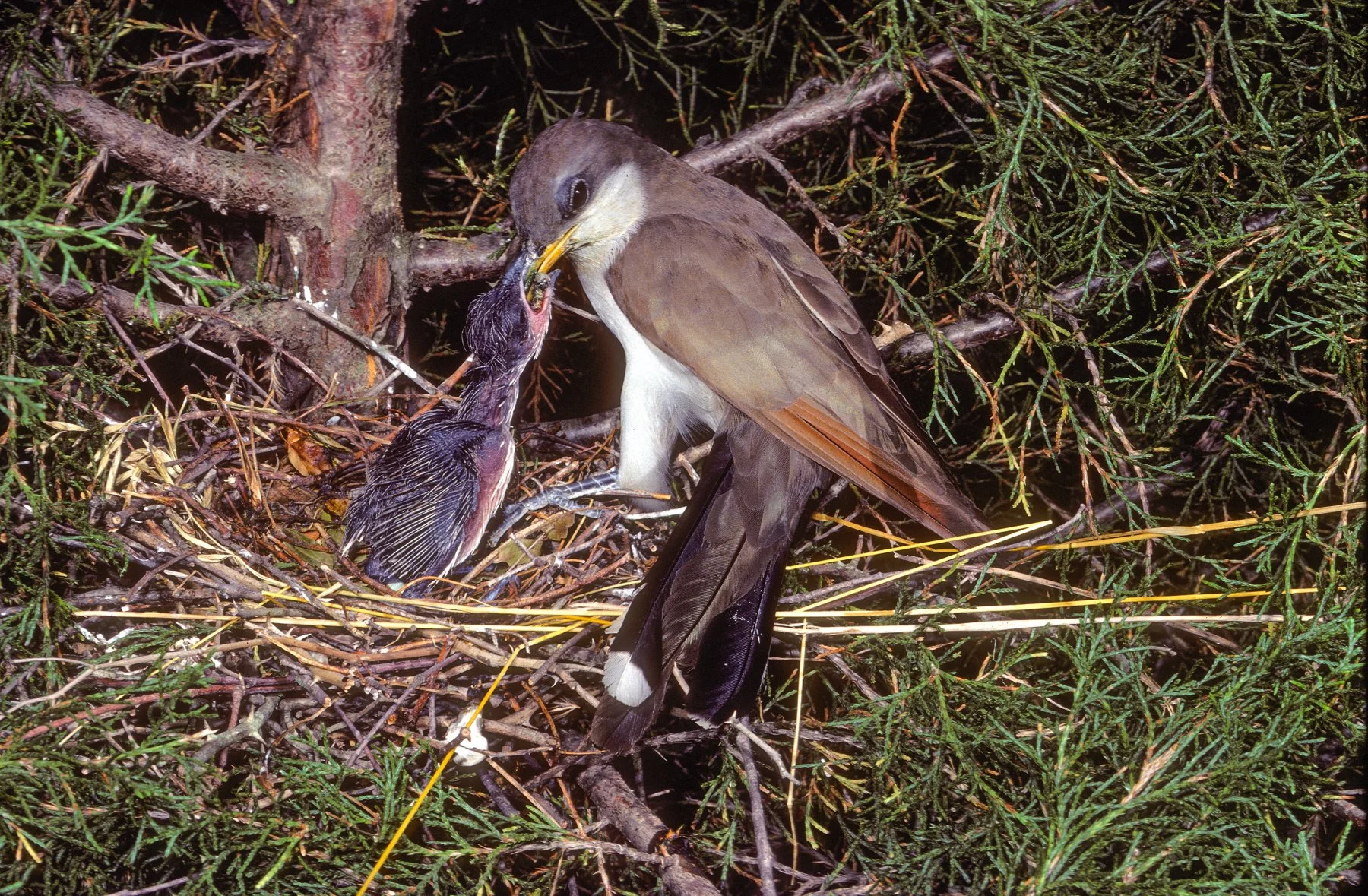
Yellow-billed Cuckoo feeding young in nest (photo: Gary Shackelford).
Yellow-billed Cuckoos nest anytime between late May and early August and have a very short nest cycle (from onset of incubation to fledging) of 17 days. The timing of nesting is apparently triggered by an abundance of food. Unlike Eurasian cuckoos, the Black-billed and Yellow-billed Cuckoos of the Americas are not often brood parasites, though they occasionally do lay eggs in the nests of American Robins, Gray Catbirds, and Wood Thrushes.
Cuckoos are the perfect challenge for slow birding. Sit quietly in the woods and wait for the call.
Written by Penny Shackelford, Fair Meadows sanctuary manager
Cover photo by Andy Reago & Chrissy McClarren. A Yellow-bellied Cuckoo is tucked within a tangle of branches with green leaves. The bird’s yellow bill is distinctly visible.
