
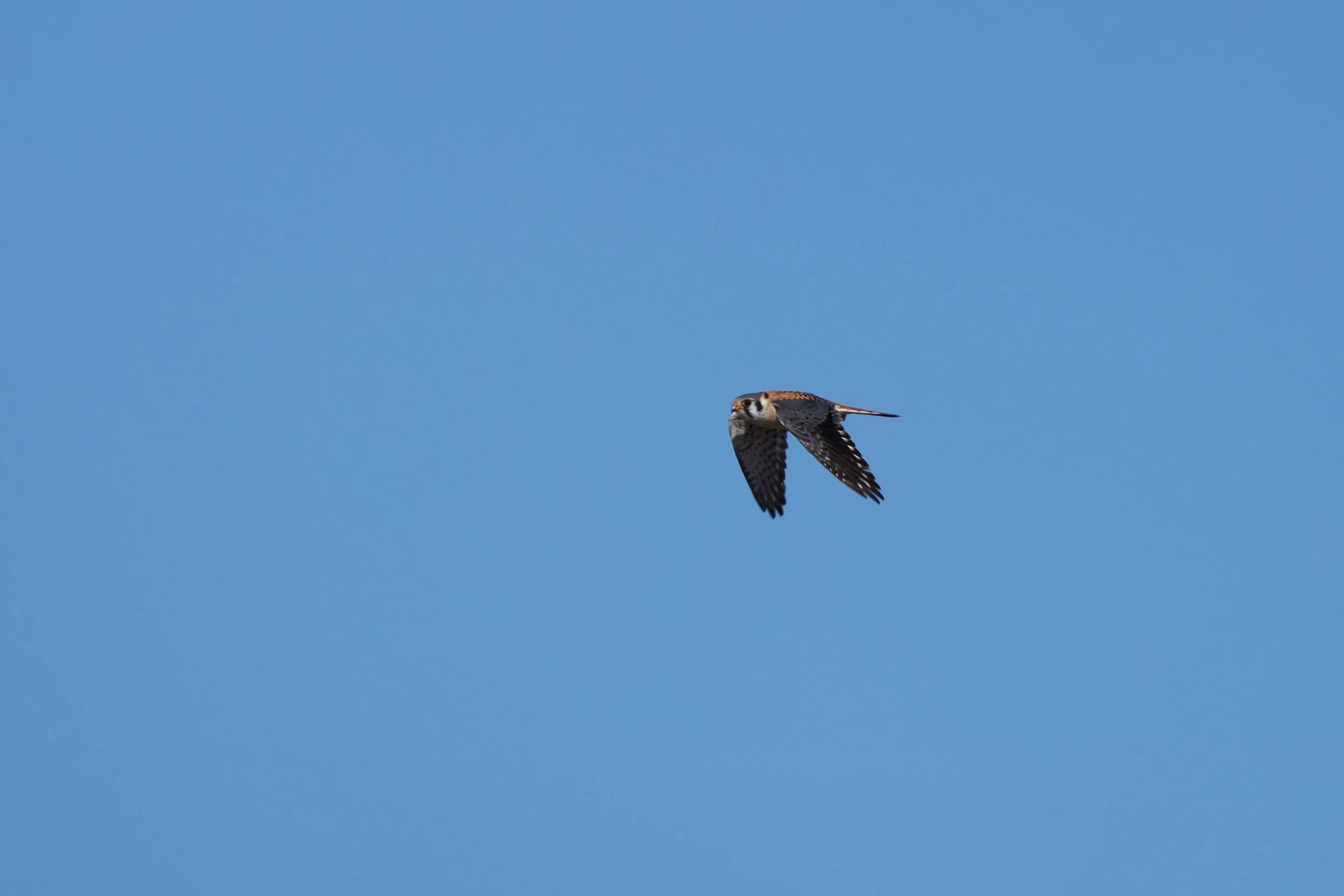
American Kestrels are North America’s smallest falcon, and although still fairly common, have faced a population decline of over 60% in the last 60 years. Some of that has to do with availability of nesting habitat. Kestrels are cavity nesters that need dead snag trees to nest and raise their young. With an increased removal of snags due to human development came an increased need for them to rely on provided housing, like nest boxes.
In 1984, Mark and Sue Martin at Southern Wisconsin Bird Alliance’s Goose Pond Sanctuary began putting up nest boxes in the sanctuary area. In 2012, they asked Brand Smith, a volunteer, to take over the Kestrel Nest Box (KNB) program. In the years since he took on the volunteer role of program coordinator, Brand has increased the number of nest boxes from 34 to 225, and from a couple of volunteers to 120!
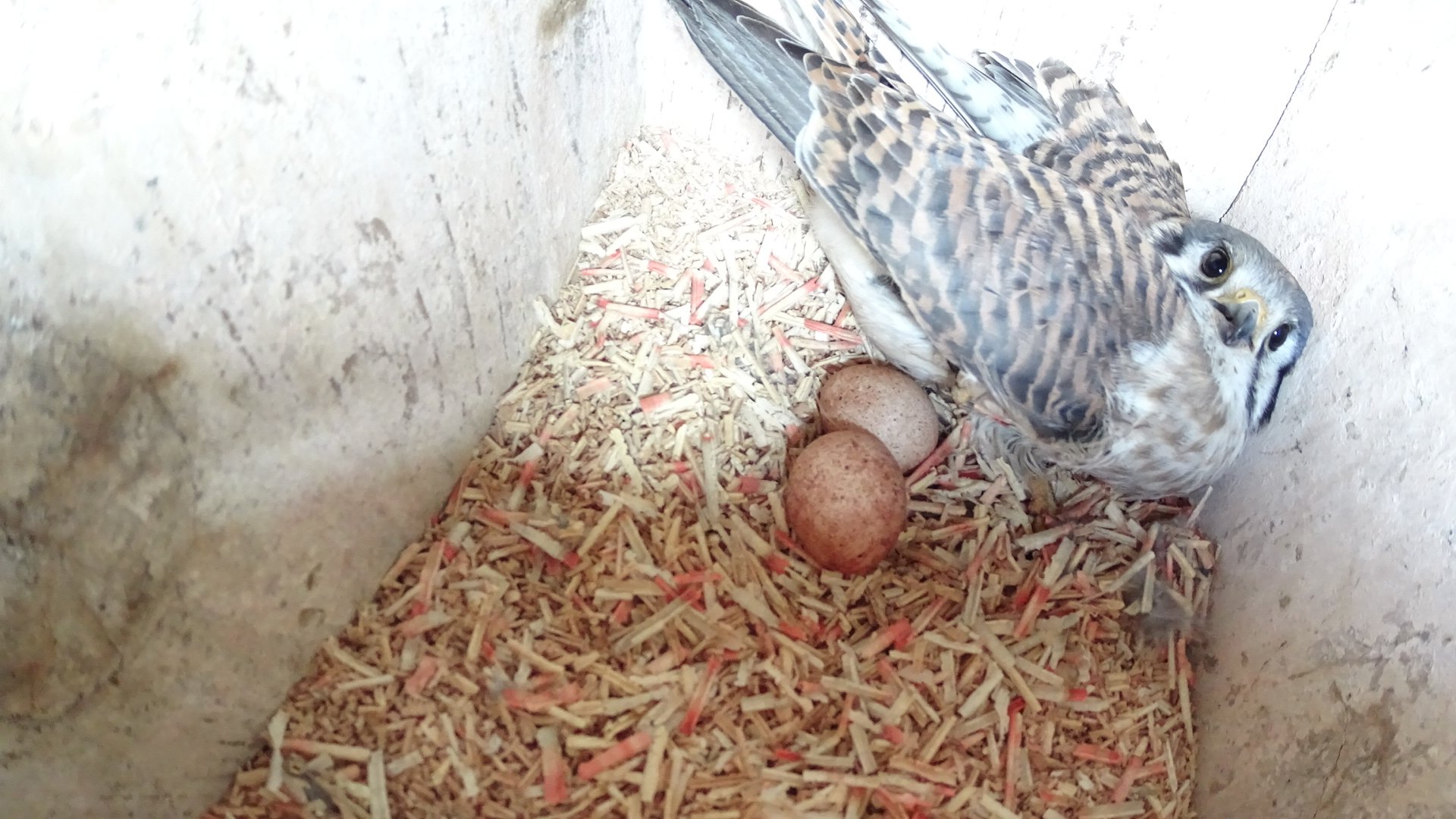
A peek into a nest box reveals a female kestrel and eggs! (photo: Kay Gabriel/KNB volunteer)
Our goals for the program are: (1) to support as many kestrels (and other native species who use the nest boxes) to nest and raise young as possible, and (2) to put an identification band on all of the kestrel chicks and as many adults as we can. The reason for doing this is to determine nest fidelity, survival estimates, and tracking movement.
Our KNB program is made up of vibrant, enthusiastic, and dedicated volunteers—including Brand, who spends hundreds of hours on checking and repairing boxes, moving or installing new boxes, banding adults, banding chicks, answering questions about kestrels, and thinking about how our data can become something bigger.
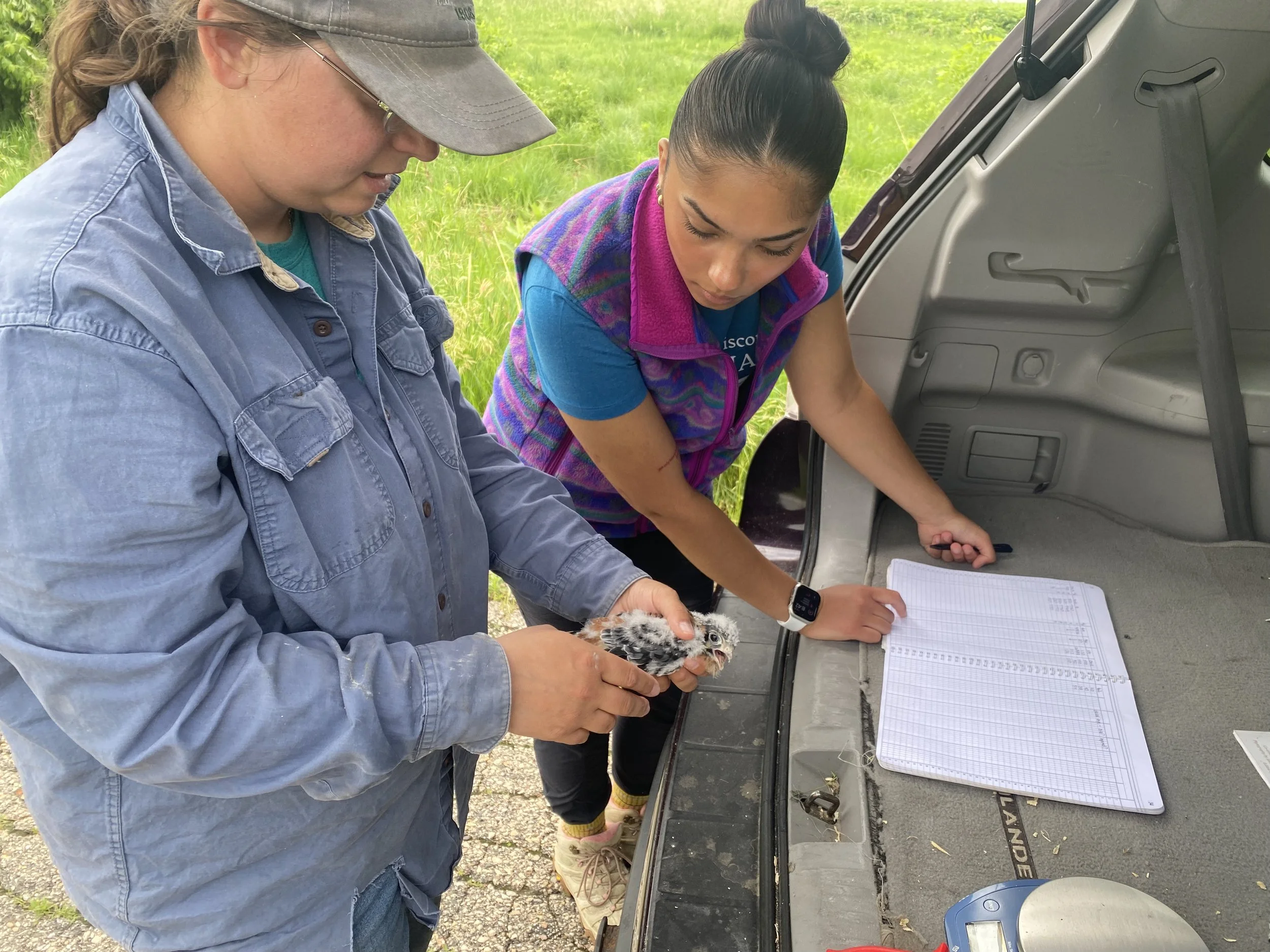
Emma Raasch holds a kestrel chick during banding while intern Aileena Ilanderage records it on a data sheet (photo: Brenna Marsicek/SoWBA).
Since 2016, we have banded kestrel chicks and adults as a way to contribute to a bigger research pool. We worked for many years with Janet and Amber Eschenbach (Central Wisconsin Kestrel Research program) to have them band for us. In 2021, Kurt Reed, a master bander, began banding with us in the Jefferson County area. In 2022, Brand became our third bander, and in 2024, Goose Pond land steward Emma Raasch became our fourth. We are able to band a lot of birds together, because of this great team!
A Surprise in a Nest Box
Like most years, the 2026 nest box season offered some interesting surprises. In addition to the 225 kestrel nest boxes our volunteers monitored, we heard from a Wood Duck box monitor near Rio that instead of a dozen or so white duck eggs in their box, they found two brown speckled kestrel eggs instead! Then, we heard from another Wood Duck box monitor at Otsego Marsh that they had four kestrel eggs in theirs, too! This is unusual because kestrels prefer grassland habitats—wide open meadows where they can hunt, whereas Wood Duck boxes are located over or very near water and are often surrounded by trees. Quite an interesting choice for those kestrels to make!
Between Brand and Emma, we were able to band the female adult kestrel at each Wood Duck box, and all of the chicks.
On the flip side, our volunteers always find that some of our nest boxes aren’t used by kestrels. Often, Eastern Bluebirds, Northern House Wrens, Tree Swallows, and Black-capped Chickadees find kestrel boxes are just right for raising their young. Once in a while, we’ll find other unusual and neat species using the kestrel boxes, like Eastern Screech-Owls, Northern Flickers, and Great Crested Flycatchers.
You never know what you’ll find when you open a nest box!
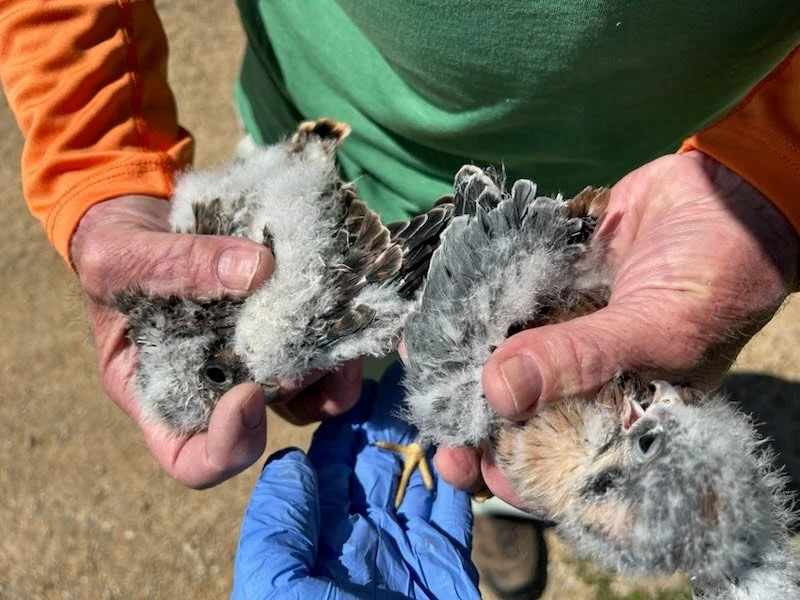
An orphaned kestrel (left) is placed in a box with similarly aged nestmates for wild fostering (photo: Huan-Hua Chye).
A Wild Foster
Every few years, we also have the opportunity to partner with the Dane County Humane Society’s Wildlife Center to place one or more kestrel chicks that were brought into their care and needed to be rehomed and raised by kestrel adults. Renesting rehabilitated chicks into an existing nest box with nestlings the same age often provides the best-case scenario for the orphan to survive as a wild bird. This is called “wild fostering.”
This year, we had the opportunity to wild foster a kestrel chick. The Wildlife Center contacted us on June 17 indicating they had one kestrel chick in their care, to see if we had any nest boxes with chicks around 18 days old. And we did! The chick was placed in box 402 near Goose Pond, and our monitors reported all four chicks—three that were originally there plus the foster—fledged from the nest box!
Good Things Come to Kestrels Who Wait
Finally, one interesting and unusual component to this year’s kestrel program was the number of late-nesting kestrels. Typically, most nest boxes have kestrel eggs laid in late March, April, or early May, with chicks fledging in May and June. As a “just in case” protocol, we ask our volunteers to check their nest boxes one last time in early July to make sure they are in fact empty.
This year, during our final box checks, three volunteers found that their boxes had new kestrel eggs in them! We believe that all three boxes were cases in which the first clutch of eggs was not viable, so the females laid a second clutch. Each box had four chicks in it, and all 12 chicks were banded and fledged.
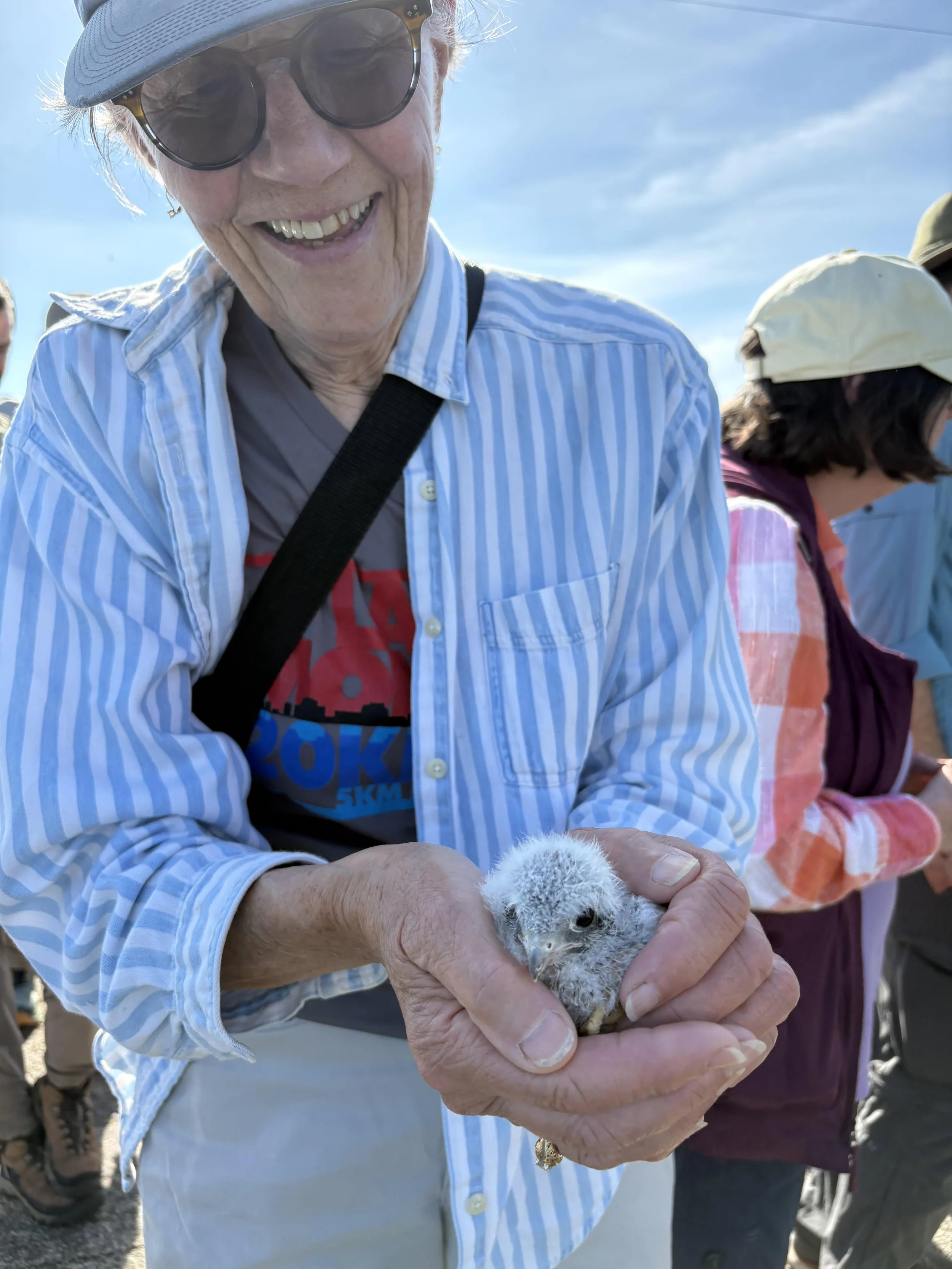
A just-banded kestrel chick (photo: Bonnie Benson).
Thank you to our volunteers!
We are grateful to all of our kestrel volunteers for their hard work and dedication throughout the season—none of this would be possible without you! A special and giant thank you goes to Brand Smith for coordinating the program, and Brand, Kurt, and Emma for taking on so many hours and communications around the banding effort.
Keep an eye on our kestrel webpage in December to sign up to help with this effort in 2027.
Written by Brenna Marsicek, director of outreach and one of the program coordinators for SoWBA’s Kestrel Nest Box Monitoring & Banding Program
Cover image: Courtney Celley/USFWS. A male kestrel zips through the sky.
Kestrel Nest Box Monitoring & Banding
2026 Season Data
Effort results
Volunteers: 120
Approximate amount of time contributed to monitoring in 2026: 922 hours
Value of volunteers’ time: $33,321 (wow!!)
Nest box monitoring results
SoWBA kestrel nest boxes available in the beginning of the season: 225
Boxes used by kestrels: 76, or 34% (annual average for our program is 32%)
Boxes used by other native species: 10 (includes Eastern Bluebirds, Northern House Wrens, and Tree Swallows)
Successful kestrel nest boxes: 71, or 93% (annual average for our program is 85%)
Nestlings that fledged from these boxes this year: 353
Nestlings that have fledged from SoWBA boxes since 2012: 2,843 (!!)
Kestrel banding results
Adults newly banded in 2026: 64 (47 female, 17 male)
Adults caught that were already banded: 43 (36 female, 7 male)
Chicks banded: 353 (161 female, 167 male)
100% chicks banded from our boxes
*All banding that occurs in Southern Wisconsin Bird Alliance’s KNB program is part of an effort to study an important species that is declining across North America. Federally-permitted researchers safely band and recapture kestrels to study the species over time. All banding, marking, and sampling is conducted under established protocols and under a federally authorized Bird Banding Permit from the USGS Bird Banding Laboratory.
