
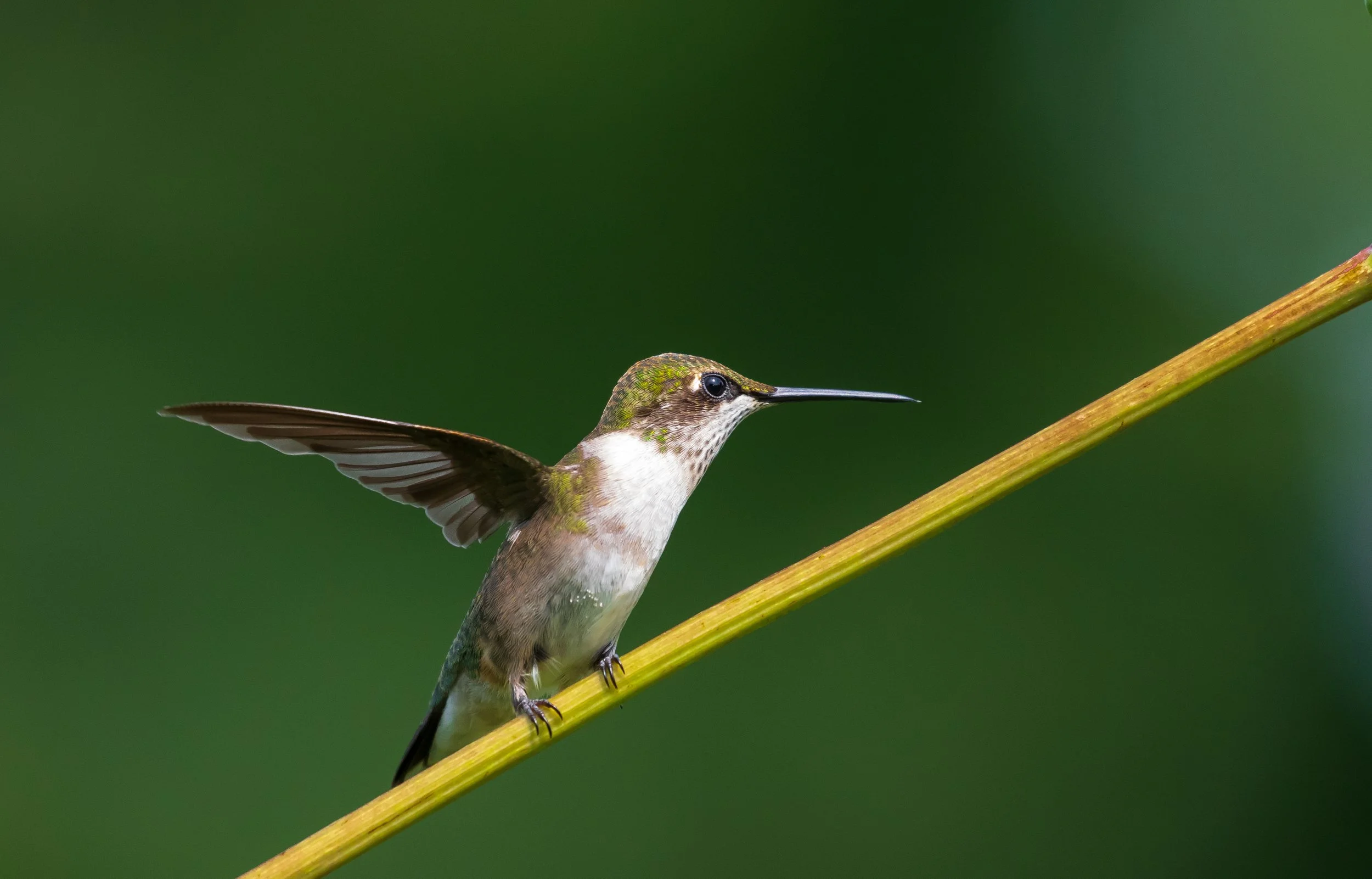

Blink and you’ll miss it! The Ruby-throated Hummingbird zips by without making a sound except for the humming of its wings. Recently, I saw two individuals chasing each other around one of Faville Grove Sanctuary’s prairie restorations. I felt quite lucky to see this display—whereas Ruby-throated Hummingbirds can be a frequent sight around sugar-water feeders, they are not necessarily a common sight in the field.

Ruby-throated Hummingbirds (photo: Monica Hall)
Watching these two birds interact with each other really made me appreciate their agility. Speeding down toward the ground, they suddenly spiraled upward in a tight corkscrew before returning back from where they came. I barely had time to realize they were hummingbirds before they were out of sight. Right next to me was a large patch of orange jewelweed (Impatiens capensis), the nectar of which is an important food source for the Ruby-throated Hummingbird, so perhaps they were quibbling over who got to feed there. Hummingbirds use their long beak and long tongue to feed on flower nectar, lapping the nectar similar to how a cat drinks. High-sugar nectar makes sense as a food source for a bird that beats its wings over 50 times per second.
Males and females of this species are similar in size, but differ in coloration. Both have a metallic green head and back with a white underside. A small patch of white feathers right behind the eye gives the Ruby-throated Hummingbird an inquisitive look. Males have a strip of black from the beak to the back of the neck, and a brilliant iridescent red on the throat gives the bird its name. The red comes from structural coloration, meaning feathers have microstructures that reflect and refract light in specific ways. Under certain light conditions, or from certain angles, the red patch may appear black because of how the light is dispersed. Females lack the red patch on the throat and have grey on their faces instead of black.
Hummingbird movement is unique in the bird world. A few different adaptations allow the hovering flight they are known for. One is the tiny size of the hummingbird (usually 3–6 grams), which makes it easier to hover or change direction suddenly. A second is their enlarged supracoracoideus (chest) muscles, which give them very strong upstrokes. Additionally, the bones of hummingbirds’ wings are modified to allow them to rotate their wings while flapping. Male Ruby-throated Hummingbirds also use these adaptations to their advantage during courtship: quickly flying back and forth in a parabola while making buzzing noises or quickly flying side to side in front of a perched female.
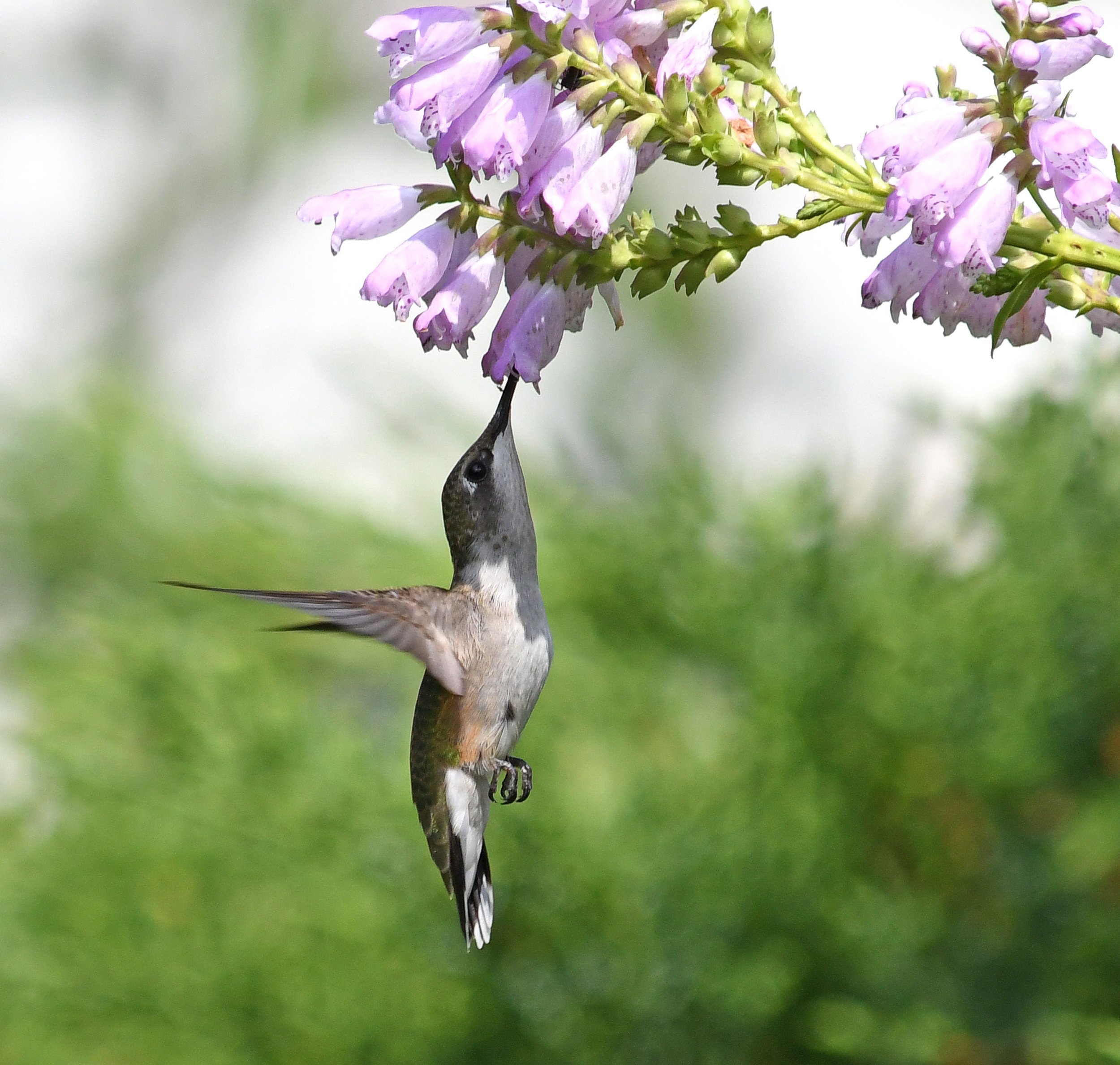
Ruby-throated Hummingbird feeding on nectar from obedient plant (photo: Jim Hudgins/USFWS).
Although male hummingbirds put a lot of effort into their mating display, their parenting skills leave much to be desired. He will depart immediately after mating, leaving the female to construct a nest and raise the chicks solo. Such a small bird needs only a small nest—usually about two inches wide and one inch deep—made of lichen, bud scales, plant fibers, and animal hairs. Into this tiny nest she lays one to three eggs,which she incubates for about two weeks. After the chicks hatch, the mother will feed them for another three weeks.
Ruby-throated Hummingbirds can be found at Faville Grove from May to September; they migrate south to spend the winter in the warmer climates of Florida and Mexico. At the sanctuary, look for them around wetland edges, like at Kettle Pond or Faville Bog, where they might be feeding on the colorful, nectar-rich blooms of cardinal flower, obedient plant, or jewelweed.
Written by Parker Gimbel, Faville Grove land steward
Cover photo: Mike Budd/USFWS. A Ruby-throated Hummingbird alights upon a narrow branch.
