

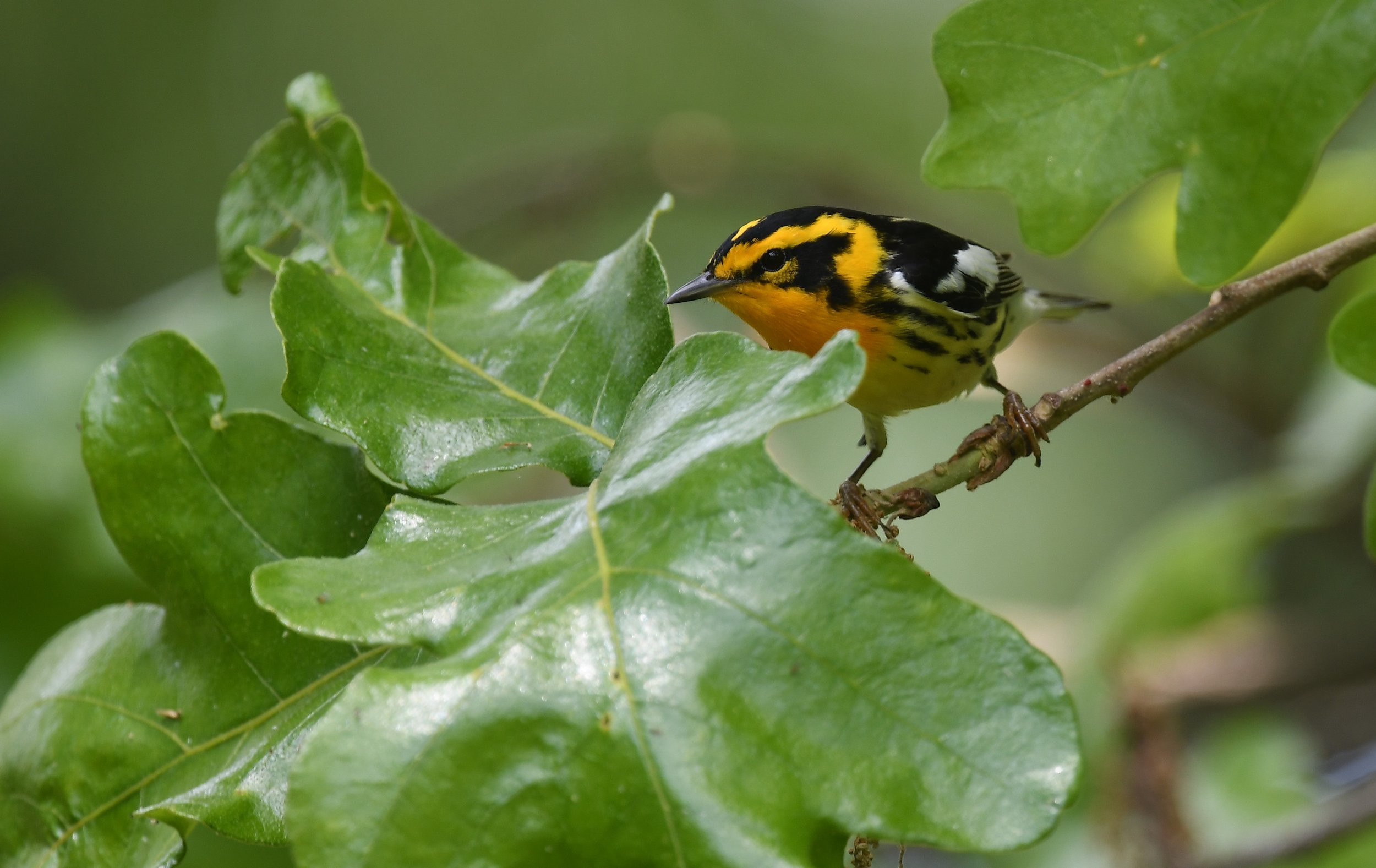
A Blackburnian Warbler in an oak tree (photo: Andy Reago & Chrissy McClarren).
In 2016, Heather N’te Inzalaco, a graduate student from the University of Wisconsin–Madison conducted a bird survey using point counts as her masters project. The areas surveyed included Southern Wisconsin Bird Alliance (SoWBA) properties around Goose Pond Sanctuary and the property of a private landowner named David Gunnulson, which SoWBA was looking to potentially purchase at the time (the organization acquired the land in 2024 and it became Hillside Prairie Sanctuary in 2025). What Heather found helped guide management decisions on these lands for years to come.
Now, ten years later, I conducted similar point counts to learn what birds can be found on these properties to reflect how management decisions have affected bird populations and how we can make informed management decisions going forward. I covered the same areas that Heather surveyed, as well as some new areas that had been purchased by SoWBA since 2016.
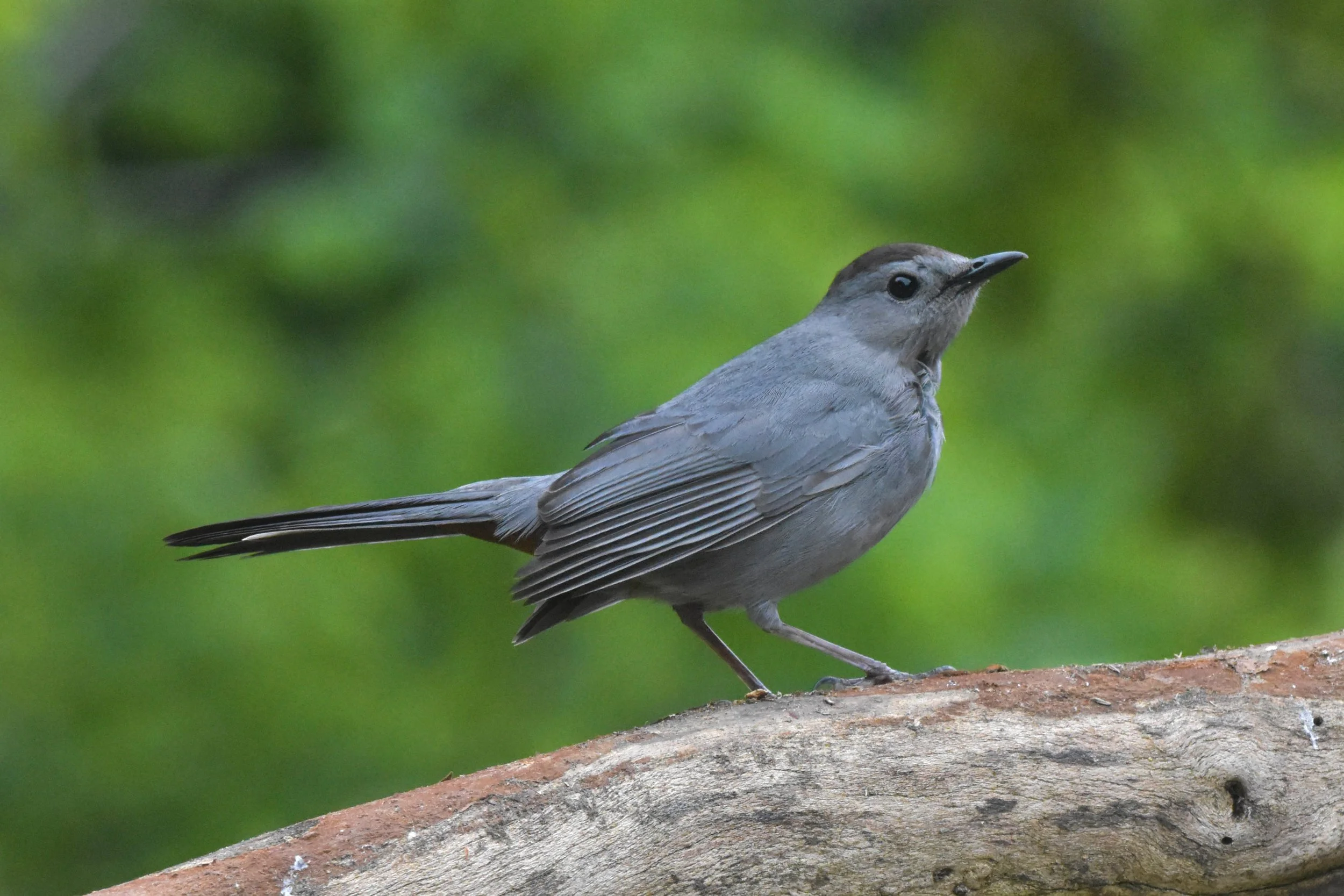
Gray Catbird perched on a branch in a wooded area (courtesy of Pixabay).
The findings of my survey are already being used to guide management decisions, such as influencing the conversation about exterior fence lines at Hillside Prairie. Originally, the idea was to remove any surrounding trees that were between the grasslands and adjacent farm fields. However, I found that species such as Baltimore Orioles, Orchard Orioles, Brown Thrashers, and Gray Catbirds were utilizing these exterior fence lines. This knowledge contributed to the management decision to keep some of the exterior fenceline trees standing as a buffer, which will also provide habitat for these birds.
My surveys have also helped provide baseline data about the wooded areas at Hillside Prairie. The American Bird Conservancy (ABC) is providing SoWBA with a grant to restore over 40 acres of oak savanna and open oak woodland habitat. My data are being used as a baseline to see what birds are already in the area—this will help SoWBA and ABC see what management practices are effective.
My point counts also included some surprising findings. I was able to find two species of birds that had never been recorded at Goose Pond Sanctuary (Eastern Whip-poor-will and Magnolia Warbler) and five species of birds that had never been recorded at Hillside Prairie (Canada Warbler, Blackburnian Warbler, Bay-breasted Warbler, Yellow-throated Vireo, and Yellow-bellied Flycatcher). Each of these findings are pretty significant for different reasons. It is really valuable to find new birds at Goose Pond because people have been recording bird sightings there since 1958 (with over 240 species documented on eBird). For Hillside Prairie, it is valuable for almost the exact opposite reason. Sightings have only been recorded there since 2021, meaning that I am helping more thoroughly document bird species on a lesser-known property, creating a more comprehensive picture of the ecosystems there.
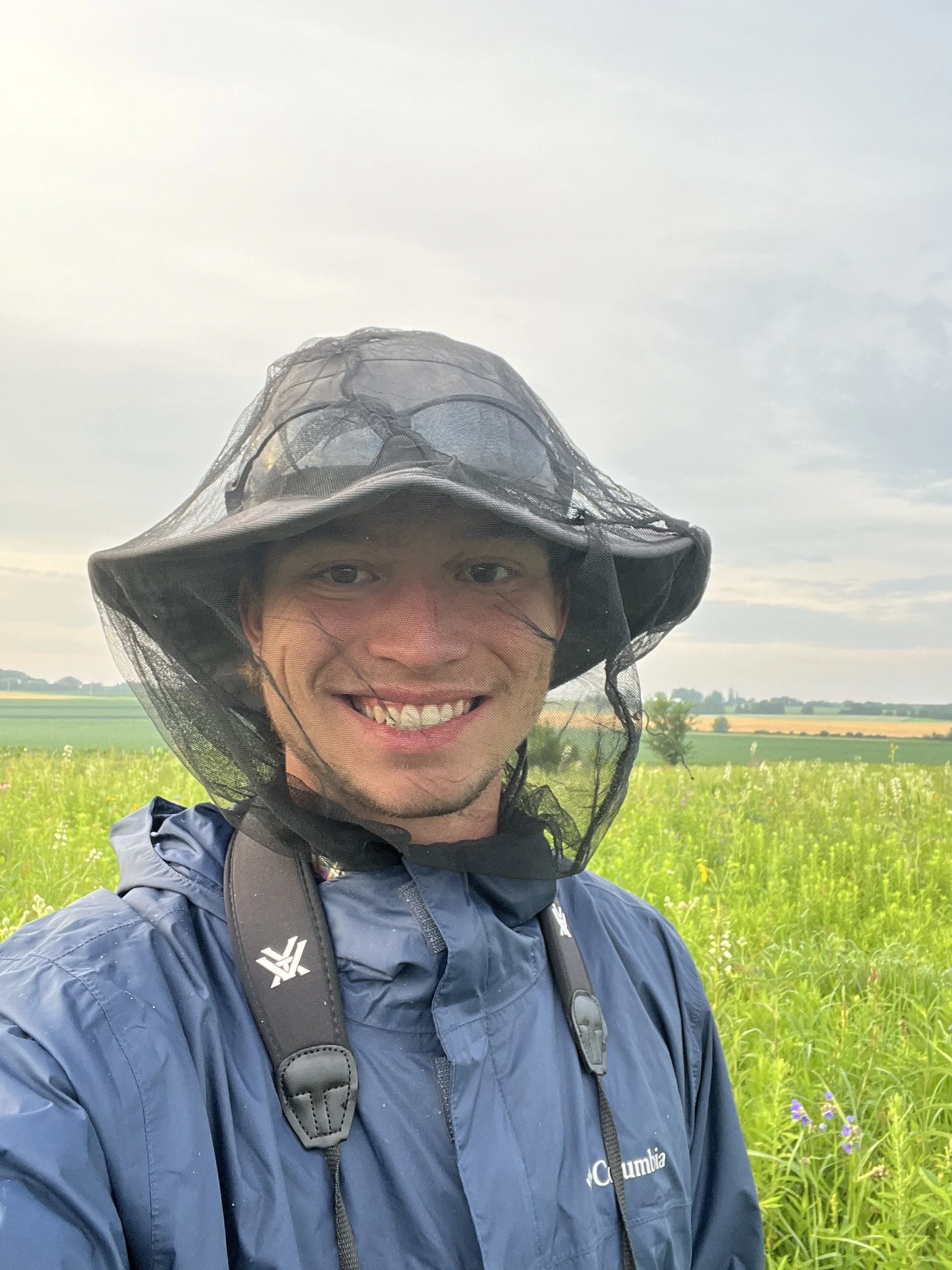
Andy conducting point counts at Hopkins Prairie at Goose Pond Sanctuary (courtesy of Andy Smith).
Some of my surveys also documented new high counts of birds. High counts are important to know because they give a feel for how many birds of a certain species a property can hold at one time. At Goose Pond, I recorded or tied the high count for 10 species; at Otsego Marsh, for 23 species; and at Hillside Prairie, for 31 species. It makes sense that I got so many high counts because I was doing some of the most extensive birding on these properties that anyone has ever done.
I taught some of SoWBA’s other interns—Goose Pond interns Eva Weddell and Raquel Bello, and Diversity in Conservation intern Aileena Ilanderage—about the work I was doing by taking them out in the field with me for a single day of point counting each. It was a good learning opportunity for all of us.
Across my survey, I found a lot of really interesting things at Goose Pond Sanctuary and SoWBA’s Columbia County properties. It felt like every day I found something exciting, odd, or thought-provoking. Here are just a few:
An unusual visiting goose: Snow Geese do not breed in Wisconsin and can normally only be seen during spring and fall migration. However, on June 6, I found one at Goose Pond. I saw it from a distance hanging out with about 25 Mallards. Mark Martin suspected that the bird was an older or injured individual that was unable to complete its northward migration.
A big day for warblers: If you are able to find the right place at the right time on a spring day in Wisconsin, you will be greeted by some of the most vibrant birds that spring migration has to offer. Luckily for me, Otsego Marsh on May 20, 2026 at 5AM was the right place and right time—I found 14 beautiful migratory warbler species. The sheer numbers I found were also very exciting—I counted 76 individual warblers that day. It was really fun and chaotic trying to write down all of the birds as I saw and heard, and that day ended up being one of my favorite days of the season.
An unexpected finding: There is a dead tree in the area of the pond at Erstad Prairie that is visible from almost anywhere on the property. When I arrived on June 3, I saw five to ten larger birds sitting in that tree that I figured were crows. The tree was not near any of the points that I was starting with, so I went along my way and really did not think much of it. I finally got to my last point near the tree and took a closer look—only to realize that it had not been crows but rather seven Green Herons! This was the most Green Herons that I had ever seen at a single time and the first time that I had ever seen them roosting.
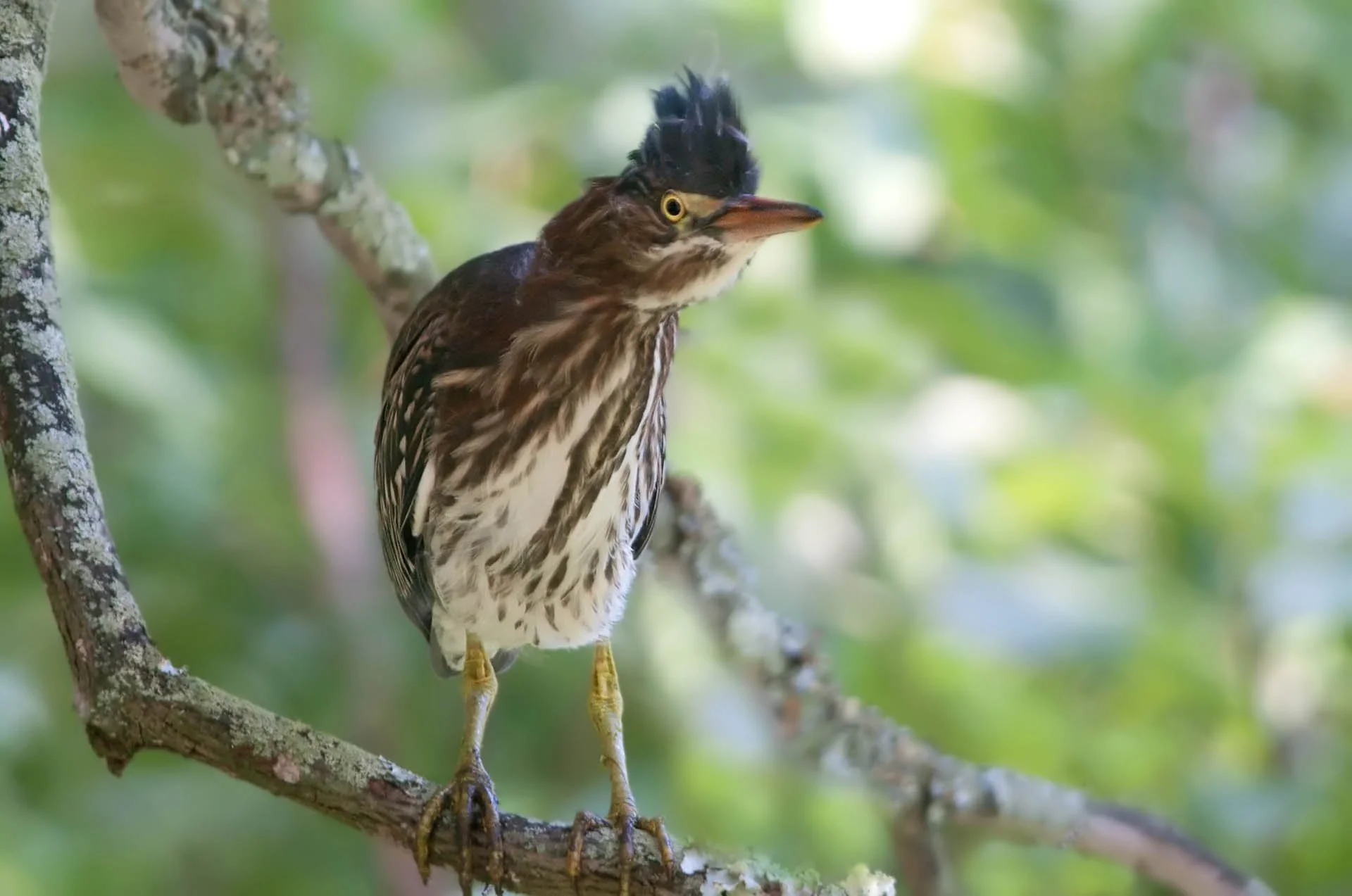
A juvenile Green Heron in a tree (photo: Kelly Colgan Azar).
I had an amazing experience this summer conducting my surveys. If you were to have asked me when I was still in grade school what my dream job would be when I grew up, I would have told you almost exactly what I ended up actually doing this summer: being outside and looking for birds. The surveys taught me so much about doing environmental science at the highest level, and I am excited to see how the data that I have collected this summer will be used for management decisions at SoWBA properties going forward.
I would like to say thank you to SoWBA; my advisor and Goose Pond Sanctuary manager Mark Martin; Goose Pond land steward Emma Raasch; former land steward Graham Steinhauer; and Heather N’te Inzalaco for making this possible.
Written by Andy Smith, Goose Pond intern
To read a draft PDF of Andy’s full report from summer 2026 bird count surveys, click here.
