

“The Lincoln Sparrow in his summer home . . . bursts upon you in a torrent of music, a flood which leaves you fairly gasping. This little, slinking, bird-afraid-his-shadow gets all at once the courage of mighty convictions . . . though he still skulks and evades.”
It’s a crisp October morning, and I’m out birding in the prairie, looking for fall migrants, especially sparrows. I spot a solitary Song Sparrow and a few White-crowned Sparrows, both juveniles and adults, but now I see the sparrow that I am most eager to find—a Lincoln’s Sparrow!
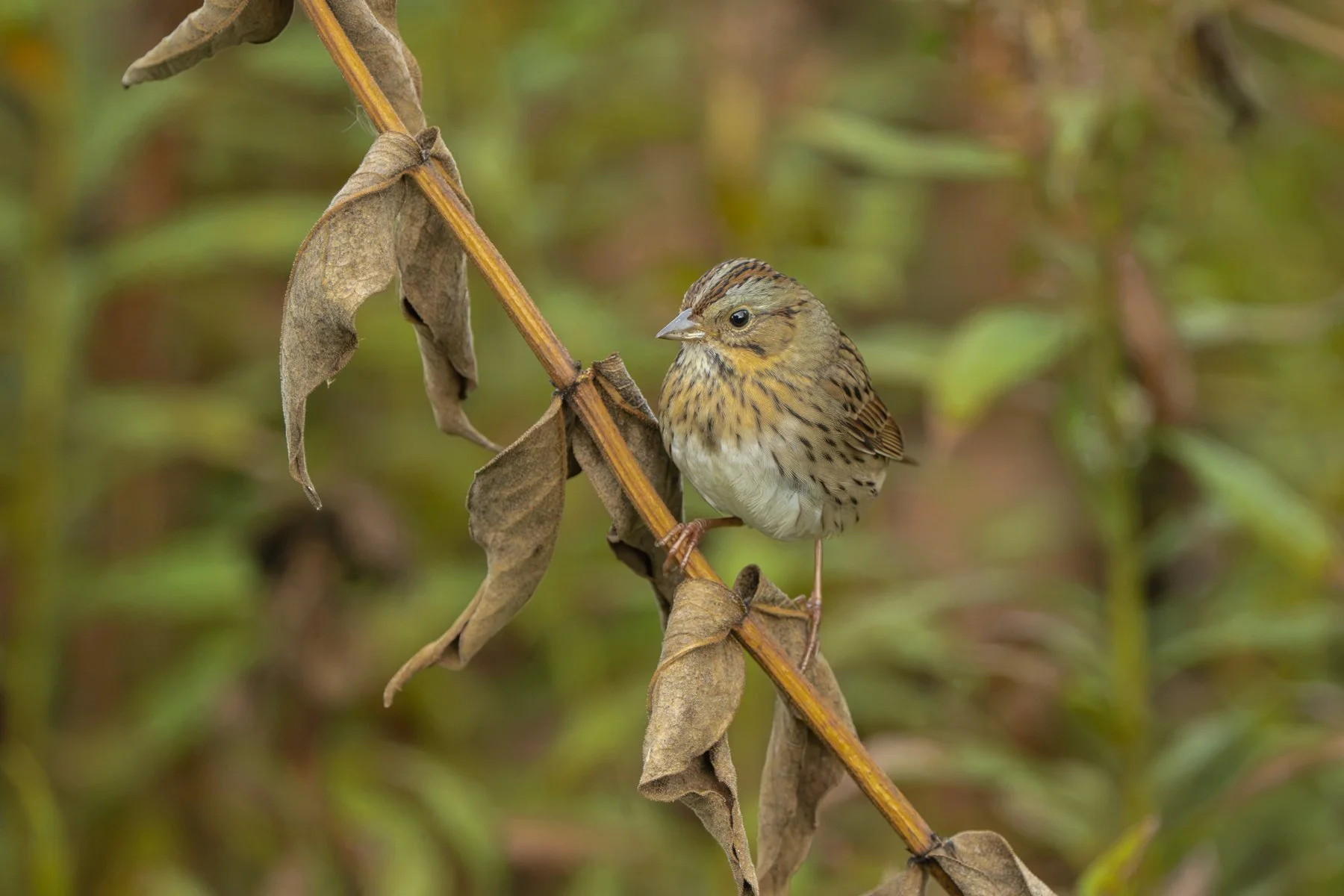
Lincoln’s Sparrow perched on rosinweed in the prairie during fall migration. The streaks on the chest are coalesced into an ill-defined central spot. This individual may be a first-year bird, as it is overall browner than a typical adult. (Photo: Gary Shackelford)
The Lincoln’s Sparrow (Melospiza lincolnii) is most closely related to the Song Sparrow and Swamp Sparrow, the only birds that are included in the genus Melospiza. The species was first described by John James Audubon in 1834 and named after Thomas Lincoln, who accompanied Audubon on an 1833 expedition to northeastern Canada and collected the first specimen. At Fair Meadows Sanctuary, Song Sparrows and Swamp Sparrows are residents during breeding season and occasionally during winter, but Lincoln’s Sparrows are here only during spring and fall migration. Their breeding range is primarily subarctic and subalpine, including the montane western United States. Northern Wisconsin is near the southern limit of their breeding range in the eastern US.
Lincoln’s Sparrows are secretive birds, famously described by Roger Tory Peterson in his field guides as “a skulker, afraid of its shadow” in referencing the quote from William Dawson’s book on California birds. They rarely stray from cover on their breeding grounds, but during migration they can be found in more open areas. They are usually seen as solitary individuals or as members of a small, loosely aggregated group, similar to the other two Melospiza species. We most frequently observe Lincoln’s Sparrows at Fair Meadows during fall, when they forage in our prairies, seeming to favor the seeds of Indian grass.
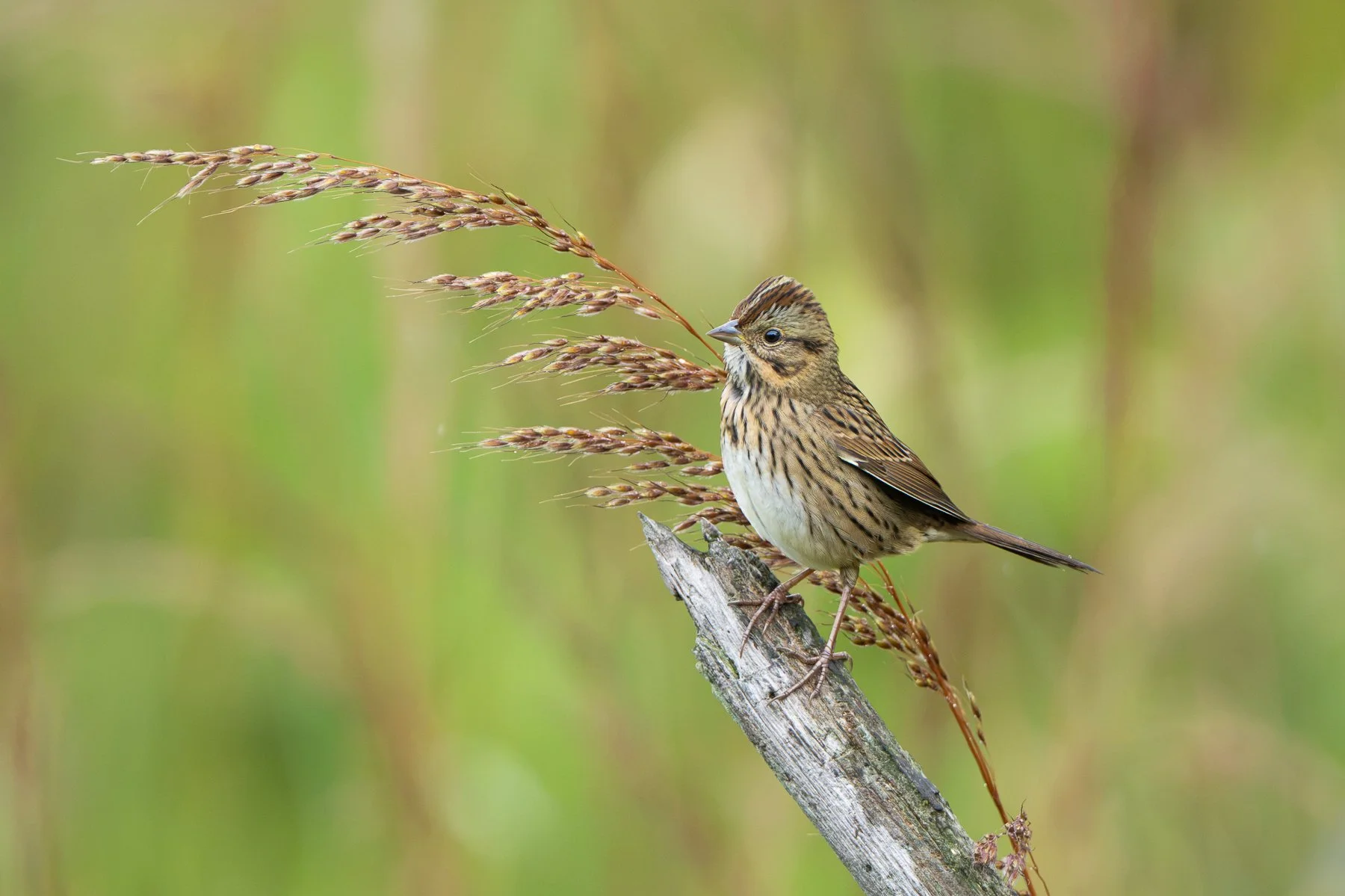
Lincoln’s Sparrow in the prairie during fall migration, perched near Indian grass, whose seeds are a favored food. Note the buffy chest and flanks with thin, sharply defined streaks, the gray face, narrow eye ring, white throat, buffy malar band, and ruddy brown crown with fine black streaks and a central gray stripe. The crest is slightly raised. (Photo: Gary Shackelford)
Male and female Lincoln’s Sparrows are similarly marked. They are strikingly handsome, and when seen well, the plumage of adults is distinctive. They exhibit fine streaking above and below, a gray face, thin buffy eye ring, and a ruddy brown crown with fine black streaks and a gray median stripe. The fairly long, ragged crest is often raised. The malar region stands out as a prominent buffy band. The breast and sides of the belly are buffy, contrasting with a white throat that is usually finely streaked. Black streaks on the breast and flanks contrast with the underlying buffy color and are so fine that they suggest being drawn with a sharpened pencil. On some individuals the streaks may form a central breast spot, but the spot is never as pronounced as it is on Song Sparrows. The rich, complex song that is referred to in the Dawson quote above is rarely heard away from their breeding grounds. Vocalization during migration is most often a sharp chip.
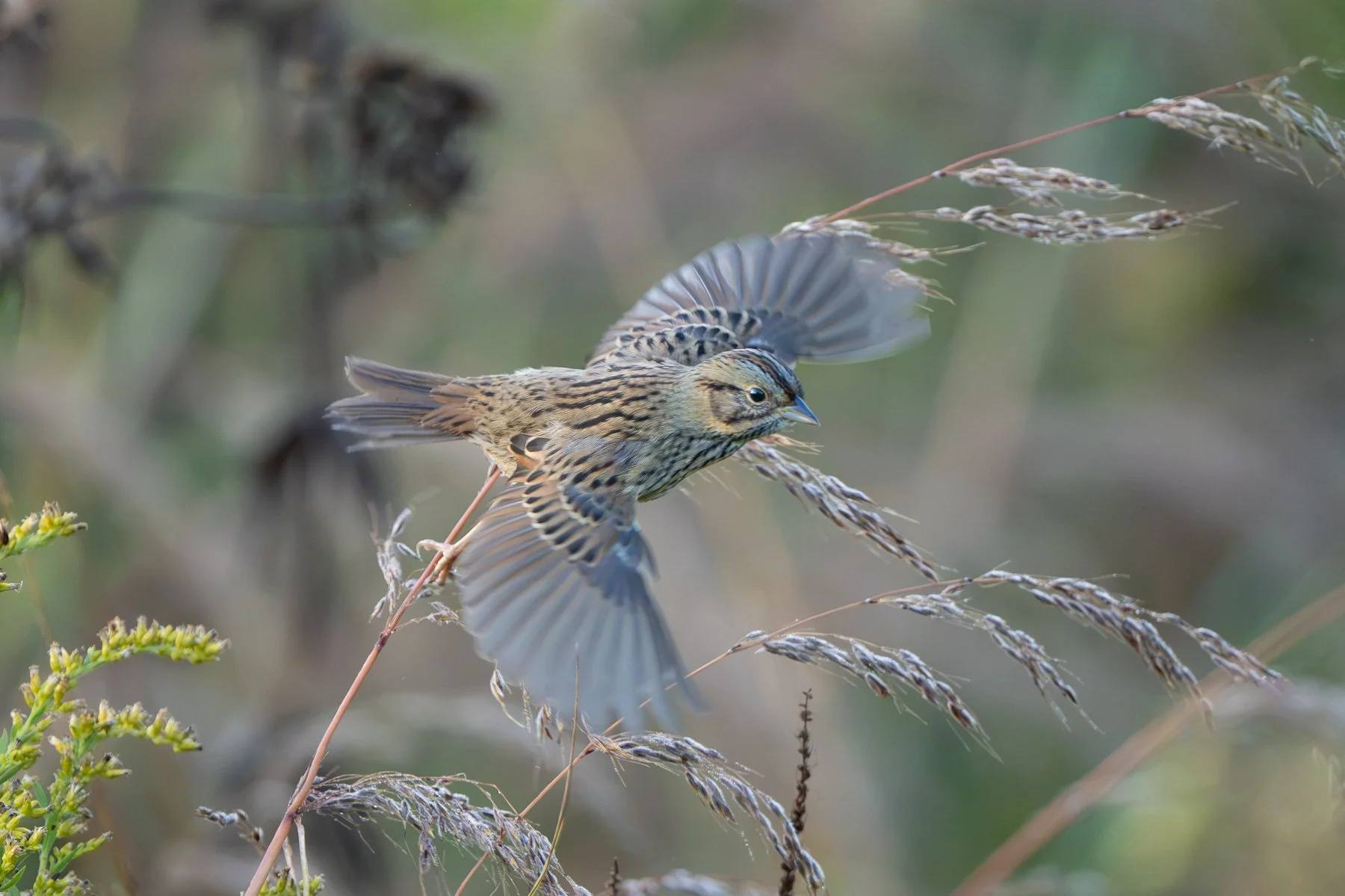
Lincoln’s Sparrow in flight in the prairie during fall migration. Note the tail feathers, which are molting and being replaced by emerging feathers that are rufous with dark central streaks. (Photo: Gary Shackelford)
Native sparrows can be an attraction to birders for a variety of reasons. To some people, they are dismissed as “Little Brown Jobs” (LBJs). Others are drawn to sparrows as consummate identification challenges. Nuanced markings that may be helpful include complex patterns of streaks, spots, and delicate lines. Features such as beak size and shape, presence or absence of an eye ring, tail length, and habitat may have special significance, and familiarity with their vocalizations can be very helpful. Even brown can be subtly beautiful, and to me, the penciled black breast streaks set against a warm, buffy background, the cool, gray facial markings, and the warm chestnut crown infused with black streaks are an embodiment of understated elegance. The Lincoln’s gets my vote as the most beautiful sparrow of them all.
Written by Gary Shackelford, Fair Meadows sanctuary manager
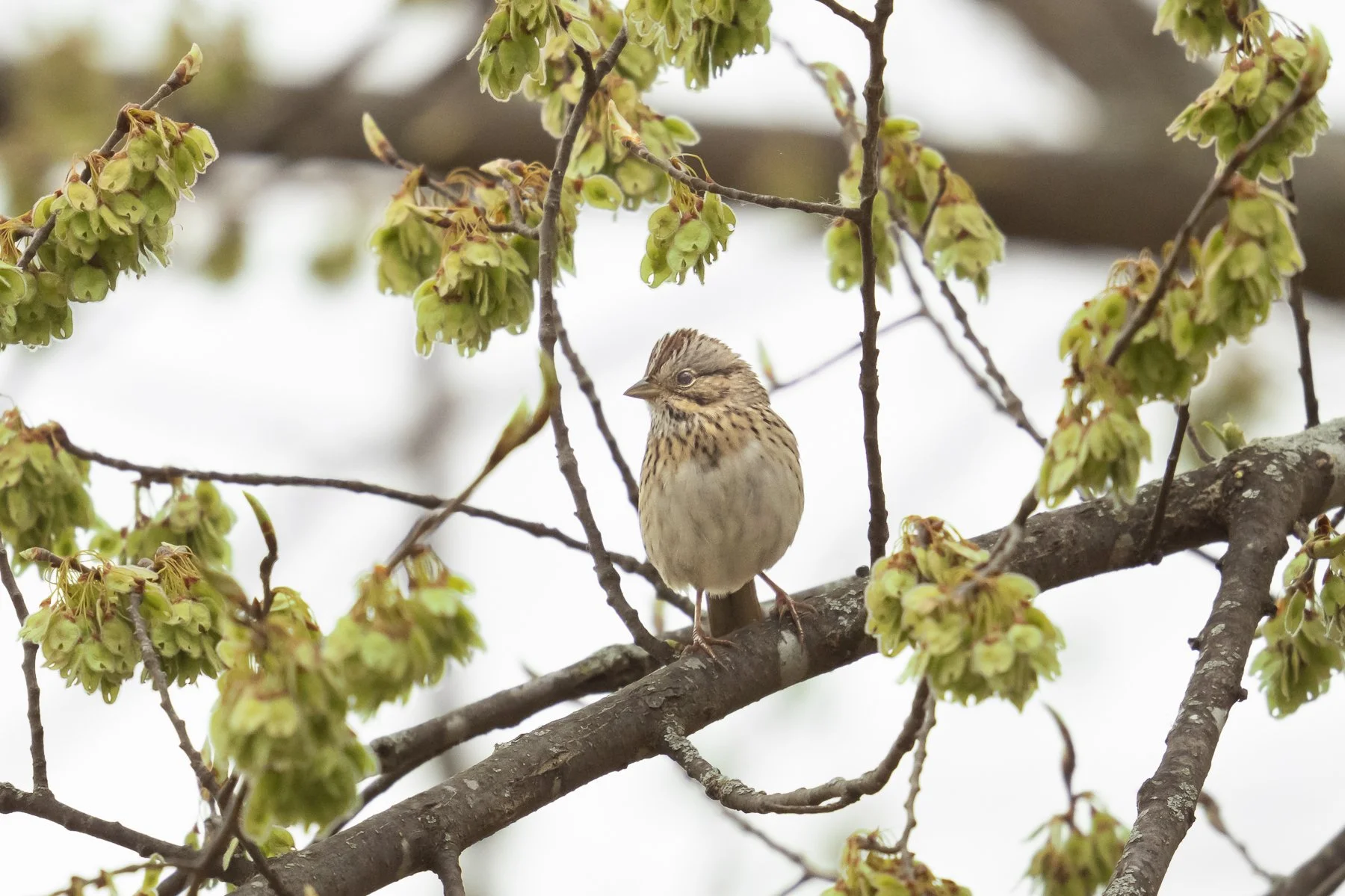
Cover photo by Gary Shackelford. Lincoln’s Sparrow perched in an elm tree during spring migration.
