

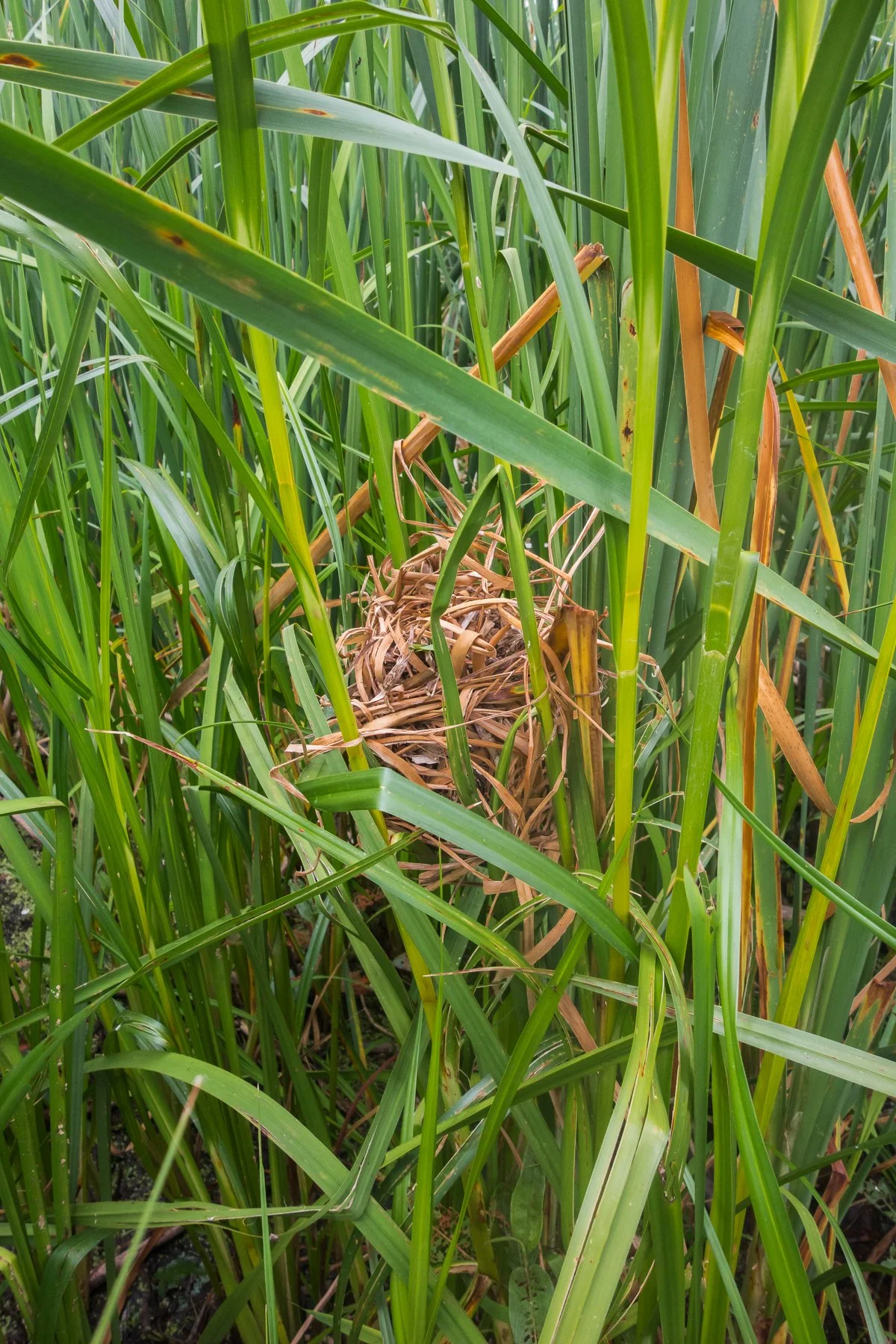
A nest built by a Marsh Wren at Fair Meadows (photo: Gary Shackelford).
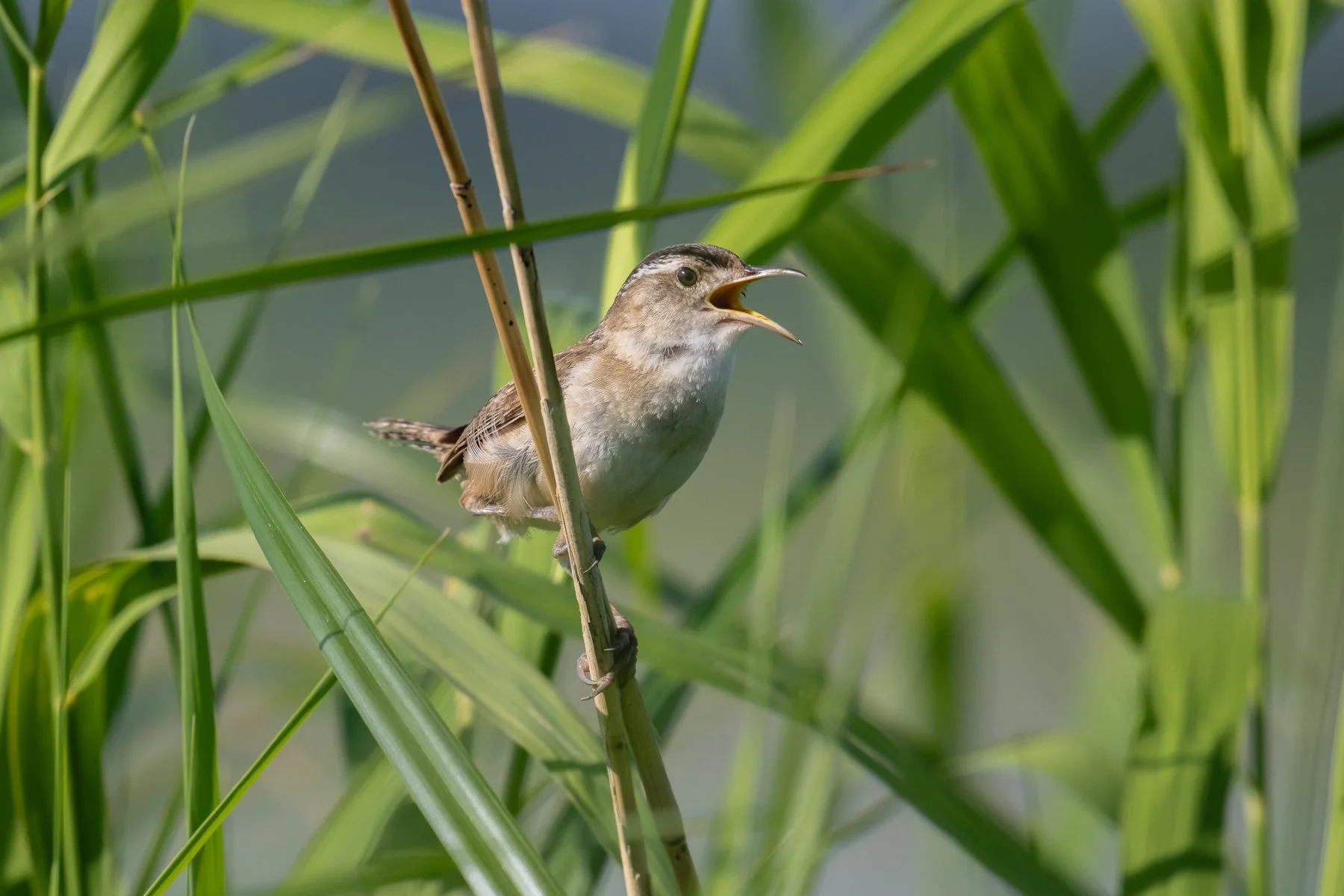
As my kayak slides through a wetland on a lovely day in May, I am on the lookout for ducks, terns, herons, and maybe even a bittern. My concentration is interrupted by a persistent, buzzy chattering. I try to locate the source, but it seems to be on the move. I give up and glide on, but another call erupts from the next clump of cattails. Finally, I see a “lump” in the cattails, about the size and shape of a football. It’s a nest that belongs to the caller—a Marsh Wren.
Eventually, I do see the busy singer, moving from cattail to cattail. The small brown bird has a dark cap, white stripe over the eye, white throat, buffy sides, black and white stripes on the middle of its back, and a barred tail.
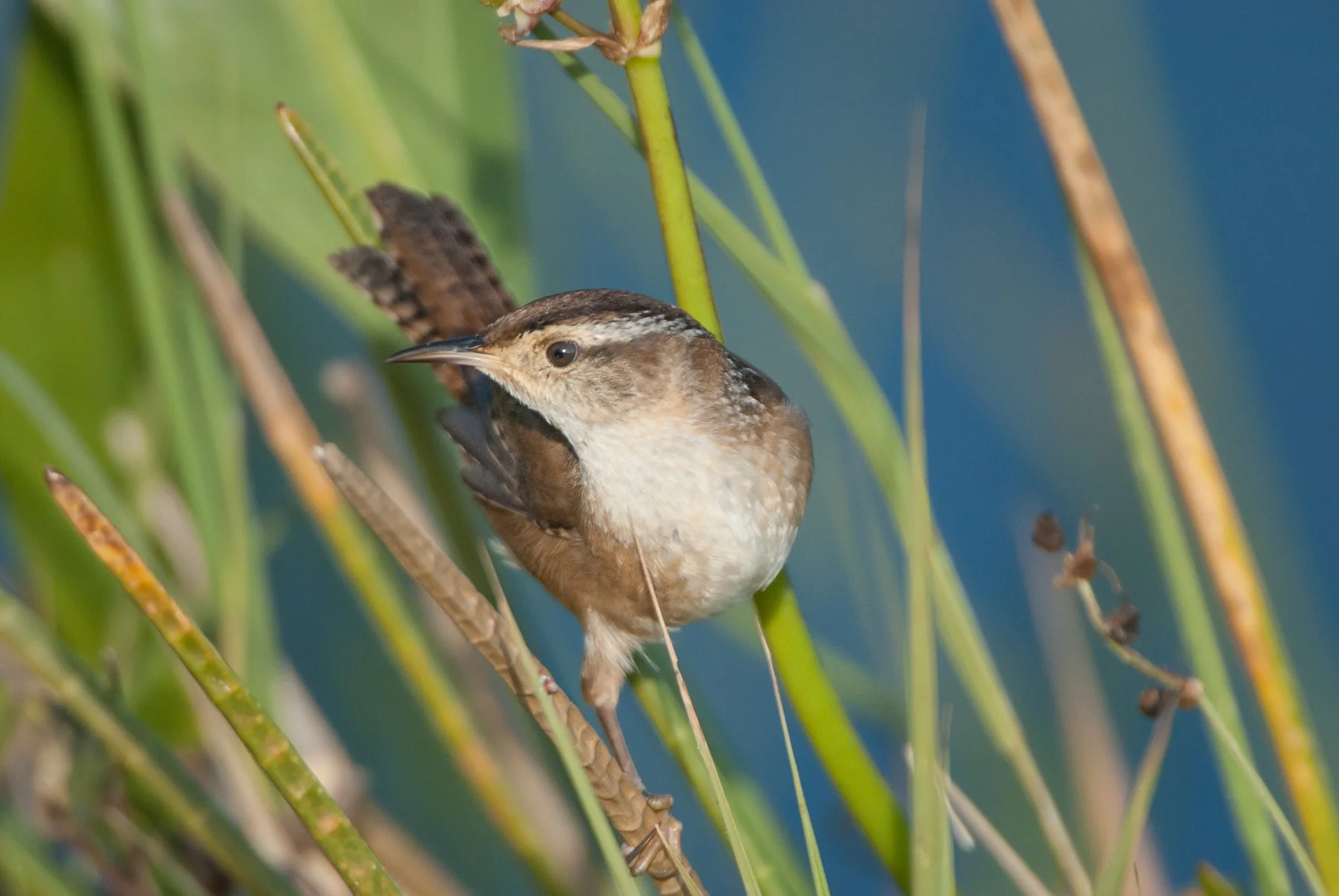
Note the Marsh Wren’s white stripe over the eye, white throat, buffy sides, barred tail (photo: Gary Shackelford).
The marsh at Fair Meadows has many Marsh Wrens, most easily seen in the emergent vegetation that rings the open water in the middle of the marsh. Like other wren species, these busy little birds each build multiple nests, most of which are dummy nests. Building dummy nests is one of several behaviors that makes sense for a bird that is polygynous. Each male mates with two or more females. Therefore, he must vigorously defend his territory, building multiple nests, singing frequently, and even destroying the eggs of other Marsh Wrens or other bird species.
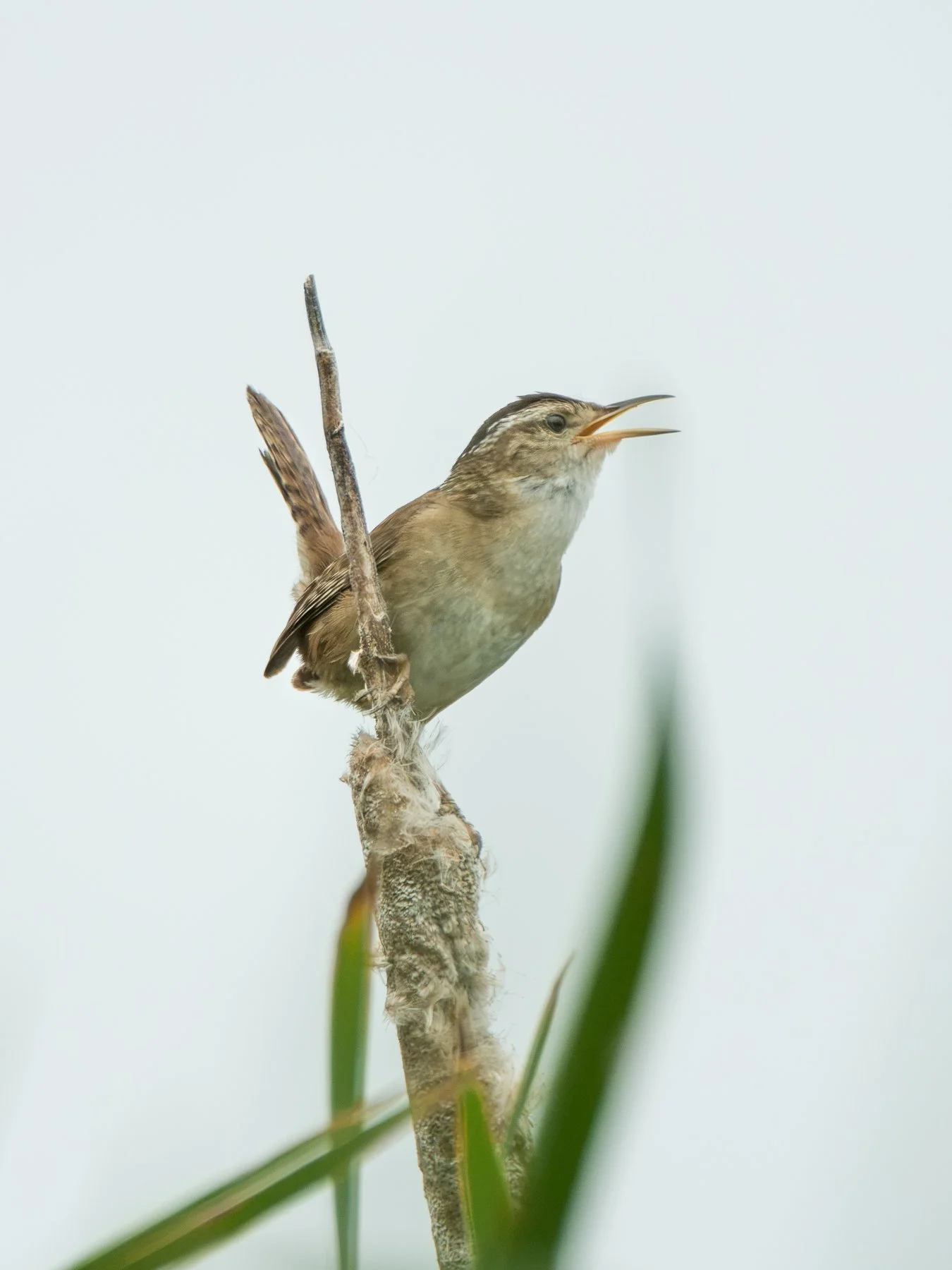
During breeding season, Marsh Wrens may sing day and night (photo: Gary Shackelford).
Until about 20 years ago, this species was called the Long-billed Marsh Wren to distinguish it from the Short-billed Marsh Wren—now named the Sedge Wren. This was a good name change: Sedge Wrens always prefer wet prairies or sedge meadows, and, unlike the Marsh Wren, are never found in the bulrushes or cattails of the marsh. Fair Meadows has an abundance of both species, and they reside quite faithfully in their namesake habitats!
New technology to study bird song has revealed that the apparently simple, unmelodic song of the Marsh Wren is one of the most complex of all bird songs. Studies have shown that a young male Marsh Wren learns 50 to 200 different songs, beginning at about three weeks of age and continuing through his entire first year. Interestingly, if he is reared hearing the song of other bird species, he will learn to sing those songs instead. The Marsh Wren’s vocal learning is also exhibited through geographic variation in their songs and by matched countersinging between males—“contests” in which one male will repeat each song sung by another in an adjacent territory, often utilizing multiple types of song in close succession.
Marsh Wren countersinging (Thomas J Sander, Macaulay Library)
My day in the marsh also revealed a diving Osprey, Black Terns visiting their floating nests, American Coots, and Mallards, but I was most satisfied when I was finally able to spot one of those loud but elusive Marsh Wrens.
Written by Penny Shackelford, Fair Meadows sanctuary manager
Cover photo by Gary Shackelford. A Marsh Wren sings from a perch on a cattail.
