
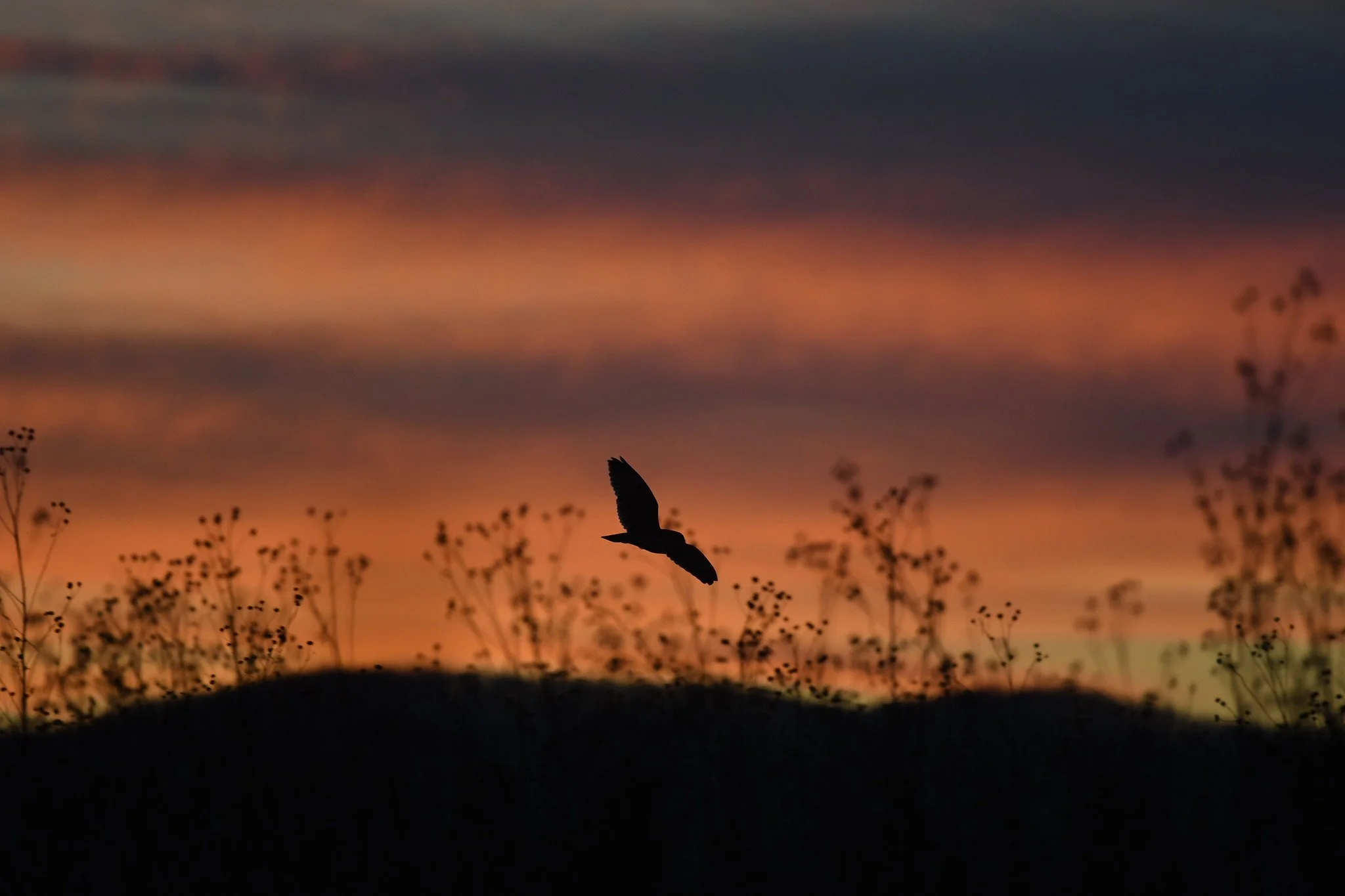

In September, while seed collecting in Charles Prairie, something large burst out from behind a clump of sedges in front of me. I jumped in surprise as the Short-eared Owl I had nearly stepped on let out a territorial bark. I’m not sure who was more startled between the two of us, and found myself locked into a staring contest which the owl was certainly winning. The eyes of a Short-eared Owl epitomize the word “piercing”: two yellow irises circled with thick black eyeliner and set in a pale face framed with a crisp white border. With eyes like that, it’s easy to understand why owls were avatars of wisdom and courage throughout human history.
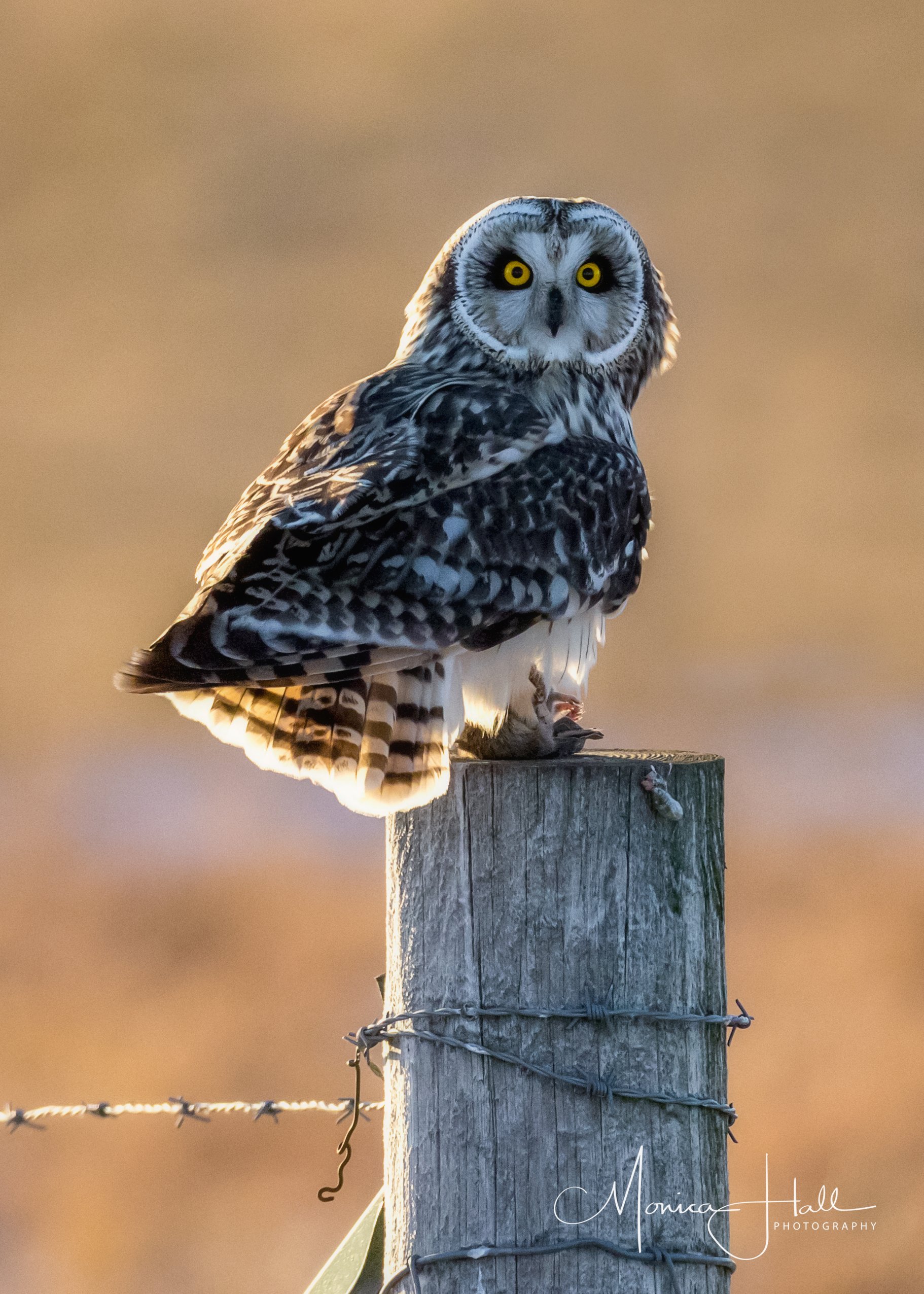
A Short-eared Owl perched on a post with prey. Note the facial disk and piercing yellow eyes (photo: Monica Hall).
Apart from their territorial calls and courtship displays, Short-eared Owls hardly make any noise at all. To aid in hunting, owls are specially adapted for silent flight. Their outer wing feathers are intricately serrated to break up turbulence in the air and quiet airflow around their bodies. When they fly low to find a meal, they are primarily listening for their prey rather than looking. Their facial disk of feathers, a trait unique to owls and harriers, is shaped to conduct sound waves to their ear openings on the sides of their head. (The namesake tufted “ears” on top of their head are just display feathers.) These ear holes are at asymmetric positions on their heads, one higher and one a little further forward than the other. Asymmetric alignment allows their ears to very quickly triangulate noises and locate fast moving prey. They can hear the soft rustle of a vole in grasses dozens of feet below them, but the vole doesn’t hear a thing.
These owls are most common at Faville Grove during winter, soaring over the floodplain off of Prairie Lane at twilight. They can be identified from afar by their “mothlike” flight pattern, irregularly beating their wings and flying low to search for food. They are nomadic birds who follow small mammal populations and whose numbers fluctuate in accordance with the abundance of their prey. In the northern US, Short-eared Owls compete with Northern Harriers for food and both can be seen gliding low to the earth in their hunt. In the evening when the two species are active, conflict can break out. After a chase and a mid-air grapple, sometimes an owl will lose a fresh catch to a thieving harrier.
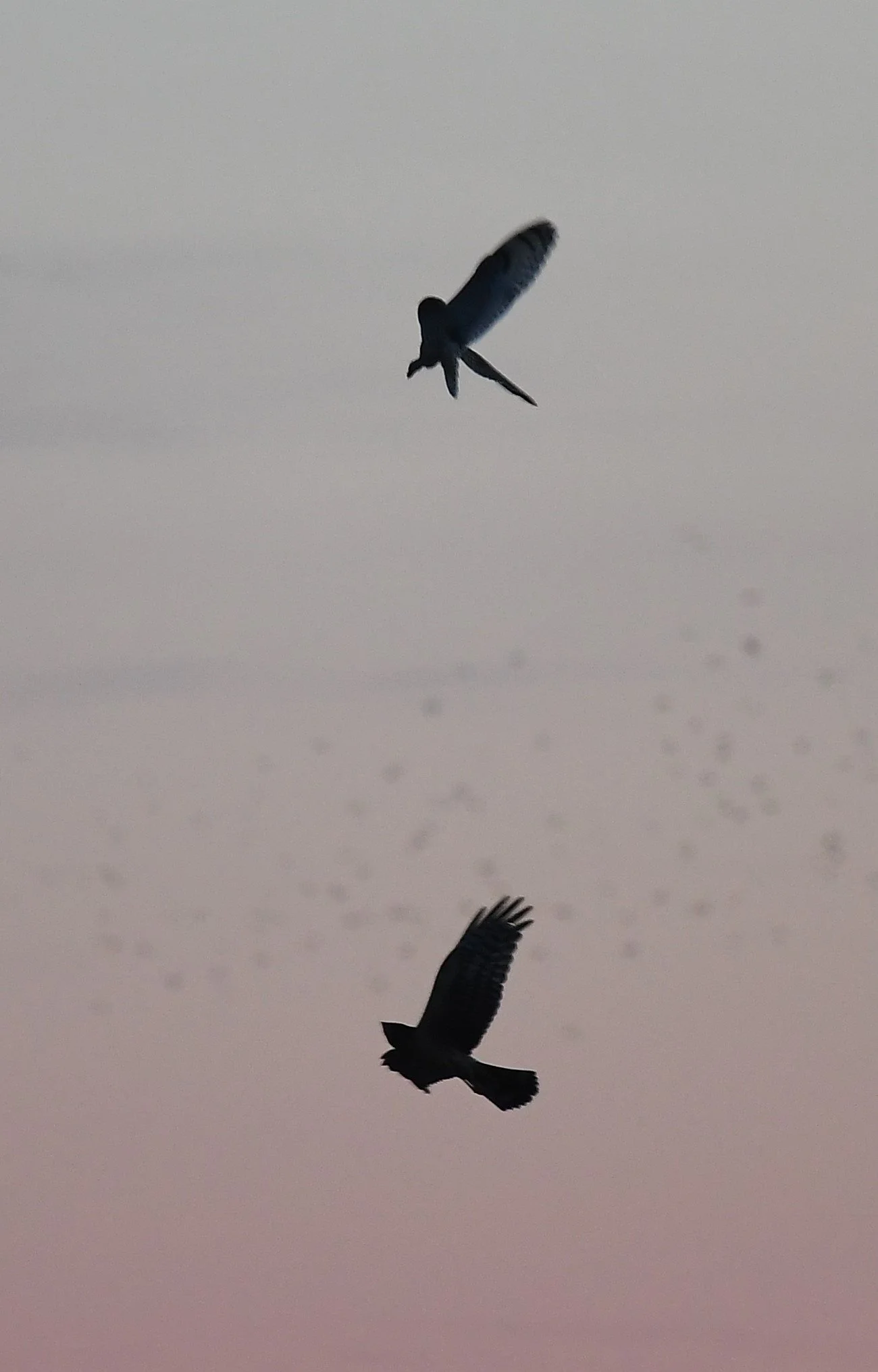
Silhouettes at dusk of a Short-eared Owl (above) and Northern Harrier (below) (photo: Andy Reago & Chrissy McClarren).
If there is ample food available, Short-eared Owls may breed in the same grounds where they overwinter. During the breeding season, they make nests in grasslands on the ground. They are one of the few owl species to make their own nest rather than using an abandoned one or a tree cavity. Female Short-eared Owls carve out an indentation on the ground for nesting under the cover of a shrub or grass clump and line it with feathers and vegetation.
Their daytime activity and cosmopolitan distribution would suggest they are easier to see than other owls, but you still need a little luck on your side to spot one. Only a few decades ago, this species was extirpated from the Crawfish River floodplain. The silent wingbeats of an owl over a vast prairie was a forgotten sight here until the restoration of Faville Grove Sanctuary. Hopefully, as habitat expands here in southern Wisconsin, eventually luck won’t be necessary to see the striking Short-eared Owl.
Written by Soraya Castle, Faville Grove land steward
Cover image by Andy Reago & Chrissy McClarren. A Short-eared Owl flies above a field at dusk.
