

It was not until 1975 or 1976 that monarch researchers located the monarch butterfly’s wintering areas in the oyamel fir forests west of Mexico City. In 1992, the Monarch Watch initiative was founded by researcher Chip Taylor at the University of Kansas. That same year, he began tagging monarchs with small sticker tags, and also made them available for others to use, with the goal of learning more about the butterflies’ migration movements. Since then, over three million tags have been applied to the wings of these migrating insects!
At Goose Pond Sanctuary, we began applying sticker tags to monarchs in 2012, starting with an initial 50 tags. Since then, Southern Wisconsin Bird Alliance and partners have tagged more than 11,000 monarchs with sticker tags. Over the years, 60 of our tags were recovered on monarchs in Mexico on their wintering grounds and one tagged monarch was netted in St. Louis.

Monarch tagged with a BlūMorpho solar transmitter at Goose Pond on Sept. 6, 2026 (photo: Emma Raasch/SoWBA).
After several years of testing, 1,069 monarchs were fitted with BlūMorpho solar transmitters during the 2026 fall migration in Canada and the United States. Receiver devices (like iPhones with bluetooth and Motus towers) can detect monarch transmitters from about 100 yards away. Each of the tags, along with data tracking for eight months, costs $200.
In Wisconsin, 73 transmitters were deployed this fall—by Southern Wisconsin Bird Alliance at Goose Pond Sanctuary (30), by Beaver Creek Reserve near Eau Claire (20), by Urban Ecology Center in Milwaukee (14), by Xerces Society in the Madison area (5), and by the University of Wisconsin–Madison Biocore program (4).
This project has been a collaborative effort. Our team was trained by Emma Pelton, a biologist with the Xerces Society. Chip Taylor at Monarch Watch provided guidance on the timing of applying the tags—he recommended tagging the butterflies from South Dakota to Michigan so that their release would coincide with all members of the group reaching the 43° latitude at approximately the same time (which would allow him to see how the entire group reaches the wintering grounds in Mexico). Monarch Watch also provided tagging equipment, including scales to weigh the monarchs. We’ve been in close communication with Beaver Creek Reserve, Urban Ecology Center, and UW–Madison Biocore program to share resources and offer lessons learned. It truly takes a village to pull off a project like this!
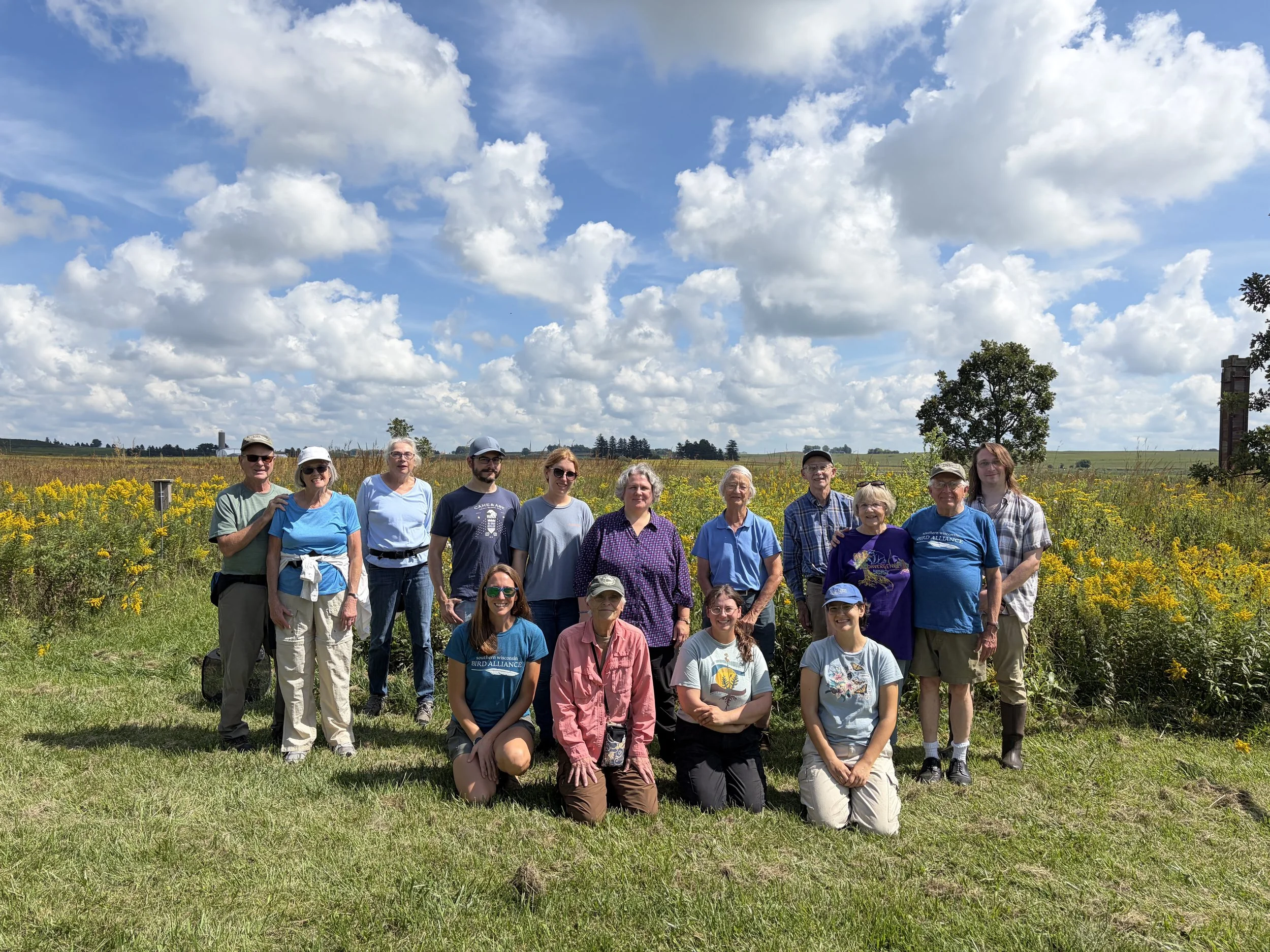
The team of staff, volunteers, and donors who helped tag monarch butterflies at Goose Pond Sanctuary on September 6, 2026 (photo: Brenna Marsicek/SoWBA).
The Southern Wisconsin Bird Alliance released 30 monarchs on September 3 (3), September 5 (16), and September 6 (11). The weather was about the same on all days and included east and southeast winds. We thought that the released monarchs would continue to nectar around Goose Pond for a few days, then head south into Illinois.
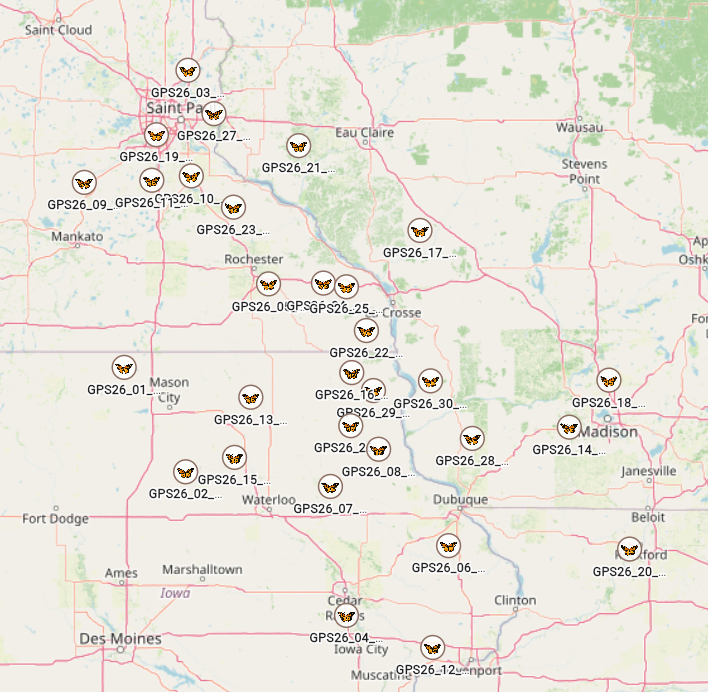
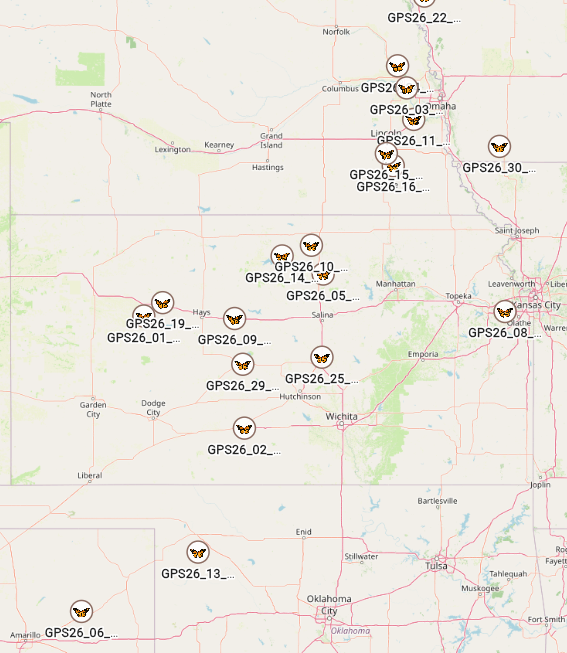
Only one monarch (#20, named “Gotta Go”) did so. Most of our monarchs left the sanctuary, then showed to be heading immediately westward or northwestward. One monarch, released around noon, roosted in Iowa that same night! After September 10, our monarchs in Minnesota began heading south, showing up in Iowa, Nebraska, and Kansas.
On September 19, we couldn’t find one of the butterflies (#13, named “B&G”) that we had released on September 6. When we looked closely at the map, we found out that it was actually in the same place at the same time as another of our butterflies released on that day (#6, named “Chickadee”). Within an hour, both were within a half-mile of each other near Hays, Kansas.
When there is poor migrating weather and fewer receiving devices available, it is not unusual to have monarchs absent from recording for five to seven days—it doesn’t necessarily mean that the transmitter is malfunctioning or has fallen off, or that the monarch has died. On Saturday, September 26, only three of our monarchs were detected. When the weather changed the next day, 19 were detected. “Gotta Go,” the furthest south, was not detected on September 27; however, she was detected 625 times—most recently in Oklahoma, about 800 miles from Goose Pond.

EXTRA, EXTRA! Local media stories about monarchs
Sept. 6, 2026: “Tiny trackers help researchers follow monarch migration from Wisconsin to Mexico” reported by Amina Haniieva for WMTV. Click here to watch.
Sept. 10, 2026: “Wisconsin using new tracking technology to better understand monarch migration” reported by Elissa Eaton for WPR. Click here for the full story.
Sept. 11, 2026: “Wisconsin researchers are putting tiny trackers on monarch butterflies” reported by Barry Adams for the Wisconsin State Journal. Click here for the article.
Sept. 18, 2026: “Volunteers with the Southern Wisconsin Bird Alliance tag monarch butterflies to track migration” by Phillip Boudreaux for Spectrum News 1. Click here to watch.
Sept. 20, 2026: “Tagged with new technology, monarchs are set for a big reveal” reported by Paul A. Smith for the Milwaukee Journal Sentinel. Click here for the article.
Above: Mark and Sue release tagged monarchs at Goose Pond (photo: Brenna Marsicek/SoWBA)
Goose Pond volunteer Don Schmidt, who has flown over Mexico where the monarchs travel once they leave Texas, has noted that there is a lot of desert that the monarchs will be flying over, with fewer receiving devices. This winter, there will be researchers checking to see when the tagged monarchs arrive and how long they stay at the preserves.
Anyone can track the monarchs by downloading the free Project Monarch app to their smartphone or by visiting projectmonarch.org/app on a computer.
Thanks to the volunteers and staff at Goose Pond Sanctuary who supported most of the purchase of the BlūMorpho tags; the many people who helped out with the project, including land steward Emma Raasch and Wisconsin Master Naturalist Samantha Humes for their GPS tagging work; and everyone who provided guidance, especially Chip and Kristen Baum with Monarch Watch, David La Puma with Cellular Tracking Technologies, and the Cape May Point Science Center that founded Project Monarch.
We are excited to see how many of Wisconsin’s monarchs are found in Mexico this winter and hope some also return to Texas next spring.
Written by Mark Martin & Susan Foote-Martin, Goose Pond sanctuary managers, and Emma Raasch, Goose Pond land steward, with Brenna Marsicek, director of outreach
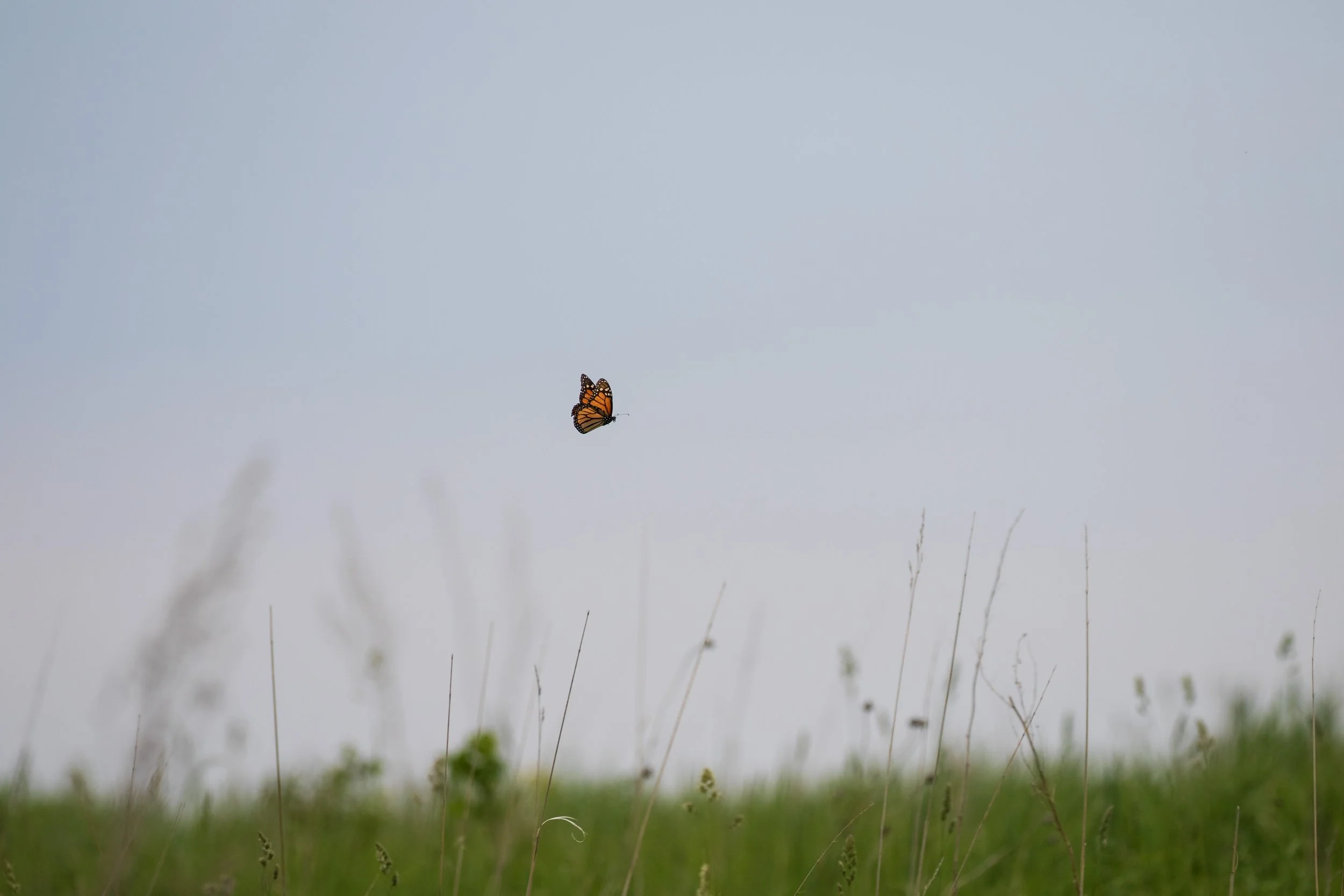
Header photo by Mike Budd/USFWS. A single monarch butterfly soars over a grassland.


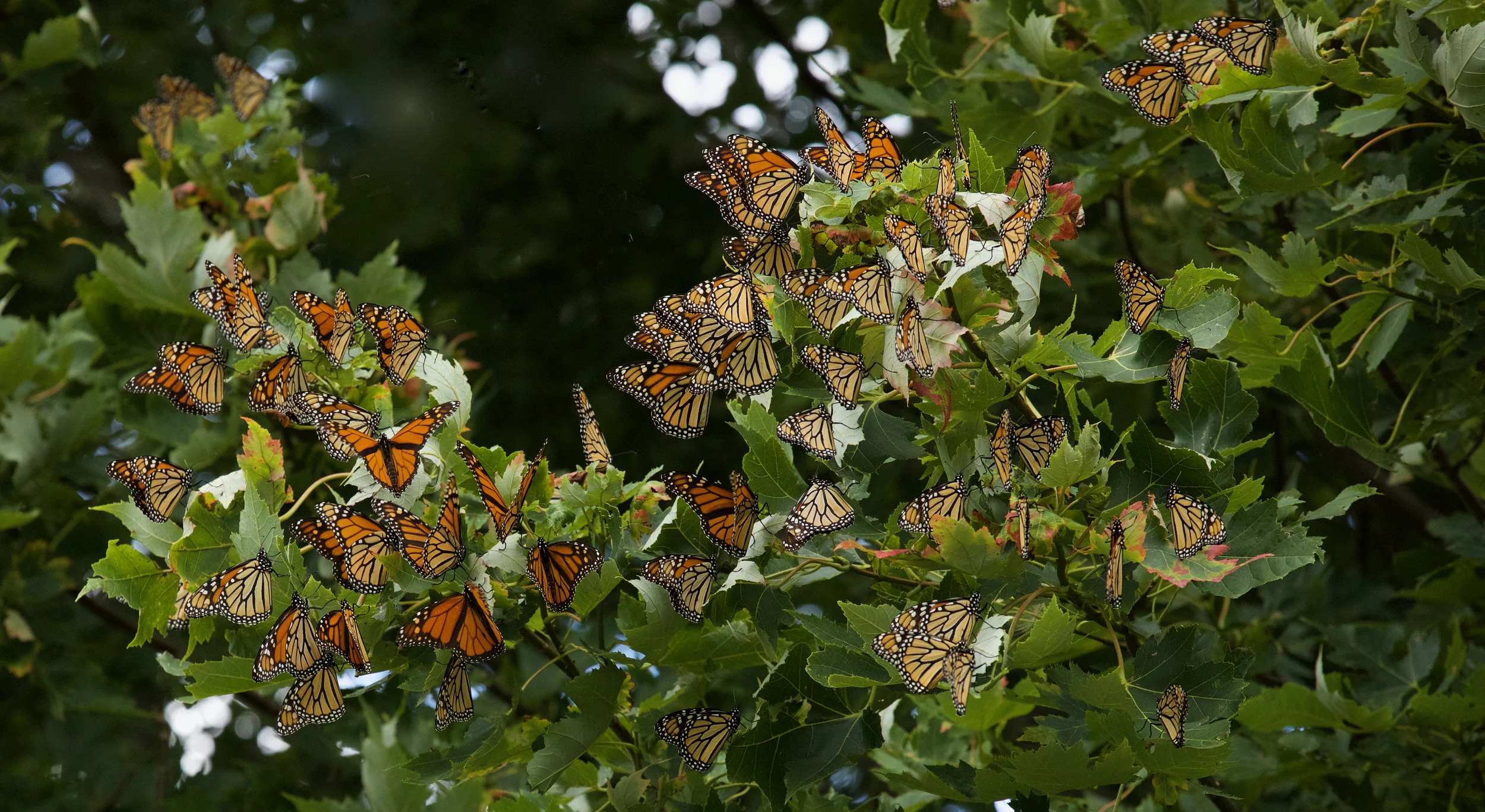

This fall, Southern Wisconsin Bird Alliance fitted 30 migrating monarch butterflies with BlūMorpho solar transmitters at Goose Pond Sanctuary, to help researchers track their routes to wintering grounds in Mexico.
Photo by Mike Budd/USFWS