Friday Feathered Feature

Goose Pond Sanctuary July Butterfly County

A question mark butterfly obscured by the cup plant it nectars on is one of the hundreds of butterflies counted at Goose Pond Sanctuary this July. Photo by Maddie Dumas

A question mark butterfly obscured by the cup plant it nectars on is one of the hundreds of butterflies counted at Goose Pond Sanctuary this July. Photo by Maddie Dumas

Friday, July 28th was a sunny day to tour the beautiful prairies at Goose Pond Sanctuary. We took the opportunity to grab the butterfly nets and take an inventory of the butterflies using our prairies for food, shelter, and egg laying. Over the course of the day, we counted a record number of 3,144 wings -- butterflies have two pairs of membranous wings (forewing and hindwing) on each side -- or 786 butterflies.

Goose Pond volunteer and Madison Audubon board member Topf Wells with butterfly guide in hand checking out a sighting. Photo by Arlene Koziol

Goose Pond volunteer and Madison Audubon board member Topf Wells with butterfly guide in hand checking out a sighting. Photo by Arlene Koziol

For the past three years, Goose Pond staff and volunteers participated in the Mud Lake North American Butterfly Count held at the beginning of July. This year we decided to conduct a separate count later in the month to see if we found different species or a change in numbers.

Fifteen counters divided into four parties lead by Mark, Maddie, Jim Otto, and Greg Tiedt. Overall we found 19 species. Check the spreadsheet below for count data. 

Eastern tiger swallowtails were new to the count along with Jim Otto’s find of a giant swallowtail, a more southern species that sometimes strays north into Wisconsin in late summer. In the past four years we have found 24 species of butterflies on the counts.
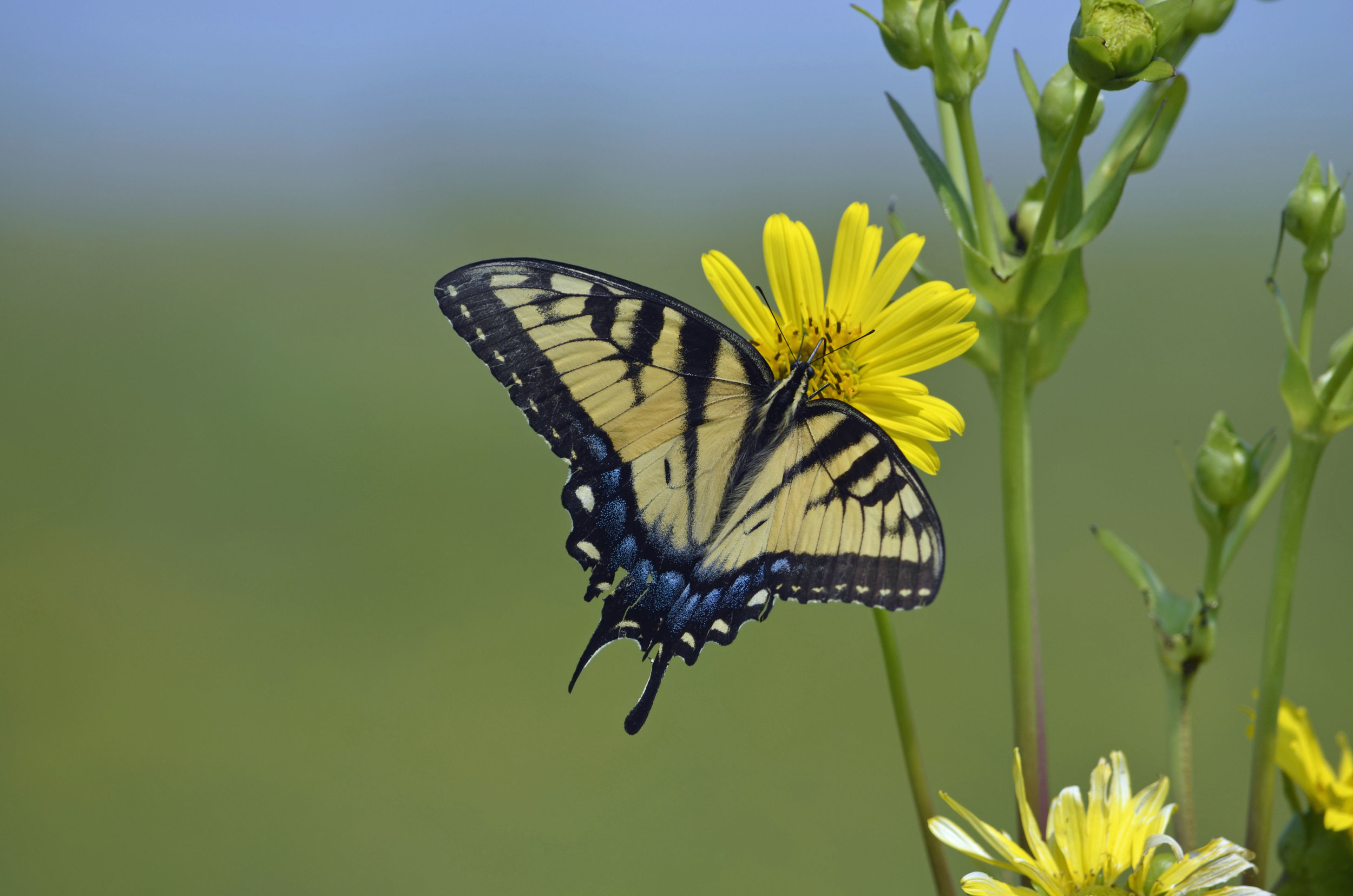
An eastern tiger swallowtail on cup plant. Photo by Mark Martin

An eastern tiger swallowtail on cup plant. Photo by Mark Martin

The count date can account for a difference in species found and the insect numbers. We found that in the past some species were more numerous in early July counts including the skippers, and sulphurs. However, we found many more viceroys, common buckeyes, pearl crescents, and painted ladies in our late July count.

A monarch finds energy and nourishment from the nectar of a meadow blazing star. Photo by Maddie Dumas

A monarch finds energy and nourishment from the nectar of a meadow blazing star. Photo by Maddie Dumas

The highlight was finding 344 monarchs compared to 23 found last year on July 2nd.  Maddie and her team counted 131 monarchs, many of them nectaring on meadow blazing stars that were just beginning to flower. Meadow blazing stars may be at the tail end of flowering when monarch tagging begins so we will have to concentrate on searching the showy goldenrod flowers. 

Monarch tagging is a great citizen science activity for the whole family. Accessible, mown trails wind through some of the best nectaring habitat on the sanctuary, so people of all ages and abilities are welcome. Our 1,500 monarch tags arrived last week and if you would like to come out and tag in September you can sign up at Madison Audubon website.

Thanks to the summer interns and volunteers for helping out on a day of counting our winged friends. It was a great learning experience for everyone. If you would be interested in helping count butterflies next July contact us at goosep@madisonaudubon.org.
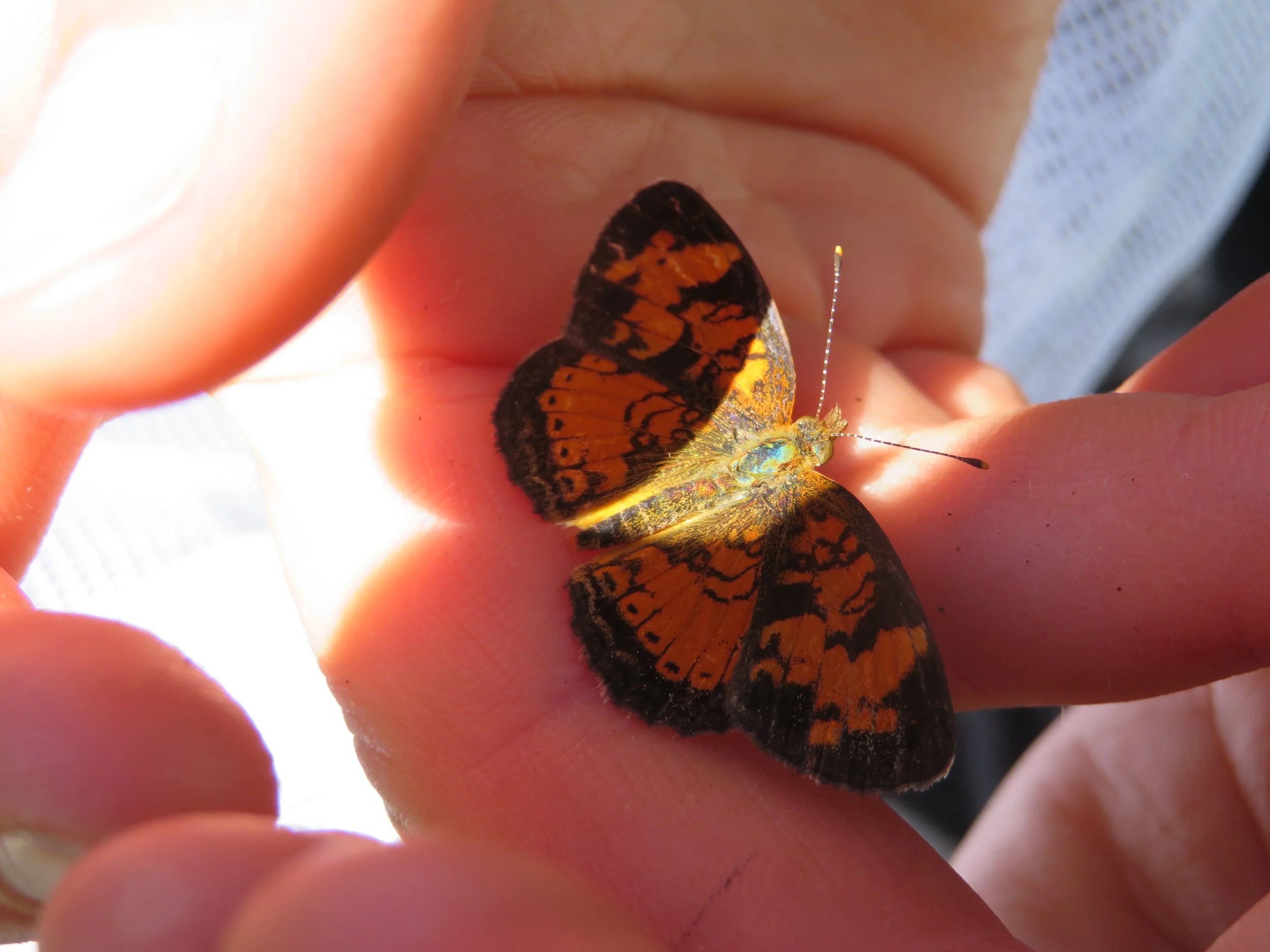
A butterfly in-hand is worth two on the flower -- look at the beautiful coloring of this pearl crescent butterfly! Photo by Maddie Dumas

A butterfly in-hand is worth two on the flower -- look at the beautiful coloring of this pearl crescent butterfly! Photo by Maddie Dumas

Written by Mark Martin and Susan Foote-Martin, Goose Pond Sanctuary resident co-managers, and Maddie Dumas, Goose Pond Sanctuary land steward

Japanese Beetles and the Value of Birds

The beautiful but devastating Japanese beetle can lace plants faster than your granny with a crochet hook. Photo by Joshua Mayer

The beautiful but devastating Japanese beetle can lace plants faster than your granny with a crochet hook. Photo by Joshua Mayer

On a recent early morning, I was looking out our kitchen window and bemoaning the fact that both the swamp white oak and tamarack tree in my view were full of Japanese beetles.  I had noticed hundreds of these shiney bugs in both trees the day before and we were making plans on how to rid the trees of these damaging insects. 

The early light enabled me to notice a number of birds actively feeding in those trees.  First, an eastern phoebe with two young perched nearby was plucking the beetles from the leaves and feeding them to the young.  Next, a gray catbird flew into the action and ate a few before carrying some away, and then a song sparrow, followed by some house sparrows that eagerly ate some too.  Before long, a beautiful Baltimore oriole came by to partake of the feast!  I had to know more.

My research showed that the champion beetle eaters are European starlings followed by blue jays, robins, crows, grackles, kingbirds, woodpeckers and purple martins, to name a few.  Some birds eat the grubs, some the adult beetles, and some both.

This made me think about the economic value of birds and their work as pest controllers, especially given the fact much of the credit for this service is given to our declining cave bat mammal species who struggle with white nose syndrome.  I continued to look for more evidence of the value of these flying bug exterminators.

The most recent summer edition of Living Bird magazine (7/17) contains an article on this topic titled Analysis: The Economic Value of Birds by Cagan H. Sekercioglu.  In his article, he mentions a recently published book called Why Birds Matter, authored by himself along with Chris Whelan, University of Illinois, Chicago and Dan Wenny, San Francisco Bay Bird Observatory. 

Sekercioglu talks about the large economic value of pest control by birds saying, “Birds can reduce the intensity of spruce budworm outbreaks and mitigate damage on spruce tree plantations comparable to effective insecticides.  In Washington (state) avian control of spruce budworm was calculated to be worth at least $1,473 per square kilometer per year.”  He goes on to site many other examples of ecosystem services of birds as pollinators, seed dispersers, and even carcass cleaners (disease control).

A female dickcissel captures a large insect at Schoeneberg Marsh Waterfowl Production Area. Photo by Jim Otto

A female dickcissel captures a large insect at Schoeneberg Marsh Waterfowl Production Area. Photo by Jim Otto

We love to watch birds, feed birds, and study birds.  Many of us plan our vacations and lives around birds. We love to work with non-profits like Madison Audubon, restoring habitat at our sanctuaries where we welcome and count the birds, monitor their populations, and provide nest boxes for cavity nesting birds.  We band birds to learn more about their life cycles and travels across the landscapes.

No matter why you connect with birds, you might agree that they bring value to our lives by providing color and beautiful songs for our senses, and wonder which piques our curiosity, lifts our spirits, and builds a lifetime appreciation and connection to nature. 

And, birds eat Japanese beetles.

Susan Foote-Martin, Resident Co-Manager, Goose Pond Sanctuary

Marsh Wren

The marsh wren is histrionic, bouncing from one cattail to another, calling out with its trill and rattling voice.  

Photo by Arlene Koziol

Photo by Arlene Koziol

A whirring vector of motion and sound, the marsh wren frenetically builds anywhere from 5 to 22 nests per year.  The male is tasked with building these nests, showing the female around each cattail-down lined nest.  However, the female often builds the nest that will become occupied.  She steals materials from nearby nesting marsh wrens further along in the nest cycle. 

Expending such energy to construct nests likely has the benefit of deception.  Marsh wrens will destroy the eggs of other marsh wrens and red-winged blackbirds, and the blackbirds will return the favor.  These dummy nests serve as decoys for predators, structure for fledgling young, and mark the male’s territory.   

The marsh wren loves marshes. The first Breeding Bird Atlas in Wisconsin found 79% of marsh wren records in open lowland marsh. An excellent place to find the marsh wren this summer is at the Snake Marsh at Faville Grove Sanctuary. The intern crew has discovered numerous nests throughout the Snake Marsh, seeing up-close the wren-crafted nests and wren wrought chattering. 

By Drew Harry, Faville Grove Land Steward

Mallard

A special treat in the fall at Goose Pond is to see swirling clouds of mallards above recently picked corn fields.  This was Maddie’s first fall of seeing this amazing sight and she could hardly believe these large flocks were comprised of the familiar mallard!  Mark and Sue have seen clouds of mallards hundreds of time but always enjoy watching them.