Friday Feathered Feature

Golden Eagle

Print Friendly and PDF
Ted is an excellent observer and ornithologist! He worked in the fall of 2016 at Veracruz, Mexico, which is host to the greatest raptor migration spectacle in the world. More than 25 species of migrating raptors are recorded each autumn, with counts…

Ted is an excellent observer and ornithologist! He worked in the fall of 2016 at Veracruz, Mexico, which is host to the greatest raptor migration spectacle in the world. More than 25 species of migrating raptors are recorded each autumn, with counts reaching more than 100,000 migrant raptors and vultures per day during the peak of the flight. An additional 10 million daytime passerine and water birds migrate as well. He reported that his best count day in Mexico was when he recorded over 200,000 raptors and vultures. Almost 4 million raptors and vultures were counted throughout that fall. Last spring, Ted also helped count around 500,000 raptors in Israel at a migration site that holds the record for the largest spring migration.

On March 19, Ted Keyel, a former Goose Pond Sanctuary intern, entered his Goose Pond observations on eBird saying, “Pretty surreal experience. I was watching the geese and swans when they became very agitated and started to flush. I saw a large raptor coming in, and presumed it to be a Bald Eagle, until it banked and I got a clear view of the wing profile. Rounded bulging secondaries of a Golden opposed to the very even trailing edge of a Bald. The small head and proportionately longer tail were also obvious. As I continued watching it, I saw darker coverts than remiges, (large flight feathers) and a dark tail with darker tip. The sun even reflected well off the head. I've never seen a Golden Eagle hunt geese before, although it seemed to give up pretty quickly. It then caught a thermal and rose higher and higher before I lost it.” 

Late the next afternoon, Sue looking west out of the kitchen window watched two Canada geese as they flew over the yard heading east toward the pond.  Suddenly, a golden eagle approached them from the north and broke up the pair in mid-air. “The whole scene reminded me that these large eagles have to be on the hunt at all times, looking for the opportunity to make a kill”. The large raptor did not circle back in pursuit of the geese, rather it left the scene and the geese made a bee-line for the safely of Goose Pond.

Ted's golden eagle capture on March 19 at Goose Pond. Photo by Ted Keyel

Ted's golden eagle capture on March 19 at Goose Pond. Photo by Ted Keyel

Sam Robbins in 1991 wrote in Wisconsin Birdlife that golden eagles are “rare spring migrants”. From 1960 to 1990 he was able to locate only one record in late fall of a golden eagle in Columbia County. Robbins also reported a nesting pair of golden eagles from Ferry Bluff in Sauk County around 1905 to 1907. In 1908 the pair was shot by a local farmer.

Golden eagles with a seven-foot wingspan are the largest raptor in North American. They are the most widely distributed eagle, being found throughout the Northern hemisphere and are also found in the old world from Finland to Japan.

Photo by Tony's Takes Photography

Photo by Tony's Takes Photography

They are incredible hunters and are able to spot prey over two miles away, make dives after prey between 150 to 200 miles per hour, and can squeeze their talon with a force of between 400 to 750 pounds per square inch. They hunt a wide variety of prey including jack rabbits, badgers, cranes, and swans. Many people have watched the YouTube videos of a golden eagle knocking a mountain goat off a cliff, or a father and son with their golden eagle hunting fox in Mongolia. We will never forget our sighting of a golden eagle flying high over Teddy Roosevelt National Park carrying a prairie dog!

In Wisconsin, during the winter golden eagles can feed on deer carcasses and hunt wild turkeys. The National Eagle Center in Wabesha, Minnesota conducts a golden eagle count in January in Wisconsin, Minnesota, and Iowa. They usually tally over 100 golden eagles in Wisconsin. Many goldens are found on prairie bluffs in Buffalo County.

Photo by Eric Begin

Photo by Eric Begin

Many people think that our wintering population is from the western great plains and mountain states; however, eagle biologists with the use of transmitters have found that our overwintering golden eagle population summers in the high arctic in the Northwest Territories.

We hope you will be lucky to find some birds at Goose Pond Sanctuary this spring that you will remember for years to come.

Written by Mark Martin and Susan Foote-Martin, Goose Pond Sanctuary Managers

Cover photo by Tony's Takes Photography

Eastern Bluebird

Print Friendly and PDF
Photo by Pat Ready

Photo by Pat Ready

Very few in modern America, outside of those that read articles such as these, know the joy of spring birds like the eastern bluebird. It's with regret that I reference modern America, for modern America has been terminally slipping according to those citing modern America. Yet, according to research by the US Fish and Wildlife Service, only 5% of Americans watch birds “away from home.” That number increases to 10% of the population when you include those who watch birds at home, but who could recognize a bluebird in their yard while failing to recognize one on a country road, at the park, or around the neighborhood? The answer is apparently 20 million people. Those people, I suspect, cannot tell a bluebird from a blue bird: an eastern bluebird from a mountain bluebird from a bluejay from an indigo bunting.

Photo by Pat Ready

Photo by Pat Ready

I once knew spring without bluebirds. I identified spring with Easter, March Madness, baseball, and a sudden flush of green on the landscape that meant the lawn must be mowed. The calendar dictated these events, mostly. Soon I learned that spring cleaning includes not just vacuuming and window washing but also bluebird box cleaning—and spring was instantly enriched. I also learned that bluebirds are not unlike people—they hold a wide berth of opinions.

Some bluebirds, first arriving on March 4 of this year, believe it is reasonable to start planning for spring well before it is fashionable to do so. A March 6 snowstorm puts into question their resultant migration, but, and I hate to say it, bluebirds have cliches just the same as people, and the early bird gets the worm. Cutworms found in lawns are a favorite food, and beetles, crickets, grasshoppers, and spiders make up a large percentage of their diet during the growing season. But those food sources are scarce on March 4, and my backyard birds rely on juniper berries, grape, sumac, and Virginia creeper to sate their hunger.

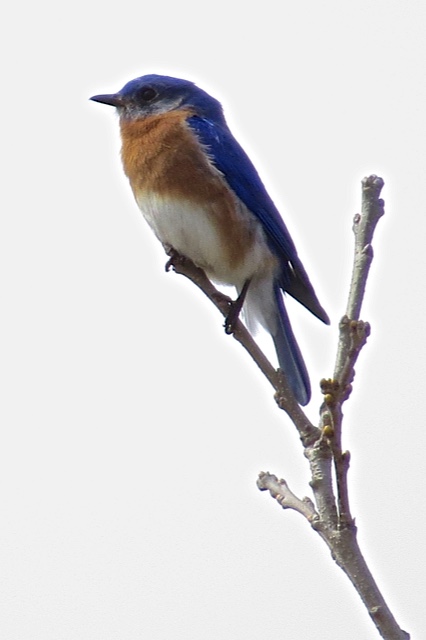
Other bluebirds have arrived tardy, and on the past few mornings their soft and melodious songs have echoed me awake, only for their pastel blue wings to delight the branches of oak trees, their round bodies gracefully flapping in the gutter on the roof. These birds scope out nest boxes around my house, and that old drama unfolds as males (brightly colored blue above with rusty breasts) chase females (subtler grayish above with brownish breasts) who are waiting for males to chase away other males.

Female eastern bluebird. Photo by Pat Ready

Female eastern bluebird. Photo by Pat Ready

Those nest boxes have increased bluebird populations across Wisconsin since declines in the 1960's and 70's, thanks largely to the Bluebird Restoration Association of Wisconsin. Today, these birds are likely to be found in urban, suburban, and rural environments where they can find a nest box or natural cavity for nesting.

The relocation of a nest box last year to a position viewable from my window cued me into the ecology of bluebird life. I saw the nest, fine dried grasses and stems, with two eggs, within the average clutch size of 2-7. This pair was a second brood attempt, and I witnessed the trope of an evil villain emerge as house sparrows bombarded the parent bluebirds, a chronic occurrence in bluebird circles. As June broke into its second week, the parents' concentration seemed to break as well, and the house sparrows' repeated attacks eventually led to one of the eggs being lost. I intervened, when possible, and waved away the marauding birds. Eventually the egg hatched, and at about 14 days, right on average, the chick fledged out of the box, a welcome sigh of relief for a bluebird box I had become wholly invested in.

Photo by Pat Ready

Photo by Pat Ready

There is drama in each of the seasons, and with the return of spring comes the drama of the liquid warble of bluebirds at Faville Grove, as sure a metaphor for spring as any. Spring is a beautiful, bounding, bountiful thing. For some, spring is, as Aldo Leopold said, “a goose cleaving the murk of March thaw.” For others spring is a sandhill crane, turkey vulture, bluebird, or swallow. Admittedly, spring is spring and I cannot pick one embodiment of a season so diverse. Rather it is with reluctance that I resort to cliches to describe the season, for, if it's possible, I find spring a refreshing and unexpected cliché—like the bright March bluebird.


Written by Drew Harry, Faville Grove Sanctuary land steward

Horned Lark

Print Friendly and PDF

The horned lark decorates fields and short grassy lands on late March mornings, providing a subtle cue that winter wanes. With a yellow face, a black mask, and horn-like feathers that stick straight up, these birds provide solace through a March snowstorm, singing all the while (listen to the horned lark's song and calls here). Horned larks are common continent-wide, from central Mexico to the upper reaches of Canada and Alaska. In Wisconsin, the birds can frequently be found in farm fields and open areas with little vegetation.

Photo by Monica Hall

Photo by Monica Hall

These birds, a pleasant sight throughout their winter spent in Wisconsin, can light up a snow field with their yellow faces contrasting against the glistening white. When the snow melts, however, their brown dirt-colored feathers camouflage well into the forty of a farm field—you'll have to watch for that flash of yellow as you scan a field.

Nests come surprisingly early, and nests with eggs can be found in late March. Even by mid-March, however, most birders have seen migrating flocks of geese and ducks, cranes and blackbirds—wanderlust sets in.

Horned lark eggs tucked into their nest amongst the grasses. Photo by Carolyn Byers

Horned lark eggs tucked into their nest amongst the grasses. Photo by Carolyn Byers

It's easy to forget the horned lark, a diminutive bird nesting in the dull habitat of farm fields. Despite the delight this bird brings in winter, it is soon passed over for bigger and smaller and better birds come spring. This is a shame, for it is the only lark native to North America and its twinkling jingle of a song reminds us of a winter that was and is a sure sign that eggs are on the way—eggs that better be quick because the field must be planted eventually.

You can spot horned larks at Faville Grove down Prairie Lane in farm fields and recently burned prairies. It's beautiful down by the Crawfish River right now with migrating Canada and white-fronted geese, sandhill cranes, and ducks. The visual spectacle—fabulous in its own right—dwindles in comparison to the auditory riot it creates on these March wetlands. Again, it's easy to bypass the horned lark for these bigger and more attention-grabbing scenes, but appreciate its faithful residence on Wisconsin corn stubble and a life that's easily overlooked .

Written by Drew Harry, Faville Grove Sanctuary land steward


Banner photo by Jeff Bryant


Northern Pintail

Print Friendly and PDF

Arlie (A.W.) Schorger, 2018 inductee into the Wisconsin Conservation Hall of Fame and author of historical accounts on Wisconsin’s wildlife species, described the arrival of the pintails thus: “The sight of a flock of pintails flying low over a marsh on a March morning renders the observer oblivious to chilling winds. The long neck, long tail and white underparts of the male produce the mirage of a frigate under full sail.” Pintails were called sprigs by early hunters in the 1800s with "sprig" being short for "sprig-tail.

Northern pintail, photo by Monica Hall

Northern pintail, photo by Monica Hall

Pintails, of course, are named for their elongated central tail feathers, which constitute one-fourth of the drake's body length. Pintails are a prairie species and Wisconsin is at the southeastern fringe of their breeding range. Northern pintails have the widest distribution of any waterfowl species world-wide and are also found in Europe, the Middle East, India, and Asia. They migrate long distances and there is a report of a pintail that flew nonstop for 1,800 miles. The U.S. Fish and Wildlife Service estimated pintail numbers in 2017 at 2,900,000 compared to a long-term average of 4,000,000.

Pintails are the earliest nesting duck in North America and nest farther from water than other ducks. The female likes to nest in an open area with short vegetation. In the Dakotas and Canada pintails like to nest in winter wheat fields.

We noticed the first pintails at Goose Pond this year on March 5 while driving along Kampen Road adjacent to our flooded food plot. As we went by hundreds of ducks near the road rose in a dense cloud. What stood out was a flock of 25-30 pintails; as usual drakes outnumbered hens. There were around 2,000 ducks, including over 1,900 mallards along with a wood ducks, black ducks, and green-winged teal in shallow water feasting on sunflower and foxtail seeds.

Photo by Monica Hall

Photo by Monica Hall

Sam Robbins in 1991 wrote in Wisconsin Birdlife that pintails are common migrants and uncommon summer residents. “Usually sprigs reach most southern areas by March 20th…” With the rain and warm temperatures in late February and early March waterfowl returned to Goose Pond much earlier than usual. Pintails also stop at Goose Pond in fall migration. The highest number of pintails recorded at Goose Pond was our October 25, 2008 observation of 120 pintails.

In 1973, March, Martz, and Hunt estimated an annual average breeding population of 1,300 pintails in the Badger State. Their breeding numbers in Wisconsin have been on the decline since the 1970s and 1980s. The first breeding bird atlas project (1995-2000) contained only one confirmed nesting report – a brood in Burnett County. We obtained a record of a pair that probably nested near Poynette and another possible nesting occurred in Ozaukee County during the first atlas project. After the third year of Atlas II, there have been no confirmed nesting records for pintails in Wisconsin.

Photo by Richard Armstrong

Photo by Richard Armstrong

The pintails are one of our favorite ducks. Sue enjoyed spending many hours carving and painting a full-sized drake pintail in breeding plumage.

This year the water levels are very high in southern Wisconsin and hopefully there will be pairs observed in May and a few broods observed in June. We hope you can visit Goose Pond in spring migration and enjoy the sprigs.  

Written by Mark Martin and Sue Foote-Martin, Goose Pond Sanctuary resident managers


Passenger Pigeon

Print Friendly and PDF

As we celebrate the Year of the Bird, we take a look back at one of North America's extinct birds, the passenger pigeon, which vanished in 1914, four years before the safe harbor of the Migratory Bird Treaty Act of 1918. Much of this information on market hunting and cuisine comes from Jennifer Price's book Flight Maps, which covers in fascinating detail the passenger pigeon and the human connection to this wonderful bird.

Artwork provided by Biodiversity Heritage Library

Artwork provided by Biodiversity Heritage Library

Ask any generation about the wildlife of their time: what sticks out as memorable? For those who lived through the DDT years, the rebound of raptors may be striking—bald eagles went from the brink here in Wisconsin and continent-wide to current breeding status in almost every county in the state. For those living through lean sandhill crane decades, their noisy and soulful return to marshlands across Wisconsin this past week is a reminder of the positive implications of conservation. Each of these birds went from abundance to scarcity, and back to abundance. For those early settlers of Wisconsin who witnessed a Civil War, they not only saw a nation divided, but also a bird that never reclaimed its mythical abundance—a bird they would not forget—the passenger pigeon.

Here at Faville Grove, we are lucky to have historical records and recollections of the passenger pigeon from Art Hawkins' notes from interviews he conducted for “A Wildlife History of Faville Grove,” published in 1940. These notes are striking in their treatment of the passenger pigeon. For each interviewee, Hawkins ran through the list of wildlife, from species of ducks to badgers to songbirds. His notes contain a sentence or two on each duck, hunting methods and stories for each mammal, and random musings on identifiable songbirds and their relative abundances. Yet, without fail, each early settler seems to have spoken at length about the passenger pigeon; if they themselves did not see the great flocks, they certainly had stories of relatives who had, and these paragraphs stand as the few local memories of a bird now lost.

Mr. Crump remembered the birds “forming a cloud before the sun.” To Mr. Scribner and many others, sowing the wheat seed (which boomed in Wisconsin for a time only to lead to catastrophe and eventually dairying) required two men, with one following the planter to cover the seed and save it from pigeons. These birds, according to Mr. Scribner, rolled across the wheat field like a huge ball, a smooth mass spinning forwards as birds from the rear replaced birds in the front. Mr. Cooper recalled flocks of millions of birds, and his father reportedly felled 23 birds in one shot, a hired hand dropping 18. Mr. Seaver is said to have seen pigeons land on a dead oak, only for the thousands of birds to break the limbs. Numerous others noted millions of birds that would block out the sun, and each of them would remark that a year or so later, the birds disappeared. Some heard of flocks in other parts of the state, but after nesting near London Marsh and Deerfield in 1878, the birds were never to be seen in the area again. What happened?

Smith Bennett, 1875

Smith Bennett, 1875

Of those 18th century inhabitants of North America, few east of the Mississippi could fail to recognize the passenger pigeon. For Native Americans like the Seneca, the passenger pigeons brought the tribe together during hunting—the birds provided food resources at a critical time when winter reserves dried up and spring plantings had yet to flourish. These communions allotted time to conduct tribal business, and thus the event became social, political, and economic. The indigenous inhabitants of eastern forests, from all indications, limited themselves to taking only pigeon squabs (newborn pigeons) during spring, which kept the adult breeding population intact.

Meanwhile, the mostly white inhabitants of the young nation enacted hunting that reflected their vision of the growing nation—limitless and independent. Shooting game, and especially pigeons, became a new world act. Free from the game preserves of the European elite, those members of the young republic sought to wield their autonomy, boasting to each other of the number of pigeons taken with one shot: 23, 37, 50. It would have even been difficult to know whether one had fired a rifle, for many reported that beneath the multitude of pigeons, one couldn't hear a rifle fire. Dung rained down like hail, and often thousands of people converged on a flock of birds, all with wanton aim in the sky. A pigeon storm was a crazy thing. These pigeon flights brought communities together and even kept them alive. A 1769 crop failure coincided with a pigeon flight, which kept 30,000 inhabitants fed for six weeks. 

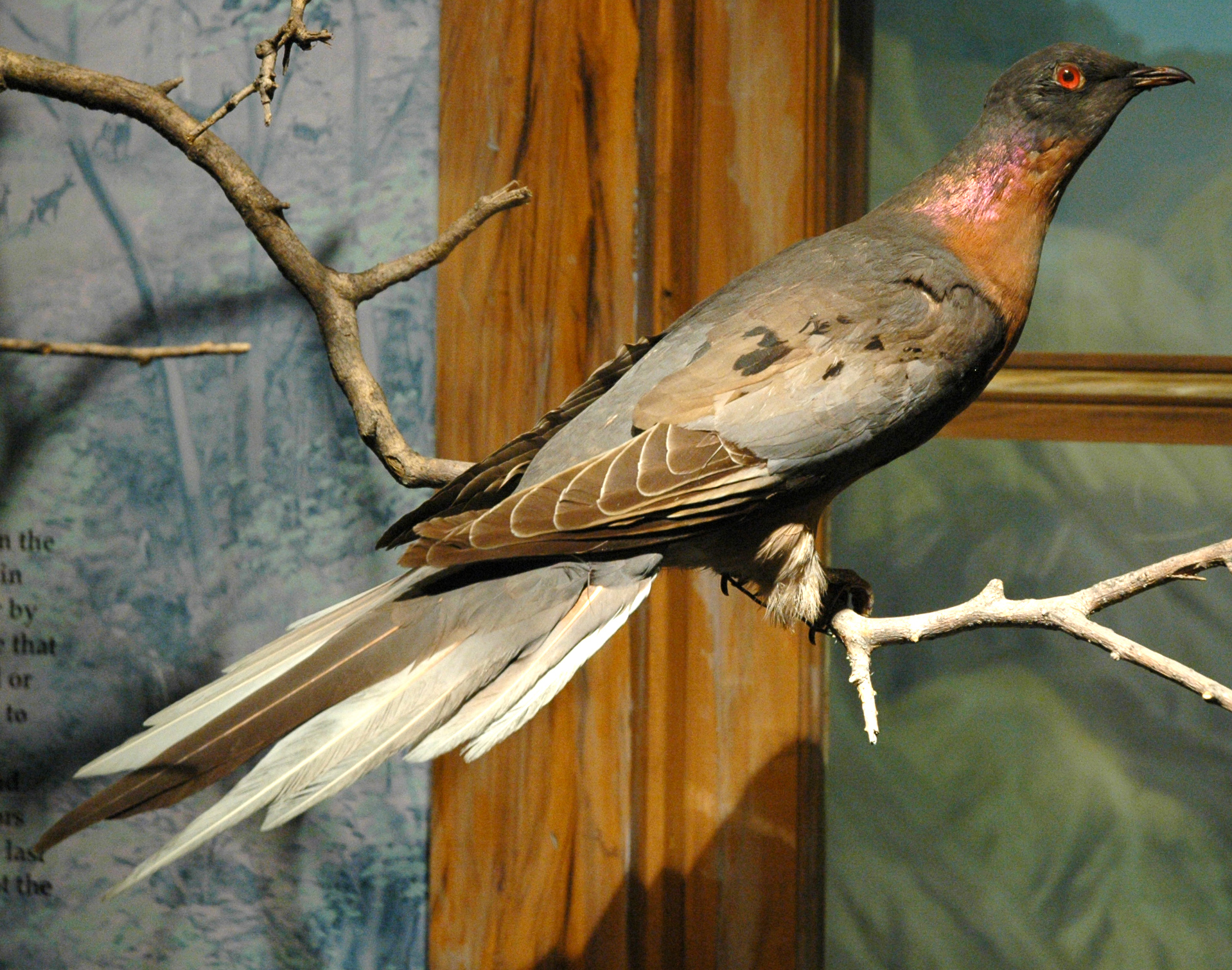
Male passenger pigeon, on display at the Cleveland Museum of Natural History. Photo by James St. John

Male passenger pigeon, on display at the Cleveland Museum of Natural History. Photo by James St. John

There were those members of the nation who were likely not embracing the nationalistic machismo of a pigeon hunt. According to some sources, over 1/3 of the immigrants to the United States before 1920 eventually returned to their homelands, and many intended to return but never did. The young nation and its resources were perhaps seen as an opportunity, something to be taken advantage of, and the passenger pigeon fit the archetype of a resource for all, seemingly inexhaustible and incomprehensible in number. Near Philadelphia's Broad Street, where this year exulting Eagles fans climbed lampposts and street lights, their ancestors climbed atop houses, buildings, and ladders, some wielding guns (problematic for downtown), but many waving brooms and knocking pigeons out of the sky. For these 18th century “pigeoners” a days-long wave of passenger pigeons was not unlike today's cultural gathering after a Super Bowl victory. 

These pigeons found themselves in pigeon pie, demonstrably so because three pigeon toes would sit square in the middle of the pie. Pigeons were smoked, cured, and stored. They were appreciated for the sustenance they provided and left behind awestruck communities witness to billions of birds.

Market hunting complicated human's relationships with the pigeons into the 19th century. Railroad line expansions throughout the country allowed market hunters to quickly, relative to other methods, seek out pigeon flocks. These same lines, with ice-packed rail cars, allowed the fresh shipment of thousands of birds. The shipment of pigeons did something remarkable; it commodified the bird and allowed the passenger pigeon to become any number of things in a quickly industrializing economy toward the end of the century. And with that exchange of money, it was easy for a bird to become something that was not a pigeon. It should be said that most all market hunters did not strike it rich by killing the passenger pigeon, rather the hunting supplemented their income, and they worked as laborers or farmhands at other times of the year.

Where did these slain birds end up? Many were shipped to fine dining establishments throughout the country where pigeons became “ballontine of squab a la Madison,” and on the table the pigeon was difficult to uncover as it was dressed with sweetbreads, glazes, sauces, creams, pastes, and jellies, stuffed with other meats, or stuffed inside other meats. Again the pigeon had lost part of its identity, no longer three toes practically squawking at the consumer, now complicit in the onslaught against the pigeons.

Other pigeons ended up stocking the yards of trap shooters. Market shooters shipped tens of thousands of birds to trap shooting events while thousands would die en route, and most would be shot upon release. These real pigeons preceded the “clay pigeon,” which was a necessary innovation since the real pigeons were extinct. Trap shooters lost track of pigeon natural history as well, as shooting the birds one by one was a sandwich at a picnic compared to the food fight anarchy of a regular pigeon flight. Trap shooters would also deny that they had even played a role in the extinction of the passenger pigeon; they weren't the ones killing the birds on breeding grounds.

This would not be the last time the pigeons became unmoored from their ecology. At the end, in the Cincinnati Zoo the last captive passenger pigeons were named. Never before could any one or any thing focus on a single passenger pigeon named Martha, for the enormity of the flock prevented it. Only once a hunter had one in the hand could he or she reckon with the individual bird, but even then, the sight of hundreds of millions of birds must have been gripping, staying with the witness as some of Hawkins' first-hand accounts can attest. Indeed these pigeons lived on as hope for decades after extinction, hope that a flock remained in northern Canada, Argentina, or even remained genetically in street pigeons, hidden in plain sight. None would prove true.

Rounds at the National Museum of Natural History. Photo by Darren & Brad

Rounds at the National Museum of Natural History. Photo by Darren & Brad

The ecology of the passenger pigeon stands just as remarkable as the human stories surrounding the bird. Huge flocks, while not only visually stunning, would also create their own wind currents and change the earth's temperature as they blotted out the sun. While these were birds of surplus and a blessing for the early pioneers, their ecological footprint was one of catastrophe. Dung, inches thick would splatter leaves and defoliate entire forests. Excess excrement upon the forest floor would wipe out the underbrush and herb layer. It's not known what effect these roostings had upon the forest, but it's fascinating to speculate. A local farmer at Faville Grove during the time of nesting in the area hypothesized that the guano of the pigeons enriched the soil and stimulated the herb layer. He based his claim partly on the fact that after pigeon years he found great densities of ginseng which he collected. The mere presence of pigeons in an area could entirely alter its ecology, and the pigeons must have been key cogs in maintaining open woodlands and early successional shrubland habitat that favors a suite of species like brown thrashers, cuckoos, and golden-winged warblers.

The passenger pigeon's story proves a complicated lesson for conservation. While the bird was hyper-abundant in its North American home, it was, importantly, not overabundant. The birds relied on these huge flocks for survival, and hunting—both subsistence and market hunting—contributed greatly to their decline. These hunts proved to have many reasons, but as these reasons became more and more removed from the pigeon itself, the decline of this bird was magnified. Habitat loss in the form of deforestation extremely exacerbated the situation in addition to disease outbreaks. A bird of huge proportions, the passenger pigeon persists, despite its extinction, as a lesson for humankind, though those lessons turn out to be more complicated than mere axioms.

Written by Drew Harry, Faville Grove Sanctuary land steward


Header image: Earliest published illustration of the species (a male), Mark Catesby, 1731