Friday Feathered Feature

Eastern White-fringed Orchid

Print Friendly and PDF
Photo by Drew Harry

Photo by Drew Harry

For this Friday "Fringed" Feature, we spotlight one of our native botanical wonders. Aldo Leopold fought to save the Eastern Prairie White Fringed Orchid at our Faville Grove Sanctuary, and on Thursday, July 11 in the Crawfish River prairie remnants, we surveyed the orchid he eulogized below in his essay, "Exit Orchis". This beautiful wild orchid is a Wisconsin Endangered and Federal Threatened plant, one we're proud to carefully and intentional conserve on our land.

EXIT ORCHIS
By Aldo Leopold
Courtesy of the University of Wisconsin Digital Archives

Wisconsin conservation will suffer a defeat when, at the end of this week, 75 cattle will be turned to pasture on the Faville Grove Prairie, long known to botanists as one of the largest and best remnants of unplowed, ungrazed prairie sod left in the State. In it grows the white ladyslipper, the white fringed orchis, and some twenty other prairie wildflowers which origianlly carpeted half of the southern part of the State, but most of which are now rare due to their inability to withstand cow or plow.

Thirty miles away a C.C.C. camp on the University of Wisconsin Arboretum has been busy for four years artifically replanting a prairie in order that botany classes and the public generally may know what a prairie looked like, and what the word "prairie" signifies in Wisconsin history. This synthetic prairie is costing the taxpayer twenty times as much as what it would have cost to buy the natural remnant at Faville Grove, it will be only a quarter as large, the ultimate survival of its transplanted wildflowers and grasses is uncertain, and it will always be synthetic. Yet no one has heard the appeals of the University Arboretum Committee for funds to buy the Faville Grove Prairie, together with other remnants of rare native flora, and set them aside as historical and educational reservations.

Our educational system is such that white fringed orchis means as little to the modern citizen of Wisconsin as it means to a cow. Indeed it means less, for the cow at least sees something to eat, whereas the citizen sees only three meaningless words. In preparation for the hoped-for floral reservation at Faville Grove, the Botany Department and the Department of Wildlife Management of the University have, during the last three years, mapped the location of each surviving colony of rare flowers, and each spring have counted the blooms. It was hoped to measure against these data the response of the flowers to complete future protection. The data will now serve to measure the rate at which destruction by grazing takes place. It is already known that with the possible exception of ladies tresses, all the rarer species succumb to pasturing. That is why they are rare. Few of them succumb to mowing, hence the past use of the Faville Grove Prairie as haymeadow has not greatly injured its flora.

In my opinion no individual blame attaches to the owner of the Faville Grove Prairie for converting it to pasture. The public taxes him on the land. It is not his obligation to provide the public with free botanical reservations, especially when all public institutions, from the public school to the federal land bank, urge him to squeeze every possible penny out of every possible acre. No public institution ever told him, or any other farmer, that natural resources not convertible into cash have any value to it or to him. The white-fringed orchis is as irrelevant to the cultural and economic system into which he was born as the Taj Mahal or the Mona Lisa.

Photo by Joshua Mayer

Photo by Joshua Mayer

John Muir, who grew up amid the prairie flowers in Columbia County, foresaw their impending disappearance from the Wisconsin landscape. In about 1865 he offered to buy from his brother a small part of the meadow of the family homestead, to be fenced and set aside as a floral sanctuary or reservation. His offer was refused. I imagine that his brother feared not so much the loss of a few square rods of pasture as he feared the ridicule of his neighbors.

By 1965, when the rarer prairie flowers are gone, the cultural descendants of John Muir's brother may look at a picture of the legendary white fringed orchis and wish they could see one.

Note: Aldo Leopold was the founder of the science of Wildlife Management and professor of this subject at the University of Wisconsin in Madison. He is now well known as the author of the fundamental text in this field, as well as the lyrical essays collected in "Sand County Almanac." The above appeal, written May 15, 1940, so simple, yet magnificent in its eloquence and emotional in its urgency, was successful in stimulating purchase of a 40-acre piece of Wisconsin prairie. Spared damage from "cow or plow",this small piece of the Faville Prairie has become one of Wisconsin's finest scientific areas. Today, administered through the University of Wisconsin Arboretum, it is useful in research, indispensable in teaching, and unsurpassed for its beauty and biological interest. Leopold was one of the early inspirers and guiding lights of the Arboretum whose own difficult beginnings are documented by Nancy Sachse, 1966 "A thousand Ages."
Green-winged Teal

Print Friendly and PDF

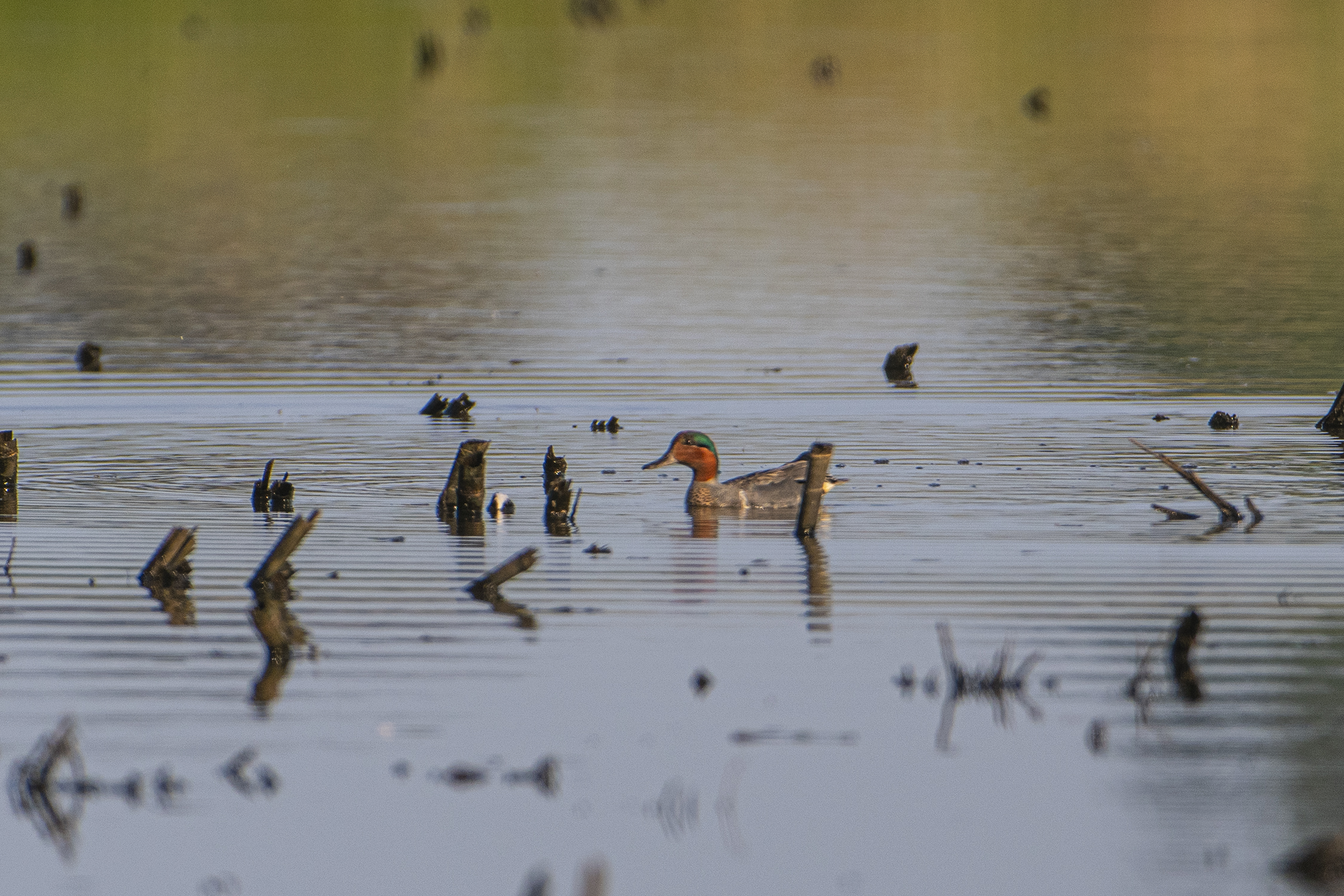
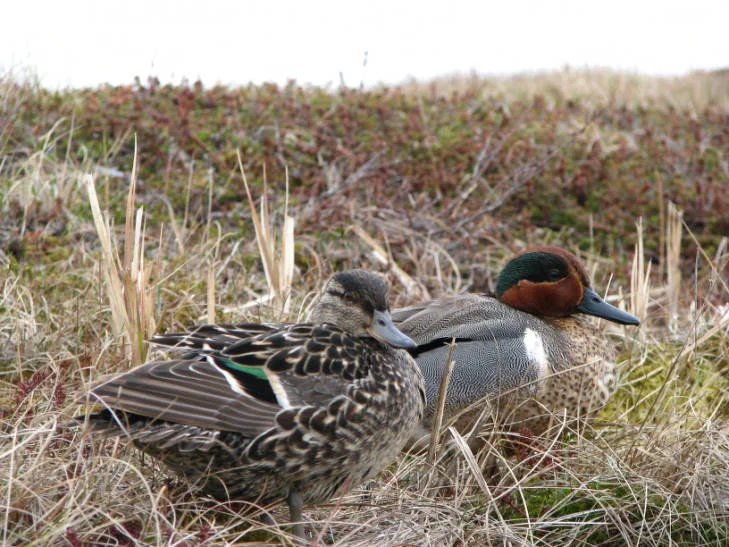
North America’s smallest waterfowl carries a descriptive, charming name. Male green-winged teal sport a chestnut brown head with an iridescent green streak that appears to run through their eyes, have gray bodies, and sport a beige patch near the tail. A vertical white stripe on their sides is a prominent field identification mark. Females are mottled brown in color, and both sexes have an iridescent green wing speculum, for which they are named. The green-winged teal is a common migrant and uncommon summer resident at Goose Pond Sanctuary. In November 2008, we counted a record high count of 550 individuals at Goose Pond. We frequently find green wings feeding in shallow water for seeds and aquatic invertebrates along with northern shovelers.

Female (left) and male (right) green-winged teal. Photo by USFWS

Female (left) and male (right) green-winged teal. Photo by USFWS

According to the Cornell Lab of Ornithology, “Green-winged Teal are numerous and their population has increased over recent decades, according to waterfowl surveys conducted by the U.S. Fish and Wildlife Service. They estimated the North American breeding population in 2015 was at least 4 million, almost double the long-term average… Most of the population breeds in Canada and Alaska, where relatively remote and inaccessible nesting areas buffer this species from habitat losses farther south caused by agricultural and urban development.”

Green-winged teal range map, courtesy of Cornell Lab of Ornithology’s allaboutbirds.org

Green-winged teal range map, courtesy of Cornell Lab of Ornithology’s allaboutbirds.org

Volunteers have been busy surveying birds for the Breeding Bird Atlas II that is ending this summer. One of our goals this year at Goose Pond was to confirm green-winged teal, the smallest waterfowl species in North America. Brand Smith recently confirmed nesting trumpeter swans, the largest waterfowl species in North America, about three miles away at Schoeneburg Marsh/Erstad Prairie.

One of the four photos taken in the past five years of a breeding female green-winged teal in Wisconsin. Photo by Richard Armstrong

One of the four photos taken in the past five years of a breeding female green-winged teal in Wisconsin. Photo by Richard Armstrong

Comments from our June 20th Breeding Bird Atlas report:

“We have small numbers of green-wings nesting at Goose Pond every year. Usually we do not see the broods due to the emergent arrowhead. The water is too high for arrowheads at this time and broods are easier to see. Mark was walking along a wetland edge south of the Kampen Road residence when a female green-winged flushed and did a detraction display. The green on the speculum was visible without field glasses from 25 feet. Could see at least six young… Mark went back for the field glasses and this time saw the female and a male about 20 yards from the female. This spring we had two pairs and two males but have not seen any green wings since about mid-May. What a pleasant surprise.” 

Later that evening we searched for more waterfowl broods and were pleased to find six broods of blue-winged teal along with broods of mallards, northern shovelers, and hooded mergansers. The Cornell Lab of Ornithology states that “The male green-winged teal defends its mate from copulation attempts by other males, then deserts the female once incubation is underway. A few hours after they hatch, the chicks can swim, dive, walk, and forage for themselves, although the female continues to brood them at night and to protect them when the weather turns cold.”  It is interesting that we saw the male nearby even after the eggs hatched. We have also noticed one male blue-winged teal interacting with a brood and female.

A green-winged teal male hangs out at Goose Pond, near the female and brood, an unusual behavior for this species. Photo by Richard Armstrong

A green-winged teal male hangs out at Goose Pond, near the female and brood, an unusual behavior for this species. Photo by Richard Armstrong

Ours is the first green wing confirmation in Columbia County and the nineteenth confirmation state-wide.  In Breeding Bird Atlas I (1995-2000), Brand confirmed the only brood of green wings in Columbia County at Grassy Lake State Wildlife Area, and greens wings were confirmed in 35 blocks. Most bird books show that green wings only migrate through Wisconsin on their range maps.  We assume that the Wisconsin Breeding Bird Atlas II data will be used in the future to update summer range maps.

We hope you visit Goose Pond Sanctuary this summer to see ducklings and other wetland bird broods. Abundant water has receded little due to above normal rainfall including 5.7 inches of rain in the past week, and wildlife viewing opportunities are excellent.  

Thanks to Richard Armstrong for taking photos to document the green-winged teal.

Written by Mark Martin and Susan Foote-Martin, Goose Pond Sanctuary resident co-managers

Cover photo by USFWS

Wilson's Snipe

Print Friendly and PDF

To begin discussing a Wilson's Snipe one must start with its call (listen to it here). Haunting and eerie in composition, the snipe's signature perhaps reflects human feelings towards the areas it inhabits: wetlands and bogs, marshes and swamps. These are marginal areas of little apparent use, though the snipe uses its bombastic winnowing on these grounds to attract mates and scare away predators. Its call is in fact not a call or vocalization, but rather the passage of air through primary feathers as the bird swirls through its wetland residency. 

I knew the call of a snipe long before I knew that a snipe made the call. It seemed amazing that such a call could come from such a shorebird. Short and stocky, with a long straight bill used for probing invertebrates, the snipe appears diminutive and awkward. Yet once flushed, the birds zig-zag in flight and incite riotous calls from nearby Sandhill Cranes and Red-winged Blackbirds. Mallards fly from the springs where a few days ago three snipe flushed as I approached a relatively fresh deer carcass. No doubt these birds were taking advantage of the invertebrates doing the work of cleaning the deer. 

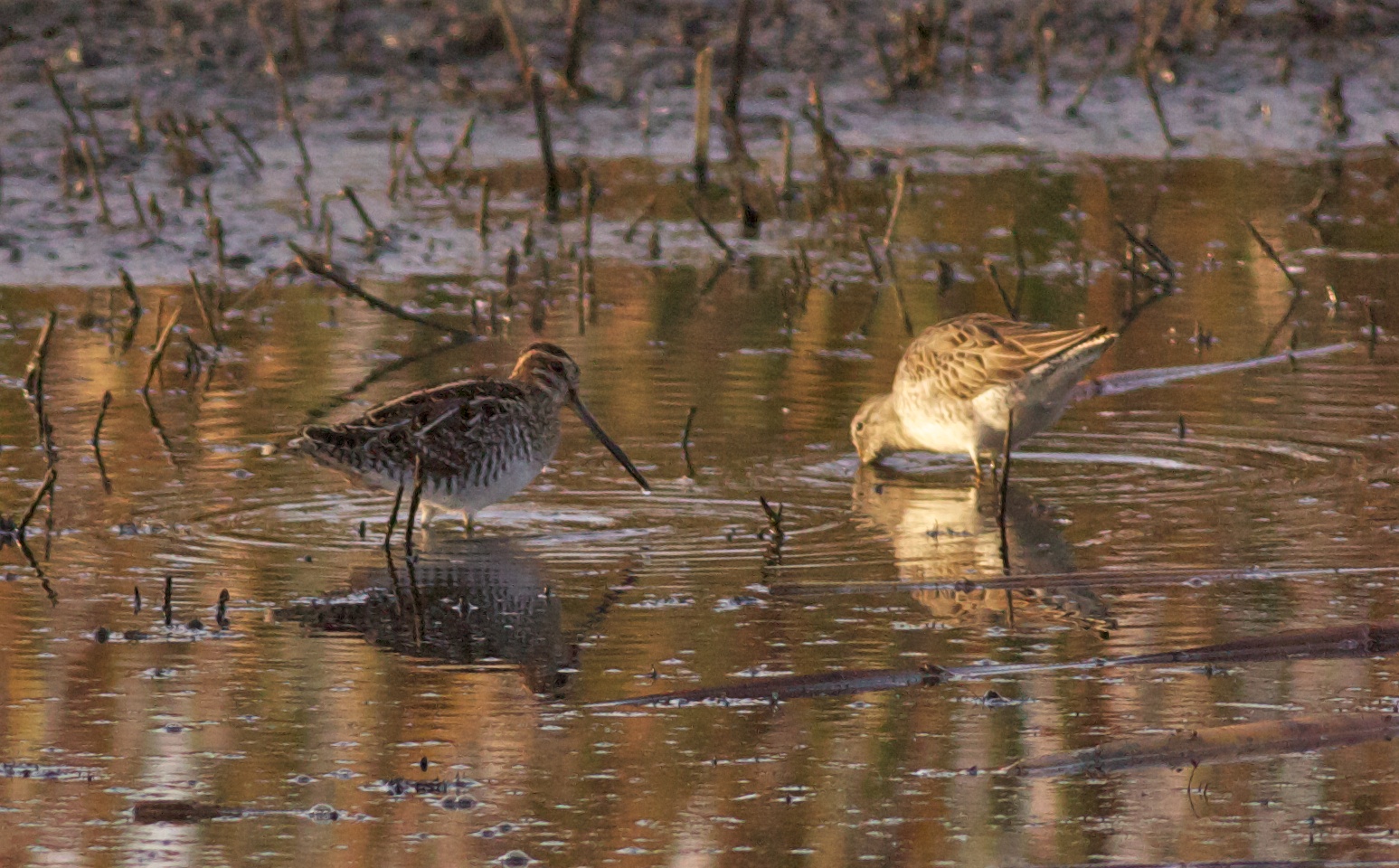
Two Wilson’s snipes stand in shallow wetlands, one with just its long beak underwater rooting for bugs. Photo by Arlene Koziol

Two Wilson’s snipes stand in shallow wetlands, one with just its long beak underwater rooting for bugs. Photo by Arlene Koziol

Wilson's Snipe are named for Alexander Wilson, a famous ornithologist. The bird's Latin name (Gallinigo delicata) means “resembling a hen.” This likely refers to the heavy chest of the snipe. Huge pectoral muscles account for one quarter of the bird's weight and help it to achieve speeds of up to 60 miles per hour in flight. The etymology of the word “sniper” originates from British soldiers hunting snipe in India, where they were said “to snipe” these erratic and winnowing birds.

Here at Faville Grove, you can't snipe the Wilson's Snipe, though you can enjoy their winnowing calls if you can find them. The wet prairies offer excellent habitat for the snipe, and standing on the south-easternmost exposure of Waterloo Quartzite listening for snipe makes for an excellent spring evening as they migrate through in great numbers.

A Faville Grove wetland, complete with iconic flora and fauna! Photo by Drew Harry

A Faville Grove wetland, complete with iconic flora and fauna! Photo by Drew Harry

During the Faville Grove summer, it’s been thought that the snipe are absent from the prairies here, moving to more northern areas of Wisconsin. However, in the past few weeks I’ve listened at the ledge on evenings as the snipe continue winnowing. About a week and a half ago, the interns and I were making our way through the wet prairie of the Lowlands South. Upon reaching an open area that had dried down from standing water earlier in the year, I noticed a short “puff ball” running along the ground. Quickly snapping pictures, my mind reeled as to the identity of the species, but a hint quickly flashed from the nearby cattails—an adult Wilson’s snipe!

The little puff ball in action. Photo by Drew Harry

The little puff ball in action. Photo by Drew Harry

Reviewing my pictures confirmed that the young fledgling was indeed a snipe. Rare nesters in southeastern Wisconsin, this is the first Breeding Bird Atlas conformation for Jefferson County, and a wonderful addition to the summer breeding birds of Faville Grove.

Written by Drew Harry, Faville Grove Sanctuary land steward

Cover photo by Arlene Koziol

Eastern Kingbird

Print Friendly and PDF

The Eastern Kingbird, a delightful bird to watch on June mornings, marks open areas with its broad tail feathers, notched at the bottom with white. To watch a kingbird is to see a bird puppeted about as it moves from a snag, hawks a group of insects, and returns to that same perch. Last year I witnessed the delightful presence of recently fledged kingbirds on a power line along North Shore Road. The parent bird went one by one and delivered food to each fledgling—a precise and delicate process.

Photo by Arlene Koziol

Photo by Arlene Koziol

Kingbirds can be found in open habitats, from savannas to prairies to orchards, across much of the United States, including all of Wisconsin. Constructing haphazard nests in shrbus and trees, the birds will defend those nests and territories from nearly every intruder. Aggressiveness of breeding birds is a common sight, and dazzling aerial maneuvers often ensue. In flight, the kingbird’s tail will regularly fan out, as the bird hovers, twists, and maneuvers chaotically.

Its Latin name Tyrannus means tyrant or despot, and the kingbird lives up to this with its defense of its nest from brown-headed cowbirds, blue jays, and hawks. You can find kingbirds at Faville Grove in most open habitats with a scattering of trees. Watch for their distinctive white tail tip and kiting flights in grassy areas.

Photo by OHFalcon72

Photo by OHFalcon72

Written by Drew Harry, Faville Grove Sanctuary land steward

Cover photo by Andy Reago & Chrissy McClarren

American Kestrels: 2019 adult banding results

American Kestrels: 2019 adult banding results

I am glad that it has warmed up and that it is time to band kestrels! Thirty volunteers for Madison Audubon’s Kestrel Nestbox Monitoring Program were busy in March cleaning out kestrel boxes, and we’re now seeing the results of their work. This nestbox program has two primary goals: 1) provide clean, abundant nest sites for kestrels to raise their young, and 2) create opportunities to band both adults and chicks to study their migration patterns, demographics, nesting preferences, and more.

Photo by Jim Stewart