Friday Feathered Feature

Welcome to Fall Migration

Print Friendly and PDF

There is an abundance of “welcoming” habitat at Goose Pond for the fall migration.  Today, there are 660 monarchs still roosting in spruce trees and one white pine in the yard at the Kampen Road residence.  The monarchs are nectaring on large patches of the colorful purple New England aster and showy goldenrod flowers.

Monarchs on New England aster, photo by Monica Hall

Monarchs on New England aster, photo by Monica Hall

Grassland birds can still be seen fliting around in the prairie or in the shrubs including silky dogwood.  Sedge wrens, common yellowthroats, and a few eastern meadowlarks along with warblers are with us now.

Sedge wren, photo by Arlene Koziol

Sedge wren, photo by Arlene Koziol

Water levels are at a record high for this time of the year.  Usually the shallow wetlands are dry with much of the area planted to corn or soybeans. However, this year instead of seven-foot high corn plants there is a diversity of emergent vegetation including water plantain, smartweeds, barnyard grass, bidens, softstem bulrush, cattails, and the first wild rice plant seen at Goose Pond.  Many of the emergent plants, especially those in bold above are providing an abundance of high energy food for migrating ducks.  Goose Pond is about seven-feet deep and most of the wetland birds are feeding in the 100 acres of shallow wetlands on Audubon property and adjacent landowners.

The southern shorebird migration began in July and there are still flocks of migrating shorebirds including yellowlegs.  The shorebirds love the mud flats where they are busy searching for invertebrates.

Great egret, photo by Monica Hall

Great egret, photo by Monica Hall

Fish eating birds, including great egrets and double crested cormorants are feasting on abundance of fat head minnows.  It has been reported that female fat head minnows can spawn every week when the water temperature is between 64 to 85 degrees.  Goose Pond may contain hundreds of thousands of minnows.  The downside to having minnows in the pond is that they also feed on invertebrates, frog, and salamander eggs.  Ducklings need an abundance of invertebrates to feed on.  

The record number of 95 great egrets has declined however over 20 egrets and great blue herons can still be photographed as they fish. Arlene Koziol photographed an osprey on the causeway.  We assume the osprey would rather feed on large fish and quickly moved south.

Other raptors observed recently include northern harriers, American kestrels, a peregrine falcon and a record number of five bald eagles seen by Arlene Koziol.  The peregrine is probably looking for shorebirds and ducks and was last seen in the tree on the Goose Pond Road causeway.

Bald eagle, photo by Monica Hall

Bald eagle, photo by Monica Hall

The pair of bald eagles whose nest is about three miles north of Goose Pond are frequent visitors.  It is not hard to tell when eagles are present as they flush egrets and ducks.  Sue was rewarded by seeing the flock of 95 great egrets overhead after they were flushed by the eagle.  Recently Mark and Graham observed two flocks of 30 blue-winged teal in the open water and then spotted the bald eagle.

The last of the migrating bobolinks will be moving south shortly after feeding on smartweed seeds and seed in our sorghum and sunflower food plot.  Red-wing blackbirds, mourning doves, and American goldfinch numbers are increasing in the food plot.

Pied-billed grebe, photo by Arlene Koziol

Pied-billed grebe, photo by Arlene Koziol

There are over 30 pied billed grebes present and they will remain for a couple of weeks.  Canada geese, ducks, and American coot numbers will be increasing.  

We welcome you to come out and enjoy the habitats and birds.  You can visit the Wingspan viewing area on Prairie Lane or enjoy the views from the benches and newly landscaped area along Prairie Lane adjacent to the spotting scope, or hike the trails, especially the trails that begins at the Browne Prairie parking.  

Come take a seat at the beautiful south edge of Goose Pond. Photo by Arlene Koziol

Come take a seat at the beautiful south edge of Goose Pond. Photo by Arlene Koziol

Written by Mark Martin and Susan Foote-Martin, Goose Pond Sanctuary resident managers

Golden-winged Warbler

Print Friendly and PDF

Though lacking much worthwhile recognition in Wisconsin, the golden-winged warbler could amply serve as the state bird. While mostly a breeder in the northern half of the state, this warbler does migrate through southern Wisconsin about this time to wintering grounds in Central and South America. Its buzzy and conspicuous song in spring “Piiiiii zaaa zaaaa zaaa” deserves investigation, and often my first golden-winged warbler of the year catches me off guard when I realize the buzzy trill is not an insect but a bird on a flight to the northern forests and shrub swamps of Wisconsin.

Golden-winged warbler sings in a tree. Photo by Drew Harry

Golden-winged warbler sings in a tree. Photo by Drew Harry

It is said that Wisconsin hosts approximately 1/5th of the US breeding population of this species, and this bird makes its distinctive mark on the habitats it occupies in Wisconsin. While preferring shrub swamps and clearcut stands near water, this bird is rather cosmopolitan in its use of habitat. Some research suggests that golden-wingeds need mature forest nearby, in addition to grassy areas for nesting, and shrubby areas for foraging . On my family’s cabin near the Pine River in Florence County, a popular activity is floating the oxbow of the river for 2-3 hours. On a June float, it’s typical to hear multiple golden-winged warblers along the way, and the mix of habitat and structure along the river—from white cedar swamps to alder thickets to open areas with standing dead elms—seems to make for excellent golden-winged warbler habitat.

Human-caused disturbance was the result of a population increase and range expansion in the early 20th century due to logging and clearcutting. Today, this trend continues. Golden-winged warblers will occupy powerline rights of way, brushy pastures, and clearcuts (especially aspen). Historical disturbances that still favor golden-winged warblers include beaver ponds, windthrown areas, and forest fires.

Beavers are extremely important diversifiers of habitat, creating early successional openings that will favor species like the golden-winged warbler. You might think of beaver dams as small-scale projects, but the largest beaver dam in the world can be seen from space!

Windthrown trees seem like another insignificant event, but satellite images of Menominee and Langlade County show the path of a tornado from 2007, still visible today.

From nasa.gov

From nasa.gov

In fact, I drove through this area on a trip over Labor Day, and young aspens dominate this swath (which stretched for 40 miles and reached 3/4mile wide in spots). This storm caused millions in property damage over its course. Yet, in uninhabited forested areas, it created excellent Golden-winged warbler habitat.

At Faville Grove, you might be able to see Golden-winged warblers in savanna and woodland areas. There’s no perfect spot to see these birds, but areas of heavy warbler activity might turn up a golden-winged; and if you do see that bird, consider how much more distinctive it is than our current state bird, the robin.

Written by Drew Harry, Faville Grove Sanctuary land steward

Cover photo by Melanie Underwood

Monarch Mania

Print Friendly and PDF

The massive movement of butterflies has been called by some as “one of the most spectacular natural phenomena in the world.”  Since we began tagging monarchs in 2012 and recording their numbers, this has been a record year for monarch abundance at Goose Pond Sanctuary during their fall migration to Mexico.

Sue first noticed the monarchs roosting in the large spruce trees in our yard on September 4, and we ended up counting 800 monarchs that morning. Three days later, we had a sighting that we will long remember of 1,800 monarchs all in the western most spruce tree where they were trying to be protected from the east winds.

Gobs of monarchs roosting in the trees begin increasing their internal temperatures by pumping their wings. Photo by Arlene Koziol

Gobs of monarchs roosting in the trees begin increasing their internal temperatures by pumping their wings. Photo by Arlene Koziol

Monarchs do not move much in the roost until the sun appears. However, sometimes a monarch flies by and the nearby monarchs welcome or signal to the monarch by opening their wings with a brilliant orange. They usually fly to nearby white cedar, dogwoods, and other shrubs, open their wings and dry off before heading to the prairies for nectaring.

We have conducted eight roost counts that include the Kampen Road residence, the spruce/white cedars in the Jackson winter cover unit, and the spruce at the Manthe farm on Goose Pond Road. Today we found 1,600 and yesterday’s count was 1,500.  See more roost photos in Arlene Koziol’s photo album here.

Fall Roost Count.png

In addition to having high roost counts, we are finding large numbers of monarchs in the prairie and many to tag.

Goose Pond Sanctuary’s Browne Prairie is a sea of yellow this fall, full of goldenrod which monarchs love to nectar on. Photo by Madison Audubon

Goose Pond Sanctuary’s Browne Prairie is a sea of yellow this fall, full of goldenrod which monarchs love to nectar on. Photo by Madison Audubon

Recently we walked about one-half mile on trails through the prairie and counted monarchs within 40 feet of the trail. We ended up with 42 monarchs per acre. It is an impressive to see the prairies ablaze with yellow flowers and brilliant orange monarchs.

On a recent day Arlene Koziol, her grand daughter Ella, and Mark found JD Arnston near the Browne Prairie parking lot tagging a large number of monarchs. We thought that this might be a day for seven-year-old Ella to see if she could set a “world record” for releasing monarchs.

Monarchs in a net will be carefully extracted and tagged with a unique identifier sticker. Photo by Ruth Smith

Monarchs in a net will be carefully extracted and tagged with a unique identifier sticker. Photo by Ruth Smith

A monarch with a tag will continue its journey to Mexico. Photo by Madison Audubon

A monarch with a tag will continue its journey to Mexico. Photo by Madison Audubon

We set up our tagging operation by the Browne Prairie bench and in one-hour J D netted 69 monarchs within a half an acre of prairie! Mark placed the tag on a toothpick and handed it to Ella. Mark then removed the monarch from the net, tagged it, had Ella determine the sex (she was 100% accurate), and then she released it saying to each “have a safe journey to Mexico.” Arlene recorded the data. This was a day Ella will never forget. She later sent us a thank you note and an excellent drawing of a monarch and a milkweed. Ella’s record of releasing 69 monarchs in one hour will be hard to beat.

Two monarch tagging participants scout their approach for their next target. Photo by Ruth Smith

Two monarch tagging participants scout their approach for their next target. Photo by Ruth Smith

We also had 17 people on a monarch tagging field trip and they ended up tagging 215 monarchs in about one hour and forty-five minutes.

The yellow color in the prairies is mostly from stiff, Canada, and showy goldenrod, along with patches of sawtooth sunflowers. The monarchs have been nectaring on all those species.

Monarch butterflies are easy to find in Goose Pond prairies right now so come and see them for yourself! As a bonus you many see many of the 95 great egrets that are still with us.

NOTE: There is still space for tagging monarchs on Saturday September 21! Come join us for an unforgettable experience on the prairie! Register here.

Written by Mark Martin and Susan Foote-Martin, Goose Pond Sanctuary resident co-managers

Cover photo by Arlene Koziol

Tennessee Warbler

Print Friendly and PDF

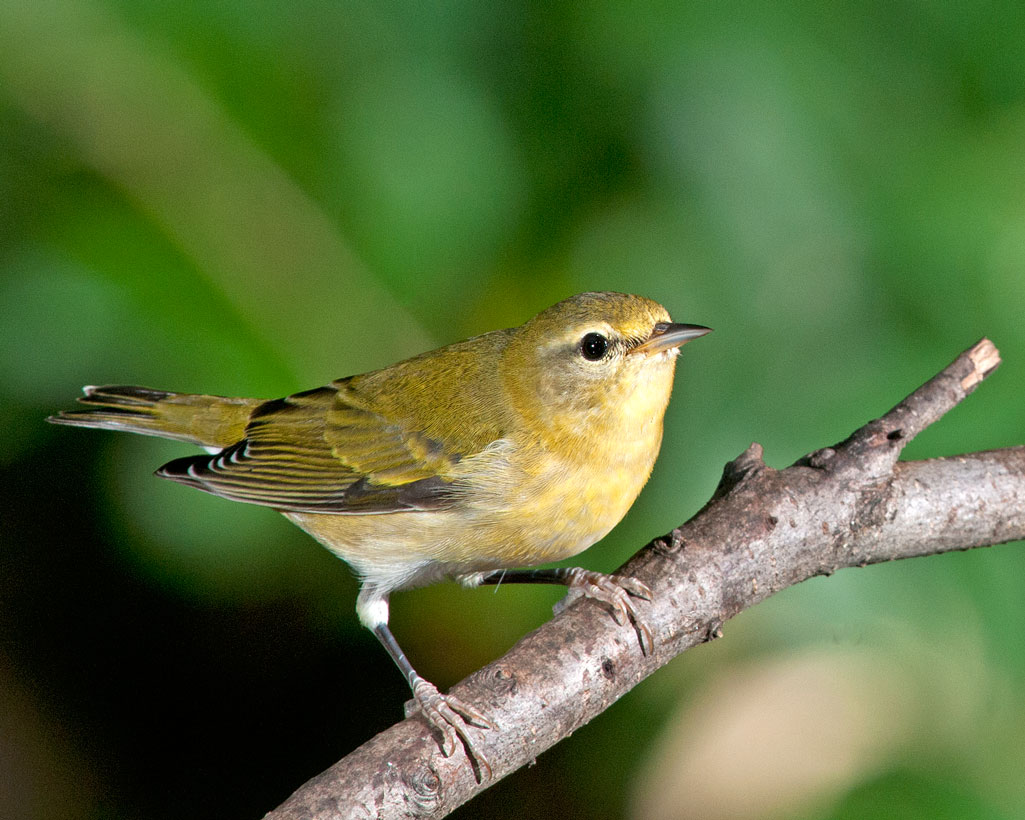
The Tennessee Warbler flies through a Midwestern spring, making itself known with its surprisingly loud “tip tip tip tip tip sippp sippp sippppp ti ti ti ti ti” song. A flock of dozens of these warblers will soon make a birder search for other species, and the full helping of the Tennessee Warbler is soon forgotten. On these dazzling spring mornings, the Tennessee Warbler is often but a overabundant appetizer, say cheese and crackers, to the buffet of warblers to be had. However, as May wanes, so does this warbler, and soon it is gone, and often unseen, until spring returns.

Tennessee warbler, photo by Jeff Bryant

Tennessee warbler, photo by Jeff Bryant

However, right now marks an excellent time to catch that Tennessee Warbler once more before it makes its way south to its namesake Volunteer State (where it only migrates through) and even further south to South America.

Once in South America, this warbler will often reside in shade-grown coffee plantations, where abundant flowering trees provide plentiful insects and nectar. This habit led ornithologist Alexander Skutch to suggest “coffee warbler” as an alternative to the misnomer of Tenessee Warbler.

Shade-grown coffee plantation, photo by Marshal Hedin

Shade-grown coffee plantation, photo by Marshal Hedin

In reality, these are birds of the high northern latitudes, breeding in openings of the boreal forest. Nests are constructed in hummocks of sphagnum and sedges, and because the spruce tree is a characteristic boreal tree, a favorite menu item of the Tennessee Warbler is the spruce budworm, which can break out and defoliate forests of spruce.

Some forestry operations in Canada will spray entire forests with insecticide in order to inhibit the spruce budworm, and more recent advances have led to lepidoptera-specific insecticides. Researchers in Canada have sought to understand whether this spraying affects the Tennessee Warbler, and have discovered that the females will alter feeding behavior in sprayed areas, and as a result will spend less time tending to their brood. However, no negative effects were found on the brood survival. Whether the long-term effects of this spraying will reduce populations of Tennessee Warblers remains to be seen, but their population is stable for now.

Tennessee warbler, photo by Russ Wigh

Tennessee warbler, photo by Russ Wigh

Again, it’s very rare for the bird to breed in Wisconsin; in the second Breeding Bird Atlas, birders only coded two Tennessee Warblers as “probable” for the entire state of Wisconsin. But these warblers are abundant for the moment, and you might find them in woodlands throughout the state as they make their way south, hopefully to a nice sustainable coffee plantation.

Written by Drew Harry, Faville Grove Sanctuary land steward

Barn Swallow

Print Friendly and PDF

I remember mowing my great grandmother’s lawn as a kid. Located in the flat country of the Lake Michigan coastal plain, this old farmstead with sideways chicken coops and crumbling barns made for interesting mowing, especially due to dive bombing swallows. Years later, I would discover that the railroad abutting the old farmstead still held a piece of mesic prairie—one of the most endangered and fragmented plant communities in the state of Wisconsin. Little did I know that six species of swallows call Wisconsin home, or that these local swallows were caring for nearby nests.

Barn swallow photo by Kelly Colgan Azar

Barn swallow photo by Kelly Colgan Azar

No, as I mowed as a kid I knew none of this, I merely risked life and limb each time I pulled out the riding mower, skirting rectangular patterns around the outbuildings. I feared the day a swallow would drill my face; they never did.

Today, I see daily the barn swallow nest under the deck on Prairie Lane, and it’s a happy reunion each year when they return from South America and brilliantly grace spring with their rich orange undersides. Of course, this acquaintance has run into some neighborly conflict.

Barn swallow chicks, photo by Whitney H

Barn swallow chicks, photo by Whitney H

I clean up the droppings from the chicks once they’re big enough to move around the nest, while on the other side of things, the parents are disturbed off the nest every time we come and go from the house. As a mark in my favor, one barn swallow a few years ago flew behind me through the open screen door and crashed about the inside of the house, leaving behind some feces. As a mark against me, I occasionally stick my camera, with the flash on, into the nest to see how many eggs and chicks occupy it—an obtrusive gesture, especially when chicks expecting a meal are disappointed to find bright lights and an iPhone.  

Barn swallow fledglings, photo by Mick Thompson

Barn swallow fledglings, photo by Mick Thompson

All in all, I get along with my barn swallow neighbors, and they are beautiful to watch in flight while they pick off dragonflies and the like. Currently, these birds are particularly abundant because recently fledged young are maneuvering their way around old farmsteads in ways only a barn swallow can. The pair under my deck already fledged four young, and the second brood is now hatched and getting ready to fledge. This species needs man-made structures to nest, or will otherwise nest on cliffs and ledges. Thus, the barn swallow exists in a secure state and is nearly worldwide in distribution.

In fact, recent observations have confirmed that barn swallows, in an unlikely move, have started nesting on overwintering grounds. Traditionally, their breeding range has included most of the northern latitudes while wintering grounds included most of the southern hemisphere. In another twist, during winter, these breeding Argentinian barn swallows migrate north for winter. The exact reason for this shift is unknown, but the barn swallow, already a bird happy with human innovations, has turned its own innovation by completely changing its migratory patterns.

Barn swallow range map, provided by Cornell Lab of Ornithology, https://www.allaboutbirds.org/guide/Barn_Swallow/maps-range

Barn swallow range map, provided by Cornell Lab of Ornithology, https://www.allaboutbirds.org/guide/Barn_Swallow/maps-range

You can find barn swallows around most of the buildings around Faville Grove Sanctuary; you can’t miss them.

Written by Drew Harry, Faville Grove Sanctuary land steward

Cover photo by USFWS Midwest Region