Friday Feathered Feature

Snowy owls: Update on Columbia & Welcome to Fond du Lac

Print Friendly and PDF
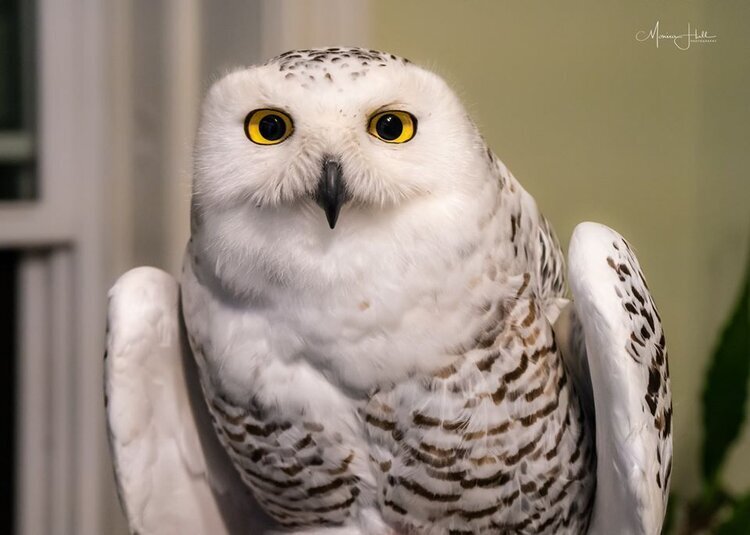
Columbia, the snowy owl, looks at the camera with her sharp, yellow eyes. Photo by Monica Hall

Columbia, the snowy owl, looks at the camera with her sharp, yellow eyes. Photo by Monica Hall

Update on “Columbia”

You can learn more about her by checking out her first Friday Feathered Feature. https://madisonaudubon.org/fff/2020/1/31/we-named-her-columbia

Scott Weidensaul’s March 1st Project SNOWstorm blog post is titled Zugunruhe to You, Too! https://www.projectsnowstorm.org/posts/zugunruhe-to-you-too/

Ornithologists use the German term, zugunruhe — which translates to “migratory restlessness” — to describe this kind of growing itch that migrants feel as the seasons change. It’s brought on by hormonal changes triggered by both the bird’s internal circadian rhythms and the changing day length. Often it’s a strong wind from the right direction — southerly, in this case — that prompts an exploratory flight…” Four snowy owls with transmitters in the Dakotas and Saskatchewan exhibited zugunruhe the last week of February.  Scott wrote, “There’s been less evidence of zugunruhe in the owls farther east. In Wisconsin, Columbia has been tracing a very distinct movement pattern northeast of Morrisonville, a narrow, 7.5-mile (12-km) long path anchored at one end by the farmland and a sand quarry near Audubon’s Goose Pond Sanctuary, and at the other what must be a highly productive field for hunting just east of a large housing development.”

Columbia did not exhibit any zugunruhe until March 8th. At sunset she said goodbye to her new friends and headed north. She was flying at 30 miles per hour on southerly 12 mile per hour winds when she passed South Leeds. At one location she was clocked at 41 miles per hour.
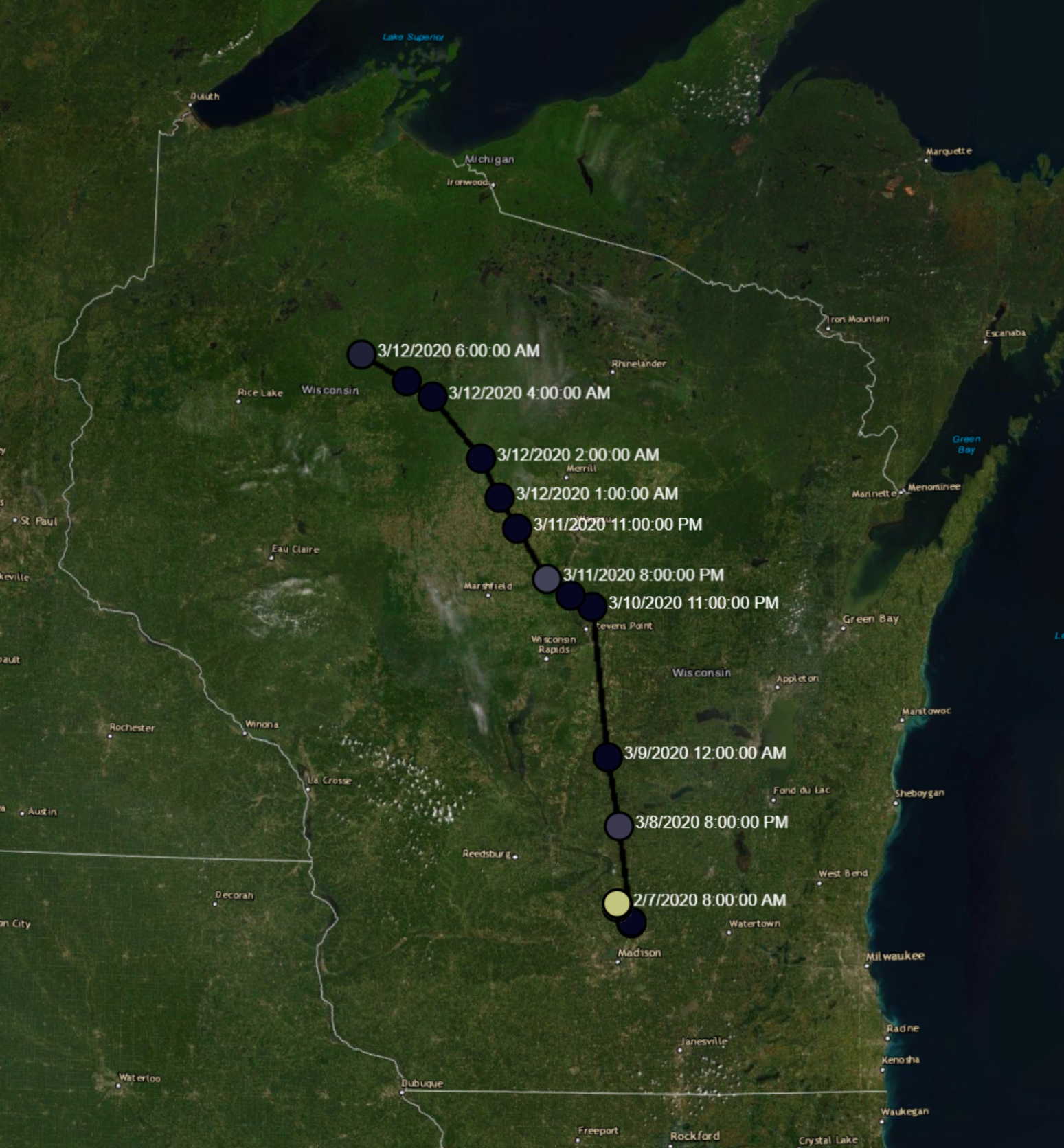
A path marks Columbia’s northward journey since March 8.

A path marks Columbia’s northward journey since March 8.

Columbia would make frequent stops, with her first at the French Creek North State Natural Area in southern Marquette County.  She then headed over John Muir County Park (this location was on her bucket list), and ended up that morning just south of the Plainfield Tunnel Channel Lakes State Natural Area in Waushara County, 62 miles from her start 12 hours before.  She roosted and hunted in irrigated crop fields until 9:00 p.m. on the 10th. Then she headed north and northwest for a 46-mile flight ending up at the George Mead State Wildlife Area, northwest of Stevens Point where she stayed for one day before again moving northwest on a 72 mile flight ending up at a open bog in Sawyer County. Could she be taking a northwest direction to avoid flying over Lake Superior?

Fond du Lac, the snowy owl. Photo by Richard Armstrong

Fond du Lac, the snowy owl. Photo by Richard Armstrong

Introduction to “Fond du Lac”

Catching another owl was a partnership effort with Fond du Lac County Audubon Society who took the lead by paying for a new transmitter. Unfortunately no one from the organization was able to join us for the trapping effort. It was amazing to be able to catch three snowy owls.   Thanks to Angel Clark, Suzanne Bahls and Scott for their articles on the experience.

The Clark and Bahls family searched for owls on Saturday afternoon and located seven snowy owls! 

From a participant:

“On Saturday evening, February 22, 2020, my husband, Pat, informed me we should take our son Ben, to Norton’s Supper Club, on Green Lake, for his 25th birthday. Pat, then mentioned we need to leave a little early to search for snowy owls on the Mackford Prairie. He called his mission, "Operation Snow Storm.” I have never seen a snowy owl in the wild, so I wasn't quite sure what to look for. I thought this was another one of his wild goose chases searching for rare birds with his Madison Audubon buddies. It also makes me nervous when he's driving and looking through binoculars, so I sat in the backseat thinking I would be safer there. 

To our surprise we found one!... A female snowy owl was peached on a snowbank. However, she didn't stay on the snowbank for very long. She started to fly south-east and we followed her. It was hard to see her with the naked eye as she flew further and further away… She finally landed again in a snow covered field near a fence line. I also would like to mention, that this is truly like trying to find a needle in a haystack with all the snow and the owl basically being all white. But we did it! And boy, were we proud of ourselves! My husband, Pat, was so excited he called Mark Martin to give him his news report... "Hi, Mark. This is Pat. We spotted a snowy owl south-east on Lake Emily Road," I could hear Mark's voice on the other end. Mark said, "That's great Pat, now find another!" I chuckled to myself. It reminded me of a school child getting a good mark on a paper, and the teacher saying, now do it again on your next paper! 

The second spotting was on a telephone pole on the corner of Hickory Road, and Highway A. It was another female snowy owl. We were all in complete awe of this magnificent creature. It seemed as if this particular bird enjoyed the attention and wanted us to take her picture. We took many pictures with our mere camera phones. Then she must have spotted something edible on the ground across Highway A. It took off, swooped down just when there was an oncoming car! I thought my husband was going to jump out of his seat! He screamed, "Oh no, don't get hit by that car!" It did not. The owl made it safely to the other side, and came back to where it was originally peached. However, that seemed like it was very dangerous for the bird. Now I can see that these magnificent creatures need safer places to be. Better places for them to perch and find food. 

...From this experience, I have a whole new appreciation for these volunteers and scientists. Now, future generations will be able to experience what we did! Thank you, Project SnowStorm for all your hard work and dedication!”

-Sincerely, Angel Clark


Nine people met on Sunday (February 23) afternoon in Green Lake County east of Lake Maria to catch as many snowy owls as possible. Volunteers included Richard Armstrong, J D Arnston, Mark and Pat Clark from Madison Audubon, Jeff and Suzanne Bahls, and Rick Vant Hoff from the Horicon Marsh Bird Club, and Gene Jacobs and Brad Zinda from Linwood Springs.   

From a participant:

“My snowy owl obsession started about thirteen years ago when I went on a “first date” with Jeff Bahls. He took me to see one on highway 49 at Horicon National Wildlife Refuge. Every winter since, I have looked forward to their visits in our neck of the woods. When Jeff and I got married a few years back, we had a small, simple ceremony with our kids and celebrated afterwards with a snowy owl cake!  Therefore, a few weeks ago, when Mark Martin contacted Jeff about locating a Snowy Owl to be tagged for tracking, thoughts of actually getting to see one up close was like a dream! 

Jeff and I headed over to where we had seen one earlier... off a lightly traveled county road. When we got there, it had relocated to the other side of the road and further away. Gene thought it was still close enough, so he set the trap near the road and we watched… and waited. This owl did not budge. We watched him cough up a pellet and we thought, well, he must be hungry now... Mark Martin, who had been watching with us decided to take a little drive around and see if there were any other Snowies in the area. He found one sitting on a pole on the next road over. We could actually see it from where we were sitting. The problem was the road the second owl was on is a busy road. Mark talked to the landowner and got permission to set a trap on  the ground away from the road. It was decided to take a chance on the second owl. 

We picked up our trap and drove over to the second location. Brad took the trap and set it within sight of the second owl. We watched and waited again. About ten minutes later, the owl hopped off the pole and flew to the trap. She landed on top of it and then hopped off. She did not get tangled in the fishing line that was used to trap her. She sat a few feet from the trap and looked at it for a few minutes, then walked back to it and jumped on it a couple times, but still did not get tangled in the line. She then flew off about a hundred yards. Our hearts sank. Brad walked to the trap and re-adjusted the fishing line, and came back to the truck. We watched and waited again...  Several minutes later she took off flying toward the trap and finally got snagged in the line. Jeff and Brad jumped out of the truck and ran to the trap and went right to work untangling the owl. We got her!

We assisted Gene Jacobs and Brad Zinda in any way we could. During those few hours we caught three adult female Snowy Owls. Two were measured, banded and released back where they were caught. The third snowy was processed and Gene attached a GPS transmitter so Project SNOWstorm biologists can track her movements. It was amazing to witness first-hand the wings, beaks and talons of these gorgeous birds, and to see and work with the people from Madison Audubon and Linwood Springs Research Station. Reflecting on the events of that night still seems like a dream. It was an experience I will dream about for many years to come.”

-Suzanne Bahls


Fond du Lac stayed close to where she was released until March 7 when she moved a few miles north, just south of Green Lake. Her last cell phone was from that area on March 10th. We look forward to seeing her migration northward. 

Find more information on the capture and release of three snowy owls at the Project SnowStorm on Scott’s  blog post titled Fond du lac, and the Owl-fecta.

We hope that the owls enjoyed their visits to southern Wisconsin.  We also wish them safe travels to the land of the midnight sun and hope they return to southern Wisconsin next winter for another vacation.

Thanks to everyone who donated funds for the transmitters, to Gene and Brad from Linwood Springs for trapping and processing the owls, and to the volunteers who reported sightings, assisted with locating owls, taking photographs, trapping, and processing the birds.  We hope you follow their journey north.  

Written by Mark Martin and Sue Foote-Martin, Goose Pond Sanctuary resident managers, and Graham Steinhauer, land steward

Breeding Bird Distributions

Print Friendly and PDF

Bird distributions are not random. Across the state, one notices that loons are a distinctly northern Wisconsin species, or that yellow-bellied sapsuckers occur over the northern half of the state, while also extending into western Wisconsin’s Driftless Area. Perhaps even locally, one notices an abundance of Canada Geese breeding around urban ponds, where park lawns and predator-free expanses make happy geese. 

Color codes for breeding status.

Color codes for breeding status.

Of peculiar interest to me, at Faville Grove Sanctuary, is the presence and absence of certain bird species. Today, we will observe the biogeography of certain bird species in Wisconsin, based on maps pulled from eBird data on the second Wisconsin Breeding Bird Atlas. To the right, you’ll see the different categories of breeding, based on quantitative observations gathered during Wisconsin’s recently completed five year long Breeding Bird Atlas.

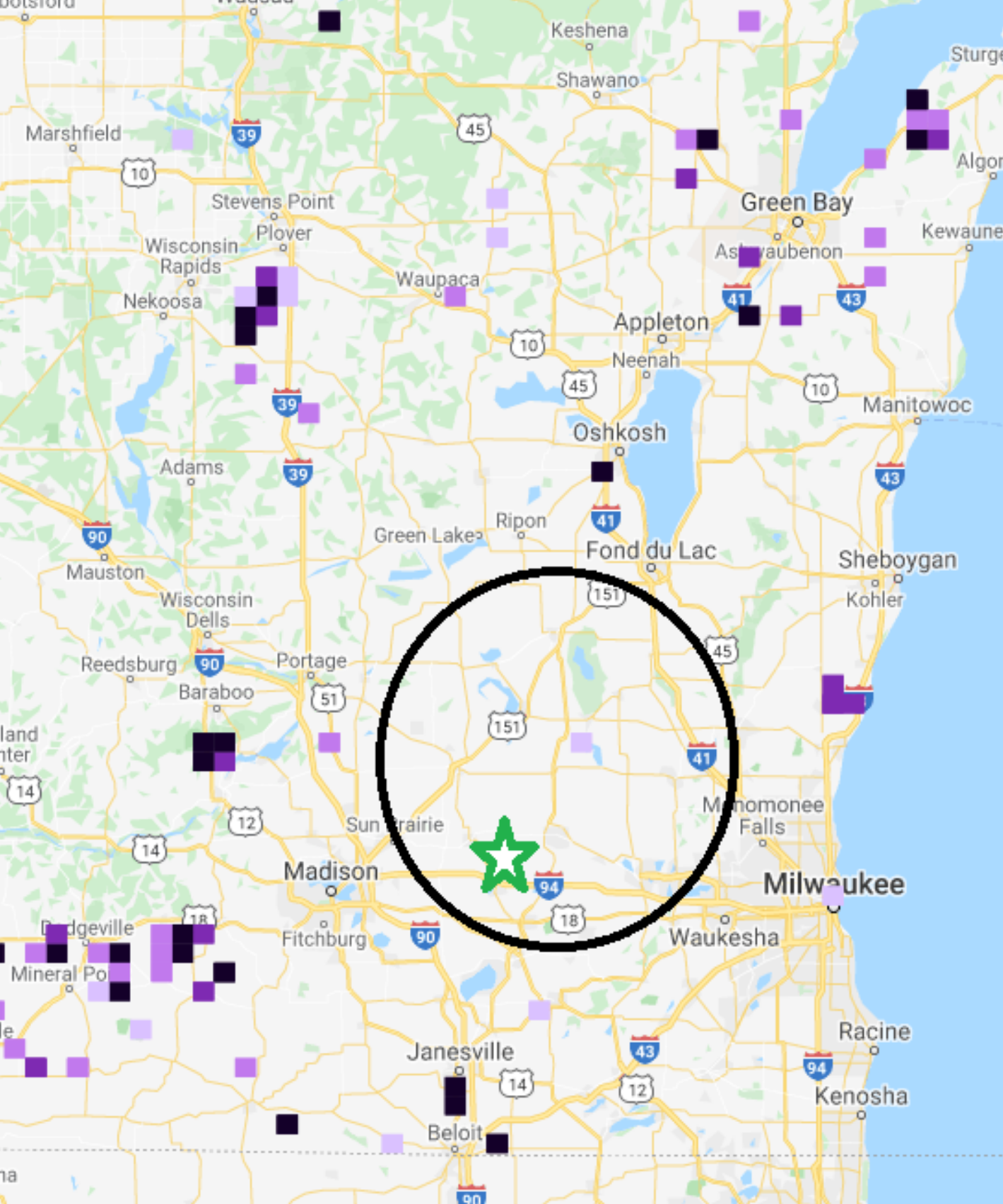
The striking feature of many of the maps that follow is the absence of breeding birds in the Faville Grove Area. From roughly Lake Koshkonong to south, Madison to the west, Horicon Marsh to the north, and the Kettle Moraine to the east, one notices distinct range gaps in many of these bird species. The absence of certain species in this region speaks to the necessity of a landscape-scale habitat project, and the presence of many of these birds at Faville Grove is a testament to the habitat restoration conducted here. 

A fun game is to try and guess the species based on the map.


First, we will analyze the upland sandpiper. Formerly abundant at Faville Grove, the bird used to nest with up to one pair every 1.5 acres, though the birds have not been seen in decades. Art Hawkins, one of Aldo Leopold’s graduate students, published an important paper on the ecology of the Upland Sandpiper at Faville Grove. 

The bird occurs south, west, east, and north of Faville Grove, though in very small numbers. South of Baraboo you can see a block of confirmations from the Sauk Prairie Recreation Area, which includes large acres of new prairie restorations. With new land acquisitions at Faville Grove forming large contiguous blocks of prairie, we eagerly await a possible return of the upland sandpiper.

Upland sandpiper, photo by Vitalii Khustochka, FCC

Upland sandpiper, photo by Vitalii Khustochka, FCC

Upland Sandpiper breeding range in southern Wisconsin, conspicuously absent from the circled area. Star indicates Faville Grove Sanctuary

Upland Sandpiper breeding range in southern Wisconsin, conspicuously absent from the circled area. Star indicates Faville Grove Sanctuary


The short-eared owl was a common breeding species at Faville Grove up until Aldo Leopold’s time in the 1930’s and 40’s. The bird has returned with increasing grassland acreage, overwintering on a diet of meadow voles from the prairie. There is potential for breeding pairs with expanded contiguous habitat.

Short-eared owl, photo by Mick Thompson

Short-eared owl, photo by Mick Thompson

The light purple block west of the I-94 marker is the atlas block that contains Faville Grove Sanctuary

The light purple block west of the I-94 marker is the atlas block that contains Faville Grove Sanctuary


A charismatic and bold bird, the red-headed woodpecker is a relatively common breeder in southern Wisconsin, though remains uncommon in the Faville Grove region. Oak trees and dead snags are critical to keep this species over summer, and a breeding pair has occupied this exact habitat at Hope Lake Bog (an outlying Madison Audubon property) for a number of years. Consistent sightings in the savanna of the Lake Mills Ledge indicate that the canopy thinning has improved habitat for this species.

Red-headed woodpeckers, photo by Kelly Colgan Azar

Red-headed woodpeckers, photo by Kelly Colgan Azar

Red-headed woodpecker breeding locations.

Red-headed woodpecker breeding locations.


A unique warbler with a warm buzzy song, the blue-winged warbler has been expanding northward in Wisconsin since the turn of the twentieth century. Between the first and second Breeding Bird Atlas, breeding pairs have moved even further north into the northwestern and northeastern parts of the state. Yet, the bird is strikingly absent from the Faville Grove Area. One pair was confirmed during the Atlas at the Waterloo Wildlife Area, to the north, where I have seen and heard dozens of the birds during migration. Nesting in shrubby areas and along forest edge, why the birds remain absent from Faville Grove remains a mystery.

Blue-winged warbler, photo by Kelly Colgan Azar

Blue-winged warbler, photo by Kelly Colgan Azar

Breeding map for blue-winged warblers in southeastern Wisconsin.

Breeding map for blue-winged warblers in southeastern Wisconsin.


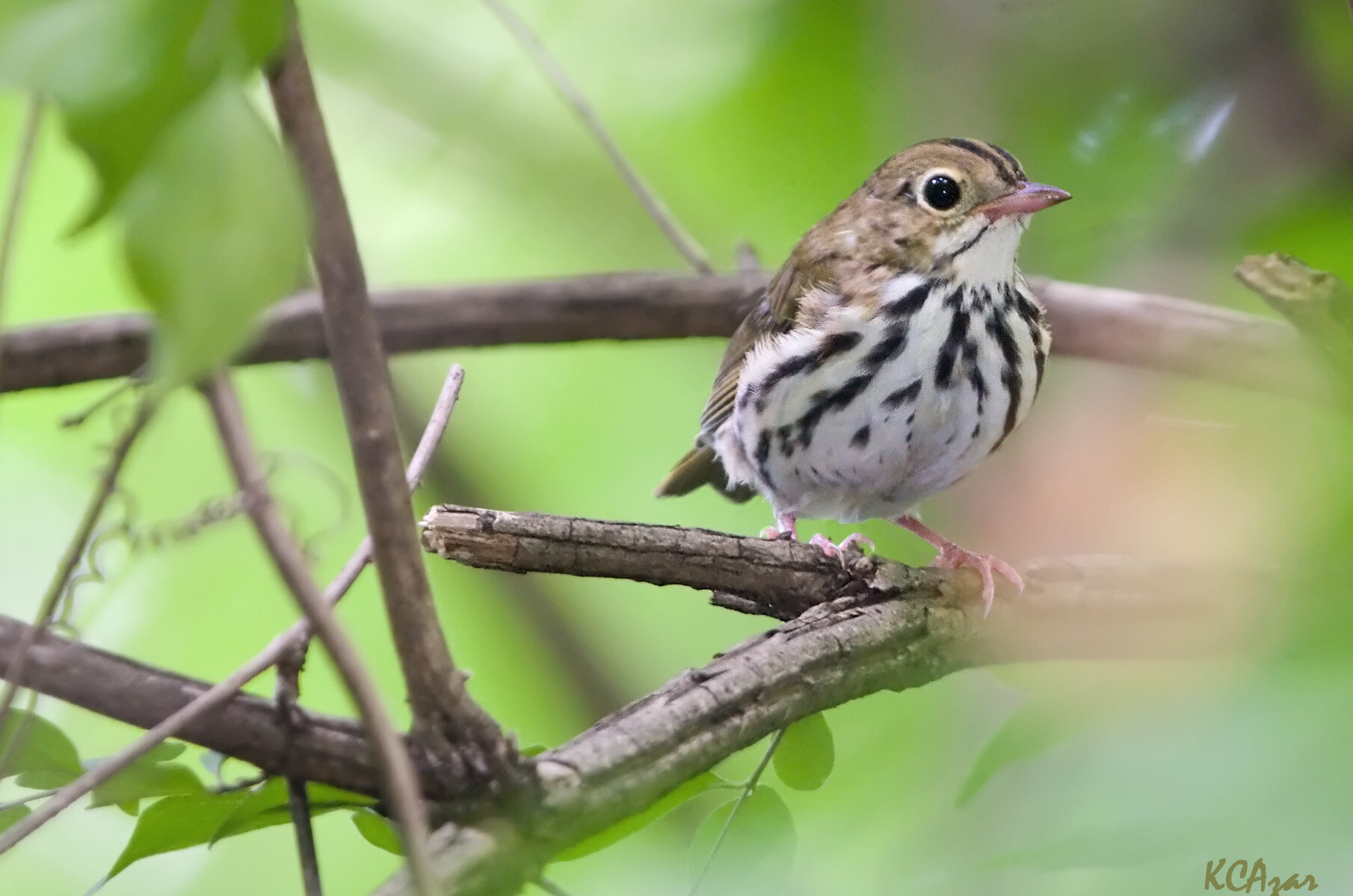
A declining forest bird, the ovenbird lacks necessary habitat at Faville Grove. A ground nester, the ovenbird needs extensive forest tracts.  From the map, we can almost identify the entire Kettle Moraine from southwest to northeast. It seems that outside of the Kettle Moraine, little suitable habitat exists. This is a common plight of many forest birds—the southeast glacial plains ecological landscape is about 4.9 million acres, with almost 3 million acres in agriculture. A mere 392,000 acres of the entire landscape is upland forest, and the only large blocks of forest are located in the Kettle Moraine, where you can also find ovenbirds.

Ovenbird, photo by Kelly Colgan Azar

Ovenbird, photo by Kelly Colgan Azar

Breeding map for ovenbirds in southeastern Wisconsin.

Breeding map for ovenbirds in southeastern Wisconsin.


Found in young forests and shrublands, the mourning warbler occurs for the most part north of Faville Grove, but does breed in the Southern Kettle Moraine State Forest. Savanna restorations may be important breeding areas for this bird, though the overall extensive forest cover of northern Wisconsin is preferred.

Mourning warbler, photo by Tom Benson

Mourning warbler, photo by Tom Benson

Breeding map for mourning warblers in southeastern Wisconsin.

Breeding map for mourning warblers in southeastern Wisconsin.


Here, we see a grassland species with an affinity for forb-rich prairies and high diversity. Faville Grove’s high diversity prairie restorations should provide excellent habitat for the grasshopper sparrow, and one singing bird this past summer could be an indication of a bright future at Faville Grove. Breeding pairs in this area would be an important population boost for the region.

Grasshopper sparrow, photo by Kelly Colgan Azar

Grasshopper sparrow, photo by Kelly Colgan Azar

Breeding map for grasshopper sparrows in southeastern Wisconsin.

Breeding map for grasshopper sparrows in southeastern Wisconsin.


Finally, we can locate Faville Grove’s block precisely on this map, where a black square west of the I-94 marker confirms the breeding of Henslow’s sparrows at Faville Grove. Unburned prairie seems a necessity for the Henslow’s sparrow, and a shifting patchwork of burns has provided excellent habitat for an increasing population of this state-threatened bird at Faville Grove.

Henslow’s sparrow, photo by JanetandPhil, FCC

Henslow’s sparrow, photo by JanetandPhil, FCC

Breeding map for Henslow’s sparrow in southeastern Wisconsin.

Breeding map for Henslow’s sparrow in southeastern Wisconsin.


It could be that the geographic gap in species’ ranges is an artifact of the sampling—located between high population centers in Madison and Milwaukee, the gap apparent in many ranges could just lack sufficient birding. However, the map below shows many areas between Madison and Milwaukee with over 100 checklists, and an overall good coverage of the entirety of southeast Wisconsin.

Map of sampling effort in southeastern Wisconsin.

Map of sampling effort in southeastern Wisconsin.

A confluence of factors merges to produce these range gaps in many species. As stated earlier, only 8% of the southeast glacial plains is upland forest. Of the entire landscape, only 4% is publicly owned. Small slivers of habitat tend to hold fewer birds than large blocks. Thus, on a landscape wanting for many bird species, a landscape-scale habitat restoration project like Faville Grove can fill the gap.

Written by Drew Harry, Faville Grove Sanctuary land steward

Northern Shrike

Print Friendly and PDF

One of the most striking birds of winter resides on the shrubby grasslands and savannas of southern Wisconsin. In this habitat, you can find wild plum, hawthorn, black locust, or barbed wire. The common link is spikes, thorns, or barbs. In winter in Wisconsin, if you search these spiny spots, the unsettling link might be impaled microtine voles. The uninitiated might look to the sky, wondering if a hawk dropped its prey randomly onto a plum bush. The answer comes from the sky, though not from a raptor species dropping the vole. Instead, you are on the wintering range of the northern shrike, a passerine, or songbird, (the only passerine in Wisconsin to regularly eat vertebrates) which actively stuck the vole in its place. The purpose of this act is to consume prey efficiently over the course of the winter. At any point, a northern shrike will cache, or save, up to seven prey items.

An impaled vole is cached for a northern shrike’s next meal. Photo by Drew Harry

An impaled vole is cached for a northern shrike’s next meal. Photo by Drew Harry

Impaled voles, mice, and other small mammals are common indicators that you are on shrike territory, which can range from 500-1,000 acres over winter. Another interesting prey item are species of its own order—songbirds! Shrikes will consume birds like horned larks, dark-eyed juncos, house sparrows, American robins, red-winged blackbirds, pine grosbeaks, and red crossbills. Many of these birds are much bigger or quicker than the shrike, and thus shrikes will take other birds in surprise attacks. In a twisted move, shrikes will even mimic the calls of other songbirds to lure them into area where they ambush an unsuspecting sparrow.

In February, I often start getting concerned about the house sparrows looming around bluebird boxes around my house, although this year they have been noticeably absent. The reason might be a shrike that I’ve spotted a few times around the house. Shrikes typically sit for 1-2 minutes on the tops of trees, perched, and waiting to strike. A week ago, I was able to get some decent pictures through my window of an immature northern shrike as it moved from bur oak tree to pear tree and again back to the bur oak trees scattered about the yard; each time sitting for 1-2 minutes and allowing me to capture a few shots.

A northern shrike is spotted at the top of this oak tree at Faville Grove Sanctuary. Photo by Drew Harry

A northern shrike is spotted at the top of this oak tree at Faville Grove Sanctuary. Photo by Drew Harry

A northern shrike scouts the landscape to make its next move. Photo by Drew Harry

A northern shrike scouts the landscape to make its next move. Photo by Drew Harry

A northern shrike sits perched on the tip-top of a tree, giving nearby humans a minute to get a good look. Photo by Drew Harry

A northern shrike sits perched on the tip-top of a tree, giving nearby humans a minute to get a good look. Photo by Drew Harry

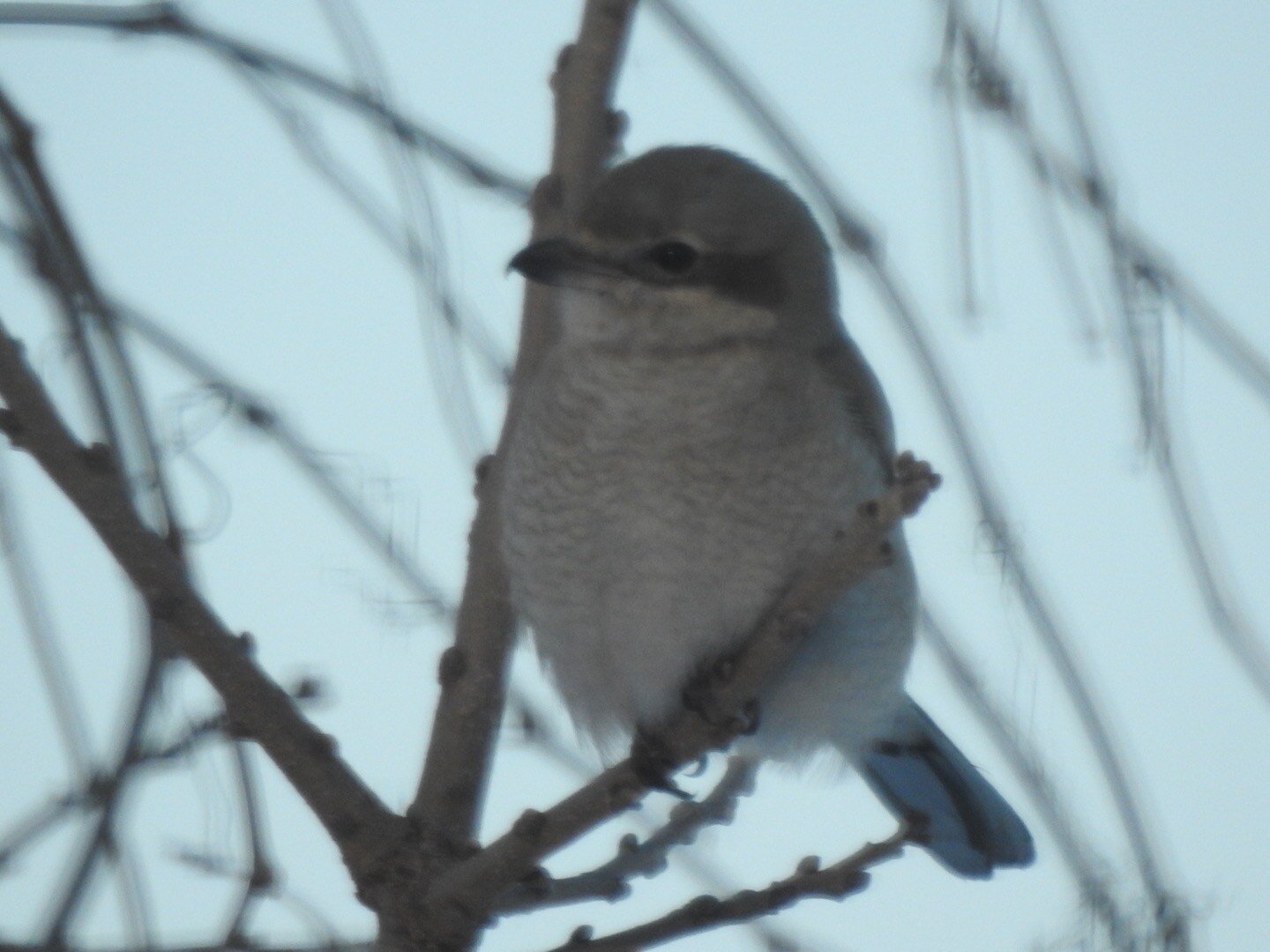
The immature shrike shows gray barring on its chest, a white eye-ring, and like adult shrikes has a light underside with a blue-gray top and a narrow black mask across its eye. The hooked bill is also diagnostic.

Barring, eye ring, and mask are all visible in this shot of a northern shrike. Photo by Drew Harry

Barring, eye ring, and mask are all visible in this shot of a northern shrike. Photo by Drew Harry

For me, the most fascinating part about the northern shrike is its winter diet. While impaled small mammals steal the show, over 60% of an individual bird’s winter diet is composed of arthropods. A study in Idaho analyzed the regurgitated pellets of northern shrikes and found an average of 2.8 prey items per pellet. Overall, 33 species were identified in pellets for a wide and diverse sampling of food. To follow a shrike in winter is to understand the surprising breadth of prey items active through winter.

You might ask, aren’t arthropods dormant during winter? For the most part, yes. However, many species will stay active, and on slightly warmer days the south-facing slopes, rock outcrops, or other exposed areas can heat more quickly than other areas and cause some invertebrates to become active. In southwestern Idaho, rimrock areas are preferred by shrikes presumably due to the higher arthropod activity on these exposed rock areas.

Faville Grove has exposed rock—1.8 billion year old quartzite—perhaps a source of arthropods for the local shrike? Each winter we often see a shrike in the western part of the Sanctuary, hanging out in the tops of tamarack trees in the Diedrich-Alexander Wildlife Area along North Shore Road. You might find a shrike anywhere within Faville Grove Sanctuary, but your best bet is to keep looking at the tops of trees, or look for indirect evidence on spiny trees and bushes.

Written by Drew Harry, Faville Grove Sanctuary land steward

Cover photo by Eric Ellingson

Canada Warbler

Print Friendly and PDF

Adorned with a black necklace of spots on its chest, this warbler resembles the magnolia for its intricate jewelry. A curious white eye-ring resembles a Connecticut warbler without the temperamental dark grey head. Cheeky black markings resemble a Kentucky warbler or even a hooded warbler. Together these markings, with the addition of a wondrous blue-gray back, provide evidence of a Canada warbler.

Canada warbler peeks out behind a tree. Photo by Drew Harry

Canada warbler peeks out behind a tree. Photo by Drew Harry

This bird mostly migrates through southern Wisconsin, preferring the boreal forest elements of northern Wisconsin. Its continental range extends well into Canada and includes the northern tier of most Midwestern and eastern states, extending down into the Appalachian range. These warblers breed preferentially in wet areas like spruce and tamarack swamps, and are thus a difficult bird to monitor and document breeding. The Canada warbler’s range does reach into southern Wisconsin; in areas with extensive forest cover like the Baraboo Hills and areas with large undisturbed blocks of tamarack swamp like Cedarburg Bog, the Canada warbler can be a surprising summer find.

As a member of the boreal forest birds, the Canada warbler may be especially susceptible to a warming climate. According to Audubon’s climate scenarios, under warming of three degrees Celsius, the Canada warbler will lose 95% of its current range. Range expansion north could result in a 63% gain in habitat, but overall a net loss of a huge amount of habitat and birds is possible.  Boreal forest birds are especially susceptible to a changing climate because they are at the northern reaches of forested cover in North America. If the climate of these forests becomes uninhabitable, there is a lack of forest cover to the north for them to inhabit. Of the 48 boreal forest species identified by Audubon, 47 face moderate to high vulnerability.

Photo by John Sutton

Photo by John Sutton

While the long-term prognosis may be grim, Canada warblers have seen small population increases in Wisconsin over the last few decades, according to breeding bird survey data. Finding suitable habitat in southern tamarack swamps, the birds will build a nest on or near the ground in dense shrub thickets, producing 2-6 eggs.

Fall migration begins in August and stretches into September, and the birds will make a long flight to the Colombian Andes, where over 50% of the over-wintering population resides. On these slopes, the birds prefer elevation between 3,200 and 6,000 feet and also prefer mature and large forest blocks. Research from Laura Céspedes and Nicholas Bayly indicates that 14% of overwintering range in the Colombian Andes is currently protected, and these unprotected areas could be prime for conservation and restoration.

Your best bet for finding Canada warbler at Faville Grove Sanctuary is during spring of fall migration. In the middle of May, areas along the Crawfish River may be an excellent spot for finding mixed flocks of warblers, including the Canada. The foraging behavior of Canada warblers is unique, and you can find the birds low in the understory, moving quickly, often with its head cocked.

Written by Drew Harry, Faville Grove Sanctuary land steward

We Named Her "Columbia"

Print Friendly and PDF

Dec. 2, 2020 update: Columbia is back in the US! Her latest recorded location (with a 3 day delay) is in North Dakota. Track Columbia's movements and progress here.


Snowy owls make their way to our neck of the prairie each winter. Some years we host a half-dozen or more, while others it can be tricky to find just one. This year, the snowys have been pretty darn elusive, but we have good news on that front!

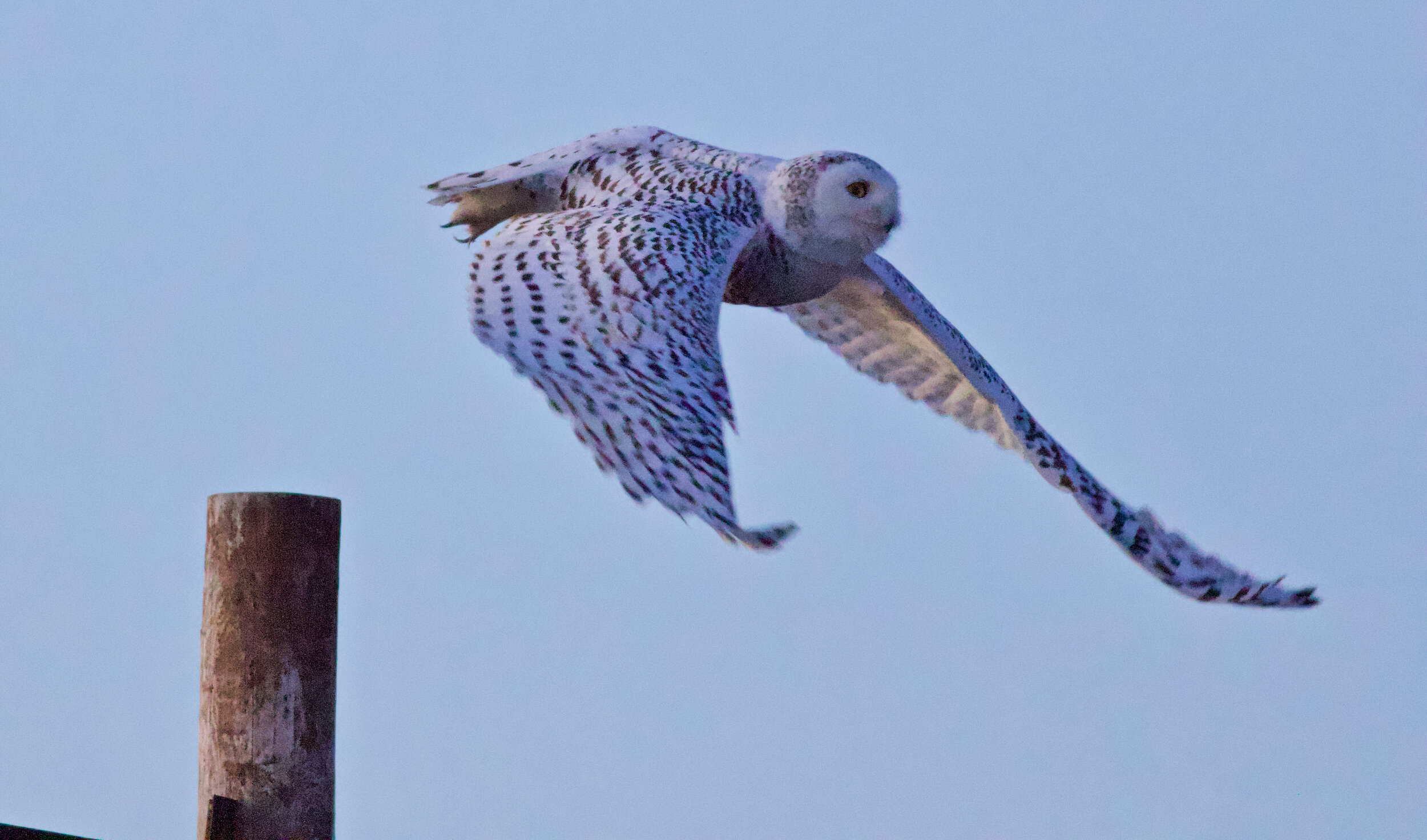
This lift-off was caught on camera on Dec. 11 near Goose Pond. Birdwatchers were hopeful that we’d get to meet this snowy owl again! Photo by Arlene Koziol

This lift-off was caught on camera on Dec. 11 near Goose Pond. Birdwatchers were hopeful that we’d get to meet this snowy owl again! Photo by Arlene Koziol

The Project

We are close partners with Project SNOWstorm, which is a non-profit organization that studies snowy owls’ ecology and migration each year (Dave Brinker, co-founder and Wisconsin native, will give a presentation for Madison Audubon on April 21 — plan to attend!). They do this by outfitting owls with GPS transmitters that collect data on their location regularly. Those data upload to the database whenever the transmitter has reception, or stores the data until the owl “has service” again (a handy feature when most of the year the owl is in the Arctic!). The transmitters are feather-light, solar powered, and do not impact the owls’ flight or behavior.

We have successfully caught and outfitted two snowy owls in the past — Goose Pond in 2015 and Arlington in 2018. In addition, we caught and weighed Quarry in 2018 at the same time as Arlington (but we had only 1 transmitter). Finally, a snowy that was caught in central Wisconsin used one of our previous transmitters making Coddington in 2019 our third outfitted owl.

The Lead-up

On December 11th, Mike Bertram, UW Arlington Research Station Manager reported the first snowy owl sighting for the winter on Badger Lane at the station.

On January 16th, owl volunteers assembled with high hopes of locating and trapping at least one and maybe two snowy owls.  Lowell Wright, Noise/Environmental Officer with Dane County Regional Airport, set up trapping operations at the airport where there were two snowys residing, but he had no luck catching them that night.

On the same evening, Gene Jacobs set up his traps on Ramsey Road at the Otteson family residence near Highway 51.  Steve Otteson had reported that for the past week a snowy owl had been seen perched on the electric pole at the corner of their yard in late afternoon.  This owl was probably the 1.5 year-old female that first showed up on December 11th. Snowy owls like the openness of the Ramsey Road area.

The owl searchers drove a large area before and during the trapping operation and only found three short-eared owls. People were disappointed that the snowy did not appear that night, especially because Richard Armstrong stated that he’d “bet $100 we that we would see the owl.”

On January 20th, three snowy owls were reported at the Dane County airport and some of us thought that the owl on Ramsey Road was now  at the airport. However, on January 24th, our neighbor Judi Benade, sent us an email titled "Owl" along with a photo of the bird and this comment "Still owls around ... this one on Kampen Rd on the 4th phone pole west of County I."   This pole is near the northwest corner of Browne Prairie.

This unexpected snowy owl gift was a good omen on Jan. 28! Photo by Stacy Taritas

This unexpected snowy owl gift was a good omen on Jan. 28! Photo by Stacy Taritas

Today’s the Day

The owl was also seen on the 26th and 27th in the same area so plans were made to trap on the 28th. Stacy sent us this image on the morning of the 28th with this caption, “When my first grade student gifted me this snowy owl this morning, I of course hoped it was a sign that today is the day.”

Searchers again worked in vain before Gene arrived.  With no owls spotted in our area Gene and all our volunteers headed to the airport except for Mark and Fred Dike who continued searching for the owl around Goose Pond.  Vice President Pence was in Madison that day and Lowell informed us that we could not drive around the airport area searching for owls until the the Vice President left. 

Arlys and Curt Caslavka and Dennis Schenborn were a search  team. Arlys wrote,

“After two hours of searching at Goose Pond and the airport with only seeing the owl at the airport that we couldn’t try and trap, it was exciting to get the call that a snowy had been spotted on an electric pole near Goose Pond. The site was perfect for setting up the caged live pigeon about 60 yards from the pole. The snares made of fishing line on top of the cage were easily visible from where we sat. 

And then the tense waiting.  Five cars facing the space between the owl and the cage lined up like at an outdoor movie…for 30 minutes. Was she hungry? Interested in the pigeon? Too smart for us? Waiting for dark?  At 5:07 p.m. she swooped down and landed near the cage. And for about eight minutes she hopped, walked, bounced, and danced around the cage. She puffed up her feathers and lifted her wings to move close in and out, looking in all directions, obviously cautious and assessing the situation.  We didn’t want to blink for fear of missing something. Suddenly she leaped up above the cage and began flapping as the snare caught hold of her, but only by a single toe. In a second, Gene and Richard Armstrong were out of the car and heading up the hill to the trap. A minute later the owl was freed, calmed, and safe heading back in Gene’s arms. What a beautiful owl and what a heart-thumping experience this was. Lucky us!”

The beautiful snowy owl caught near Goose Pond Sanctuary on Jan. 28, 2020. She was outfitted with a transmitter for research purposes and release back into the wild. Photo by Monica Hall

The beautiful snowy owl caught near Goose Pond Sanctuary on Jan. 28, 2020. She was outfitted with a transmitter for research purposes and release back into the wild. Photo by Monica Hall

Everyone returned to the Kampen Road residence to the laundry room to help process, photograph, and observe the banding and attachment of the transmitter.  After processing the owl she was released at the capture location by Graham Steinhauer. Everyone wished her good luck.  

Gene Jacobs examins the snowy owl to determine her age. Photo by Dennis Schenborn

Gene Jacobs examins the snowy owl to determine her age. Photo by Dennis Schenborn

Meet Columbia

The marvelous snowy owl weighed a hefty five and a quarter pounds. Later Gene examined wing photos and found that she was the same 1.5 year old that Arlene photographed on December 11th. Project SNOWstorm likes to name owls after a location. Our first owl an adult male caught on February 13, 2015 was named Goose Pond. Arlington, a juvenile male, was our second owl so Sue said “Let’s name her Columbia.” Thanks to everyone that has provided us with owl sightings, photographs, and assisted with searching and trapping. 

Third time’s a charm?

After Arlington passed away in 2018, his transmitter was recovered, refurbished, and placed on Cottington, an adult male, in 2019 at the Buena Vista Marsh southwest of Stevens Point.  Unfortunately Cottington ended up getting covered by manure at a farm and had to enter rehab. He was cleaned up and released without the transmitter. So Arlington’s transmitter was placed on Columbia making this the fourth Madison Audubon owl of Project SNOWstorm’s 100 owls.  We wish Columbia well on her journey to the arctic and hope that she helps researchers learn more about snowy owl ecology and also provides an educational opportunity for the public to appreciate these magnificent animals.

Leslie, a mother of two children and a grade school teacher wrote the following note after her visit with the kids the day before Columbia was caught. 

“On Monday afternoon my children Wally (7) and Cece (5) and I set out to explore Goose Pond for a great outdoor winter adventure looking for snowy owls. We'd been following the pictures and stories about the snowys on the Madison Audubon Facebook page and tracking the owls on Project Snowstorm for the past few winters. We LOVE snowy owls at our house, so we came prepared! We brought our three stuffed animal owls - 2 snowys and their friend, the barn owl.  

We were very fortunate to encounter Mark & Graham in the first few minutes of our search. In fact, we hadn't even gotten out of the car when they found us and lead us to a nearby area where they had just recently seen the bird we now know as Columbia. We could hardly contain our excitement at having found some guides who might lead us to see the snowy ourselves. When we pulled into a driveway, we could see the snowy owl right at the top of the hill. We were absolutely thrilled. This was a huge highlight of 2020 thus far! We stayed probably 45 minutes and watched the bird through binoculars. The kids squealed with delight when it seemed as if Columbia looked right at them! Watching the snowy owl fly was incredible for all of us, too. Just stunning. The following day in school, Wally was inspired to write a story about snowy owls here in Wisconsin and teach his classmates all we know about the snowys.

Columbia sits and waits for supper (taken on Dec. 11, 2019). Photo by Arlene Koziol

Columbia sits and waits for supper (taken on Dec. 11, 2019). Photo by Arlene Koziol

What a treat! Thanks so much to Madison Audubon for your incredible work. And special thanks to our tour guides on this special day! We'll not forget it and we'll look forward to tracking Columbia and to more adventures in the beautiful Goose Pond area.”

Within a week or so, anyone will be able to track Columbia’s whereabouts on the Project SNOWstorm website. The project protects the birds by delaying the release of locations by 3 days, so keep that in mind as you watch her move around Wisconsin and eventually up to the Arctic.

Bon voyage, Columbia!

By Mark Martin and Susan Foote-Martin, Goose Pond Sanctuary resident managers, goosep@madisonaudubon.org