Tundra Swan

The tundra swan migration is well underway at Goose Pond Sanctuary!  

These Holartic swans are on a 1,800 mile fall migration route that began in the high arctic with major stops in North Dakota and along the Mississippi River before they will reach their destination at Chesapeake Bay. White tundra nesting birds are some of the last to migrate into our area and in October, we had a snowy owl and two snow buntings that were early for both species.

39057649384_ae8aa36f25_o.jpg

Tundra swans usually arrive at Goose Pond in late October but this year three swans were present on October 15th.  Swan numbers did not reach 100 until November 13 when there appeared to be a significant migration out of the northern great plains. The following week tundra swan numbers averaged around 140 birds at Goose Pond.

This year, the swans are feasting on an abundance of arrowhead tubers.  Ideal swan feeding habitat is a shallow prairie wetland covered with arrowheads.  Arrowheads covered Goose Pond this summer but quickly decayed in September.  Mallards also like to feed on arrowhead tubers - which are sometimes aptly called "duck potato".  In most years, diving ducks, like redheads, sometimes are adjacent to the feeding swans waiting for them to dislodge a tuber that they try to capture.  However, this year water levels are low resulting in poor diving duck habitat.  In mid-November the only diving ducks seen were a flock of eight ruddy ducks. 

Some visitors comment on why some swans are gray or dirty looking.  These grayish birds are young swans and contrast greatly with the white adults.  The young swans comprise 11% of this year’s flock compared to 6% in 2014.  The “Class of 2015” is learning the migration route and in a few years they will be able to lead the flock to Goose Pond.  It would be interesting to be able to experience the first fall migration as a young swan on a 1,800 mile long journey with their family.  We assume some of these long-lived birds have visited Goose Pond for many years.

Usually the swans remain as long as there is open water.  The 3,800 Canada geese and 700 mallards pack together with the swans and help keep a small area of open water.  However, if snow and low temperatures materialize like the forecast predicts, swans may leave in a few days.  We invite you to visit Goose Pond sooner rather than later to see these magnificent birds.    

Written by Mark Martin & Sue-Foote Martin, Goose Pond Sanctuary Managers

Photo by Mark Nenadov, Flickr Creative Commons

Snow Bunting

Snow buntings have been making their way through southern Wisconsin, returning from their high Arctic nesting grounds. With a splendid white underside and copper back and face, snow buntings' markings merge with the coming winter snowstorms. Their copper ear coverts give the appearance of blushing—a modest bird.

2355205639_fa2e751e12_o.jpg

Male snow buntings make their way to the Arctic by early April, when temperatures still hover in the negative double digits. While most of the Midwest wriggled uncomfortably in the polar vortexes last year, snow buntings felt the familiar spring breeze of the northern limits of the earth.

During the nesting season, snow buntings have no northern limit and are circumglobal in their distribution; stretching from Canada to Russia to Norway. Some research suggests that snow buntings are bound by southern limits relating to light regimes—when there is not enough light, the buntings are not able to reproduce.

You can look for snow buntings at Faville Grove in open fields, along gravel roads, and on power lines. Perhaps the rock outcroppings of the ledge savanna offer similar habitat to the rocky tundra where they spend their “summers.”

Written by Drew Harry, Faville Grove Land Steward

Photo by Eric Begin, Flickr Creative Commons

Northern Pintail

Sleek and slender, it looks more like a drawing than a real dabbler.  The drake’s plumage—smooth gray on the sides and upper back; jet black accents along a tail in sharp relief; a chocolate head, richer than Venezuelan cocoa couverture; pearly white breast plotted like a pointed lapel against the darker colors—is aesthetically simple and, for me at least, appealing.

3100218851_157cf984e3_o.jpg

North America, distinguishes this bird.  Around 1,000 nest in Wisconsin each year, gracing the marshes and grasslands with a sartorial gravitas.  The birds arrive early in the year, mid-March, hemming themselves along the shortgrass uplands relatively far from water, creating a runway from nest to wetlands where they dabble, court, and rest. 

With the eclipse, the drakes molt a new plumage, decidedly less crisp, swapping layers—fashion for comfort.  They also leave the hen to incubate the young and raise the newly hatched.  If found in a Wisconsin fall, the bird will be moving south hurried by the cold gray winds and skies that stole its color.  Think of the pin-up for waterfowl and you’ll see this bird, tailored in breeding plumage, the Northern Pintail. 

Written by Drew Harry, Faville Grove Land Steward

Photo by Rick Leche, Flickr Creative Commons

Peregrine Falcon

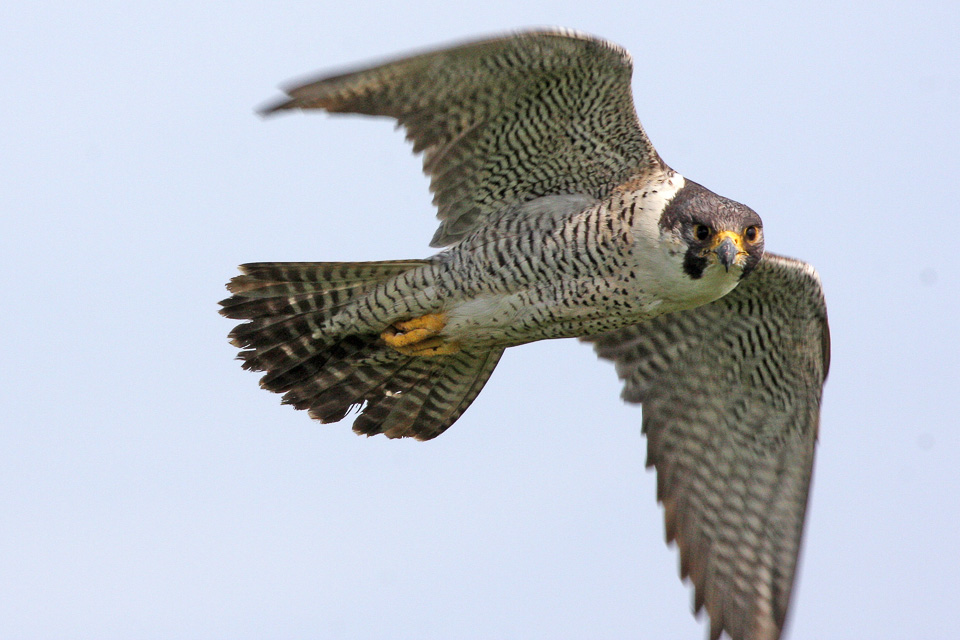
Many recent visitors to Goose Pond Sanctuary have been treated to views of the fastest bird in the world - a peregrine falcon.

A peregrine's average cruising flight speed is 24 to 33 mph and increases to 67 mph when in pursuit of prey! When stooping (dropping on prey with their wings closed) these falcons can reach speeds of 238 mph.

When hunting, peregrines start by watching from a high perch (in our case, the dead trees on Goose Pond Road between the two ponds). They also hunt by soaring from great height. Stoops begin 300–3,000 feet above their prey and end either by grabbing the prey or by striking it with the feet hard enough to stun or kill it.

Peregrine falcons eat mostly birds, of an enormous variety—450 North American species have been documented as prey. They have been observed killing birds as large as a Sandhill Crane and as small as a hummingbird.  However, they especially like to feed on shorebirds and ducks - which is why we they've been frequenting Goose Pond during this heavy migration season.

On October 19, Daryl Tessen reported seeing 13 different species of shorebirds at Goose Pond to WISBIRDN.  We found five species of ducks on October 23, including 635 mallards and 230 green-winged teal. We also observed a peregrine chasing (but not catching) shorebirds.

Greg Septon, Wisconsin’s peregrine biologist, wrote in the Atlas of Breeding Birds in Wisconsin that peregrines have historically nested on about 20 cliff eyries along the Mississippi and Wisconsin Rivers and in Door County. These eyries were abandoned during the late 1950’s and early 1960’s due to the use of DDT.  

Peregrines were reintroduced into Wisconsin beginning in the 1980’s. During the first Breeding Bird Atlas in the 1990s, peregrines were recorded nesting at 11 sites. Their nests were mostly found at power plants or tall buildings along Lake Michigan, Lake Superior, or the Mississippi River - the only inland record was from Madison.

This year - the first year of the second atlas project - shows at least 14 pairs have been found nesting including a pair at the MG&E power plant in Madison and at Devils Lake State Park!

Dan Berger, co-founder of the Cedar Grove Hawk Research Station in 1950, banded young peregrines from Wisconsin eyries in the 1950’s and was very pleased to find banded young a few years ago from the cliff at Maiden Rock on the Mississippi River.

Dan reported in the first week of October that over 30 peregrines had been seen at Cedar Grove but none were trapped and banded.

The name "peregrine" means wanderer, and the peregrine falcon has one of the longest migrations of any North American bird. Tundra-nesting falcons winter in South America, and may move 15,500 miles in a year.

Arlene Koziol photographed an unbanded peregrine on October 19 and we observed a banded peregrine on October 23rd.  We could see the silver Fish and Wildlife Service band and could not see the other leg that may have contained color bands. The unbanded bird may be heading from the tundra to South America while the banded bird may be Wisconsin peregrine. If you see a banded peregrine please let us know the band color code and we will try and get the location it was banded.  

Thanks to the Cornell Lab of Ornithology for providing information on the peregrine falcon.

Written by Mark Martin & Sue Foote-Martin, Goose Pond Sanctuary Managers

Photo by Ron Knight, Flickr Creative Commons


Dark-Eyed Junco at Faville Grove

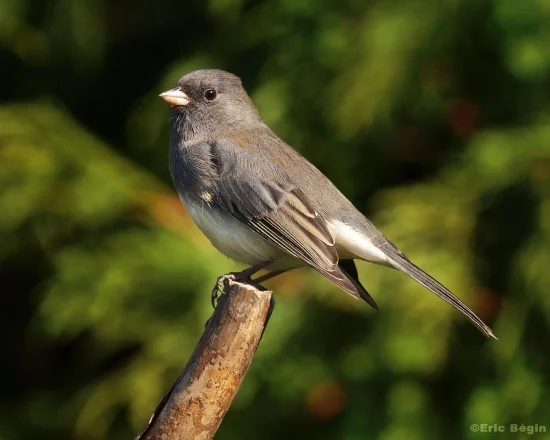
A common feeder bird, Dark-eyed Juncos come with the first frosts in southern Wisconsin.

The bird's Latin name (Junco hyealis) means “of the winter.” Juncos arrive for the winter in mid-September and head north in March-May. It could be discouraging that Juncos, the bird “of the winter,” stay in Wisconsin for seven months. We've been seeing plenty of Juncos, but the windy, sunny, and cool fall days have a permanence of their own. Here at Faville Grove, winter is a long way off. We are busy collecting seed for our fall planting, and we hold volunteer work parties every Wednesday and Saturday 9:30 am-noon and 1:30-4:00 pm (Saturdays only).

junco_1_550_440.jpg

Seed is a vital component of the junco's diet, up to 75% by some accounts. Skilled at finding feeders and hopping around lawns for food, juncos keep a steady diet throughout winter. Our restored prairies contain abundant and diverse seed sources for migrating birds and recent winter residents.

Juncos can reside year-round in northern Wisconsin. Throughout North America, year-round junco residents have, on average, shorter wings. Longer wings offer an advantage flying long distances, which is why migrants will often have longer wings.

Look for Dark-eyed juncos at feeders or in woodlots, hopping along the ground and tipping their white tail feathers. If you're not yet in the mood for winter, you'd do well to avoid the Dark-eyed Junco, though it might be difficult to miss one of North America's most common birds.

By Drew Harry, Faville Grove Land Steward

Photo by Eric Belgin, Flickr Creative Commons