Northern Parula

Print Friendly and PDF

The northern parula is a delightful spring treat in Wisconsin, as it skips along the canopy, headed to northern boreal and coniferous forests. This blue-gray bird, with a yellow belly and throat and a bejeweled necklace of blue gray and copper, looks to have arisen from the tropical forests of Central America, and does return to those forests to overwinter for over almost 8 months of the year.

Photo by Steve Guttman

Photo by Steve Guttman

Recent research indicates that northern parulas may not be keeping up with a changing climate. On their spring flights from Central America and the West Indies, the birds are falling behind leaf-out dates in North America. This asynchrony can have cascading impacts on the birds and their overall populations. A key to the migratory ecology of neotropical migrants is the correct timing of migration, yet as these birds follow the day length, northern climates are rapidly greening, and this leafing out of trees and shrubs brings a pulse of insects, including many caterpillar species. Missing this important pulse of resources could have significant implications for the conservation of the northern parulas.

Range maps of northern parulas show a distinctive gap roughly through the Midwest and portions of the Northeast. There are a number of possible explanations for this, though none very satisfying.

parula map.png

One possibility is habitat loss in these areas; the northern parula needs rather extensive blocks of forest, and remaining forest tracts in southern Wisconsin are relatively small. Yet, the parula makes it into areas of northern Illinois and Indiana, which are intensively agricultural and only have small forest fragments.

Old Man’s Beard lichen, photo by Bob the Lomond

Old Man’s Beard lichen, photo by Bob the Lomond

Another possibility is that parulas have some ecological requirement that is unfulfilled in the upper Midwest. In many observed cases of nest building, northern parulas use Spanish moss in the south (actually a bromeliad) and old man’s beard lichen in northern Minnesota, Wisconsin, and Michigan. These wispy materials are ideal for constructing nests. It is possible that a decline of the old man’s beard lichen (an Usnea species) due to air pollution has also caused a decline in northern parulas.

Lichens offer astounding insights into the overall quality of an ecosystem. Research in the Pacific Northwest has shown lichens to be reliable bioindicators, or representative of ecosystem health. Lichens accrue pollutants throughout the year, showing no seasonality, and they are long-lived. Lacking roots, lichens depend on atmospheric and water sources for nutrients, which also contain contaminants. Dynamic cycles of moisture and drying can concentrate pollutants over the lichen tissues, cell walls, and organelles. These features make lichens sensitive to pollution. In addition, widespread ranges offer clues as to where more severe pollution may have reduced or eliminated populations of lichens.

Above, a density map of native epiphytic (plant growing on another plant, obtaining nutrients from air, rain, water, or debris) species in the United States roughly corresponds with the range of the northern parula.

Above, a density map of native epiphytic (plant growing on another plant, obtaining nutrients from air, rain, water, or debris) species in the United States roughly corresponds with the range of the northern parula.

All of this is to say, the northern parula has an interesting range map; a curious gap in the central United States likely has no clear explanation, but a number of theories take aim at reasons why.

While northern parulas do not breed in most of southern Wisconsin, you can find them right now and in the next few weeks as they move through woodlands where the oaks are just starting to leaf out. Just the other day I was watching a group of parulas flitting through a stand of aspen. I got an excellent look at one of the birds as it dropped down onto a shrub and swallowed a massive caterpillar. The bird sat still for a few seconds—an eternity for a parula—and then flew off again, likely on its way to a spruce or tamarack forest in northern Wisconsin.

Written by Drew Harry, Faville Grove Sanctuary land steward

Header photo by Dan Pancamo

A Banner May: Goose Pond bird count

Print Friendly and PDF

May is a busy month for birding!  It is designated as American Wetlands Month; is the month for Big Day counts that are often tied in with the Natural Resources Birdathons; a month to add species to priority Breeding Bird Atlas blocks and confirm early nesters; a major month of for migrating songbirds warblers, and shorebirds; the month when most ducks and wetland birds begin nesting and an ideal month to enjoy the spring weather and birds (just check out all the field trips we’re hosting this month).  Put all of these factors together, and you have the makings of a great bird migration spring!

A pied-billed grebe paddles through Goose Pond. Photo by Arlene Koziol

A pied-billed grebe paddles through Goose Pond. Photo by Arlene Koziol

This is the 40th year that waterfowl pair counts have been conducted at Goose Pond and it also happens to be a record year for high water. Water is present from Highway I on the west side of the Sanctuary and goes east one for one and a half miles to Ankenbrandt Prairie. The large amount of shoreline habitat and shallow wetlands are attracting large numbers of marsh birds.

Mark and Graham conducted a 3.5-hour bird survey on May 2, with a focus on breeding waterfowl and cranes, and found 42 species of and 1,048 birds!  This count was very good considering that only three shorebirds were found including 46 yellowlegs, and one warbler, a yellow-rumped. And that doesn’t even include the grassland birds flittering about, but were not a focus of this count.

Five species were found nesting including one Canada goose nest, a clutch of 16 hooded merganser eggs in the duck box at Sue Ames Prairie, two sandhill crane nests (another pair was seen building a nest earlier in the day), a robin nesting on a window ledge of the smoke house at the Kampen Road residence, and unfortunately, a pair of starlings nesting in the kestrel box at Hopkins Road Prairie. 

Blue-winged teal pair, photo by USFWS Midwest Region

Blue-winged teal pair, photo by USFWS Midwest Region

Puddle ducks were the focus of the count and a record of 141 mallards were seen. Lone drakes count as pairs since the females may be already be incubating eggs on a nest. Mark and Graham estimated a high of 118 mallard pairs compared to a previous high of 93 pairs in another high-water year. They believe the 49 pairs of blue-winged teal will stay and nest along with some of the 16 pairs of green-winged teal and eight pairs of northern shovelers. One drake pintail was observed, and while pintails have not been confirmed in the current Breeding Bird Atlas, the hope is that the female is nesting and we will locate a brood!

Most diving ducks are at the tail end of migration, however we found 117 ring-necked ducks, 70 lesser scaup, and seven buffleheads. Also found were a pair of redheads and hopefully that pair will nest. There are no records for nesting redheads at Goose Pond even though they nest every year at Schoeneberg Marsh about three miles to the northeast.

Ninety-nine American coots and 28 pied-billed grebes were present and we could have record numbers nesting for both species.

American coot, photo by Arlene Koziol

American coot, photo by Arlene Koziol

Other interesting observations were a merlin at the Lapinski-Kitze Prairie just north of Goose Pond, a sora rail that Mark flushed along the Manthe wetlands to the east of the pond, and a flock of eight turkeys adjacent to Hopkins Road with two gobblers in full display.  There are few trees in our area and are always surprised to see turkeys.

Goose Pond is in two atlas blocks and you see the species and totals on  https://ebird.org/atlaswi/view/checklist/S55707690 https://ebird.org/atlaswi/view/checklist/S55706285

On a sad note, there was a dead gray squirrel on Goose Pond Road between the ponds.  In the past 40 years there have been less than 10 squirrels observed at Goose Pond, not surprising due to the lack of trees.

We hope you will visit Goose Pond in May to view the wetlands and enjoy the birds.  And consider participating in the Great Wisconsin Birdathon by forming and team and going birding or supporting one of the many teams raising funds for bird conservation.  Half of the funds that our “Reckless Wrens” team raises goes to Madison Audubon.

This is the final year to participate in the Breeding Bird Atlas. You can contact Mark and Sue, Columbia County Coordinators, at goosep@madisonaudubon.org to participate. No experience is necessary. In Columbia County we will be going out in teams to survey atlas blocks or search for priority species such as families of screech owls. The highlight this spring so far was finding at least six red-shouldered hawk nests!

Written by Mark Martin, Goose Pond Sanctuary resident co-manager and Graham Steinhauer, Land Steward

Cover photo by Arlene Koziol

Eastern Meadowlark

Print Friendly and PDF

Stout and confident, this bird attains reach with its melodic song. From pasture to prairie and back, those inhabiting this grassy world know that song to belong to the eastern meadowlark, as even the star-nosed mole (functionally blind) stops and listens to the meadowlark’s declaration “spring of the year.

An eastern meadowlark sings “spring-of-the-year!” Photo by Pat Ready

An eastern meadowlark sings “spring-of-the-year!” Photo by Pat Ready

A lemon yielded from a leafless gray hickory tree seems quite unlikely, yet every spring the meadowlark makes its way north into Wisconsin where grass will host it, revealing itself as a sweet and tart spring treat, all the way from Blue Mounds to Door County to the Bayfield Peninsula and back.

This bird, not a member of the lark family but rather of the tribe of blackbirds, possesses similar habits in feeding to other blackbirds; the eastern meadowlark will probe its beak into the soil, open the beak, then pick through the open hole for invertebrates. Crickets, grasshoppers, caterpillars, and grubs make up much of the diet during the summer breeding season.

An eastern meadowlark nest, tucked in the grass and litter. Photo by Carolyn Byers

An eastern meadowlark nest, tucked in the grass and litter. Photo by Carolyn Byers

Enjoying large fields and savannas of open grassland, meadowlarks prefer taller vegetation, and are rather choosy about breeding in unburned prairies. This litter accumulation helps conceal the nest from potential predators, and the nest structure becomes a tent that hides the eggs/chicks, and can be quite effective camouflage.

Meadowlarks are among the first species to stake their claim to the recently defrosted Wisconsin landscape, arriving as early as February. Migration south occurs from mid-September through early November, though a handful of meadowlarks have overwintered in Wisconsin in the past decade. On that southern journey, meadowlarks will reside in open areas as far north as central Illinois, but commonly overwinter in the south-central United States.

Here at Faville Grove, I’ve seen just one meadowlark this spring, singing on from the top of the shed on Prairie Lane. The absence of meadowlarks here is curious, given the abundant grassland habitat and large acreage of prairie restorations, which meadowlarks are typically not shy about occupying. Recent sightings from eBird, as of 4/26/19, show the relative absence of meadowlarks in the centrally located area.

eBird shows observations of eastern meadowlarks to be pretty sparse in the Faville Grove area.

eBird shows observations of eastern meadowlarks to be pretty sparse in the Faville Grove area.

Significant population declines have occurred since the 1960’s, according to data from the National Breeding Bird Survey. Changes in agricultural practices have had major impacts on many grassland birds, including meadowlarks. Increased haying destroys nests, conversion from grass hay fields to alfalfa degrades habitat, and conversion of pastured areas to row crops eliminates habitat entirely. It’s possible that the intensity of agriculture and development north of Lake Koshkonong has considerably degraded habitat for meadowlarks. In any case, growing areas of prairie restoration at Faville Grove should provide ample breeding habitat, and we hope to see more meadowlarks in the future.

Written by Drew Harry, Faville Grove Sanctuary land steward

Header photo by Arlene Koziol

Sandhill Crane

Print Friendly and PDF
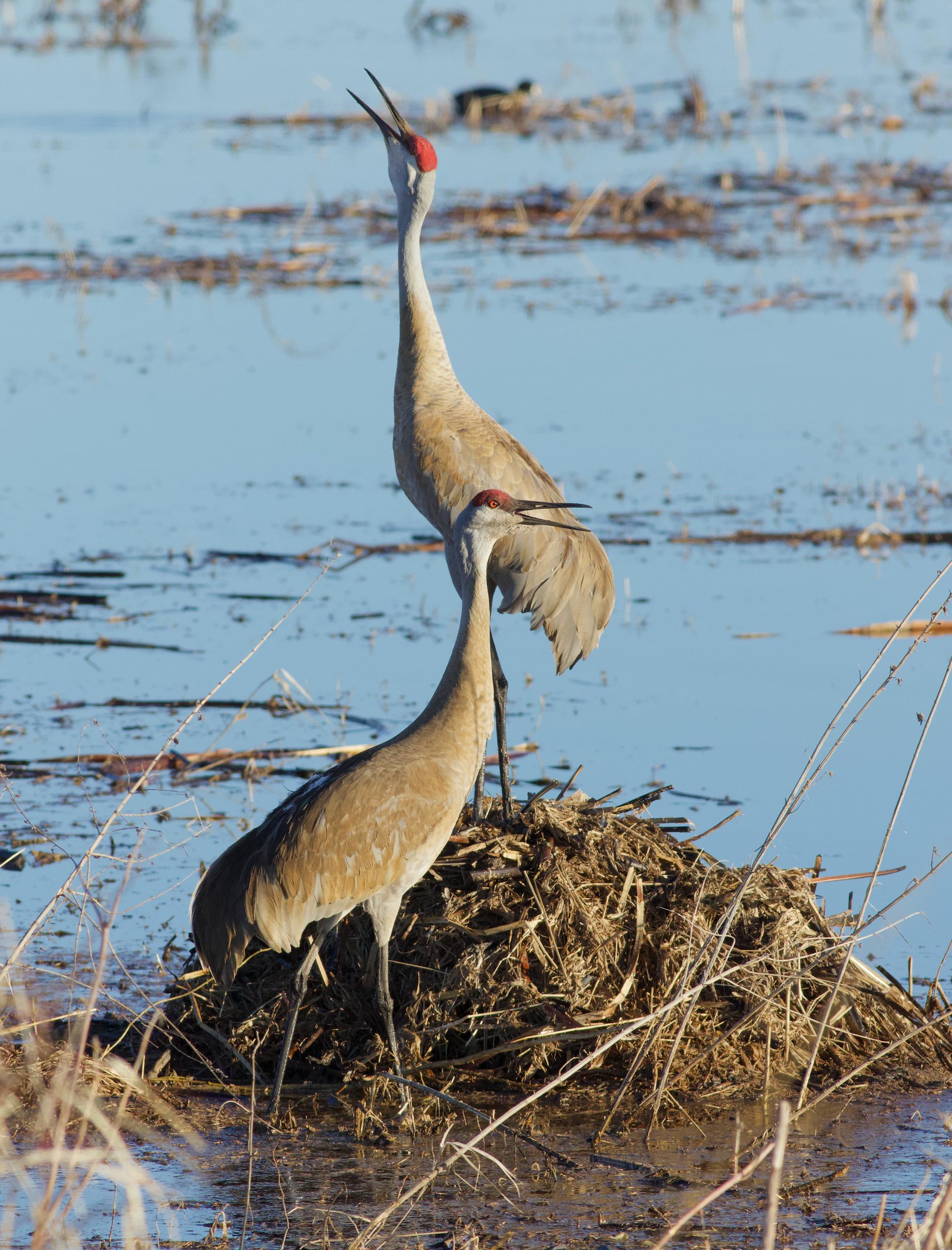
Sandhill crane pair in calling in unison at Goose Pond. Photo by Arlene Koziol

Sandhill crane pair in calling in unison at Goose Pond. Photo by Arlene Koziol

One of my favorite birds is the sandhill crane. Their appearance, ecology, resilience, and their signal of spring all appeal to me. They also brought my wife, Sue, and I together. What’s not to love?

Sandhill numbers have had changed dramatically in the past 175 years. Kumlin and Hollister, early ornithologists in southeast Wisconsin, believed that sandhills were an “abundant and common migrant” around the 1850’s.

Sam Robbins wrote in Wisconsin Birdlife (published in 1991) that people thought that crane numbers greatly declined around the early 1900’s due to hunting, and wetland drainage for agricultural development.

In the mid 1930’s the state wide population was estimated at around 25 pairs mostly in west central Wisconsin. Aldo Leopold thought that sandhill cranes would disappear from Wisconsin and penned “A Marshland Elegy” in the 1940’s to mourn that idea.

Students at UW Stevens Point began studying cranes in the 1970’s. Ernie Gluesing conducted an aerial census and estimated the state population at 850 in 1973. He also studied crane territories and reported that territories averaged 339 acres.

In the 1970’s I enjoyed fall visits to the area around Muir Park in Marquette county where several hundred sandhill cranes staged and fed in the surrounding area. The Fish and Wildlife Service acquired the large wetland complex adjacent to Muir Park for the cranes. At that time cranes were still uncommon in Dane and Jefferson counties.

In the mid 1970’s the International Crane Foundation began their annual sandhill crane count that now covers parts of six states.

I fondly remember attending a February 21, 1978 meeting at Piason’s restaurant to discuss the Dane County crane count. My friend Dorothy Haines was there and brought along her friend Sue Foote. I apparently made a memorable impression on Sue when I ordered milk with my pizza. (You might know the rest of that story: we dated, married, immediately moved to Goose Pond Sanctuary to take over as resident managers, and have been there ever since!) Ron Sauey, co-founder of the International Crane Foundation, joined us and later that evening, according to my diary, gave an “excellent talk on Siberian cranes” at the monthly Audubon meeting.

Two sandhill cranes in flight. Photo by Arlene Koziol

Two sandhill cranes in flight. Photo by Arlene Koziol

Sam Robbins wrote sandhill cranes were that cranes were an uncommon migrant and uncommon summer resident. Sam also mentioned crane researcher found nests with eggs as early as April 22 and that most cranes left Wisconsin in October following the start of the waterfowl hunting season.

Crane numbers and biology have changed much since the 1970’s. The first Breeding Bird Atlas (1990’s) found cranes incubating by March 22. Cranes also nest on small wetlands and appear to have smaller territories. Cranes do not leave Wisconsin when waterfowl hunting season begins. Thousands of cranes stage at Crex Meadows in Burnett County and along the Wisconsin River in Sauk County by the Leopold Shack and Foundation, and do not usually leave until November.

Sandhill crane building a nest at Goose Pond, April 8, 2019. Photo by Arlene Koziol

Sandhill crane building a nest at Goose Pond, April 8, 2019. Photo by Arlene Koziol

Crane numbers have also greatly increased in Columbia County. In 1995, Sue and I recorded the first sandhill crane nest at Goose Pond and continue to participated in the annual crane count. This year, I counted at Goose Pond on April 13. I was excited to be up before dawn and wondered what I would find with record amount of water. It did not take long to hear and see cranes and ended up finding three pairs and two individuals. Usually there are a pair of cranes on the west pond and a pair on the east pond.

Goose Pond was alive with birds. I counted 37 species of birds by 7:30 a.m. and ended the day finding five more species. Highlights that day included 16 species of ducks, a flock of 25 white-fronted geese, two horned grebes, large numbers of American coots, and a pair of northern harriers with the male in courtship display. At dusk I was treated to seeing a short-eared owl hunting about 50 yards east of the house.

Sandhill cranes on the nest. Photo by Arlene Koziol

Sandhill cranes on the nest. Photo by Arlene Koziol

There are two pairs nesting on the west pond with 40 yards of Prairie Lane and Goose Pond Road and probably a pair in the Manthe wetlands on the east pond. Sue and I hope you can visit this summer and enjoy these fascinating birds along with the other wetand and grassland birds.

Written by Mark Martin, Goose Pond Sanctuary resident co-manager

Common Loon

Print Friendly and PDF

One of the most iconic species of summer in the northern forest, the common loon beckons admiration, from wooden carvings, gift shop trinkets, ring tones, and paintings. For those spending a vacation around a campfire in northern Wisconsin, loons lay the soundtrack in equal parts to the campfire.

In fact, I think the distribution of common loon breeding in northern Wisconsin is a good approximation for the southern limits of “up north.”

Rough approximation of “up north” based on common loon breeding range in Wisconsin. Image courtesy of eBird

Rough approximation of “up north” based on common loon breeding range in Wisconsin. Image courtesy of eBird

The Journal Sentinel has developed a map where you can draw your own line for where “up north” is located; most agree, it follows a line a little north of Green Bay west to about Chippewa Falls.

Over the course of the year, loons will move through southern Wisconsin, typically occupying larger bodies of water along the way. Lake Mendota in Madison and Rock Lake in Lake Mills are two excellent spots to view the common loon right now as it migrates through the area.

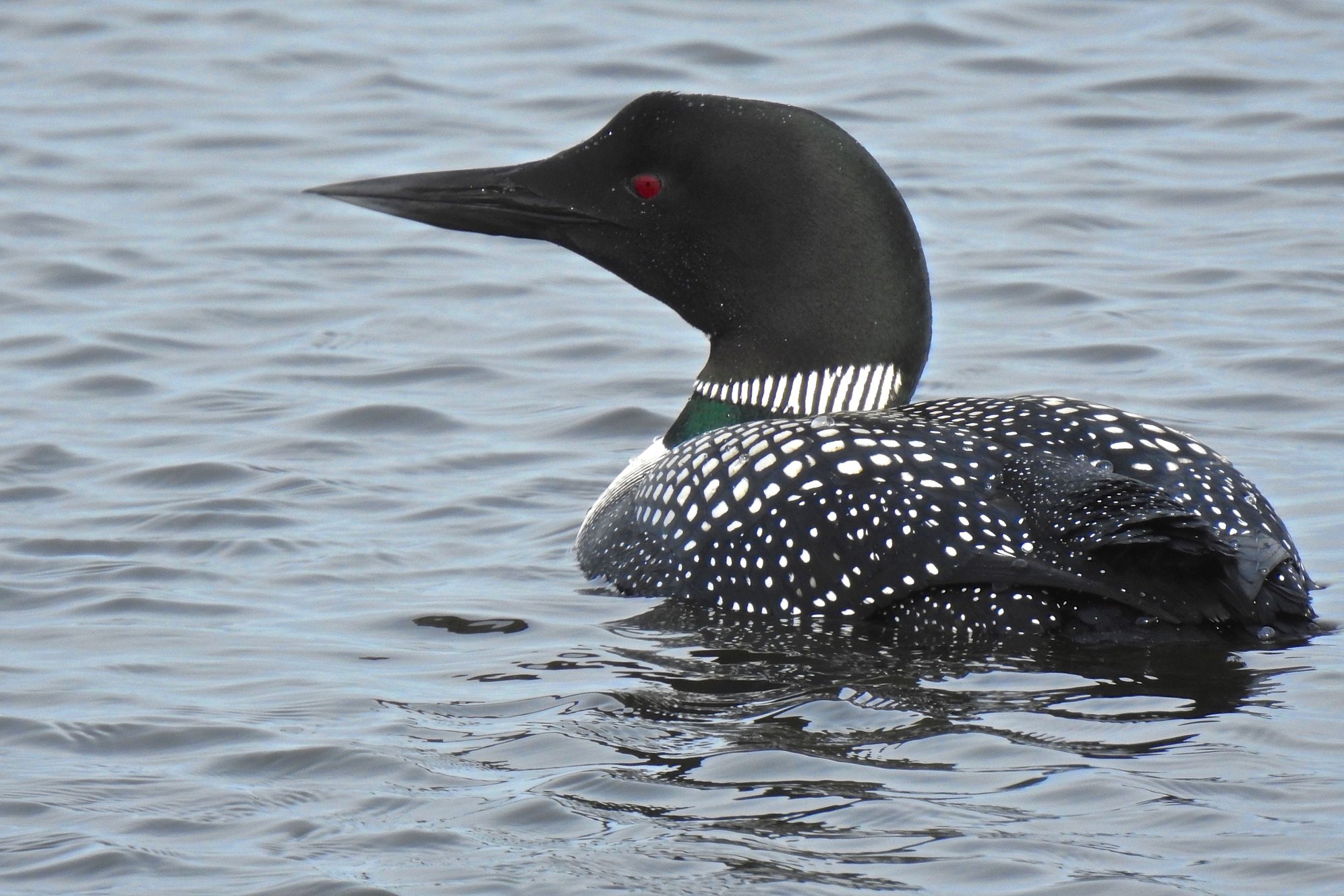
Colorful common loon on Lake Monona, April 4, 2019. Photo by Pat Ready

Colorful common loon on Lake Monona, April 4, 2019. Photo by Pat Ready

Lake Monona loon, april 4, 2019. Photo by Pat Ready

Lake Monona loon, april 4, 2019. Photo by Pat Ready

During migration, loons with tracking devices have been recorded on dives of 174 feet.  If you see any loons on Lake Mendota this spring, imagine the deep hole between Picnic Point and Maple Bluff. That’s 82 feet deep, so loons can dive to depths of more than two Lake Mendota’s!

Listen to the calls of the common loon, and watch how it deftly dives and swims underwater. Video by BR Valley.

Historical accounts indicate that loons did nest in parts of southern Wisconsin. A number of factors conspired to limit the loon’s range to the northern expanse of Wisconsin, including wetland loss and degradation, mercury bioaccumulation, and lead poisoning.

Loons nest within a few feet of the water, and wetlands at the edge of lakes are critical to nesting success. A common spot for loon nests is on the floating sphagnum mat at the edge of relatively acidic lakes in northern Wisconsin. Unfortunately for loons, lakefront development can negatively impact the ability to nest.

Good habitat on a sphagnum mat, inset: no habitat. Photo courtesy of Mike Meyer, “Twenty Four Years of Common Loon Research in Wisconsin”

Good habitat on a sphagnum mat, inset: no habitat. Photo courtesy of Mike Meyer, “Twenty Four Years of Common Loon Research in Wisconsin”

Researchers have found that development of housing greater than 25 buildings per kilometer of shoreline prevents loons from nesting in the area. Housing development usually leads to the degradation or elimination of wetland habitat along shorelines.  It doesn’t need to be this way. Many alternatives to a barren lawn exist that beautify the yard and add habitat for wildlife, and protect the erosion into the lake.  You can find numerous excellent examples here.

The map below is from the USDA Forest Service’s North Central Research Station and shows how housing density has increased in northern Wisconsin since 1940.

Image from Wisconsin’s Land Legacy Report

Image from Wisconsin’s Land Legacy Report

Having the pleasure of loons on your lake can come with a number of responsibilities. Known nesting sites should not be disturbed during the summer. If there are known nesting sites, efforts should be made to reduce wake in those areas. Additionally, lead fishing tackle contributes to significant mortality each season. In Minnesota, one study found that 15-20% of dead loons had lead poisoning. Using non-lead alternatives is good for loons and the whole ecosystem. One of the biggest items on Wisconsin’s Conservation Congress hearings this past week was a ban on lead tackle and ammunition. This would have positive impacts for the loon population, and it is estimated that a lead ban would save over 50 loons in Wisconsin each year.

An issue outside of a loon enthusiast’s direct control is the emission of mercury from coal-generated power plants. As stated before, loons are sensitive to the bioaccumulation of methyl mercury because they are high in the food chain, long lived, fish-eaters, and nest on acidic lakes, which tend to have higher availability of mercury to move up the food chain (pictured below).

As pH decreases (becomes more acidic) mercury concentrations increase in both adults and chicks of common loons. Graph courtesy of Mike Meyer, “Twenty Four Years of Common Loon Research in Wisconsin”

As pH decreases (becomes more acidic) mercury concentrations increase in both adults and chicks of common loons. Graph courtesy of Mike Meyer, “Twenty Four Years of Common Loon Research in Wisconsin”

A new EPA proposal would roll back some limits on emissions of mercury for coal-burning power plants. This could have a huge effect on public health, and different accounting estimates calculate the potential indirect benefit of saving thousands of lives due to the “co-benefit” of also decreasing particulate matter linked to lung and heart disease. In Wisconsin, coal-burning power plants have been granted exceptions for mercury emissions. Beyond public health, mercury for loons spells trouble. 

As mercury increases, hatching rates decrease beyond a sustainable number. With high mercury concentrations in the food chain, adults become lethargic and might not reproduce at all. This decreases the likelihood of success for the common loon, which already faces difficult enough odds on its breeding grounds where approximately 50% of nests fail, due to predation, flooding, or other causes.

Another twist might occur as the climate continues to change. With flooding more likely, the amount of mercury in aquatic systems may also increase. Research from UW-Madison’s Center for Limnology has found an interesting correlation between annual water levels and the concentration of mercury in walleye. You can see that interesting blog post here. With flooding and high water levels, loons may be even more susceptible to mercury bioaccumulation.

While fragile, the outlook for loons in Wisconsin is rather positive. Since 1980, the population has nearly doubled and continues to increase. If you’re able to help, you can sign up for Northland College’s Loonwatch, which aids research in a number of areas.

Written by Drew Harry, Faville Grove Sanctuary land steward

Cover photo by Arlene Koziol

Sources

Stewart, S. I., Hammer, R.B., Radeloff, V.C., Dwyer, J.F., & Voss P.R. 2003. Mapping Housing Density across the North Central U.S., 1940-2000 [Slide show]. Available: http://www.ncrs.fs.fed.us/IntegratedPrograms/lc/pop/hd/title.htm

Meyer, Mike. "Twenty Four Years of Common Loon Research in Wisconsin." Microsoft PowerPoint file. Accessed here.