Friday Feeder Feature: The Great Backyard Bird Count 2016

At Goose Pond, we've been practicing for the for the 2016 Great Backyard Count that begins TODAY and goes through Monday February 15! We enjoy feeding our feathered friends and look forward to the annual Count! 

Goldfinches feeding at Goose Pond Sanctuary feeders

Goldfinches feeding at Goose Pond Sanctuary feeders

Want to give the Great Backyard Bird Count a try? It only requires 15 minutes (or longer, if you wish) and it helps scientists better understand our local bird populations. Click here to find out how you can participate!

Looking back at past data shows how bird numbers change. In 2015, bird watchers from over 100 countries submitted 147,265 checklists and observed 5,090 species for the count.

We will be counting at both Kampen Road residence and at our Wildland cabin near Wyocena. Black oil sunflowers, sunflower fines, white millet, suet, and cracked corn are found at both count sites. At Wildland we are also feeding shelled corn that attracts wild turkeys, fox squirrels, and cottontail rabbits. We want to thank the customers at Mounds Pet Food Warehouse that purchase bags of bird seed exclusively for our Goose Pond feeders. The birds go through a lot of "Madison mix" in one season!
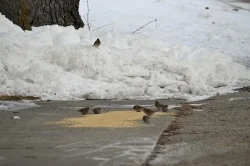
Tree sparrows near millet piles. Mark and Sue suggest moving your millet pile locations frequently to avoid pest and disease problems.

Tree sparrows near millet piles. Mark and Sue suggest moving your millet pile locations frequently to avoid pest and disease problems.

Our Goose Pond Sanctuary habitat includes restored prairie, spruce and cedar shelter belt/cover unit, two corn food plots and shrub plantings. The Wildland habitat in Wyocena includes restored prairie, oak savanna with brush piles, and a large red pine plantation on our neighbor’s land.

We have observed the following species in the past two weeks at the two sites: ring-necked pheasant, Cooper’s hawk, red-tailed hawk, rock pigeons, mourning doves, red-bellied woodpeckers, downy woodpeckers, hairy woodpeckers, blue jays, American crows, black-capped chickadees, white-breasted nuthatches, American tree sparrows, dark-eyed junco, northern cardinals, house finches, common redpolls, pine siskins, American goldfinches, and house sparrows. It is interesting to note the different feeding times of species. At Wildland, turkeys arrive around 8:00 a.m. and have fed and moved on in 30 minutes while cardinals feed heavily just before dark.  Some people ask how we count large numbers of doves.  At Goose Pond, the doves line up on the power line making for easy counting.

In the local area there are hundreds of horned larks and Lapland longspurs along roadsides that are easy to count. We will also try and find Eurasian collared doves west of Arlington.

If you want to get involved, know that bird counts for the GBBC can be conducted anywhere, and are not restricted to back yards like the name might suggest. 

Click here to see how you can help on this citizen science project!

The data for the GBBC is available for review as quickly as it is entered.  Stay tuned for our results, which we will post on the MAS website soon!

By Mark and Sue Foote-Martin, Resident Managers, Goose Pond Sanctuary.

Red Fox

Foxes are wily and sly creatures in literature—clever and dishonest. In Aesop's fables, a fox tries to eat grapes but can't reach them, proclaiming the grapes sour. The dishonest fox will not admit defeat, marking the origin of “sour grapes.”

Photo by KegRiver, Flickr Creative Commons

Photo by KegRiver, Flickr Creative Commons

In Disney's Fox and the Hound, a fox named Tod undergoes a number of missteps in a coming-of-age story where he becomes enemies with his childhood hunting dog friend. Here the film makes clear that it is the humans who mistrust and hunt the fox, rather than anything inherent to the fox.

Werner Herzog's documentary Grizzly Man depicts a man (Timothy Treadwell) perhaps too trusting of nature. Treadwell interacts with a family of foxes, and Herzog narrates: “as a filmmaker sometimes things fall into your lap which you couldn't expect, never even dream of. There is something like an inexplicable magic of cinema.” The foxes dance around Treadwell and steal his hat as he curses them back to their den, where the hat stays.

Perhaps the fox is all of the above: cunning, playful, innocent, and sly.

Photo by bzd1, Flickr Creative Commons

Photo by bzd1, Flickr Creative Commons

There's much to be said of playful red foxes. Charles Long, in The Wild Mammals of Wisconsin, calls fox kits at the den “an aesthetic blessing of nature.” In Wisconsin, red foxes (one of two native foxes, the other the gray fox) are breeding throughout the state.

By March or April, litters of 4-5 kits occupy dens on sand or gravel substrate. Dens may be adopted and modified from badger of woodchuck burrows. Foxes may even co-habituate a den with a badger or another family of foxes.

Foxes are capable of thriving in fragmented landscapes and as such have an excellent status throughout the state. Between woodland, grassland, stripcover, pasture, and fencerow, foxes will make a den and a home range. Ranges can cover an impressive 1,200 acres (about the size of Faville Grove), but in ecologically diverse areas will range from 142-400 acres (more likely at Faville Grove given the diversity of habitats). Territories will be patrolled about every other week and are defended with scent (urine). If a standoff ensues, chasing is most likely and physical altercation is extremely rare.

Michigan and Wisconsin are said to have some of the highest fox harvests in the world. Trappers caught 4,708 foxes in 2014 with an average pelt price of $20.81. Trapping is a supplemental source of income for farmers, trappers, landowners, and Native Americans throughout the state. The highest recorded harvest of red foxes occurred in 1960 at 54,090 foxes. The average pelt price that year was $10.57 when adjusted for inflation. 1978 saw the highest average price ($248.18) and a harvest of 32,581 foxes.

Red foxes eat about five pounds of food per day and will cache food for later consumption, marking the area of cached food with urine. Foxes are opportunistic and will eat almost anything, but frequently feed on rabbits, voles, and mice.

Come visit Faville Grove this winter after a fresh snowfall and look for fox tracks, among the many other mammals and birds leaving signs of their presence. We've been seeing fox, muskrat, squirrel, otter, deer, rabbit, and possibly weasel tracks throughout the sanctuary. Tracking is an excellent way to learn the ecology and habits of a species. Fox tracks have four toes on both the fore and hind prints and are about two inches wide. About a week ago, I stumbled upon a red fox running away from me, barking as it ran. Following the tracks was a mesmerizing experience, like reading a journal entry in some long-forgotten language.

You can visit the sanctuary at any time, or join us on Feb. 13 for our Midwinter Snowshoe field trip!

By Drew Harry, Faville Grove Land Steward

Poynette Christmas Bird Count: Goose Pond Highlights

The December 26, 2015 Goose Pond count area of the Poynette Christmas Bird Count was the best ever in the past 16 counts.

Photo by Mark Martin

Photo by Mark Martin

The 2,200 acre Goose Pond count area includes Madison Audubon’s 660 acres at Goose Pond Sanctuary, and surrounding lands. Jim Hess and Bill Walters assisted with the count, as they have for many years. We all enjoy the comraderie of our day together hiking around the sanctuary and counting our feathered friends.

Thanks to the record setting El Niño, Goose Pond had open water for the first time in the 44-year history of the Poynette Count! Thirty four species have been recorded on 15 previous counts. This year, cackling geese (3), trumpeter swans (8), tundra swans (191), and American black duck were added to the Goose Pond list that now stands at 38 species.   

The eight trumpeter swans were a highlight. The family unit of a pair and six young was a joy to watch on the water. One adult was collared with a yellow collar and was banded/collared by the DNR on August 27, 2008 as a young bird, sex unknown, adjacent to the Necedah National Wildlife Refuge in Juneau County. It is encouraging to see these birds at the sanctuary.  

Last year, Goose Pond was frozen hard and we were lucky to count 600 Canada geese flying around.  This year, however, 3,300 Canada geese were counted! Sixty one mallards and 42 ring-billed gulls also enjoyed the open water.

The large number of geese helped to bring our total bird numbers to 3,878 for the day, setting a record for Christmas Bird Counts at Goose Pond. The second highest count year was in 2000 with 2,727 birds. That year, the total included a flock of 2,000 Lapland longspurs.

Photo by S.Wong, Flickr Creative Commons

Photo by S.Wong, Flickr Creative Commons

Usually, the most numerous feeder birds at our Goose Pond count are the mourning dove, American tree sparrow and dark-eyed junco. In 2014, only one mourning dove was counted, compared to 116 this year! We also counted 63 tree sparrows (compared to 54 in 2014) and 22 juncos (compared to 27 in 2014).

Our high count of ring-necked pheasants was in 2007 before the hard winter of 2008 when we found 226 pheasants. This year we were pleased to find 22 pheasants in our corn food plots.

Other birds of interest included a great horned owl, one American kestrel, and two adult bald eagles. The eagles were probably hunting waterfowl and have been present most of the fall and early winter, largely thanks to the late open water on the pond.

Photo by Arlene Koziol

Photo by Arlene Koziol

Jim, Bill and I are already looking forward to the 2016 Christmas Bird Count on December 31, 2016!  Our guess is that the 2016 count will be more like past counts with a frozen Goose Pond.

Mark Martin, Goose Pond Sanctuary co-manager

From the Educators: Winter is the lull between two storms

Fall migration and the start of the school year are behind us, and we’re beginning to gear up
for spring migration and end-of-school-year field trips.

Children help collect seeds to help create prairie habitats close to home.

Children help collect seeds to help create prairie habitats close to home.

Last fall Madison Audubon provided after school programming at four different community centers: Kennedy Heights, Lussier, Vera Court, and Salvation Army. Through these programs we helped underserved city kids learn about themselves through nature exploration. We watched them build their self-confidence with each lesson; a trait that carries over into every aspect of their lives. Our after school kids made frog slime, explored prairies and examined grasshoppers, and used dip nets to get a closer look at water critters.

Our Education Intern, Mary Schneider, did an excellent job leading programs at both Vera Court Neighborhood Center and Lussier Community Education Center. She grew as an educator, mastering techniques needed to reach reluctant kids, and gaining experience with planning lessons.

This winter we have been visiting several schools in the city of Madison, and have strengthened our partnership with Lincoln Elementary. More than half of the kids at Lincoln Elementary come from low-income families, and the free programming you help us to provide really goes a long way! Some of our favorite lessons involve identifying animal tracks and scat- poop! Animal signs are a great way to learn about the wildlife around us, and the kids love learning about them.

This spring we are looking forward to taking several different school groups out on field trips to local natural areas. Transportation costs are one of the biggest hurdles for teachers taking kids on field trips. Because of you, we are able to provide free bussing to kids who really deserve it.

Our new education intern, Lauren Sinclair, will be working with Vera Court and Goodman Community Centers to provide more afterschool programming for kids. They will focus on exploring different types of natural habitats and the animals that call those places home.

This work was made possible by you! Thank you for helping Madison Audubon Society connect kids with nature!

Introducing the Young Birders Club of Wisconsin

Adding to the ever-growing list of Young Birders Clubs across the country is the new Young Birders Club of Wisconsin. Started by Ryan Treves and sponsored by the Madison Audubon Society and the Wisconsin Society for Ornithology, this club aims to connect young birders grades 5-12 at meetings, field trips, and activities across the state. 

Young Birders Clubs are great opportunities for students to socialize with other birders their age, learn about future career paths, and have fun birding in new places.

The Young Birders Network, linked through the eBird website, aims to provide resources for young birders to connect and learn, while giving their adult advocates resources to encourage and support. The network is coordinated by the Black Swamp Bird Observatory and the Cornell Lab of Ornithology and includes dozens of partners. 

If you are interested in joining the Wisconsin club, please contact Ryan Treves at ryantreves@gmail.com

Here is the club's official announcement, shared via eBird and Facebook:

"The birdwatching community might appear dominated by adult experts and mature naturalists. However, there is a less visible but equally important demographic hidden out there: teenage birders. We are the future of birding in Wisconsin. Did you know that Illinois, Iowa, and Ohio all have active youth birding clubs? Now is the time to join the Young Birders Club of Wisconsin.

"The YBC of Wisconsin is intended to be non-profit and free, welcoming all experience levels. Our goal is to hold meetings 3-4 times a year in various locations around Wisconsin, to offer members a chance to socialize, learn, and plan trips.

The YBC of Wisconsin might also conduct projects, such as volunteering for Audubon chapters, the Christmas Bird Count, Wisconsin Breeding Bird Atlas II, and the Great Wisconsin Birdathon. The Club is always open to new ideas!

This announcement is not only for teens! Adults, if you know any young bird enthusiasts, please talk to them about this!"

Thanks to the Birding Wire for this press release about the newly-formed Young Birding Club of Wisconsin! Stay tuned for more information and updates about this exciting new club.