
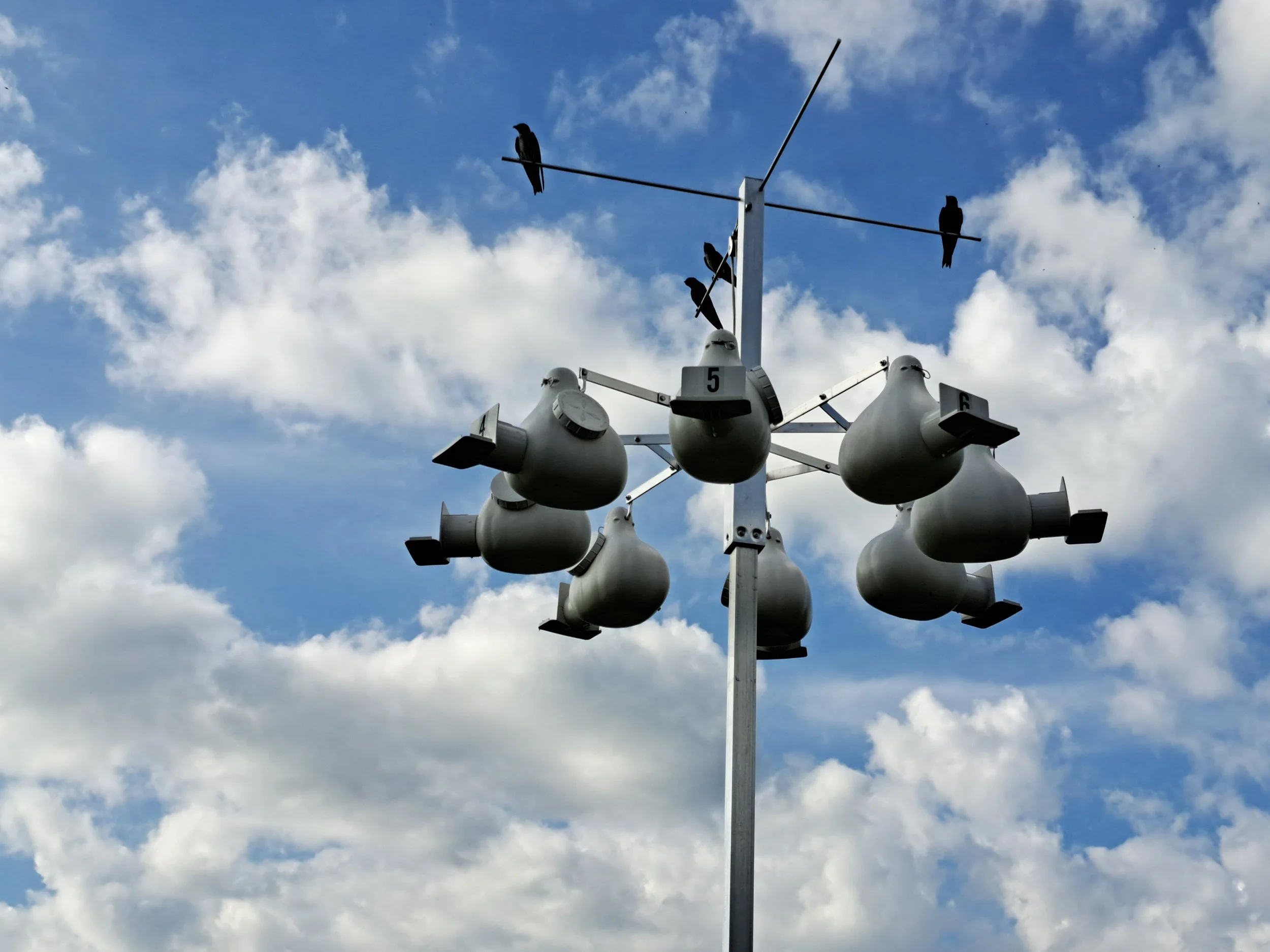

Purple Martins are one of our favorite species for quite a few reasons. They are beautiful, chatty, and acrobatic fliers. They’re the largest swallow species, a cousin to other charming species, like Tree Swallows and Barn Swallows. They eat enormous amounts of insects and are known for their long-distance migrations, flying between Brazil and the United States or Canada each year.
But one of their most delightful traits is that they are comfortable near human activity and even rely on human-provided housing to lay their eggs and raise their young. They like when their nests are near our homes, and we like that they like to be close!
Purple Martins prefer community housing where one pair can nest alongside a dozen or more other pairs, like in T14 boxes or gourds hung on racks. T14 boxes have 14 nesting units within each house, and each pair will select an “apartment” to lay their eggs in. Gourds are often hung in groups, so there are many gourds on one rack—each gourd supports one nest.
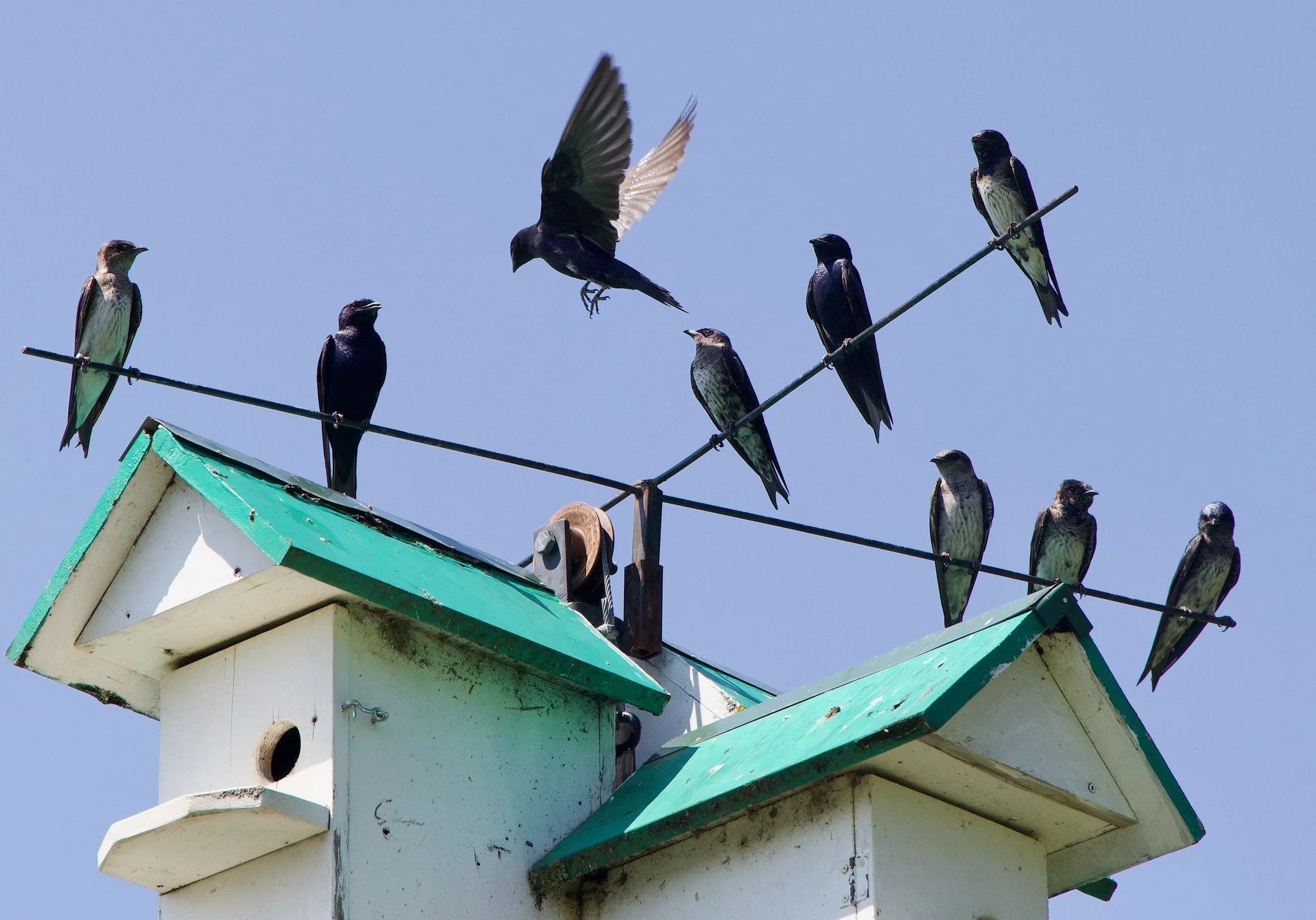
Purple Martins perch on the top of a T14 box at an Amish farm in July 2026 (photo: Arlene Koziol).
Each summer around the Fourth of July, we work with retired Wisconsin DNR biologist Dick Nikolai to set up banding events at farms and other sites in southern Wisconsin. Dick is a board member of the Wisconsin Purple Martin Association and a Master Bander—he has banded over 30,000 Purple Martins!
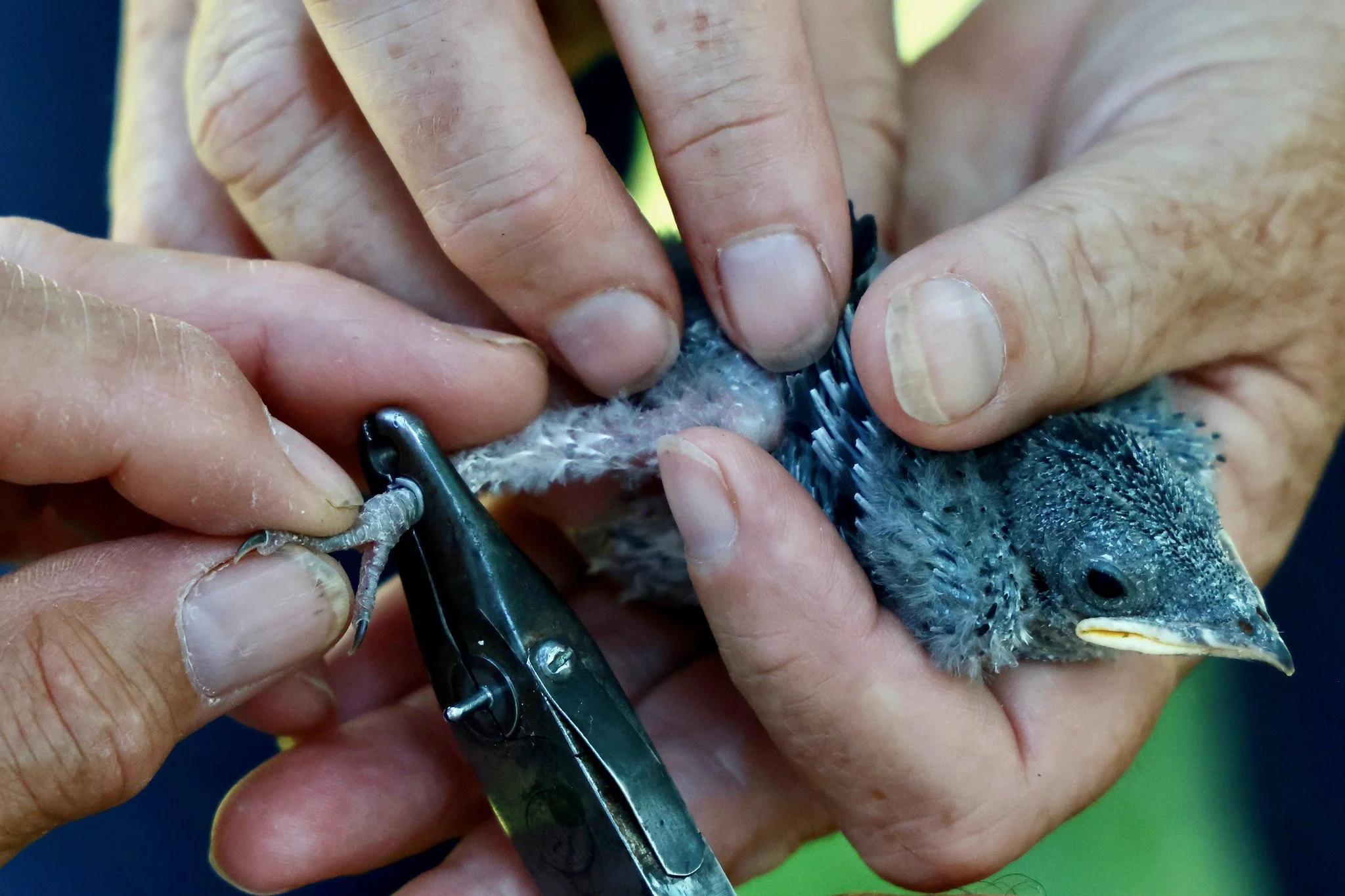
A band is carefully applied to a young Purple Martin in early July 2026 (photo: Eleanor Koziol).
We have worked with Dick to band Purple Martins in our area since 2016. Banding is a great opportunity for biologists to learn more about birds, particularly their migration, nest site fidelity, lifespan, and much more, in addition to checking on the status of birds in a number of locations throughout Wisconsin. It’s also a chance for other members of our community to see this species up close, learn about their life history and conservation needs, and help with the banding process. During the sessions, we band only chicks that are not able to fly yet—less than 28–29 days old. They also need to be more than 10 days old, so their legs are fully grown for the bands.
Most of our banding sessions are held on Amish farms in Marquette, Green Lake, and Columbia counties. The Amish are wonderful Purple Martin landlords—perhaps in part because the T14 boxes require excellent craftsmanship to build (Andy Troyer, an Amish man in Pennsylvania, came up with the T14 design). Many Amish farms in our area have multiple T14 boxes and gourd racks.
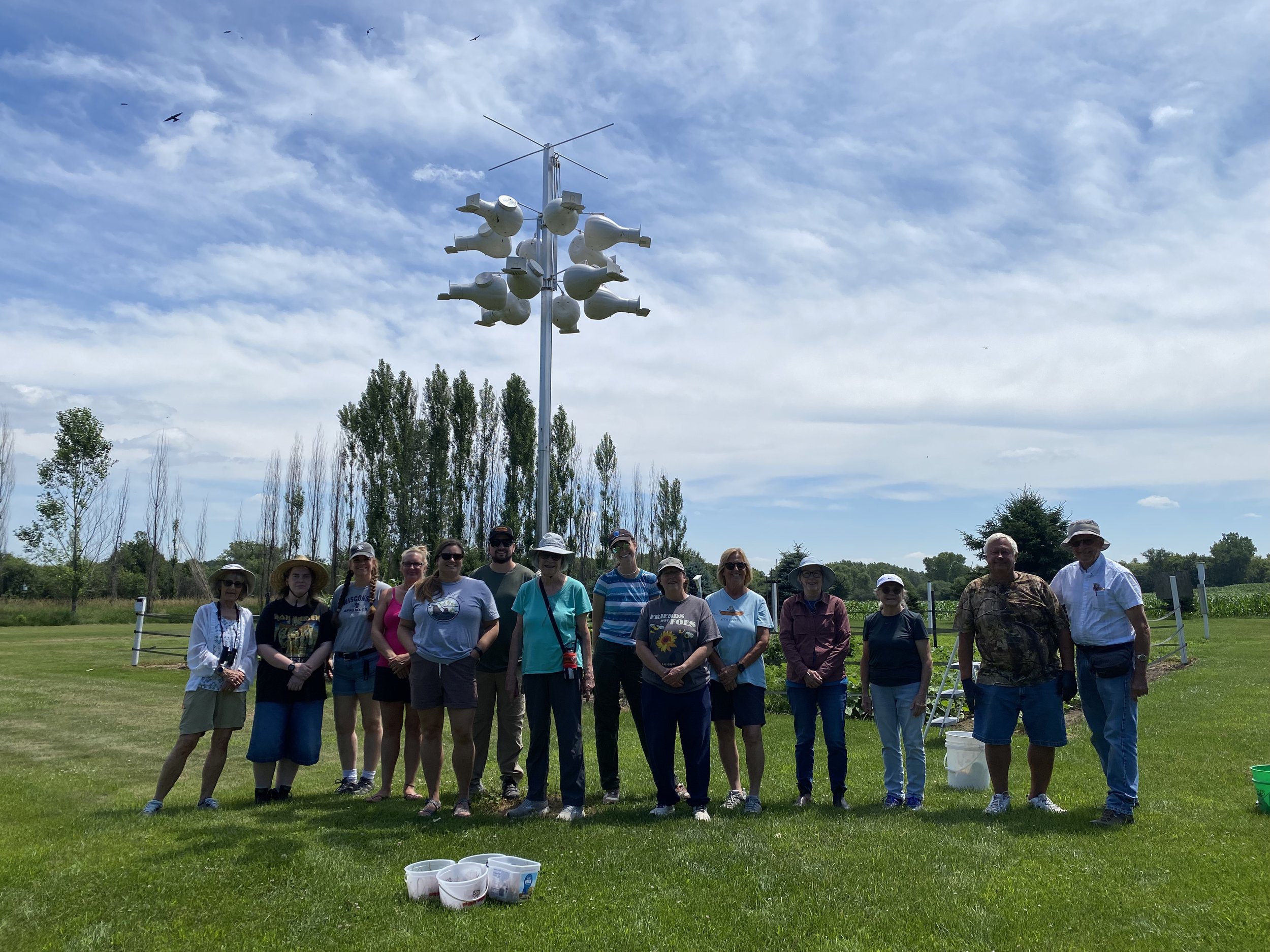
The banding group underneath a gourd rack on July 7, 2026 (photo: Brenna Marsicek/SoWBA).
This year, we knew there were at least three Amish farms that had Purple Martin chicks ready for banding, and other farms nearby with dozens of active nests. We set a goal to band 500 chicks, and invited SoWBA members and volunteers to join us. Over the two days, 522 Purple Martin chicks were banded. Amazing!
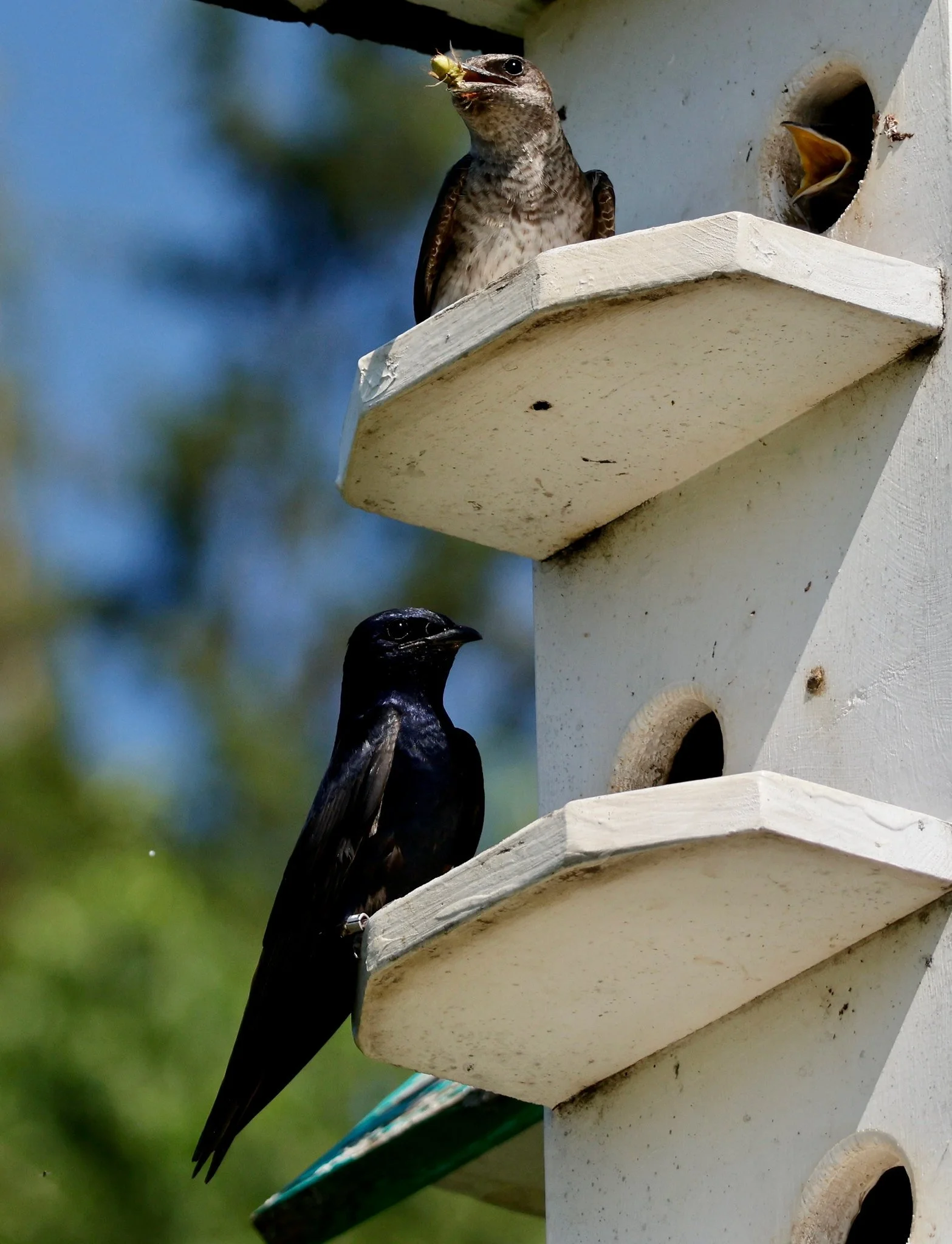
A pair of adult Purple Martins on a T14 box. The female is feeding her young (photo: Eleanor Koziol).
On Monday, July 6, we started at Jacob Peterscheim’s farm in the morning and banded 174 young out of five T14 nest boxes. Jacob said he observed fewer martins at his farm this year, so he did not erect one of his T14 boxes. We also did not check one T14 box—it was the last one erected and did not have many martins that were old enough to band.
That afternoon, we banded 102 martins at Ora Mast’s farm. Ora has five T14 boxes. He and his son also make and sell them. We were pleased to have three of Ora’s young grandsons assist us. We did not check his gourd rack and two of the T14 boxes because we ran out of time. A third Amish farm, Sloping Acres, also had many Purple Martins that we typically band at, but did not have enough time to get there, either!
On Tuesday, July 7, we banded at two farms north of Rio. First, we banded 222 birds in three hours at John Jurgerson’s. John has one T14 box and three gourd racks, offering a total of 64 nest cavities, 56 of which were used by martins.
After John’s, we banded 24 chicks at Mark and Sue Martin’s Wildland property nearby. At the Wildland property, Dick also added an additional red-colored band on 20 of the Purple Martins. He will be looking for red-colored bands at the large roost in the Poyan Marsh area that forms before fall migration. John, Mark, and Sue will also be looking for red-banded birds next spring.

Mark and Sue’s story
“It all started at Wildland in May of 2024 when John mentioned that if he was just starting out today, with his knowledge acquired trying to attract martins beginning in the 1980s, ‘he would begin with erecting an eight-unit gourd rack.’ We quickly ordered an eight-unit gourd rack and attracted one pair. Last year, we had three pairs that fledged 14 young. This year, we erected a 12-unit gourd rack and have eight nesting pairs. Dick is recommending we erect another 12- or 18-unit gourd rack for next year.
We really enjoy our Purple Martins. We looked forward to the arrival of the first adults in April and then seeing the birds that fledged last year arrive in May and early June. Our gourds are within 40 feet of our home, and it is a special treat to hear their cheerful calls through the open windows from the time we rise until sunset. We are also treated to seeing them building nests, catching food, feeding young, and the young birds when they fledge!”
Left: gourd racks at Wildland (photo: Mark Martin)
Attracting Purple Martins to Goose Pond Sanctuary
When Mark and Sue became the managers of Goose Pond Sanctuary in 1979, Purple Martins were very uncommon and erecting a nest box was unlikely to help. In 2007, Mark and Sue moved into the Kampen Road residence and someone donated an aluminum martin nest box to them with 12 compartments. Each small compartment was only 6x6 inches—small compared to today’s gourds and T14 nest boxes, which typically have 6x11-inch compartments. They erected that nest box in an excellent area but never saw a martin. The nest box was removed around 2020 after it deteriorated.
A Goose Pond neighbor, Rollie Manthe, was raised on the farm on the north side of the east pond. Once he mentioned that there were Purple Martins at the farm in the 1950s and 1960s. Mark recently asked his son Kendall for more information and his reply was, “My uncle Larry built a house for the birds to nest in (probably in high school). It looked like a bird hotel-style box with multiple nesting cavities. I do remember seeing it in the mid-’60s. But by the ’70s, only sparrows nested in it and soon thereafter it was torn down. It was located on the light pole in the yard.”
The earliest eBird report for Purple Martins at Goose Pond was from Bill Hilsenhoff, who identified 10 birds on May 11, 1958. There were six historic sightings on eBird by Bill and David Willard from 1958 to 1962. All the martins were probably from the Manthe farm.
There are eBird reports at Goose Pond from five years between 2006 to 2023, with most observations of one or two birds during spring migration. In the Breeding Bird Atlas II from 2015–2019, Purple Martins were only found in Columbia County at two colonies on Lake Wisconsin along with another eight colonies in the Pardeeville and the Portage area. Since then, Purple Martins have increased in Wisconsin, especially on Amish farms. The birds are raising more young thanks to improved designs in nesting structures and poles.
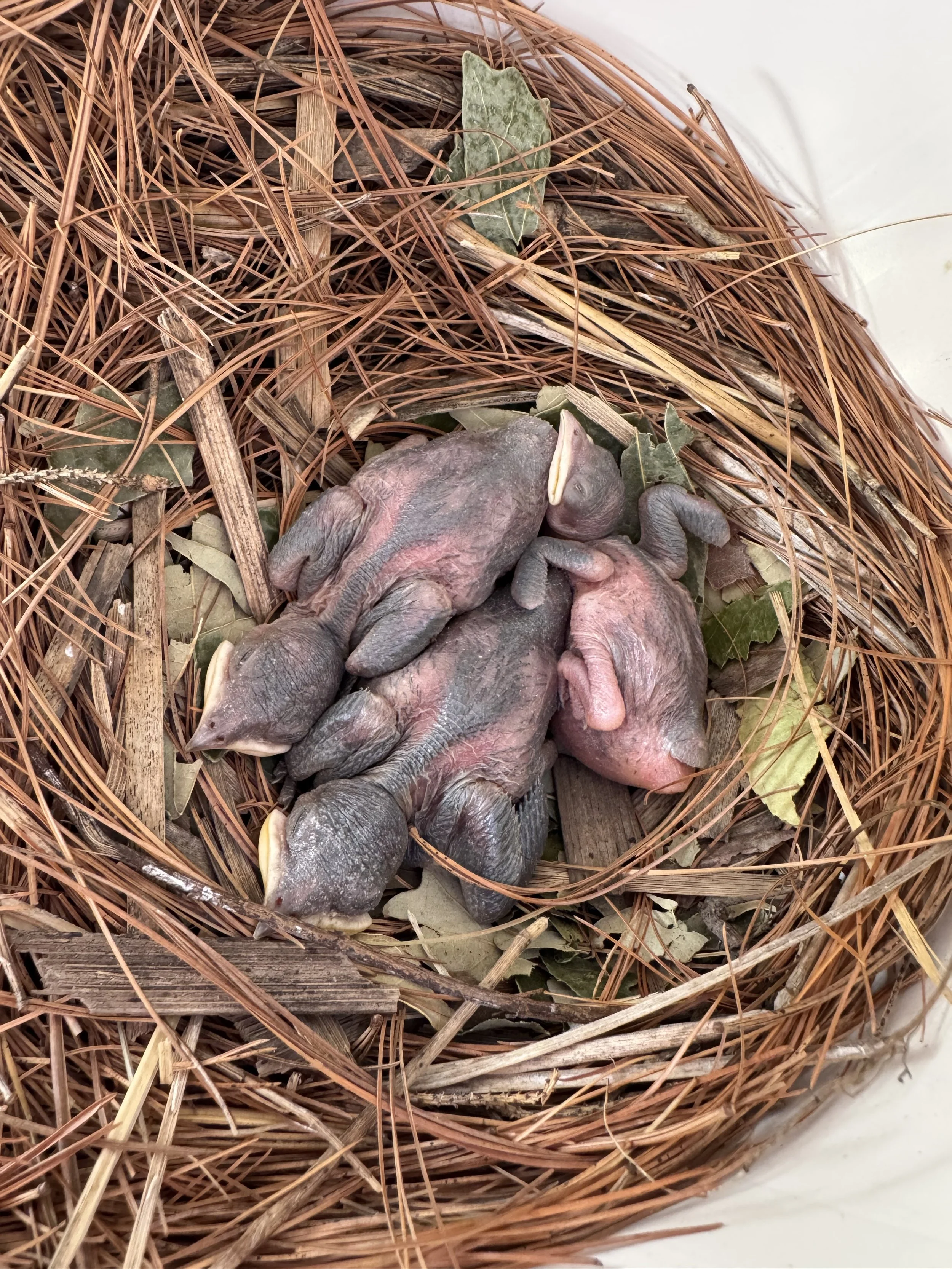
Three Purple Martins in a nest at Goose Pond on July 22, 2026 (photo: Emma Raasch/SoWBA).
We thought 2026 would be a good year to try offering Purple Martins a nest site at Goose Pond again. We purchased an eight-unit gourd rack with funds raised from donations to our Reckless Wrens Birdathon team and erected it in May. We thought it might take a few years before martins found it; however, we were surprised and very pleased when six second-year birds showed up. Second-year birds arrive late and do not always nest. On our weekly check on July 17, we were excited to find three young that were two days old. This is most likely the first Purple Martin nest around Goose Pond in 55 years!
We wish our Purple Martin friends good luck on their summer ahead and long migration journey to Brazil this fall!
Written by Brenna Marsicek, director of outreach, and Mark Martin & Susan Foote-Martin, Goose Pond sanctuary managers
Header photo by Susan Foote-Martin. An eight-unit gourd rack at Goose Pond Sanctuary.
