Friday Feathered Feature

2018 Great Backyard Bird Count

Print Friendly and PDF

This year marks the 20th Great Backyard Bird Count (GBBC), coordinated by the Cornell Lab of Ornithology, National Audubon, Bird Studies Canada, and eBird. Over 160,000 people across the globe spend a chilly February weekend (this year: Feb. 16-19) simultaneously taking a snapshot of the distribution and abundance of birds by counting and submitting online the number of species and individual birds they find in their yards. It’s a fun and comfortable way to participate in citizen science, especially during 2018 -- the Year of the Bird!

Snowy owl, photo by Monica Hall

Snowy owl, photo by Monica Hall

Mark Martin and Sue Foote-Martin, who are year-round residents and managers at Goose Pond Sanctuary, have participated in the GBBC since 2001. Maddie Dumas, Goose Pond land steward, is in her second year of GBBC. Birds can also be counted and reported from anywhere, not just backyards. For example, Mark and Curt Caslavka, longtime friend and volunteer at Goose Pond Sanctuary, reported a snowy owl on Feb.16, seen across Highway County I directly west of Jill’s Prairie.

Each year brings the regular characters to the count: blue jays, black-capped chickadees, tree sparrows. Some years bring unusual faces, like ring-necked pheasants, and some years bring bumper crops of other species. This year, thanks to the GBBC, we have a new record of 110 common redpolls for Goose Pond Sanctuary, surpassing the record of 50 birds seen by Aaron Stutz in 1997. The high count in Wisconsin for common redpolls was a flock of 150 in Langlade County.  

House finches (with the red faces and breasts) and common redpoll (with the red cap) feasting during the GBBC. Photo by Maddie Dumas

House finches (with the red faces and breasts) and common redpoll (with the red cap) feasting during the GBBC. Photo by Maddie Dumas

We kept close watch of the bird feeders at both Goose Pond residences on Monday, February 19, the last day of the four-day Great Backyard Bird Count. Mark and Sue were surprised to see a large flock of winter finches flying back and forth from the spruce windbreak to the ash trees in the Kampen Road residence and identified them as common redpolls. The flock stayed high up in the spruce and only one redpoll was seen at the sunflower fine feeders.

The Martins also checked their feeders at their cabin (Wildland) north of Rio in Columbia County. The habitat around the cabin consists of restored prairie, oak savanna and wetland. This setting provided the greatest diversity of bird species (see spreadsheet), totaling 19 as compared to 6 species at the Kampen Road residence and 9 species at the Prairie Lane residence.

Goldfinch (top left), common redpoll (bottom center), and pine siskins (all the rest) converge on one feeder at Wildland. Photo by Mark Martin

Goldfinch (top left), common redpoll (bottom center), and pine siskins (all the rest) converge on one feeder at Wildland. Photo by Mark Martin

The Goose Pond residences are in an open landscape with few trees and restored prairie within one half mile of a wildlife food plot of sunflowers and sorghum.  The food plot helps attract birds to the area.  Mourning doves, American tree sparrows, common redpolls, and American goldfinches have been in the food plot since December and move back and forth to the residences.

Ring-necked pheasants are uncommon in the GBBC and Maddie found a pair feeding at her feeders. Good numbers of mourning doves and American tree sparrows were found at all three residences. Pine siskins are also more common in Wisconsin this winter and have been feeding in high numbers at the Wildland feeders for many weeks.

Factors contributing to the higher species count and higher number of individuals included more diverse habitat, the number and types of feeders, and the variety of seeds present. We find that the best seeds for us are black-oil sunflowers, sunflower fines, white millet, and suet. Nine of the 20 species observed at three feeders were in the top 10 species recorded world-wide in 2017 (see spreadsheet).

On Thursday afternoon, February 22 GBBC reports were still being entered.  Thursday totals included 160,000 checklists, 6,031 species and 25,300,000 birds counted. This is an impressive number that reflects on the number of people interested in birds. In Wisconsin, birdwatchers submitted 2,400 checklists and reported 121 species.

Downy woodpeckers munching on suet. Photo by Mark Martin

Downy woodpeckers munching on suet. Photo by Mark Martin

We really enjoy counting birds and participating in the GBBC that gives us a snapshot of bird usage at our feeder in late winter. Thanks to everyone that feeds the birds, and if you live in suitable habitat we encourage you to begin feeding the birds. Winter feeding, in particular, can make the difference in helping some species make it through cold and snowy weather. The color and variety of species brighten our winter days and make us feel good knowing that we can provide them with quality habitats and nutritious food.  

P.S.  This time of year is a good time to start thinking about planting native shrubs and plants for wildlife habitat in your yard! Check out this list of nurseries that sell Wisconsin native plants and offer lots of resources like catalogs, planting recommendations, and more. Dream big and make your yard a little haven for birds (you’ll be making it a haven for lots of other great wildlife as a byproduct, too!).

Written by Mark Martin and Susan Foote-Martin, Goose Pond Sanctuary resident managers, and Maddie Dumas, land steward

Header photo: Common redpoll, by Emily Meier


Mourning Dove

Print Friendly and PDF

Continent-wide, the mourning dove is one of the most common birds around, though it's often overlooked. Even so, over 20 million individuals are sighted and dropped in the US by hunters each year—the most of any game bird in the US—but the population sits at a stable estimate of 350 million birds.

Photo by Monoc' Paul

Photo by Monoc' Paul

Understated plumage, a calm song, and ubiquity conspire to veil this bird in plain secrecy, yet there was a time when the mourning dove was a species of conservation concern in Wisconsin. In 1951 a study was conducted where rural mail carriers listened on their routes for five months for mourning doves. An average of 6 doves were found per 100 miles. Compare that to today, when one might see 6 doves just at one feeder! Intensive hunting in the early part of the century which gave way to the Migratory Bird Treaty Act of 1918 (for which we celebrate 2018 as Year of the Bird), and allowed the population to rebound. By the mid-1900's, mourning doves had recovered to a point where some scientists in Wisconsin felt comfortable with a hunting season. However, it was not until 2003 that a hunting season opened in Wisconsin, the first since 1918. The bird was named the state symbol of peace in 1971, and was removed as a game species at that time.

Mourning doves in Wisconsin will often migrate south to the Gulf states. Some will spend the winter, but many of our Wisconsin resident winter doves come from Minnesota, Michigan, and Canada.

Photo by Boris Grozev

Photo by Boris Grozev

Vigorous breeders, mourning doves can lay two to five clutches per year, with two eggs per clutch. The mourning dove's young are called squabs, the same name given to young of the closely related but now extinct passenger pigeon. Those squabs are altricial when they're born, meaning they are born featherless and stay in the nest while they rapidly build body mass. In 15 days, squabs will put on 14 times their weight at birth, and they may fledge up to 4 days before that, just 11 days out of the egg.

Mourning doves are incredible habitat generalists, and have adapted well to human expansion across the continent. They can be found in woodlots, fencerows, old fields, prairies, suburban and urban areas... really almost anywhere in the state except heavily forested areas in northern Wisconsin.

Photo by Eric Begin

Photo by Eric Begin

With a strong, whistling flight clocked at 55mph, mourning doves can travel exceedingly fast, especially when hunted. However, their migration plans turn out to be a little more relaxed. Often the birds won't fly more than twenty miles in a day, and won't reach speeds over 35mph. The birds rely almost exclusively on seeds and grains for their diet, and likely find plenty of sustenance on their way south, enough sustenance to distract the birds and turn what could be a straight-line flight into a weeks- long extravaganza.

You can find mourning doves at Faville Grove this winter in sheltered shrubby areas, in the ledge savanna, and along Faville Woods. Spring birds will return in early April, and their reproductive cycle begins in late April and early May.

Written by Drew Harry, Faville Grove Sanctuary land steward

Short-eared Owl

Print Friendly and PDF

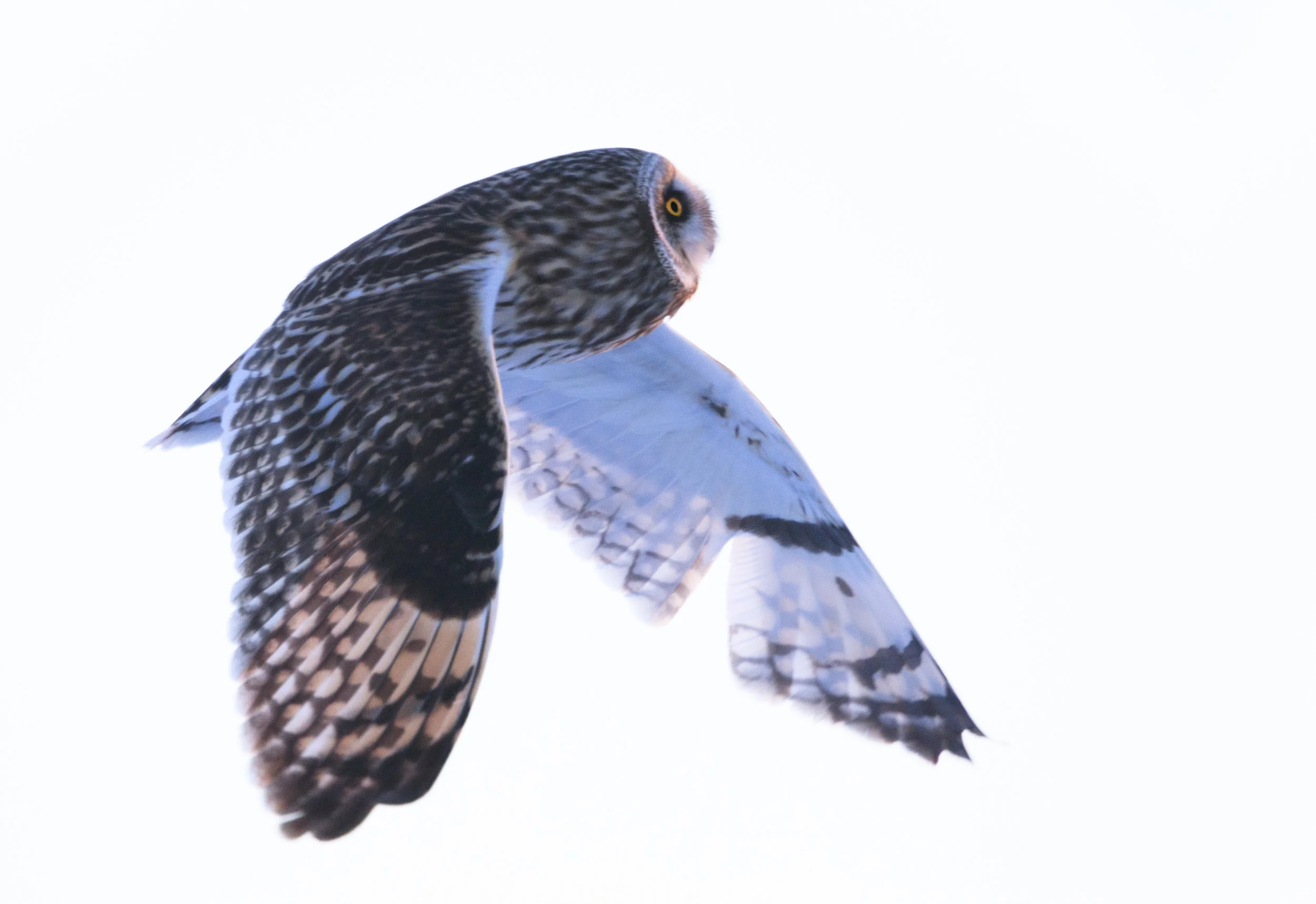
The short-eared owl is one of our favorite grassland birds.  In addition to the numerous snowy owl sightings this winter we have also enjoyed seeing short-eared owls on a number of days.

The short-eared owl and the Northern harrier occupy the same habitat, preferring large grasslands, especially habitat with short grass or alfalfa.  Both are ground nesters and concentrate their hunting on areas with large numbers of small mammals, especially meadow voles.

Photo by Jim Stewart

Photo by Jim Stewart

In 1991 Sam Robbins wrote in Wisconsin Birdlife that short-eared owls are uncommon migrants and rare summer residents.   Sam could only find 10 nesting records before 1972 when Fran Hamerstrom and her assistants (playfully called “gaboons” by Fran) located 17 nests on the Buena Vista State Wildlife Area north of Wisconsin Rapids.  

In the first breeding bird atlas from 1995 – 2000 there were 14 nest records in six counties in central and northern Wisconsin including Crex Meadows in Burnett County.  At the end of the third year (2017) of the WI Breeding Bird Atlas II there are only five confirmed nesting records, all at Buena Vista Marsh.  Last year we had a short-eared owl hunting Browne and Jill’s Prairie in early May.  Randy Hoffman also found a short-ear at Mud Lake State Wildlife Area east of Poynette last May.  Unfortunately they did not stay in the area and nest.

With an increase in habitat we are seeing more short-eared owls in migration and in winter.  This winter we have been seeing up to four short-eared owls, south of the intersection of Goose Pond Road and Highway K, hunting the pastures and alfalfa fields at the UW Agricultural Research Station.  We also saw one on Badger Lane east of the UW Research Station headquarters, and  three owls were found a number of days on Harvey Road south of Highway DM and one mile east of Highway 51.

Photo by Monica Hall

Photo by Monica Hall

The best time of the day to find these owls is the “blue hour” when the animals of the night replace the animals of the day.  However, on some days short-ears were seen hunting around mid afternoon.   Wildlife photographer Monica Hall spends a lot of time searching for owls and has been rewarded in finding short-ears hunting with good light conditions.  She uses her car as a blind and sometimes the owls have flown close to her or perched nearby.

Our best sighting this winter was on February 6th.  In late afternoon we spotted a snowy owl on a utility pole on the west side of Highway I along the Wood Family Prairie.  We then headed to the UW Farms looking for “Arlington” our snowy owl with a transmitter.  While heading to Arlington’s usual roosting areas we were treated to two short-ears flying with their characteristic moth-like flight over the UW pasture and alfalfa fields south of Highway K.  

Photo by Jim Stewart

Photo by Jim Stewart

We were unsuccessful in locating any more snowy owls and headed back to check on the snowy owl along Highway I.  We drove past the Browne Prairie and were very surprised to see a short-eared owl in the parking lot sitting on the mailbox that holds a guest book for visitors.  We had our camera ready and slowly backed up.  Seconds before we were ready to take a photo, a snowy owl flew by and the short-ear flew toward the snowy owl.  The snowy made a loop and landed on a pole across from the parking lot.  Moments later the short-ear made a pass on the snowy; the snowy then flew away.

In early February, Spence Stehno was searching for owls at Buena Vista Marsh and reported to ebird “I saw one (short-ear) fluttering over the field, and then up it flew directly into the face of a snowy owl sitting on a telephone pole and started to dive-bomb the snowy.  A few seconds later a second SEO joined the first and was doing the same thing to the snowy who at that point, other than flying off to a farther pole and landing, did not appear to offer any defense from the two SEO's.  When flying the much larger size of the snowy to the SEO was obvious.  SEO's 3 & 4 were now in the area, making the sweet sound of their bark and screech as they were flutter-flying around. There was definitely a different sound being made by the SEO's when they were coming near the snowy on the pole.”  Our guess is that snowy owls may prey on short-eared owls if they are found sitting and not paying attention.  So maybe short-eared owls will harass snowy owls to force them to move on from the area.  In the air the short-ears probably can outmaneuver the snowies.

Photo of Mark with the short-eared owl we rescued. Photo by Sue Foote-Martin

Photo of Mark with the short-eared owl we rescued. Photo by Sue Foote-Martin

In the past, we’ve had wonderful short-eared owl sightings in central South Dakota in mid-October.  In some years we have seen 50 short eared owls in the Fort Pierre Grasslands and Conservation Reserve Program fields.  Usually the short-ears are in groups and our record was flushing 10 at one time!  One day we were driving around with Curt Caslavka and Chuck Pils when we found a short-eared owl caught on a barbed-wire fence.  Lucky for the owl we came by.  He was quickly released and flew off unphased.

We always wonder how these uncommon birds find the areas with large small mammal populations for nesting or hunting in migration.  Owl searching requires luck.  We recently went owl prowling with Jeff and Arlene Koziol.  We knew of five snowy owls in the area and did not expect to see any short-ears since they have not been seen for 10 days.  We ended up finding two short-ears and no snowy owls.  Hopefully the snow will not get too deep for the short-eared owls to feed.

Written by Mark Martin and Sue Foote-Martin, Goose Pond Sanctuary Managers

Brown Thrasher

Print Friendly and PDF
Photo by Vicki Deloach

Photo by Vicki Deloach

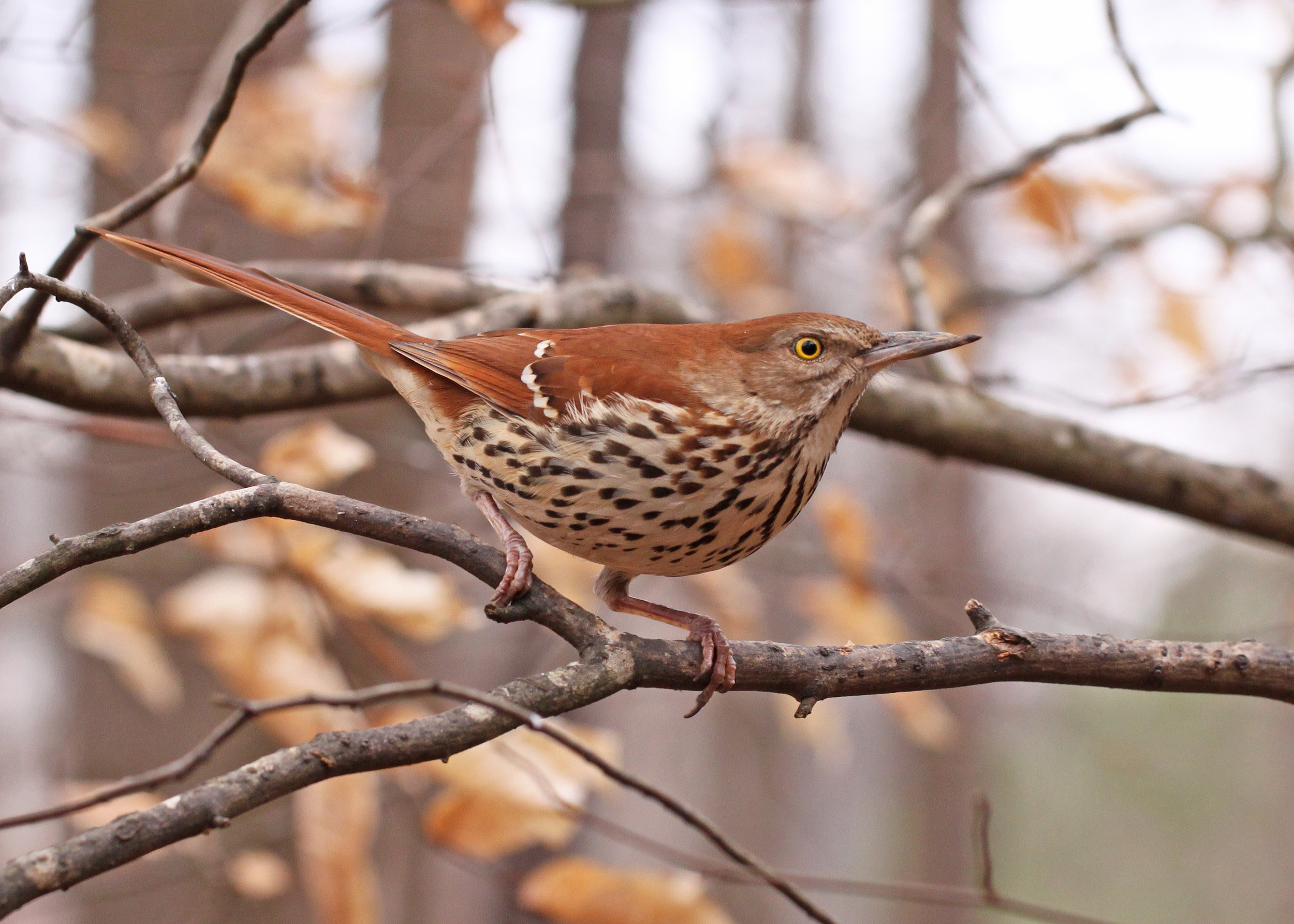
Cutting brush along the pond at the Laas acquisition a few weeks back, I stopped for a minute while I filled the brush cutter with gas. As the tank gurgled with fuel, I heard a sound nearby—two squawking notes—which I thought might be a blue jay. Tracing the source of the call led me to a rufous-backed bird with black streaks on its breast and a slightly curved bill. My winter birding brain didn't quite compute initially, but I soon realized I had a brown thrasher in front of me.

Thrasher is a fantastic name for the bird, which you can see when it thrashes through its brushy habitat. When flushed, the brown thrasher will often drop to the ground and scamper through  a tangle of dogwood, briar, and likely some non-native honeysuckle. For these habits, I think of the brown thrasher as a rather messy and unkempt bird. Its yellow eyes seem fierce in an insane sort of way, and the twice repeated notes of its song give the thrasher a digressive voice.

But this is a beautiful bird, its rusty feathers occupying an under appreciated habitat (shrublands), and just because its shrubby labyrinths aren't usually accessible to humans doesn't mean we can't appreciate the thrasher.

We'll start with the song of the brown thrasher, and really it's unfair to the thrasher to call it a singular song. The bird has over 1,000 songs in its repertoire, with some research claiming the birds have at least 3,000 song phrases. Its calls and songs are thought to be more diverse than the related Northern Mockingbird, though the mockingbird will mimic a wider variety of birds. Nonetheless, brown thrashers will mimic tufted titmice, cardinals, flickers, and wood thrushes, among many others.

These are intelligent birds who've been known to hammer acorns and other nuts after they wedge them in a hole or under a rock. In 1841, The Birds of Massachusetts called the brown thrasher “superior to all the birds of its class... in matter of strength and intelligence,” and reported that hand-reared birds would take tough bread crumbs and soak them in water, or remove the stingers of wasps before eating.

Photo by Shawn Taylor

Photo by Shawn Taylor

Additionally, the brown thrasher helps disperse seed on account of being a frugivore, and outside of the breeding season the bird focuses on fruits, nuts, and seeds. During the breeding season, arthropods are a major component of the diet due to superior protein content. The consumption and digestion of fruits may increase germination rates in some species of plants; one study found that pokeweed germinates faster when digested by brown thrashers as compared to undigested seeds.

This overwintering thrasher at Faville Grove is quite the anomaly. In Wisconsin Birdlife, Sam Robbins notes that no thrashers were reported to overwinter during the 19th century, but sporadic reports began in 1913 and have continued since. Robbins suggested that these birds tended to overwinter at feeders, while the bird at Faville Grove doesn't appear to have access to a feeder. On eBird last month, only one other bird had been reported in the state, near Wausau, frequenting a yard feeder.

I can only guess at the diet of this bird, but it likely consists of any arthropods that might jaunt out on a warm day. This bird has survived some severely cold weather thus far, and might be fit to survive the winter. Its diet of fruits could be quite varied and consist of such delicacies like: bittersweet, juniper berries, hackberry, poison ivy berries, sumac, winterberry, hawthorn, or nannyberry. Nearby lowland areas have rich thickets of winterberry, which could provide ample food, and some large oaks around the pond have the bittersweet vines, with berries still present.

Photo by Hoan Luong

Photo by Hoan Luong

In south Texas, overwintering birds establish territories, a behavior normally associated with short-distance migrants or birds that stay put for the winter. There, brown thrashers compete with long-billed and curve-billed thrashers and will aggressively defend riparian brushlands rich in arthropods. Without sympatric species at Faville Grove, this brown thrasher won't have to fight much to defend its habitat, but finding food over the rest of winter could prove a challenge as this bird awaits the rest of its Toxostoma brethren, scheduled for a return flight in late April.


Written by Drew Harry, Faville Grove Sanctuary land steward

19 and counting: Goose Pond Christmas Bird Count

Six people participated in the Goose Pond unit of the Poynette Christmas Bird Count (CBC) held on December 30, spending most of the day counting birds at Goose Pond Sanctuary. This year Mark Martin, Maddie Dumas, Jim Hess, Bill Walters, Emily Jorgenson, and JD Arnston participated, making up the biggest group in the history of the Goose Pond CBC! Jim and Bill have participated on the count for many years. 

Photo by Monica Hall