Hooded Merganser

Print Friendly and PDF
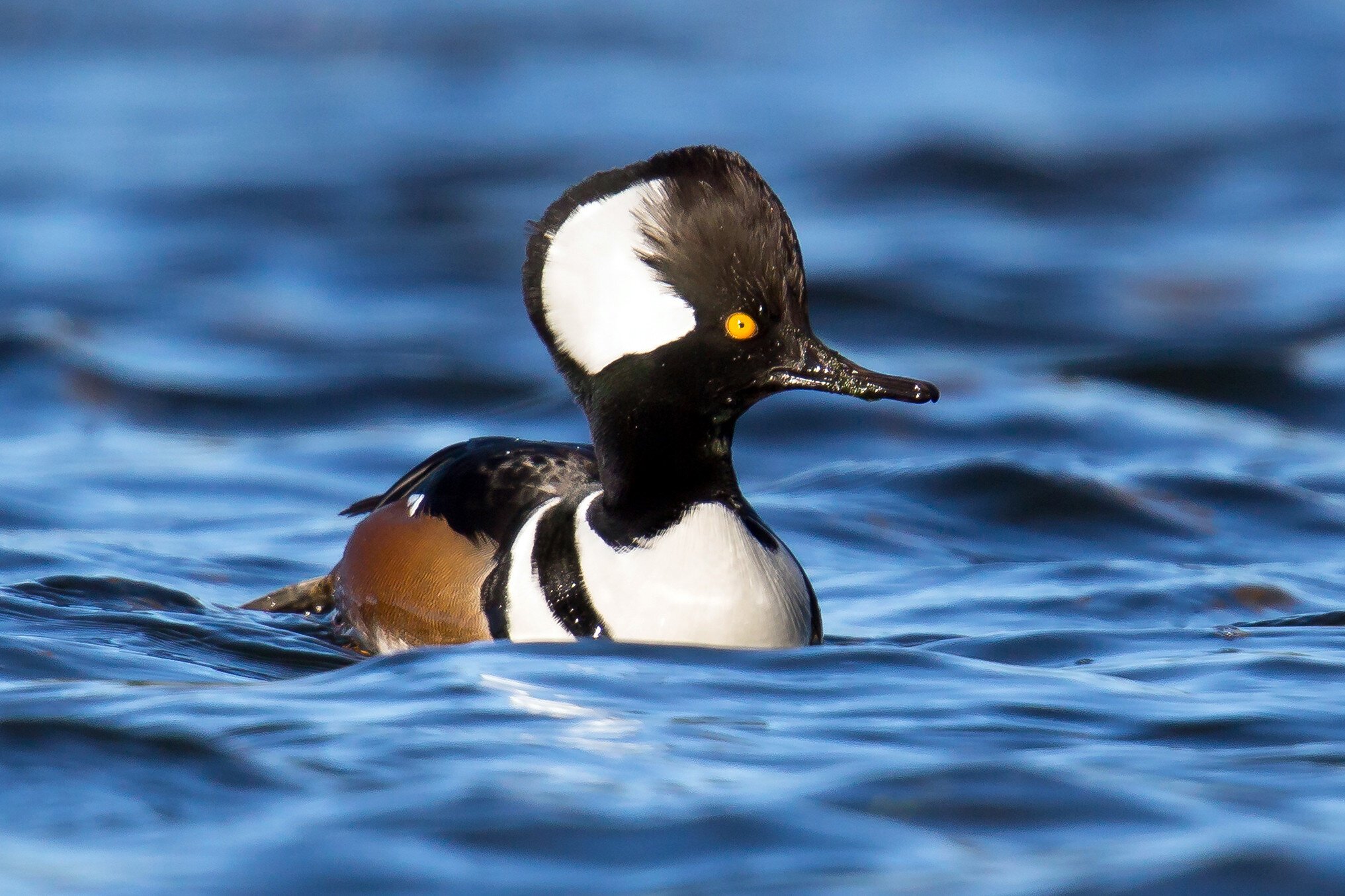
Hooded merganser, photo by Mick Thompson

Hooded merganser, photo by Mick Thompson

We always enjoy seeing hooded mergansers, especially when the males have their crests — also known as their “hoods” — raised and are in courtship display. The scientific name for hooded mergansers is Lopodytes cucullatus that means “hooded diver.” The crests can be raised and lowered in both sexes, and are a helpful identification guide for these small fish ducks, who with their narrow serrated bills, catch fish.  

Early naturalists in the 19th century listed hooded mergansers as “abundant” in Wisconsin and were found especially in forested areas near water. But Sam Robbins wrote in Wisconsin Birdlife in 1991 that hooded mergansers are uncommon summer residents in southeast Wisconsin. Columbia and adjacent counties were not not included in his breeding map for the species. Their numbers greatly declined due to loss of forested habitat that provided nest cavities and over harvesting by hunters. Sam wrote that “Theoretically, the bird’s summer range should blanket the state.”

According to the Cornell Lab of Ornithology “Hooded Mergansers are fairly common and their populations are stable and possibly increased between 1966 and 2015, according to the North American Breeding Bird Survey.”

Hooded merganser range map, provided by The Cornell Lab of Ornithology

Hooded merganser range map, provided by The Cornell Lab of Ornithology

We observed their numbers increase in Columbia County in the past four decades. In the 1980’s, we would see a few birds usually in spring migration. In the 1990’s, we began seeing a few nesting pairs. In the first Breeding Bird Atlas (1995-2000), hoodies were confirmed nesting in 12% of the statewide priority and 17% of the priority blocks in Columbia County. In the second Breeding Bird Atlas II (2015-2019), they were confirmed in 26% of the statewide priority blocks and 33% of the Columbia County priority blocks.

A freon nesting tube that was donated to us by the LaCrosse County Conservation Alliance. We replaced the freon tube with a cedar box. Photo by Richard Armstrong

A freon nesting tube that was donated to us by the LaCrosse County Conservation Alliance. We replaced the freon tube with a cedar box. Photo by Richard Armstrong

Hooded Mergansers at Our Cabin Near Rio

We had two surprises on March 25th when we began our final check of our duck nest boxes at our cabin near Rio to make sure they were ready to go. The first surprise was finding two boxes that contained screech owl pellets. One of the boxes also contained a small uneaten bullhead. Usually one does not think of owls that go fishing.  

The second surprise was finding two nest boxes with hooded merganser eggs. One box had four eggs and the other had two eggs. So far at the cabin we have three merganser nests with the first eggs laid on March 21, 23 and April 1st. An early ice out and above normal temperatures probably contributed to the early egg laying.

Lovely merganser eggs. Photo by Mark Martin

Lovely merganser eggs. Photo by Mark Martin

Our plan at the cabin is to check 20 accessible nest boxes weekly and stop checking individual boxes after finding woodie or hoodie eggs. We also have three nest boxes with wood duck eggs that were first laid on April 3, 4, and 5.  

Nesting Hooded Mergansers at Goose Pond

Goose Pond contains an abundant population of fathead minnows, probably ideal prey for these small diving ducks. But in the past, the property lacked large trees with nesting cavities. That changed in 2015 when we erected two cavities as wood duck boxes. One box was placed at a wetland at Sue Ames Prairie and the other just west of the railroad tracks in the wetland south of the Kampen Road residence.

A hooded merganser nest was found on May 12 at Sue Ames Prairie. We checked the nest box on May 18th and the young were ready to jump out. Nine membranes from hatched eggs and one unhatched egg. This was the the first hooded merganser nesting at Goo…

A hooded merganser nest was found on May 12 at Sue Ames Prairie. We checked the nest box on May 18th and the young were ready to jump out. Nine membranes from hatched eggs and one unhatched egg. This was the the first hooded merganser nesting at Goose Pond. Photo by Mark Martin

On May 12, 2016, Mark, Jim and Kathy Shurts, and grad student Heather Inzalaco conducted a big day count and Mark decided to check the nest box at Sue Ames Prairie. Mark slowly opened the side and could see an incubating female hoodie - what a surprise and a treat! Mark checked the box again on the 18th and nine young were getting ready for “jump day”. This was probably the first record for a hooded merganser nest at Goose Pond! 

Hooded mergansers have used this box every year since 2016. Last year the box contained a large clutch of eggs that did not hatch. We speculated that the female abandoned the nest, was killed, or that this was a dump nest and not incubated.   

However, one evening last July we looked out the large south window of the house on Kampen Road and saw a large brood of hooded mergansers! We were fortunate to watch them grow up. The brood started with 14 young and ended with twelve. The nest box near the brood was checked and many egg membranes and three unhatched eggs were found. Our guess is that both nest boxes were dump nests and only one was incubated. Late last month, Graham Steinhauer checked the box at Sue Ames and found a hoodie nest with the first egg laid on March 26th. 
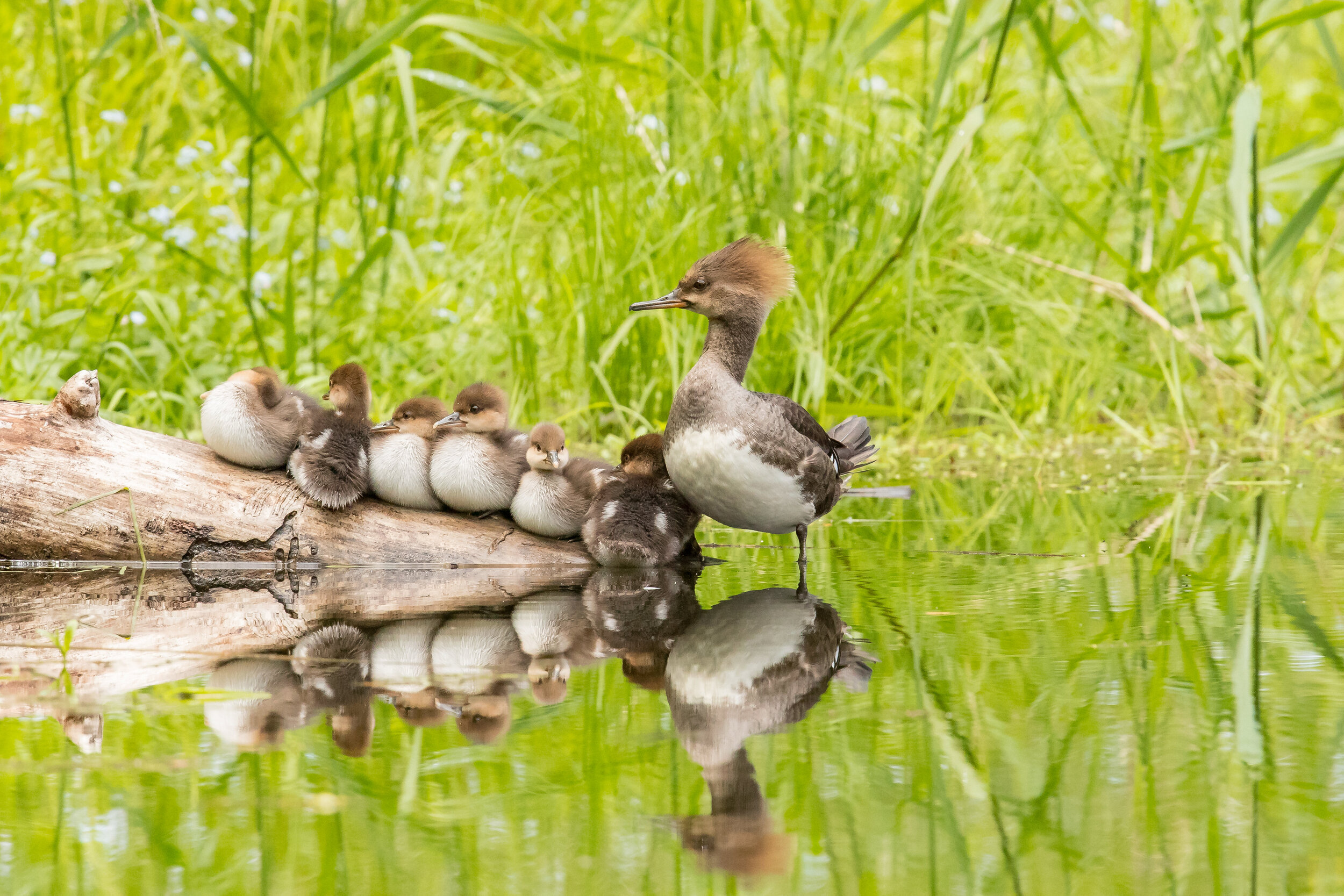
Hooded merganser cuties, photo by Mick Thompson

Hooded merganser cuties, photo by Mick Thompson

When we put up our “wood duck” boxes, our goal was to attract wood ducks, and did we not expect to have nesting hooded mergansers. As of 2020 we still do not have any records of nesting wood ducks, but the hooded mergansers are sure making themselves at home!

A question that some visitors ask is, “Why aren't male hooded mergansers present in Columbia County after mid-April?” It is often mentioned when looking up information on hooded mergansers that after the hen begins incubating the male takes off. Most waterfowl biologists believe they head to wooded river systems and may travel long distances.

Special thanks to Mark and Jenny McGinley who have been erecting, repairing, cleaning out and monitoring 41 wood duck boxes for the past 11 years that at the Anderson Waterfowl Production Area (WPA), Jackson WPA, Otsego Marsh and Schoeneberg Marsh WPA/Erstad Prairie. All areas have high numbers of nesting woodies and hoodies.

Jenny McGinley checks on of their many wood duck boxes, this one at Otsego Marsh. Photo by Mark McGinley

Jenny McGinley checks on of their many wood duck boxes, this one at Otsego Marsh. Photo by Mark McGinley

In the past eight years, Mark and Jenny found 193 successful nests including 123 (64%) nests that were only wood ducks, 31 (16%) that were only hooded mergansers, and 39 (20%) that contained eggs of both species (dump nests). Both species can also lay eggs in the nest of their species. Mark and Jenny have found dump nests with up to 33 eggs! Large clutches usually do not hatch since a female would have a hard time incubating large numbers of eggs.

Hoodie females begin nesting at age two, usually lay a clutch of 10 eggs and incubate the eggs for 32 days while woodie females begin nesting their first year, usually lay a clutch of 12 eggs, and incubate for 30 days. It is easy to look at eggs and identify the species since hooded merganser eggs are large, white, thick-shelled and spherical contrasting to smaller, brown, thinner-shelled, oblong eggs of the wood duck. It is assumed that since wood ducks have a shorter incubation period that more wood duck eggs might hatch in dump nests that also contain hooded merganser eggs. We assume that if a female wood duck is checking out nesting cavities and finds a defensive hooded merganser already nesting that she would look for another cavity.

A wood duck box should have a solid predator guard to protect the eggs from hungry raccoons and other critters. Photo by Mark Martin

A wood duck box should have a solid predator guard to protect the eggs from hungry raccoons and other critters. Photo by Mark Martin

Consider putting up a nest box to attract a breeding pair. Attach a predator guard to keep predators from raiding eggs and young.”  Note that “wood duck box” blueprints work well for attracting hooded mergansers. Here are some instructions published by National Audubon on how to build a duck box. Some people use pine, but we recommend cedar for its excellent rot resistance. Be sure to add a predator guard as raccoons and other critters love to eat duck eggs.  

If you would like to see a brood of hoodies visit Schoeneberg Marsh Waterfowl Production Area adjacent to Madison Audubon’s Erstad Prairie, or MAS’s Otsego Marsh property south of Rio. The young are fun to watch diving, feeding and interacting.  

Written by Mark Martin and Sue Foote-Martin, Goose Pond Sanctuary resident managers
American Woodcock

Print Friendly and PDF
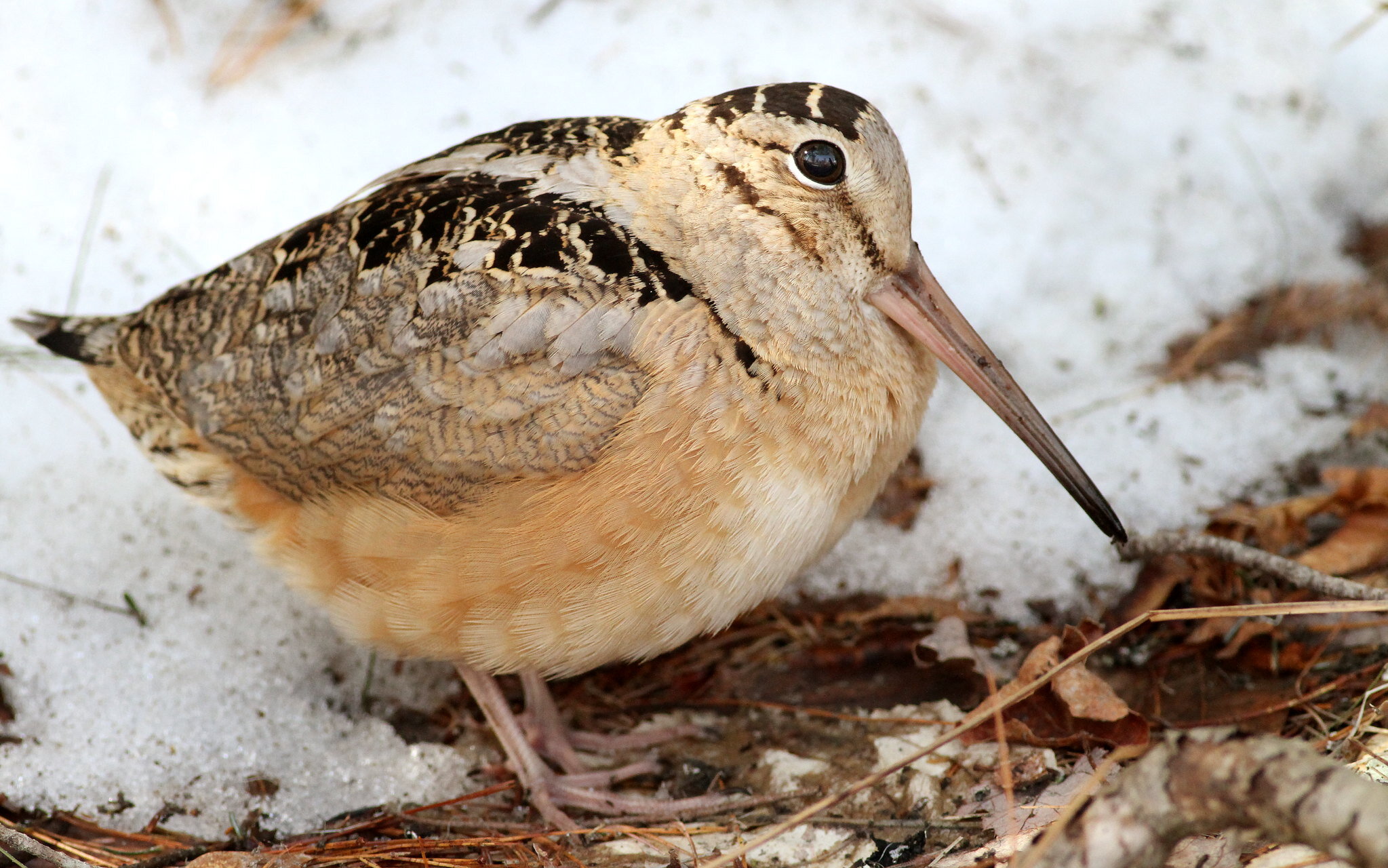
American woodcock, photo by Fyn Kynd FCC

American woodcock, photo by Fyn Kynd FCC

An unlikely candidate for one of the most beloved birds of spring, this squat, neckless weirdo nevertheless invokes breathlessness upon seeing its spring mating ritual. Belonging to a family of water-associated shorebirds, this bird somehow ended up living its life away from water in early successional woodland, shrubland, and grassland. Its heavy looking body and short legs are not all that unusual when compared to its buzzy and bug-like “peeent” call that the males make during courtship.

Is this bird an ugly duckling? Well, not exactly.

Though its mish-mashed body and habits suggest drunken design, the American woodcock somehow maintains a level of coolness and popularity that overcomes its oddness. These birds can be reliably found in open areas surrounding woods, savannas, and thickets. Their performances begin at dusk, starting with a single peent and climaxing here at Faville Grove with dozens of birds peenting, twittering skyward higher and higher, and falling from the sky like a shot plane, only to land in about the same spot with a declaritive “peent!”—a reaffirming declaration that the woodcock did indeed survive what looked like certain death.

American woodcock overwinter in the Gulf states and have returned to Wisconsin in the past month or so, migrating in darkness over Midwestern states.

You can view woodcock here at Faville Grove Sanctuary. Prairie Lane and North Shore Road are the best spots, but if you are wandering around at dusk, you’re likely to a hear a woodcock almost anywhere in the sanctuary.

Dusk at Faville Grove Sanctuary. Photo by Drew Harry

Dusk at Faville Grove Sanctuary. Photo by Drew Harry

The best approach is to get settled in a bit before dusk and face west—that way you’ll be able to see the vespering birds flying into the fading light. Once the birds go through a few cycles of peenting and flying, you should be able to track down their location, and if you have binoculars you can try and trace their flight through the sky. Although the sequence appears like clockwork, sometimes a woodcock will surprise you; their fluttering flight at first sounds closer than you’ve heard, and only then do you realize that the bird is headed right for you! Of course, you whip your head and the woodcock has missed you by a considerable margin. Whether the bird was sending a message or entirely caught up in its own ritual is open for interpretation.

This spring, one woodcock has carved out a territory right near my house. I can watch it in the evenings from my deck, but I look east, so it is only a fleeting performance. My viewership is no matter, every night the bird alternates between peenting and flying, this squat and singular little bird, delighting me and perhaps a female woodcock with this strange and delightful spectacle.

Woodcock also have a strange effect on other birds. Where woodcock are found peenting and displaying, bird numbers and diversity are more than 1.5 times higher than in random forest plots. In part, this makes sense because of the diversity of habitats that woodcock use, from foraging in oak woods during the day, to performing in open prairies in the evening, to nesting near shrub thickets or at the base of trees.

If you’re able to, try to get to Faville Grove at dusk and enjoy the evening performance of the woodcock!

Written by Drew Harry, Faville Grove Sanctuary land steward

Greater White-fronted Goose

Print Friendly and PDF

Record numbers of greater white-fronted geese (Anser albifrons) at Goose Pond 

Greater white-fronted goose, photo by Ryan Askren

Greater white-fronted goose, photo by Ryan Askren

Greater white-fronted geese (aka specklebelly) can be identified by their light belly with black checkers, streaks or blotches and orange legs. They are named for the white patch of feathers bordering the base of the bill, and the latin name albifrons is derived from albus meaning white and frons meaning forehead. At a distance they are difficult to pick apart from Canada geese, but they’re smaller, have a more rapid wing beat, and announce themselves with energetic squeaks (listen in here). This opportunistic species has a nearly circumpolar arctic distribution and in North America, white-fronted geese are distinguished by a Pacific and Midcontinental population. 

Families Stick Together

Adults arrive at the breeding grounds of Alaska and Canada in May. They select a pond, shallow lake, or stream shoreline with an abundance of sedges or moss on which the nest is built. So far they sound similar to other nesting geese of the north like snow geese and brant, right? There are a lot of differences, but this is one that I found particularly interesting. 

Family pair bonds last longer in white-fronts than other geese, and broods frequently stay with their parents for a multiple years. Pretend that a breeding pair successfully reared three young in 2019. Those three young are probably still with the parents. When the family group arrives back on the breeding ground in 2020, the three young from 2019 are likely to help defend their parents nest from predators and conspecifics, possibly throughout the breeding season. White-front aren’t sexually mature until they are two or three years old so in this situation, the young from 2019 will not compete for their parents' breeding territory in 2020.  

Satellite image of the Alaskan landscape preferred by white-fronted geese

Satellite image of the Alaskan landscape preferred by white-fronted geese

Migration Changes in Wisconsin

Check out this great animated map, which tracks the spring and fall migration of greater white-fronted geese.

On their southward journey, white-fronted geese typically make two major hops. The first is from the arctic to grain fields in Saskatchewan and Alberta (about 1,400 miles), and then make another major move to the gulf coast and Mississippi Alluvial Valley (about 1,800 miles). They winter as far south as subtropical settings on the Yucatán Peninsula of Mexico. White-fronted geese take a much more leisurely approach to spring migration, and they utilize diverse habitats from deserts and grasslands to river deltas and major agricultural areas. 

White-fronted geese in flight, notice the variation in the coloring in the bellies. Photo by Arlene Koziol

White-fronted geese in flight, notice the variation in the coloring in the bellies. Photo by Arlene Koziol

According to Samuel Robbins Wisconsin Birdlife, white-fronted geese had “large numbers in spring and fall” or were even described as “an abundant migrant” in Wisconsin prior to 1890. Their populations in Wisconsin declined dramatically over the next two decades, and only a single observation of white-fronts was published between 1910 and 1938. While there were increasing observations after 1940, the 1990s in particular set the stage for a dramatic shift. This is where Columbia County comes in. Below is a short history of observations of white-fronted geese in Wisconsin provided by the Passenger Pigeon which is published by The Wisconsin Society for Ornithology.

1995 - Three counties. “Daryl Tessen had 13 in Outagamie County on 12 March and Bill Hilsenhoff had 17 in Dane County on 19 March.”

2003 - Ten counties. “The characterization of this species in Robbins Wisconsin Birdlife (1991) as a rare species reads like ancient history, with double-digit flocks now routine…Tessen was able to estimate well over 1,000 birds in Columbia and Dane Counties (combined) on March 29.”

2004 - 11 counties. “Numbers that would have been jaw-dropping even ten years ago peaked at 1,350 in Columbia County on March 20 (Tessen).” 

2008 - “The big numbers were in Columbia, Lafayette, and Dane Counties, peaking at 475 individuals in Columbia County on 13 April (Prestby).”

2012 - “By 8 March Tessen had already tallied the season’s high count with his report of 1,000 birds in Columbia County.”

2014 - “On that same date (2 April) numbers in Columbia County increased significantly with 750 birds tallied in the ephemeral flooded fields on Wangsness Road.”  Wangsness Road is four miles southwest of Goose Pond.

2017 - “Reported in 46 counties across the state this season...High count of 1,000 observed in Dane County at Island Lake WPA (David Johnson) on March 17, 2017, and in Jefferson County at Hope Lake (Aaron Stutz) on March 12, 2017.”

2018 - “Reported in 36 counties across the state this season...High count of 2,600 observed in Columbia County (Ted Keyel) on 17 March.”

2020 - (From WisBird) “More large numbers of White-fronted Geese were seen in several Columbia County ponds totaling about 3,000 - 4,000.

Photo by Arlene Koziol

Photo by Arlene Koziol

It is clear that white-fronted geese are gaining ground in Wisconsin, particularly Columbia County, but why is their migration shifting? The first reason is increasing populations. White-front numbers have been on a steady rise for decades. As more individuals inhabit a region, they tend to spread out to reduce competitive pressures related to food resources. The second reason probably has to do with a change in their wintering grounds. Geese love rice. Texas was the undisputed rice center of the United States until the 1970s. Around that time, drought and global competition reduced the amount of rice grown in Texas. Mississippi Alluvial Valley states like Arkansas were able to capitalize on this change by converting row crops like corn and beans into rice fields where they could utilize their wetter climate and more abundant water resources. White-fronted geese seem to have shifted both their primary wintering grounds and spring migration routes much farther to the east in step with agricultural changes.

The winter population moved northeast and large numbers now winter south of Wisconsin so when they move north, they find Wisconsin including Columbia County with a large acreage of open water and abundant picked cornfields to feed in. Similar to other long-lived waterfowl species, it is likely that they remember ideal habitats and return to those local areas in subsequent years.

Graphic shows changes in winter distribution of greater white-fronted geese between 1975-2015. Graphic provided by Ducks Unlimited

Graphic shows changes in winter distribution of greater white-fronted geese between 1975-2015. Graphic provided by Ducks Unlimited

Record Numbers at Goose Pond

The first time white-fronted geese were seen at Goose Pond was on March 26, 1978 by Laura Erickson. On March 22nd, 1980, Mark and Sue counted six individuals and Randy Hoffman spotted two more. The high counts for each decade at Goose Pond are 50 in the 1980’s, 10 in the 1990s, 50 in the 2000s, and 1,850 in the 2010s. The record has already been broken twice during this 2020 spring migration. Calla Norris and I counted 1,972 white-fronts on March 16, and Tom and Wendy Schultz counted 2,200 just five days later. According to past records, we’re at peak migration time for white-fronts here at Goose Pond. We encourage you to visit and view these charismatic creatures before their numbers dwindle significantly by mid-April.  If you can’t make it in person, check out Arlene Koziol’s wonderful collection of Goose Pond photos taken this week.

A lot of greater white-fronted geese at Goose Pond! Photo by Arlene Koziol

A lot of greater white-fronted geese at Goose Pond! Photo by Arlene Koziol

Additional Fun Facts

  1. White-fronts often mob terrestrial predators by advancing on a predator as a threatening flock unless they are undergoing wing molt.

  2. A high degree of natal philopatry and tendency to pair with genetically similar mates means there is strong likelihood of population structuring and the existence of unique genotypes. It is important to identify and protect these distinct groups. 

  3. The oldest recorded greater white-fronted goose was at least 25 years, 6 months old when it was found in Louisiana in 1998. It had been banded in Nunavut in 1975.  A female in captivity lived to be a staggering 46 or 47 years old!

Written by Graham Steinhauer, Goose Pond Sanctuary land steward

Song Sparrow

Print Friendly and PDF

First off, happy World Sparrow Day! Did you know such a day exists? Well, surprise, now you do! This international day of sparrow appreciation was originally designed to raise awareness of the population declines of the house sparrow (it’s true, many places on Earth are seeing significant declines). While the house sparrow is an introduced species in our part of the world, we can still appreciate and work to conserve our many native sparrow species, including but not limited to the delightful Song Sparrow. Read on!


In the theater of evolution, Darwin’s finches and Hawaii’s honeycreepers arise as the preeminent examples of adaptive radiation. These island lineages, shaped through natural selection, have undergone intense speciation. 

On the Galápagos Islands, James Smith worked with Peter and Rosemary Grant to band and track the life history of the finches on the islands. The insights from work in the Galápagos have made incredible contributions to evolutionary biology. Years later, Smith would conduct a similar study as he and armies of others have banded song sparrows on Mandarte Island in British Colombia. 

Mandarte Island, BC, Canada. Photo courtesy of mandarte-island.weebly.com

Mandarte Island, BC, Canada. Photo courtesy of mandarte-island.weebly.com

All of this interesting research is built on the work of Margaret Morse Nice, who banded song sparrows in her backyard in Ohio starting in the 1930’s, changing the study of birds forever. Although she was not a classically trained biologist, Nice became a prolific researcher and published over 250 papers on birds in her lifetime. Banding the sparrows allowed her to study individual life histories, and learn about the intricacies of sparrow ecology. 

Today, we will look at the song sparrow and its fascinating life history, the whims of selective pressures, and the dynamic processes of an island population. 

Song sparrow. Photo courtesy of mandarte-island.weebly.com

Song sparrow. Photo courtesy of mandarte-island.weebly.com

The song sparrow is one of the most polymorphic species of birds in North America, though genetic evidence suggests that geographic subspecies are more connected than initially thought. The song sparrows on Mandarte Island are year-round residents of the rocky island, which is about six hectares. The habitats on Mandarte include sea island scrub, grassland, and open cliffs. Most song sparrows breed among the scrub, and prime territories are established in these areas. Since the 1960’s, the song sparrows on Mandarte Island have been studied in depth almost annually, and researchers summering on the island have many publications on these birds and even a book, published in 2006, Conservation and Biology of Small Populations: The Song Sparrows of Mandarte Island, where much of this information comes from.

Breeding can begin as early as March, and researchers on Mandarte have found pronounced effects of breeding date on the resulting number of fledglings. The earlier a pair breeds, the more offspring that will survive to fledgling. Moreover, the age of the parent causes significant changes in the total number of offspring, with both males and females peaking in reproductive success at age 3, displaying a bell curve distribution. 

Another ingredient of song sparrow life history on Mandarte is their density dependent reproduction. When the population is high, the juvenile survival is very low, and vice versa. Thus, during population crashes on the island due to weather or other unknown causes, the population quickly recovered with high fecundity while population highs saw the likely effects of competition acting on the birds. 

Baked into those population crashes are the effects of inbreeding, and researchers found pronounced effects from inbreeding. Reproductive success declined with higher coefficients of inbreeding, and in a trial of song sparrows experimentally injected with a parasite, those with a lineage of inbreeding exhibited a lesser immune response than heterozygous song sparrows. Overall, the birds resulting from inbreeding were less fit than other birds on Mandarte.

Banded song sparrow. Photo courtesy of mandarte-island.weebly.com

Banded song sparrow. Photo courtesy of mandarte-island.weebly.com

Numbers of females on the islands fluctuated wildly from 4 during the population crash of 1989, to over 70 1986. During these population crashes, it might have been expected that high inbreeding and low population could lead to the extinction of the song sparrows on Mandarte, but this was not the case. There was one effect sprinkled in that helped to save the song sparrow: immigration. On average, 2.8 song sparrows immigrate to Mandarte each year. While a small number, during population crashes, these immigrants bolstered the gene pool of Mandarte song sparrows and contributed to a population rebound. However, sparrows since the early 1990’s have seen less vigorous rebounds after population crashes, which may be a result of decreased immigration—the island only averaged .7 immigrant sparrows per year from 1993-2002.

Another interesting variable began sneaking its way onto Mandarte Island in the 1960’s: brown-headed cowbirds. This brood parasite lays its eggs in another bird’s nest, where the resident bird will often raise the outsized cowbird young. Cowbirds are migratory, and typically arrive on Mandarte after song sparrows start breeding. The proportion of nests parsitized is low when cowbirds first arrive but steadily increases into June and July, when over half of all nests are parasitized. With a high population of sparrows, the cowbirds found plenty of nests to parasitize, thus cowbird eggs correlated with the number of breeding females. In a similar vein, the proportion of failed nests also increased with a higher female population, and reached almost 50% of nests failing when there were over 70 females on the island. Overall cowbirds depressed population size and increased the likelihood of extinction on the island. 

Perhaps the most obvious thing to study in the song sparrow resides in its name, the song. Song sparrows exhibit variation in song length, and while females do sing in early spring during the establishment of territories, males dominate singing during the breeding months. As a male’s song repertoire increases, his probability of mating increases and his number of offspring increases. One of the more pronounced effects of inbreeding in song sparrows is the effect of inbreeding on song repertoire; males with higher coefficients of inbreeding showed simpler songs. 

Screen Shot 2020-03-20 at 11.39.15 AM.png

Jonathan Weiner, in his book The Beak of the Finch, terrifically summarizes the work on Mandarte:

Summed over years, the effects of natural selection were invisible. But at each stage of their lives and each year of their lives the sparrows on that little island [Mandarte] had been “daily and hourly scrutinized” by the hand of nautral selection, much as Darwin had imagined, only in fast motion. The population on Mandarte is still being pushed every year…What seemed most striking to Dolph [a Mandarte researcher] as he studied the selection of events hidden in Smith’s data was the boring uniformity of Smith’s birds. Compared with Darwin’s finches, the sparrows of Mandarte might have been turned out by a cookie cutter. They showed only the very slightest of variations from one bird to the next in length of beak and length of tarsus... Yet even these varitaions, trivial as they seemed, had helped to decide who lived and who died. “That is pretty amazing to me!” Dolph says. It means populations don’t need to be excessively variable in order to experience natural selection. 

“Selection doesn’t happen just in the Galápagos,” Dolph concludes. “It happens in your backyard. “

Song sparrow living up to its name at Faville Grove Sanctuary. Photo by Drew Harry

Song sparrow living up to its name at Faville Grove Sanctuary. Photo by Drew Harry

From Margaret Nice’s backyard, to Mandarte Island, and even back here at Faville Grove, the song sparrow shows the tremendous variation and selective pressures present in nature, and what a remarkable view we have of these processes in one of our most common birds.

Written by Drew Harry, Faville Grove Sanctuary land steward

Snowy owls: Update on Columbia & Welcome to Fond du Lac

Print Friendly and PDF
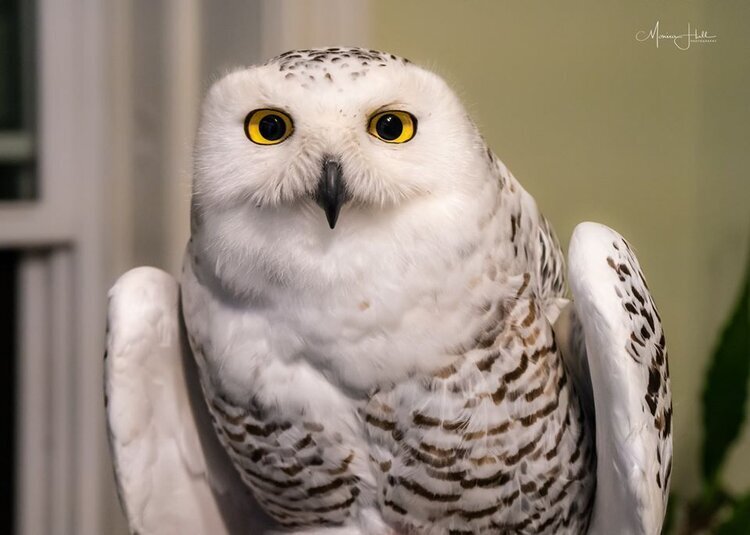
Columbia, the snowy owl, looks at the camera with her sharp, yellow eyes. Photo by Monica Hall

Columbia, the snowy owl, looks at the camera with her sharp, yellow eyes. Photo by Monica Hall

Update on “Columbia”

You can learn more about her by checking out her first Friday Feathered Feature. https://madisonaudubon.org/fff/2020/1/31/we-named-her-columbia

Scott Weidensaul’s March 1st Project SNOWstorm blog post is titled Zugunruhe to You, Too! https://www.projectsnowstorm.org/posts/zugunruhe-to-you-too/

Ornithologists use the German term, zugunruhe — which translates to “migratory restlessness” — to describe this kind of growing itch that migrants feel as the seasons change. It’s brought on by hormonal changes triggered by both the bird’s internal circadian rhythms and the changing day length. Often it’s a strong wind from the right direction — southerly, in this case — that prompts an exploratory flight…” Four snowy owls with transmitters in the Dakotas and Saskatchewan exhibited zugunruhe the last week of February.  Scott wrote, “There’s been less evidence of zugunruhe in the owls farther east. In Wisconsin, Columbia has been tracing a very distinct movement pattern northeast of Morrisonville, a narrow, 7.5-mile (12-km) long path anchored at one end by the farmland and a sand quarry near Audubon’s Goose Pond Sanctuary, and at the other what must be a highly productive field for hunting just east of a large housing development.”

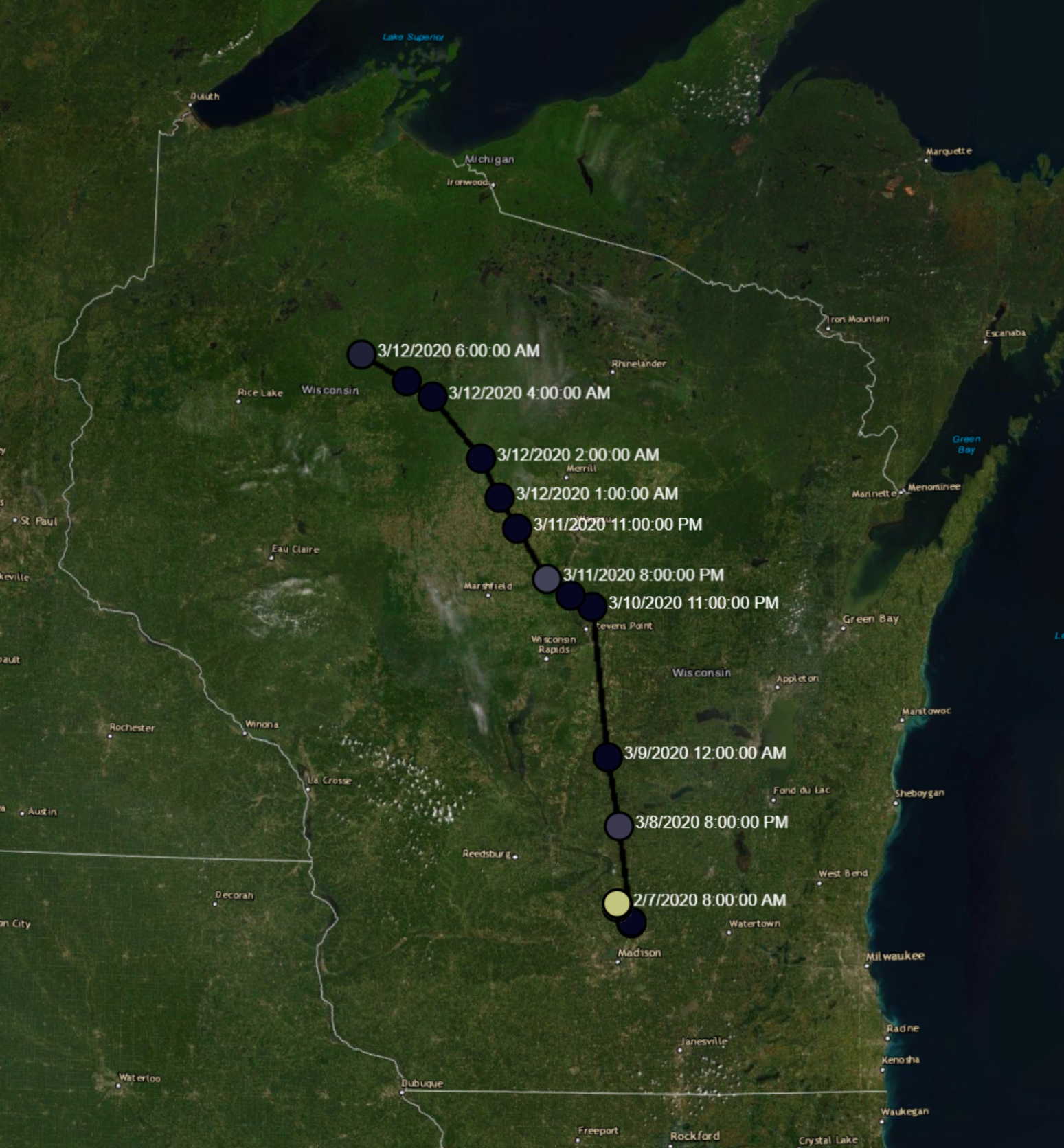
Columbia did not exhibit any zugunruhe until March 8th. At sunset she said goodbye to her new friends and headed north. She was flying at 30 miles per hour on southerly 12 mile per hour winds when she passed South Leeds. At one location she was clocked at 41 miles per hour.

A path marks Columbia’s northward journey since March 8.

A path marks Columbia’s northward journey since March 8.

Columbia would make frequent stops, with her first at the French Creek North State Natural Area in southern Marquette County.  She then headed over John Muir County Park (this location was on her bucket list), and ended up that morning just south of the Plainfield Tunnel Channel Lakes State Natural Area in Waushara County, 62 miles from her start 12 hours before.  She roosted and hunted in irrigated crop fields until 9:00 p.m. on the 10th. Then she headed north and northwest for a 46-mile flight ending up at the George Mead State Wildlife Area, northwest of Stevens Point where she stayed for one day before again moving northwest on a 72 mile flight ending up at a open bog in Sawyer County. Could she be taking a northwest direction to avoid flying over Lake Superior?

Fond du Lac, the snowy owl. Photo by Richard Armstrong

Fond du Lac, the snowy owl. Photo by Richard Armstrong

Introduction to “Fond du Lac”

Catching another owl was a partnership effort with Fond du Lac County Audubon Society who took the lead by paying for a new transmitter. Unfortunately no one from the organization was able to join us for the trapping effort. It was amazing to be able to catch three snowy owls.   Thanks to Angel Clark, Suzanne Bahls and Scott for their articles on the experience.

The Clark and Bahls family searched for owls on Saturday afternoon and located seven snowy owls! 

From a participant:

“On Saturday evening, February 22, 2020, my husband, Pat, informed me we should take our son Ben, to Norton’s Supper Club, on Green Lake, for his 25th birthday. Pat, then mentioned we need to leave a little early to search for snowy owls on the Mackford Prairie. He called his mission, "Operation Snow Storm.” I have never seen a snowy owl in the wild, so I wasn't quite sure what to look for. I thought this was another one of his wild goose chases searching for rare birds with his Madison Audubon buddies. It also makes me nervous when he's driving and looking through binoculars, so I sat in the backseat thinking I would be safer there. 

To our surprise we found one!... A female snowy owl was peached on a snowbank. However, she didn't stay on the snowbank for very long. She started to fly south-east and we followed her. It was hard to see her with the naked eye as she flew further and further away… She finally landed again in a snow covered field near a fence line. I also would like to mention, that this is truly like trying to find a needle in a haystack with all the snow and the owl basically being all white. But we did it! And boy, were we proud of ourselves! My husband, Pat, was so excited he called Mark Martin to give him his news report... "Hi, Mark. This is Pat. We spotted a snowy owl south-east on Lake Emily Road," I could hear Mark's voice on the other end. Mark said, "That's great Pat, now find another!" I chuckled to myself. It reminded me of a school child getting a good mark on a paper, and the teacher saying, now do it again on your next paper! 

The second spotting was on a telephone pole on the corner of Hickory Road, and Highway A. It was another female snowy owl. We were all in complete awe of this magnificent creature. It seemed as if this particular bird enjoyed the attention and wanted us to take her picture. We took many pictures with our mere camera phones. Then she must have spotted something edible on the ground across Highway A. It took off, swooped down just when there was an oncoming car! I thought my husband was going to jump out of his seat! He screamed, "Oh no, don't get hit by that car!" It did not. The owl made it safely to the other side, and came back to where it was originally peached. However, that seemed like it was very dangerous for the bird. Now I can see that these magnificent creatures need safer places to be. Better places for them to perch and find food. 

...From this experience, I have a whole new appreciation for these volunteers and scientists. Now, future generations will be able to experience what we did! Thank you, Project SnowStorm for all your hard work and dedication!”

-Sincerely, Angel Clark


Nine people met on Sunday (February 23) afternoon in Green Lake County east of Lake Maria to catch as many snowy owls as possible. Volunteers included Richard Armstrong, J D Arnston, Mark and Pat Clark from Madison Audubon, Jeff and Suzanne Bahls, and Rick Vant Hoff from the Horicon Marsh Bird Club, and Gene Jacobs and Brad Zinda from Linwood Springs.   

From a participant:

“My snowy owl obsession started about thirteen years ago when I went on a “first date” with Jeff Bahls. He took me to see one on highway 49 at Horicon National Wildlife Refuge. Every winter since, I have looked forward to their visits in our neck of the woods. When Jeff and I got married a few years back, we had a small, simple ceremony with our kids and celebrated afterwards with a snowy owl cake!  Therefore, a few weeks ago, when Mark Martin contacted Jeff about locating a Snowy Owl to be tagged for tracking, thoughts of actually getting to see one up close was like a dream! 

Jeff and I headed over to where we had seen one earlier... off a lightly traveled county road. When we got there, it had relocated to the other side of the road and further away. Gene thought it was still close enough, so he set the trap near the road and we watched… and waited. This owl did not budge. We watched him cough up a pellet and we thought, well, he must be hungry now... Mark Martin, who had been watching with us decided to take a little drive around and see if there were any other Snowies in the area. He found one sitting on a pole on the next road over. We could actually see it from where we were sitting. The problem was the road the second owl was on is a busy road. Mark talked to the landowner and got permission to set a trap on  the ground away from the road. It was decided to take a chance on the second owl. 

We picked up our trap and drove over to the second location. Brad took the trap and set it within sight of the second owl. We watched and waited again. About ten minutes later, the owl hopped off the pole and flew to the trap. She landed on top of it and then hopped off. She did not get tangled in the fishing line that was used to trap her. She sat a few feet from the trap and looked at it for a few minutes, then walked back to it and jumped on it a couple times, but still did not get tangled in the line. She then flew off about a hundred yards. Our hearts sank. Brad walked to the trap and re-adjusted the fishing line, and came back to the truck. We watched and waited again...  Several minutes later she took off flying toward the trap and finally got snagged in the line. Jeff and Brad jumped out of the truck and ran to the trap and went right to work untangling the owl. We got her!

We assisted Gene Jacobs and Brad Zinda in any way we could. During those few hours we caught three adult female Snowy Owls. Two were measured, banded and released back where they were caught. The third snowy was processed and Gene attached a GPS transmitter so Project SNOWstorm biologists can track her movements. It was amazing to witness first-hand the wings, beaks and talons of these gorgeous birds, and to see and work with the people from Madison Audubon and Linwood Springs Research Station. Reflecting on the events of that night still seems like a dream. It was an experience I will dream about for many years to come.”

-Suzanne Bahls


Fond du Lac stayed close to where she was released until March 7 when she moved a few miles north, just south of Green Lake. Her last cell phone was from that area on March 10th. We look forward to seeing her migration northward. 

Find more information on the capture and release of three snowy owls at the Project SnowStorm on Scott’s  blog post titled Fond du lac, and the Owl-fecta.

We hope that the owls enjoyed their visits to southern Wisconsin.  We also wish them safe travels to the land of the midnight sun and hope they return to southern Wisconsin next winter for another vacation.

Thanks to everyone who donated funds for the transmitters, to Gene and Brad from Linwood Springs for trapping and processing the owls, and to the volunteers who reported sightings, assisted with locating owls, taking photographs, trapping, and processing the birds.  We hope you follow their journey north.  

Written by Mark Martin and Sue Foote-Martin, Goose Pond Sanctuary resident managers, and Graham Steinhauer, land steward