
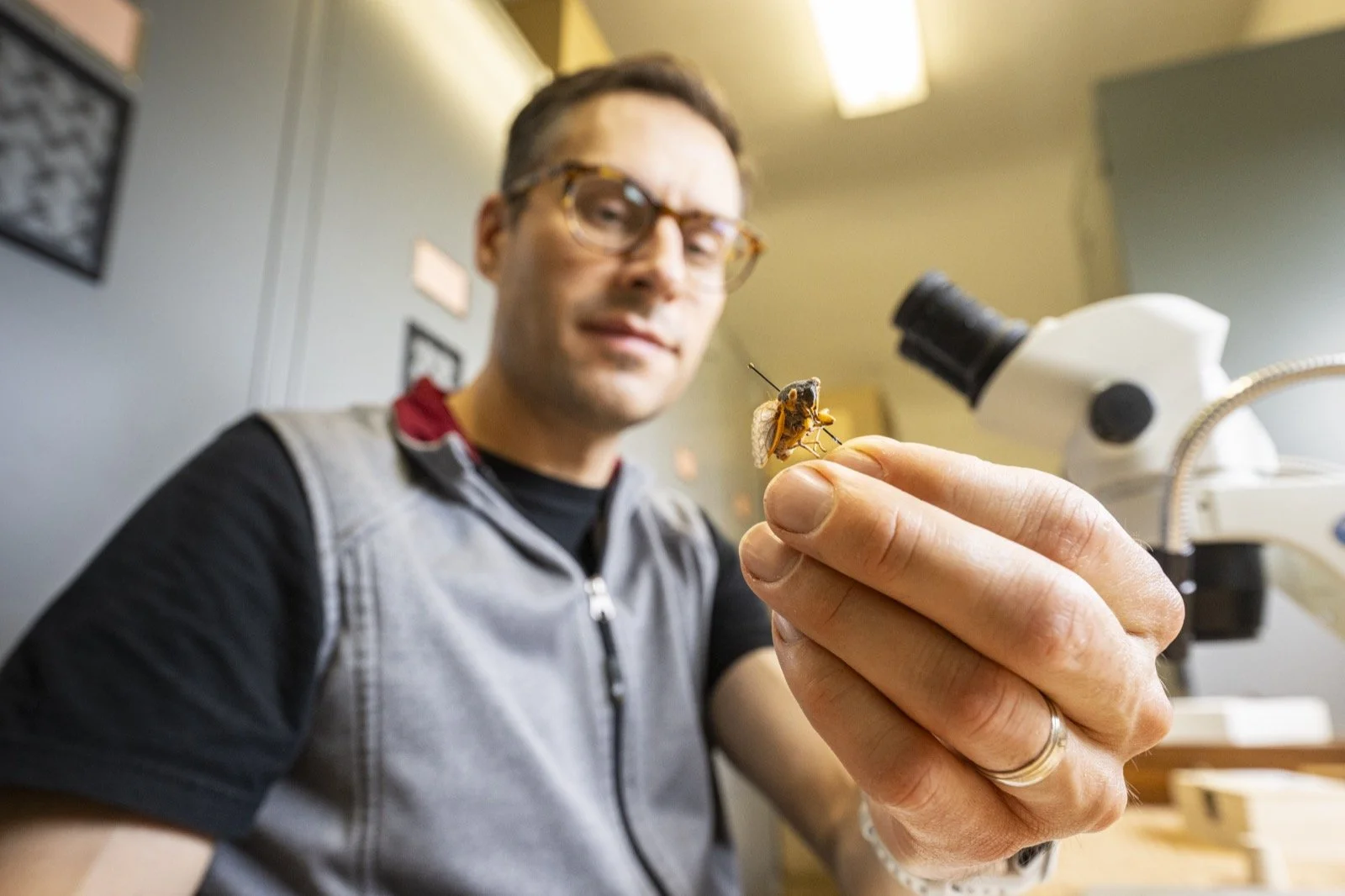
Getting an up close look at an insect (photo courtesy of PJ Liesch)
In this episode, we answer questions like "why do moths fly in circles around lights?" and talk about which insects migrate with our insect expert, PJ Liesch, the Director of the UW Insect Diagnostic Lab.
Follow PJ @WisconsinBugGuy
Subscribe to QuACK on Spotify, iHeart Radio, Apple Podcasts, or your favorite podcast app!
Transcription
Hey and welcome to Questions Asked by Curious Kids or QuACK, a podcast made by Southern Wisconsin Bird Alliance. This is a podcast where we gather questions about nature from kids to be answered with a local expert. My name is Mickenzee. I'm an educator and I'll be the host for this series. This episode I'm back with PJ Leash, the director of the UW Diagnostic Lab, and today he's going to be answering even more of our bug questions. This time about insect behavior. All right, let's dive in with PJ.
-----
Mickenzee: So hey, PJ, welcome back.
PJ: Hey, Mickenzee. It's good to be here.
Mickenzee: Last time you were on the show, you answered questions all about why insects are the way that they are and how in some ways, they're kind of like us. Well, the kids have more questions about insects. All of today's questions were submitted by third graders at Lincoln Elementary School here in Madison. And our first question begins with an observation this question asker submitted: “This fall we walked around our school building every day for nine weeks. We noticed that we usually saw insects on the same side of the building, and it was every day. Why might that be?”
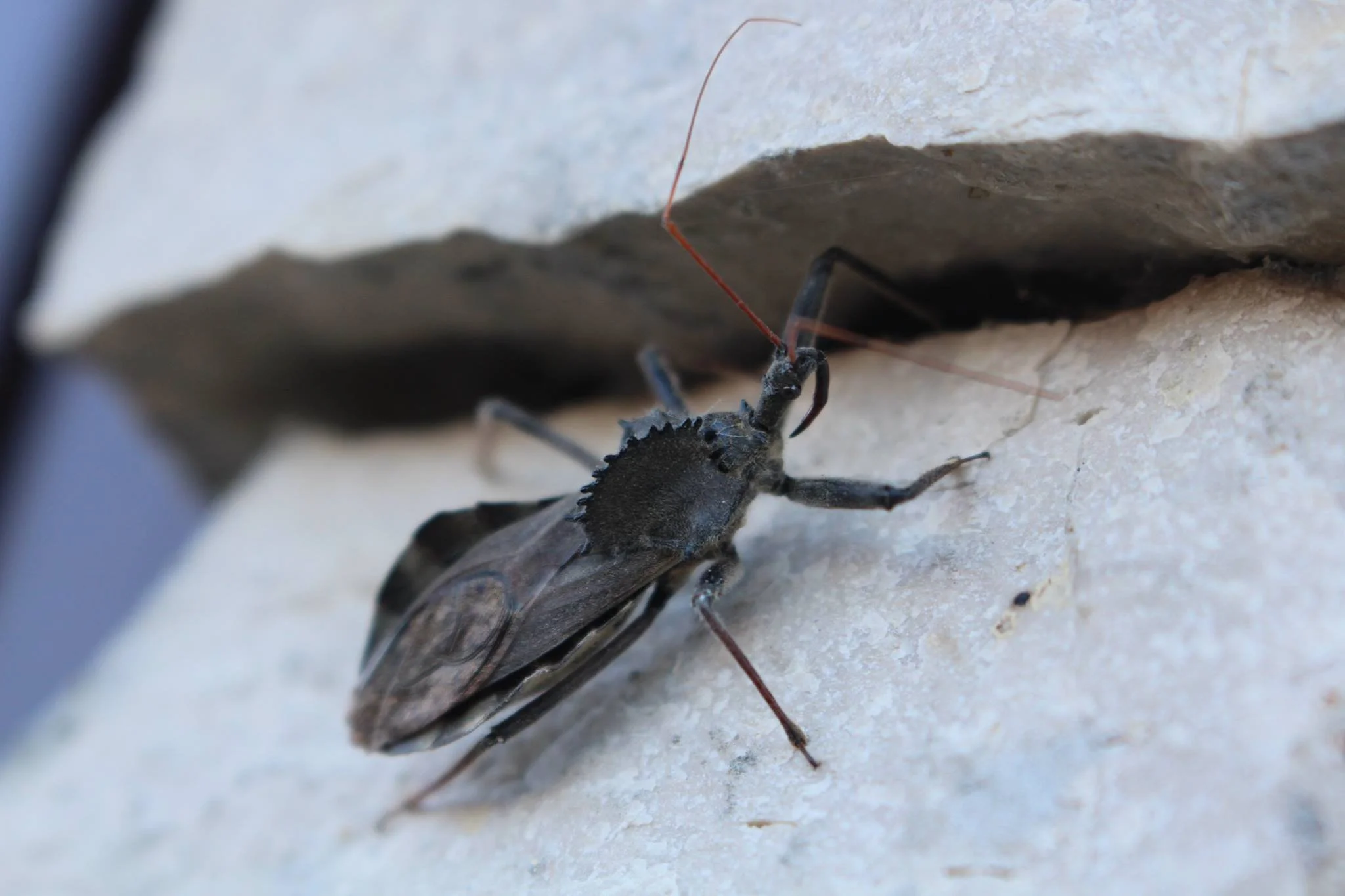
Wheel bug on a stone wall. (photo by Anna Weyers/USFWS)
PJ: Yeah. So I think this is a great question. And before I even get to the answer, I would say this is a really cool example of how, if you take the time and make observations, you can learn things and see things in the world around you. Could be at school, could be in your own yard. But if you do that enough and you make these observations, you can make little scientific discoveries all over the place. So I think that's really cool. Kind of the background for this question. So a couple of things come to mind. And I think a key thing that stands out to me is a term that we would refer to as microclimate. So we think of climate as a whole affecting larger areas and global processes. But on a very small scale you can talk about microclimate. And what that means is that for any given small scale spot, there can be differences in temperature and moisture and humidity and things like that. And that can affect insects and other wildlife and where they may show up or maybe where they're not. So just for example, if we had in, you know, in a sunny area, a rock, the top of the rock versus underneath the rock is going to be very different because the top of the rock is going to be baking in the sun, probably hot, very dry underneath the rock. It's probably going to be much cooler because it's in contact with the ground and more moisture down there. The same kind of thing can happen with buildings when you look at the geographic orientation of a building. We know the, for our latitude, the south side of the building is going to get sun, whereas the north side is not going to get sun. And so that's going to influence things like temperature, things like humidity to a certain extent. Also, if you were to look at the landscape around that, the plants and vegetation, that could influence things too. If one side of the building was much more open and got more breeze, probably going to be drier versus a side that maybe has a bunch of trees or woods close to it that could have higher humidity. Now, in a situation like this, I'd be really curious as an entomologist to know, like, which species of insects are present, because that's part of the story too. And if this were in the fall, for example, we know we have certain insects that love to hang out on buildings, and they'll actually sneak into buildings to things like box elder bugs, multicolored Asian lady beetles, Western conifer seed bugs. There's a whole bunch of insects that like to find sheltered spots where they're going to hunker down and spend the winter. And so in the fall especially, you'll just see them hanging out inside of buildings. But again, it tends to be like the southern side of the building, or maybe a western side that gets the afternoon sun. It's going to warm up those areas more than a shadier, like, north side, and also insects in a nutshell, because they're cold blooded. If they're in a spot, that's really cool, they may be kind of lethargic versus if they're in a sunny or warmer spot that keeps their body a little bit warmer and so they can move around more readily. So I think it probably has to do with that. Some of the the sun and microclimate factors probably influencing things. And then again, the exact species of insects, I'd be really curious to know what was there, because I probably have a few good guesses in terms of what might have been present.
Mickenzee: Nice. Yeah. So this just left us with more questions. We got to observe. Notice other things in the surroundings too.
PJ: Exactly. There's a lot of things you can learn. And sometimes you might say, like, gosh, it seems a little silly just to sit and stare at an insect or a couple of them for 20, 30 minutes. But you can sometimes learn a lot from doing that. And as you just said, Mickenzee, think of additional questions too.
Mickenzee: Yeah. So our next question is do insects migrate? And I can think of a major example, the monarch butterfly. But I guess I don't really know any other examples beyond that.
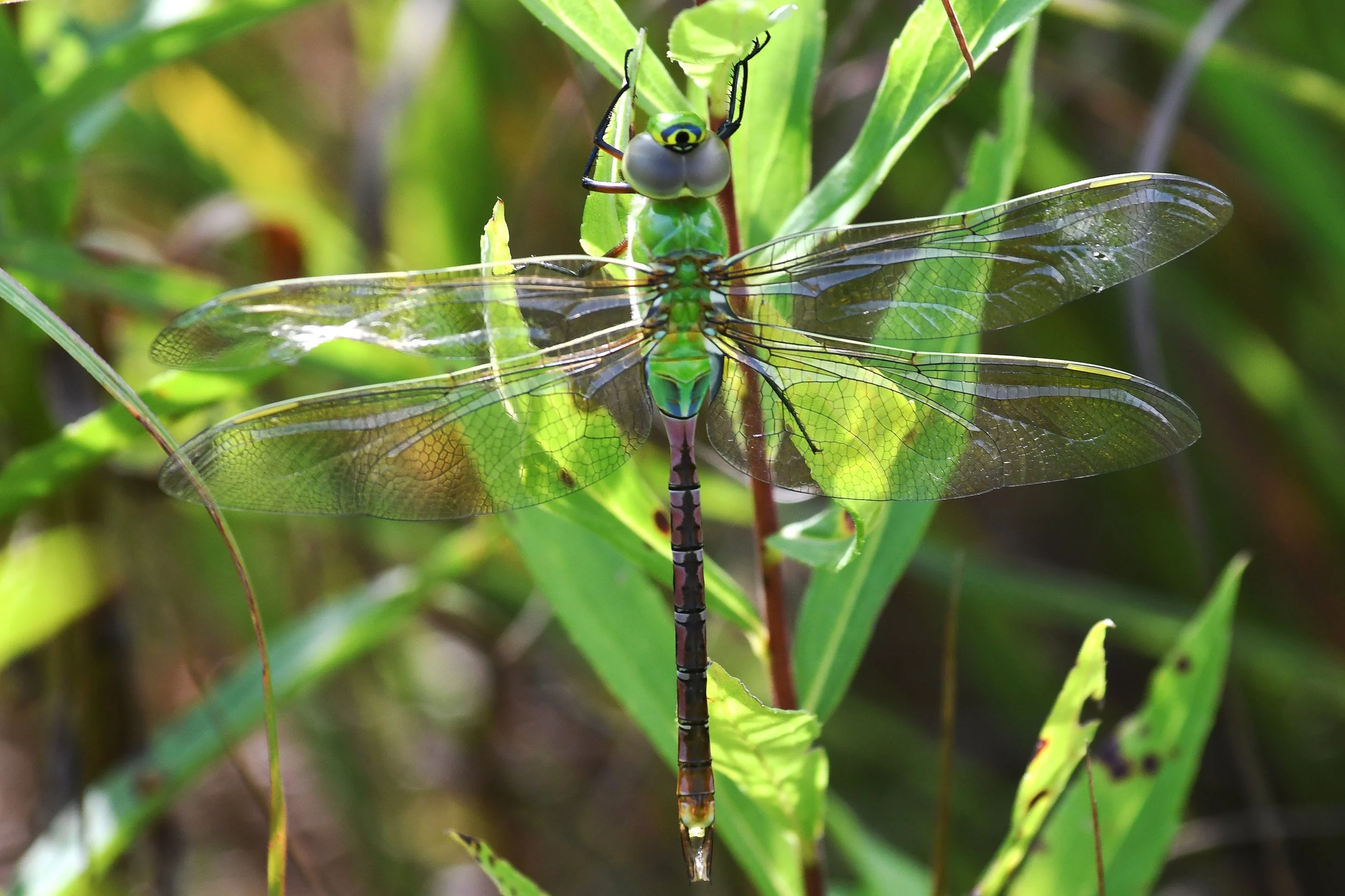
Green Darner Dragonfly (photo by Jim Hudgins/USFWS)
PJ: So it turns out there's actually lots of insects that migrate. And just as a whole, we have over a million described insects on the planet. And so for a lot of these, we just don't know exactly what they all do on a day to day basis. So we're still learning more all the time. But if you dig into the scientific literature, there's actually quite a few species that we know are migratory. Although depending on who you ask, there's a lot of different kinds of definitions or criteria for what it means for something to be migratory. So folks can kind of argue back and forth about some of those little details. But very briefly, there's quite a few insects that do migrate. As you just said, monarch butterflies are a classic example that pretty much everybody loves and is familiar with and there's other butterflies that migrate as well. Another really good example for us here in Wisconsin would be certain dragonflies like the Green Darner, which is one of our largest, commonest dragonflies, and they actually have a migratory pattern similar to the monarchs. They start down in the southern US in like the Gulf Coast regions, they have a generation that moves northwards, lays eggs from the eggs, we get our next generation that is growing and developing this time of the year, and eventually those new adults will migrate back south to the Gulf Coast states in about September or so. And so occasionally I will get very large reports of very large numbers of these in like Milwaukee area, because they don't want to venture out over the open water Lake Michigan. So the lake kind of like concentrates them as they head southward and so sometimes some parks in Milwaukee, folks will just see gazillions of these dragonflies and they're simply on their way south migrating.
Mickenzee: That would be so cool to see.
PJ: It would be. Sometimes we'll see big reports like that even here in Madison area. But Milwaukee seems to to really have some neat sightings so plenty of butterflies can migrate. We know there are lots of moths that can migrate. There are some dragonflies that can migrate. As I said, we're learning more and more all the time about this. There's some newer studies that have looked at flies, the order Diptera, hoverflies and things like that. And we're finding there's actually quite a few migratory species there, depending on where you're located on the globe as a whole, most insects probably don't migrate. It seems to be a relatively small percentage that do. But when you think of the fact that we have over a million described species of insects, that means there's lots of migrators too.
Mickenzee: Yeah, lots to discover, lots more to learn to than that question just makes me wonder what drives the migration of insects.
PJ:Yeah, and there can be a lot of different things going on. One thing could be basically environmental conditions. If you are an insect or really any animal and part of the year where you're living, maybe there's good conditions during that time of the year that season, but at another point in the year, maybe it's less than ideal, maybe it's too hot or too cold. And so that can be a reason for migration. More simply, if there are better resources, more abundant resources in another location, that can be another reason for migration as well. And then as I said, if you really dig into the nitty gritty of all these different definitions, there can be some other possible reasons for it too.
Mickenzee: Wow. Very cool. Okay, so our last question begins with another great observation. This student saw moths flying up at a light and going around in circles around the light at nighttime. And why do moths do that?
PJ: Yeah. So this is a question that humans have been asking for years, decades, centuries, essentially, why do insects go to lights? And they seem to just fly around in circles and almost like they're confused. And for a long time there were a bunch of different hypotheses in terms of what might be going on. Did they like the temperature or are they getting confused and things like that? And there was just a paper published about a year or so ago that finally kind of figured this out.
Mickenzee: Wow.
PJ: And basically what we had to do is wait for scientists and for some of the technology to get good enough to figure this out, like specialized cameras that can use photography to look at insects flying around lights. And then you can slow that down in like, super slow motion and then use a computer to analyze what's going on. So we had to wait for the computers and cameras to get good enough to do this. But in the paper they used a bunch of different insects, different scenarios with lights from above, diffuse lights, spotlight and things like that. And what they essentially found is that insects get a little bit confused and navigation kind of comes into this and flight orientation. So if you're an insect flying at night, you know, we have one main celestial body, the moon, that you can use as a clue or information to help you navigate the world as a moth or a fly or something else flying at night. In a nutshell, if you're flying horizontally and your eyes that are able to kind of see on the top of your head, if you can see the moon above you and keep your back turned to it, that lets you know that we know the moon is up and so the ground is going to be below you. But what they found is if you get confused and there's a light source that as an insect, you might be confusing that for the moon. And so you try to keep your back to it. You end up turning, keeping your back to it so you keep spiraling around. Or if you actually go over the top, you're going to loop down and dive down to the ground. And so they were finally able to figure this out with these specialized cameras that they're getting confused in a nutshell, trying to keep their back to the light because they think that is up to them. And if you're flying along, you know the moon moves so slowly, it doesn't really seem to move. But if you're an insect and on a small scale, you move past a light bulb, you're going to turn to change your course of flight. So you end up spiraling around it.
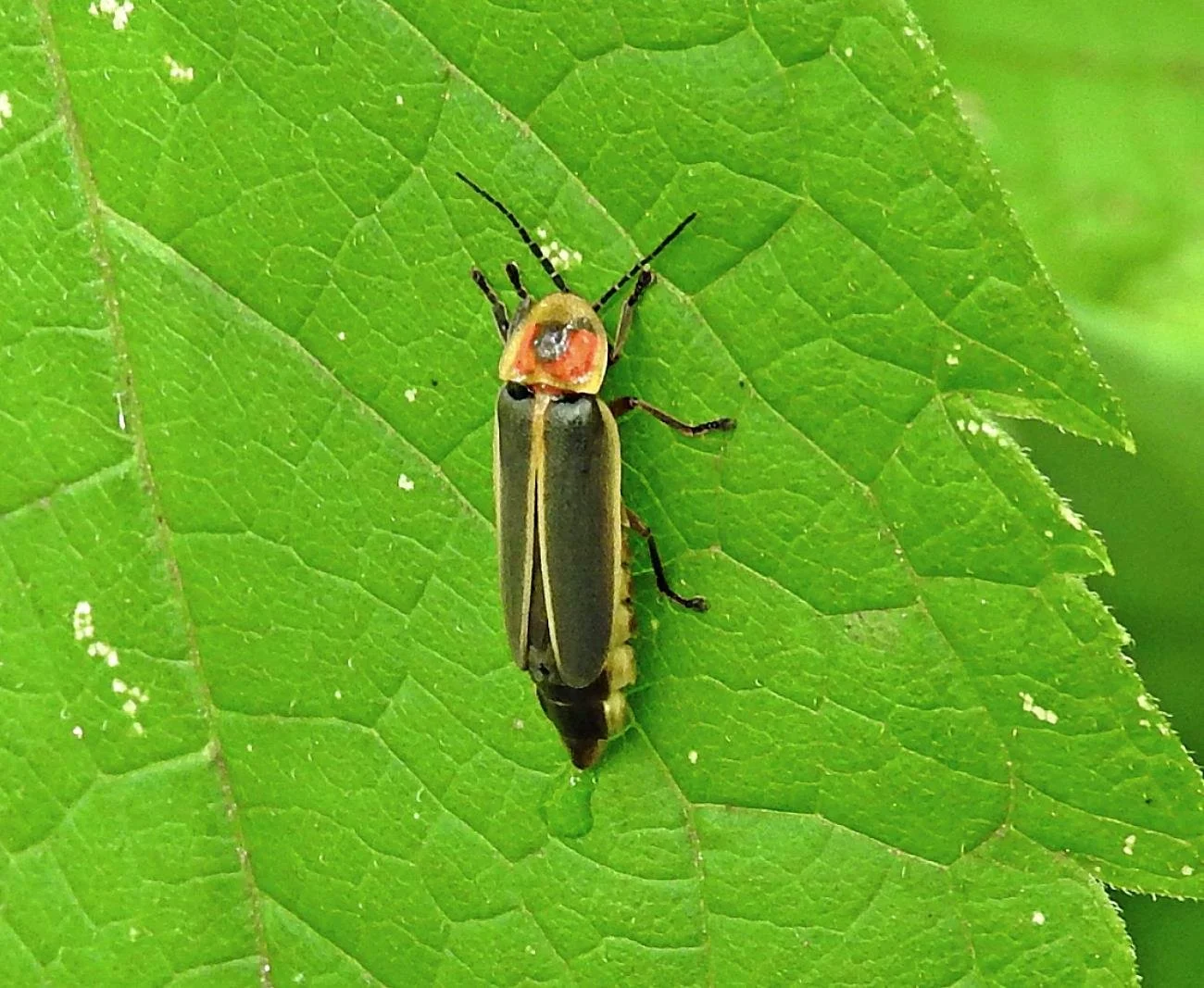
Fireflies depend on darkness to attract mates (photo by Bruce Hallman/USFWS)
Mickenzee: Oh, wow. Is there anything that people should be doing to help out these bugs?
PJ: Yeah, that's a really good question. And there's actually a lot of literature popping up on the topic of insect declines as a whole. So we know globally, there seems to be this building body of scientific evidence that insects are declining for a lot of different reasons. But there's been some more recent literature that looked at what we call ALAN. ALAN: Artificial Lighting At Night, that this may be something playing a role with some insects. And there's been some studies that have looked at like in Europe, in the UK, areas where you have more lights along roads, you end up getting fewer insects near there because the lights at night are interfering with the natural behavior of insects. If instead of flying along using the moon for navigation and orientation and going about your business of finding a mate laying eggs instead, you're spending time flying around light bulbs, that is going to throw off your behavior and biology. And there can be a lot of reasons for insect declines, but lighting may be part of it. And so with that said, you would ask, what can we do to help insects and my general answer is try to reduce and minimize or even eliminate the amount of lights you have on your house or garage or something like that at night, you know, if you need to go outside or you have a porch light on so folks can see your front door, that's one thing. But if your yard is just filled with lights and you don't need those lights on, could we turn those off? Because that can help out insects. I mean, another classic example would be fireflies, which are flashing to find mates. And so if they're trying to flash to attract other fireflies, but there's lights all around it, it's going to make it much harder for them. So trying turn the lights off, turn them down. You know, maybe he could pull shades down or close the curtains inside. So not as much light as making it out. And that will at least help them out to a small extent.
Mickenzee: Definitely. And I know that that helps out other critters at nighttime, too, to keep our lights off.
PJ: Definitely.
Mickenzee: Okay, that's all of our questions for this episode. Just like last time, I learned a ton. Thank you to the students at Lincoln who submitted their questions. And thanks, PJ, for coming on once again to teach us.
PJ: Yeah, thanks very much for having me. This was fun.
Mickenzee: Yay!
-----
If you're interested in learning more about all things nature related, please head to our website and click on over to the education tab. There you're going to find our free games, lessons and activities. There's also plenty of free downloadable resources for educators. If you're looking to get outdoors with us, click on over to the engage tab and check out our event calendar.
If you have big nature questions that you would like to have answered, please have your grown up or a teacher submit your question to info@swibirds.org with the title questions for QuACK. Make sure to include your grade in the school you attend so I can give you a shout out. Thanks for tuning in and I hope you join us next time on QuACK!
Check out SoWBA’s free lessons, games, and activities!
Get out and explore nature with us!
Make a donation to Southern Wisconsin Bird Alliance
Audio Editing and Transcription by Mickenzee Okon
Logo design by Carolyn Byers and Kaitlin Svabek
Music: “The Forest and the Trees” by Kevin MacLeod
