
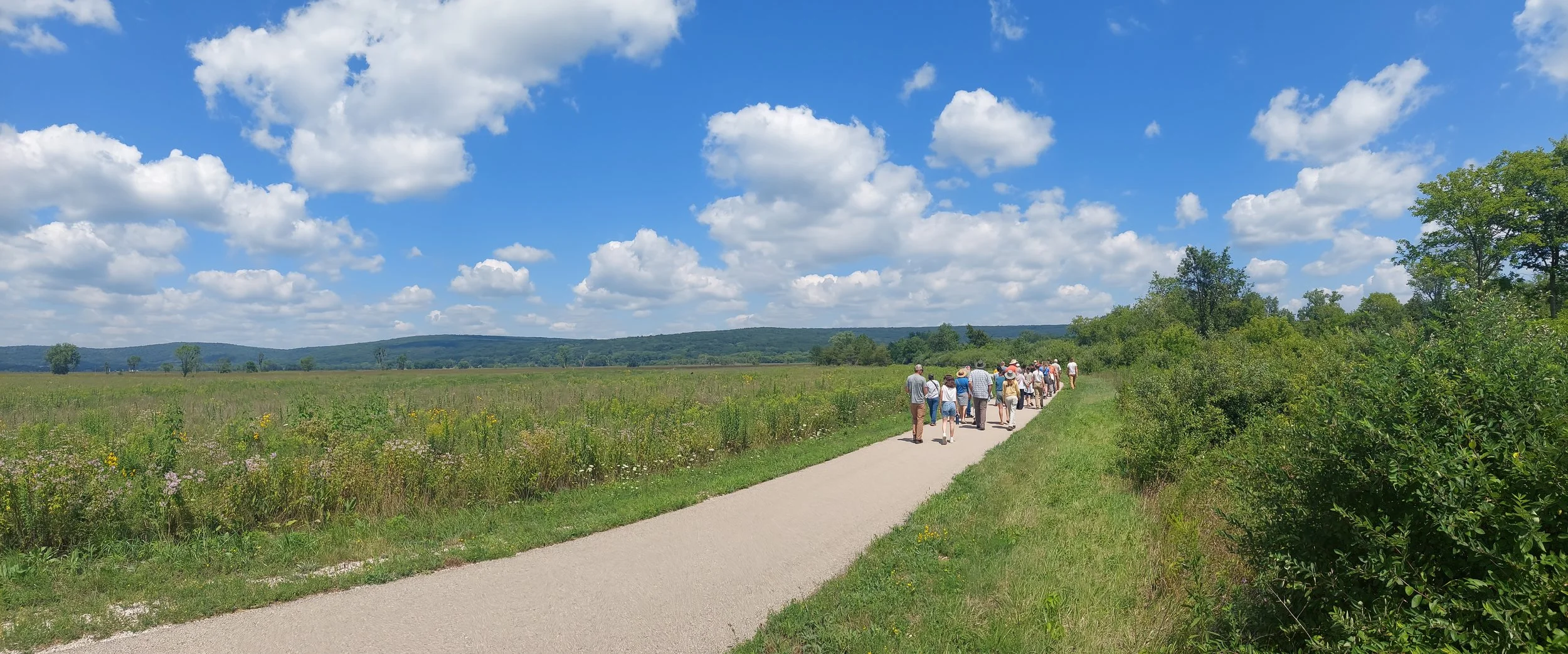
Great Sauk State Trail. On the left is open grassland of Maa Wákącąk, and on the right are invasive shrubs of the Historical Grassland project area within the Sauk Prairie State Recreation Area (photo provided by the Badger History Group).
Article by the Badger History Group in Columbia County, March 27, 2026
Hikers and bicyclers on the popular Great Sauk Trail north of Prairie du Sac will see some big changes this spring and summer, as a coalition of conservation organizations clears invasive shrubs and trees on the former Badger Army Ammunition Plant—now often referred to as “Badger Lands”. Located on the Sauk Prairie State Recreation Area (SPSRA) along the east side of the trail, the Historical Grassland project will use mechanized forestry mowing, hand cutting and treating to remove the thick growth of autumn olive, honeysuckle, multiflora rose, buckthorn and Siberian elm that have invaded since the ammunition plant closed and deconstruction ensued some 20 years ago. As explained by DNR wildlife biologist Nancy Frost, “We want to restore the grassland and scattered trees that long characterized this landscape. The declining grassland wildlife, like meadowlarks and bobolinks, depend upon this habitat”.
Once described as the largest in the world, the 7300-acre ammunition plant produced propellant for 3 wars beginning in 1942, before closing in 1997. After a community-driven effort established goals for its reuse, the plant was deconstructed, soil contamination was cleaned up, and the plant was divided among 4 landowners. The Wisconsin Department of Natural Resources established the 3,800-acre Sauk Prairie State Recreation Area, the Dairy Forage Research Center maintained its previously operations as a 2,100-acre research facility, and the Bluffview Sanitary District continued operating its small sewage treatment facility and associated tract of land. Some 1550 acres were returned to the Ho-Chunk Nation that refer to this area as Maa Wákącąk, meaning Sacred Earth. The Great Sauk State Trail was created in 2017 along a former railroad line, running northward from Sauk City through the center of the former plant and passing through or along all 4 properties.
Badger Lands provides critical habitat for grassland birds, which 2 centuries ago adapted fairly well to the conversion of their native prairies and savannas to the early agricultural landscape which maintained much grass and scattered trees among hayfields, small grains and pastures. But their populations were decimated after the mid 1900s by changes in agricultural practices and land use, and the succession to shrubs and woods that resulted from the introduction of nonnative invasive species and the loss of grazing and fire on the rural landscape. Fortunately, the extensive grazing and hay mowing that was used to reduce fire danger at the ammunition plant maintained this ecosystem, even among the 1500 buildings. The site was eventually recognized as one of Wisconsin’s Important Bird Areas, which led to the formation of a partnership among the new owners, non-profit groups and volunteer scientists and land managers, to collaborate for the benefit of these birds and other grassland wildlife, while still meeting owners’ specific land management needs.
Among the partners is the Badger History Group, whose representative Mike Mossman noted, “The grassland-savanna ecosystem is an important part of our natural and cultural heritage in southern Wisconsin—in both its native and early agricultural forms. The Badger Lands, situated on the ancient Sauk Prairie, provides a rare opportunity to preserve and manage this system at the large scale needed to sustain its wildlife populations. Wise management is needed to reverse its biggest threat -- invasive woody growth. This is clearly shown by longterm monitoring data of birds, mammals and habitat cover at the Badger Lands”.
Using monitoring and research data collected at Badger, the partnership identifies sites and management actions that allow their efforts to have positive effect that is “greater than the sum of its parts”.
According to Frost, “We selected this area along the bike trail because it will expand the open grassland that the Ho-Chunk Nation has maintained to the west, guaranteeing that open grassland species will recolonize it. It will also connect with other grasslands in the interior of the SPSRA. Trail users will soon be biking THROUGH the grassland rather than beside it. We’re very grateful to all the collaborators for their input and work, and to the Natural Resources Foundation of Wisconsin, Badger History Group, Sauk Prairie Conservation Alliance and private donors for funding. This wouldn’t be happening otherwise.”
An important collaborator is the Ho-Chunk Nation, which is helping with management on the adjacent DNR tract. As HCN steward Randy Poelma puts it, “These now rare and declining populations of grassland birds need large expanses of uninterrupted grassland, regardless of property boundaries. The habitat on one property affects the birdlife on adjacent tracts. The same goes for invasive plants, which readily spread across property lines. This is good for grassland wildlife on Maa Wákącąk, and will expand the grassland habitat while reducing the threat of shrubby invasion at our perimeter. More importantly, it is good for the whole ecosystem that we belong to.”
For more information, contact: Mike Mossman, bhg.president1@gmail.com,m 608-370-1208
