An Education Update

Winter sometimes seems like the calm between two storms in the MAS education world…

Fall migration and the start of the school year are behind us, and we’re beginning to gear up for spring migration and end-of-school-year field trips.

Last fall Madison Audubon provided after school programming at four different community centers: Kennedy Heights, Lussier, Vera Court, and Salvation Army. Through these programs we helped underserved city kids learn about themselves through nature exploration. We watched them build their self-confidence with each lesson; a trait that carries over into every aspect of their lives. Our after school kids made frog slime, explored prairies and examined grasshoppers, and used dip nets to get a closer look at water critters.

Our Education Intern, Mary Schneider, did an excellent job leading programs at both Vera Court Neighborhood Center and Lussier Community Education Center. She grew as an educator, mastering techniques needed to reach reluctant kids, and gaining experience with planning lessons.

This winter we have been visiting several schools in the city of Madison, and have strengthened our partnership with Lincoln Elementary. More than half of the kids at Lincoln Elementary come from low-income families, and the free programming you help us to provide really goes a long way! Some of our favorite lessons involve identifying animal tracks and scat- poop! Animal signs are a great way to learn about the wildlife around us, and the kids love learning about them.

Students from Wingra School explore the world of animal signs with fake scat from our free lending kits

Students from Wingra School explore the world of animal signs with fake scat from our free lending kits

This spring we are looking forward to taking several different school groups out on field trips to local natural areas. Transportation costs are one of the biggest hurdles for teachers taking kids on field trips. Because of you, we are able to provide free bussing to kids who really deserve it.

Our new education intern, Lauren Sinclair (left, in green, surrounded by adoring students), will be working with Vera Court and Goodman Community Centers to provide more afterschool programming for kids. They will focus on exploring different types of natural habitats and the animals that call those places home.

This work was made possible by you! Thank you for helping Madison Audubon Society connect kids with nature! 
-- Carolyn Byers, Education Director

Birders SHARE BIG for 2016 Giving Day

On March 1, Madison Audubon participated in the 2nd Annual BIG SHARE, an online giving day for non-profits working to build a more just, sustainable Wisconsin.

The Big Share was hosted by Community Shares of Wisconsin (CSW), which also organizes workplace giving campaigns and facilitates the popular CHIP giving program at the Willy Street Co-op. Madison Audubon Society is a member group of CSW and benefits from its services.

Our staff and board would like to thank all 109 individuals who donated during the 2016 Big Share. Bird and education enthusiasts showed their support for MAS all day, but really came through during the lunchtime "Power Hour" as the organization vied for a $500 prize for the most unique donations during the hour. 

Donor's answer to our call for donations for birds, nature-based education, and habitat protection really were remarkable. MAS was able to raise over $5,500, including our $500 "power hour" prize and our match from the MAS board of directors during the one-day event.

Overall, The Big Share raised over a quarter-million dollars for non-profits in Wisconsin. If you'd like to find out more about the annual giving event, check out this article in the Capitol Times.

It is incredibly energizing and empowering to see so many people give on one day to Wisconsin's birds. We appreciate your continuing support and look forward to staying in touch with you about all of the great work we'll be able to do for our birds thanks to your generosity!

Prairie Restoration at Dunn Heritage Park

Almost two dozen volunteers enjoyed hand planting 17.9 acres to prairie Heritage Park near Lake Waubesa on January 30, 2016. 

Photo by Ben Kollenbroich

Photo by Ben Kollenbroich

Some of the volunteers live nearby and will be able to see the results of their work on a frequent basis.  It was a beautiful and mild day. The seeds “melted” into the snow in mid-afternoon.

Forty-nine species of grasses and forbs were planted including nine species that were purchased.  The rest of the seed was collected at Goose Pond Sanctuary or by a scout troop at Don Schmidt and Carole Becker’s prairie restoration in the Town of Dunn. The prairie restoration includes wet-mesic and mesic prairie habitat. Monarchs will find an abundance of milkweeds and nectar plants.

Photo by Ben Kollenbroich

Photo by Ben Kollenbroich

The Town of Dunn is also restoring wetland and savanna habitat at Dunn Heritage Park, including land along 300 feet of shoreline on Lake Waubesa. Twelve acres were previously cropped and the prairie restoration will help improve the water quality of the lake. A few years ago the Dunn Park Commission planted oaks, and some of those are now eight feet high!  There is also a kestrel box on the site, thanks to Schmidt.

Schmidt, Town of Dunn resident and Goose Pond Sanctuary volunteer, is helping the Town coordinate the restoration project. Mark Martin, co-manager at Goose Pond Sanctuary, helped secure seed and coordinate the planting. Ben Kollenbroich with the Town of Dunn recently sent MAS a note, stating: “Thanks again for your help with everything, Madison Audubon Society and Goose Pond Sanctuary has been a great asset to the Town and to this project.”

Freeing the General: The Story of an Oak

Within the bounds of Faville Grove's recent land acquisition grows a stately bur oak. MAS staff and volunteers have been working through cold, snow, and harsh weather to free the General from the grips of spindly boxelder, elms and cedarto return it to savanna. Land steward Drew Harry reflects on the rescue mission, below.

On the shores of the past sits a tree, Chaus-cha-goo-dah, oak tree, Quercus macrocarpa, bur oak tree, the General.

"Sits" is an improper word. The branches of this single tree have moved many times around the earth, traveled farther than some spacecraft have traveled deep into space, moved more than any car, person, or animal; moved more than most everything, save light and water, molecules and atoms.

The General can be seen, looking out once again on a familiar vista of prairie, savanna, open water, and sphagnum bog.

The General can be seen, looking out once again on a familiar vista of prairie, savanna, open water, and sphagnum bog.

A big tree reaches down with its branches, dips them into the past, and brushes a story of time, place and space. The bur oak's portrait scribbles images as much about itself as about us, the people. The people fueled by oak, the people who left the trees in the middle of fields, along roads, in yards and subdivisions—because they liked those sprawling, scribbling branches. The big tree provided form to the land, Nah-hahde-key-cha-chah, the oak opening or savanna.

The General—north of Highway 89, west of a watershed divide, and just east of a kettle pond, where glacial ice once swallowed the state and froze it in glacial time—lives where it grew up hundreds of years ago in the sunlit savannas. The sun, some 93 million miles away, sketched a path for the General's branches. The fire and the poor soils erased competitors, lines out of place. Eventually the lines of European settlers and the oak diverged, the trajectory of people moving further from the roots of the big tree. Fire suppression lent space to skinny, spindly boxelders, elms, and cedars. The lower branches of the General faded and died as the skinny trees grew upward.

The General still obscured behind the limbs of more invasive woodland trees; yet in the foreground: hope. This woodland restoration will bring savanna back to the General.

The General still obscured behind the limbs of more invasive woodland trees; yet in the foreground: hope. This woodland restoration will bring savanna back to the General.

Now, we are back at the roots, on the base of the tree, feeling small, looking out on the shores of the past. The General, sunlit once again, is a promontory over the pond. Its limbs freed, its future bright. 

A reflection on restoration by Drew Harry, Faville Grove Land Steward

Friday Feeder Feature: The Great Backyard Bird Count 2016

At Goose Pond, we've been practicing for the for the 2016 Great Backyard Count that begins TODAY and goes through Monday February 15! We enjoy feeding our feathered friends and look forward to the annual Count! 

Goldfinches feeding at Goose Pond Sanctuary feeders

Goldfinches feeding at Goose Pond Sanctuary feeders

Want to give the Great Backyard Bird Count a try? It only requires 15 minutes (or longer, if you wish) and it helps scientists better understand our local bird populations. Click here to find out how you can participate!

Looking back at past data shows how bird numbers change. In 2015, bird watchers from over 100 countries submitted 147,265 checklists and observed 5,090 species for the count.

We will be counting at both Kampen Road residence and at our Wildland cabin near Wyocena. Black oil sunflowers, sunflower fines, white millet, suet, and cracked corn are found at both count sites. At Wildland we are also feeding shelled corn that attracts wild turkeys, fox squirrels, and cottontail rabbits. We want to thank the customers at Mounds Pet Food Warehouse that purchase bags of bird seed exclusively for our Goose Pond feeders. The birds go through a lot of "Madison mix" in one season!

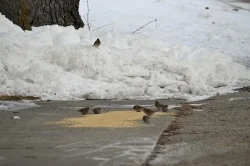
Tree sparrows near millet piles. Mark and Sue suggest moving your millet pile locations frequently to avoid pest and disease problems.

Tree sparrows near millet piles. Mark and Sue suggest moving your millet pile locations frequently to avoid pest and disease problems.

Our Goose Pond Sanctuary habitat includes restored prairie, spruce and cedar shelter belt/cover unit, two corn food plots and shrub plantings. The Wildland habitat in Wyocena includes restored prairie, oak savanna with brush piles, and a large red pine plantation on our neighbor’s land.

We have observed the following species in the past two weeks at the two sites: ring-necked pheasant, Cooper’s hawk, red-tailed hawk, rock pigeons, mourning doves, red-bellied woodpeckers, downy woodpeckers, hairy woodpeckers, blue jays, American crows, black-capped chickadees, white-breasted nuthatches, American tree sparrows, dark-eyed junco, northern cardinals, house finches, common redpolls, pine siskins, American goldfinches, and house sparrows. It is interesting to note the different feeding times of species. At Wildland, turkeys arrive around 8:00 a.m. and have fed and moved on in 30 minutes while cardinals feed heavily just before dark.  Some people ask how we count large numbers of doves.  At Goose Pond, the doves line up on the power line making for easy counting.

In the local area there are hundreds of horned larks and Lapland longspurs along roadsides that are easy to count. We will also try and find Eurasian collared doves west of Arlington.

If you want to get involved, know that bird counts for the GBBC can be conducted anywhere, and are not restricted to back yards like the name might suggest. 

Click here to see how you can help on this citizen science project!

The data for the GBBC is available for review as quickly as it is entered.  Stay tuned for our results, which we will post on the MAS website soon!

By Mark and Sue Foote-Martin, Resident Managers, Goose Pond Sanctuary.