

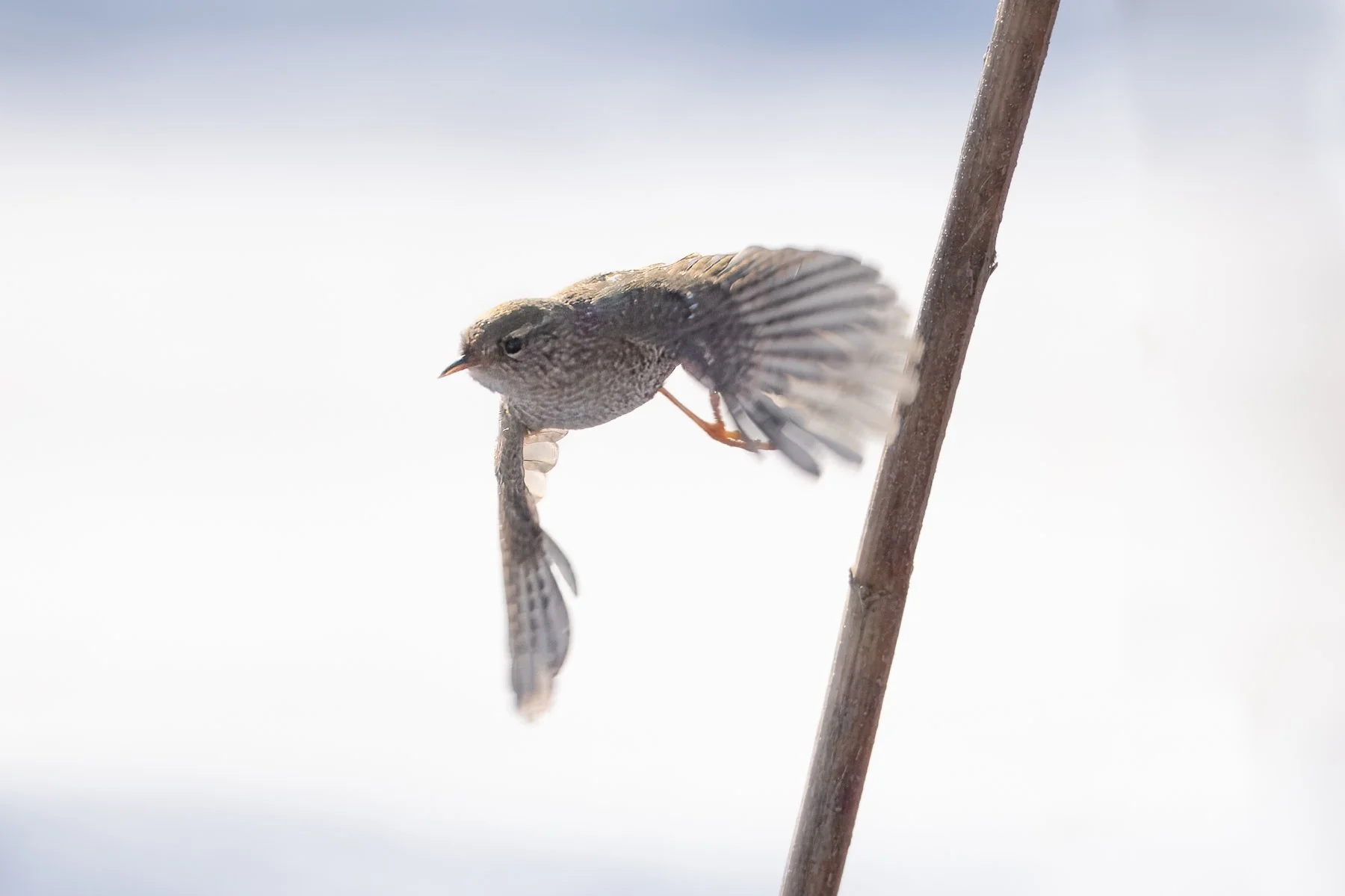
A Winter Wren takes flight at Fair Meadows Sanctuary in December 2025 (photo by Gary Shackelford).
Every four or five years, a tiny, plump bird stops at Fair Meadows to seek food and shelter during migration—a Winter Wren! In both spring and fall, we have seen Winter Wrens around the edges of pothole ponds in the woods. Last year, one late individual was spotted on December 16 near the entrance drive, where open water persists in a wetland spring complex with brisk flow from underground. The tiny brown bird was moving along the ground, holding its short tail straight up while poking in the vegetation in search of food.
Looking closely, the bird is not plain brown. There is dark brown barring on the wings, tail, and belly, and the neck and belly are paler than the back. It has a pale, tan, eyebrow stripe above the eye, and a small bill. It moves in short hops with frequent bobbing movements. As it darts along the ground, picking and probing for insects, its movements could be described as mouselike. Arthur Cleveland Bent describes this bird as a “furtive little mite.”
Unfortunately, since Winter Wrens do not breed at Fair Meadows, we don’t get to hear the male’s loud, bubbling song, which he sings repeatedly. Bent notes that Miss Cordelia J. Stanwood of Maine wrote that “a tinkling trill” announces that the Winter Wren, “the Spirit of the Brooks is abroad.”
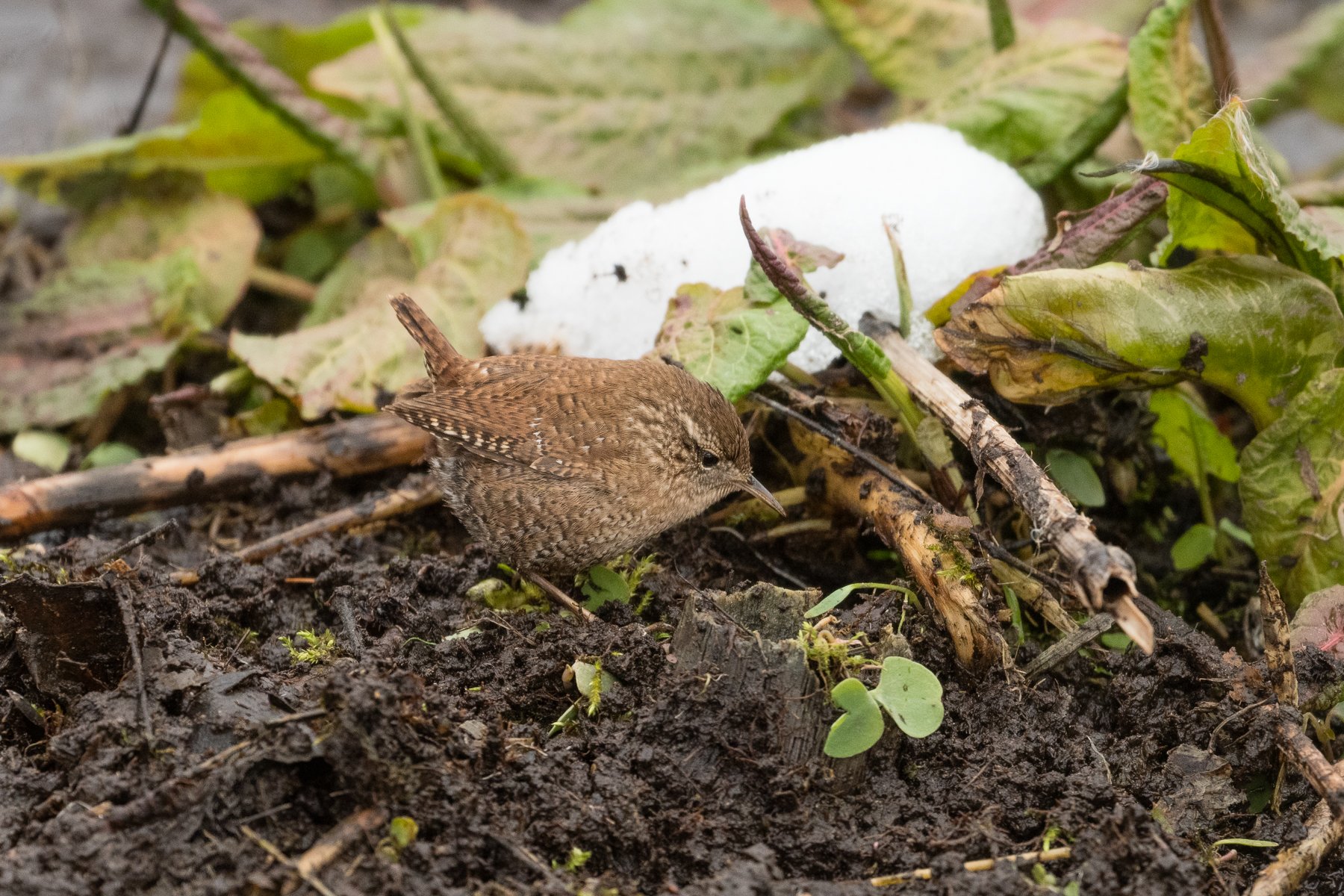
Winter Wren in typical moist habitat in a spring-fed wetland pond in April 2018 (photo by Gary Shackelford).
Winter Wrens breed in the northeastern United States and southern Canada. In Wisconsin, they breed frequently in the northern third of the state. They overwinter in the southeastern United States and return to Wisconsin in early April. They build well-concealed nests in deciduous or evergreen forests with large trees. They nest near water, especially along streams, and prefer habitats with standing dead trees, downed logs, and plenty of understory debris and vegetation. The Wisconsin Breeding Bird Atlas (WBBA) notes that Winter Wrens like to use “tip-ups,” i.e., the roots of trees that have fallen over. The male builds several nests in his territory, and the female chooses which one to use and lines it with fur and feathers. The nest is globular, with a dome, but if built under a root tip-up or in a cavity, it may lack sides or top. The nest is well camouflaged by the building material collected nearby, including moss, bark, twigs, rootlets, grass, and other vegetation.
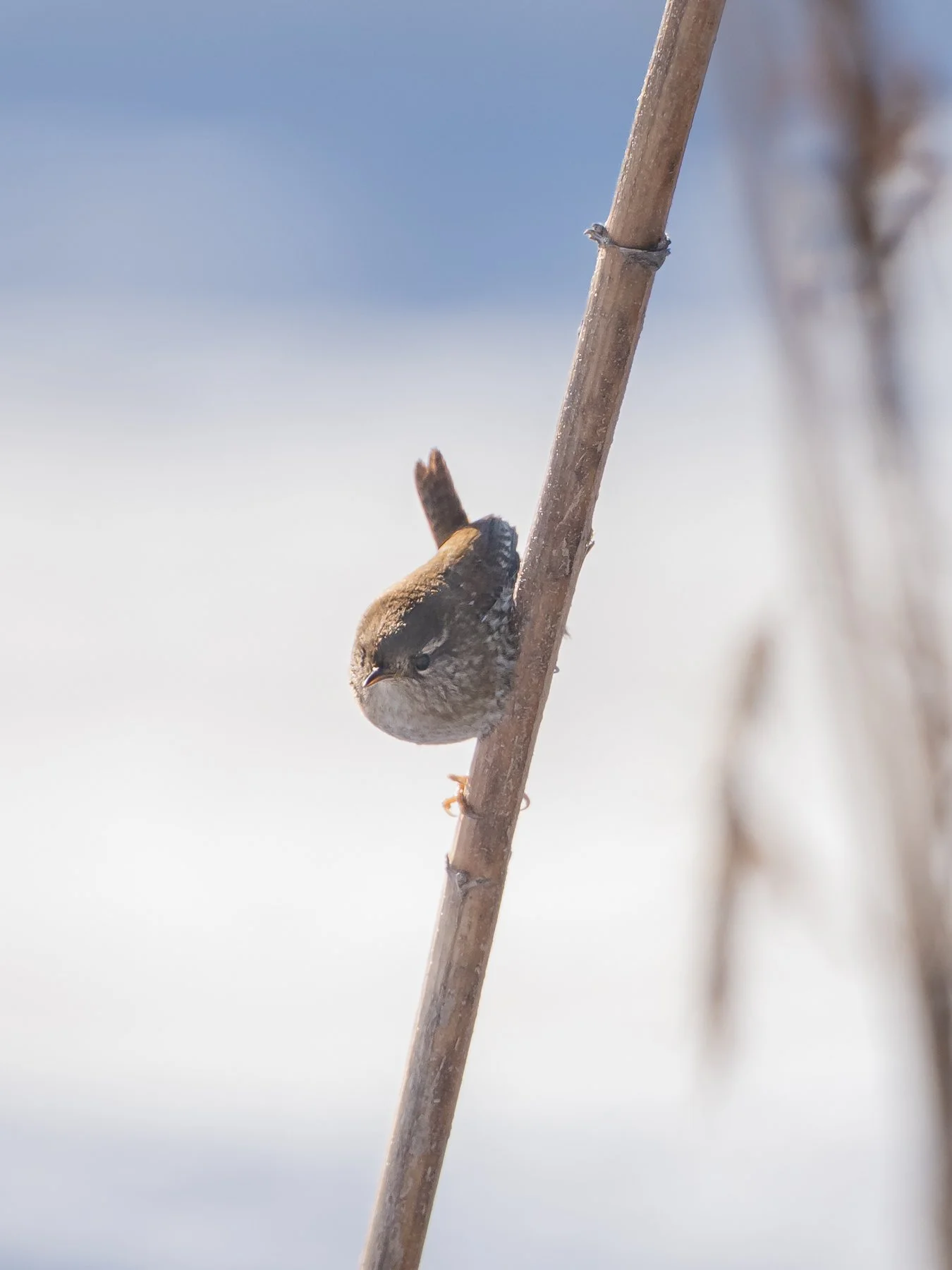
Winter Wren in spring-fed wetland at Fair Meadows in December 2025 (photo by Gary Shackelford).
The clutch size is five to six eggs, and WBBA observers reported seeing groups of five or six fledglings being fed by adults. The incubation period is about 14 days, with the young remaining in the nest for about 19 days after hatching.
The population trend for Winter Wrens appears to be stable. However, the future of these little birds will depend on conserving their preferred habitat of woodlands with large trees, tip-ups, and woody debris.
It is possible that the Winter Wren gets its name from the fact that during mild winters, a few individuals remain in the northern states throughout the season. Perhaps this was the case for the bird we spotted in December. One can only hope that the bird headed farther south when the next blast of Arctic air arrived. At least we know that the water around the springs will remain open and serve as a source of invertebrates, no matter how severe and prolonged the cold spell may be.
Written by Penny Shackelford, Fair Meadows Sanctuary manager
