
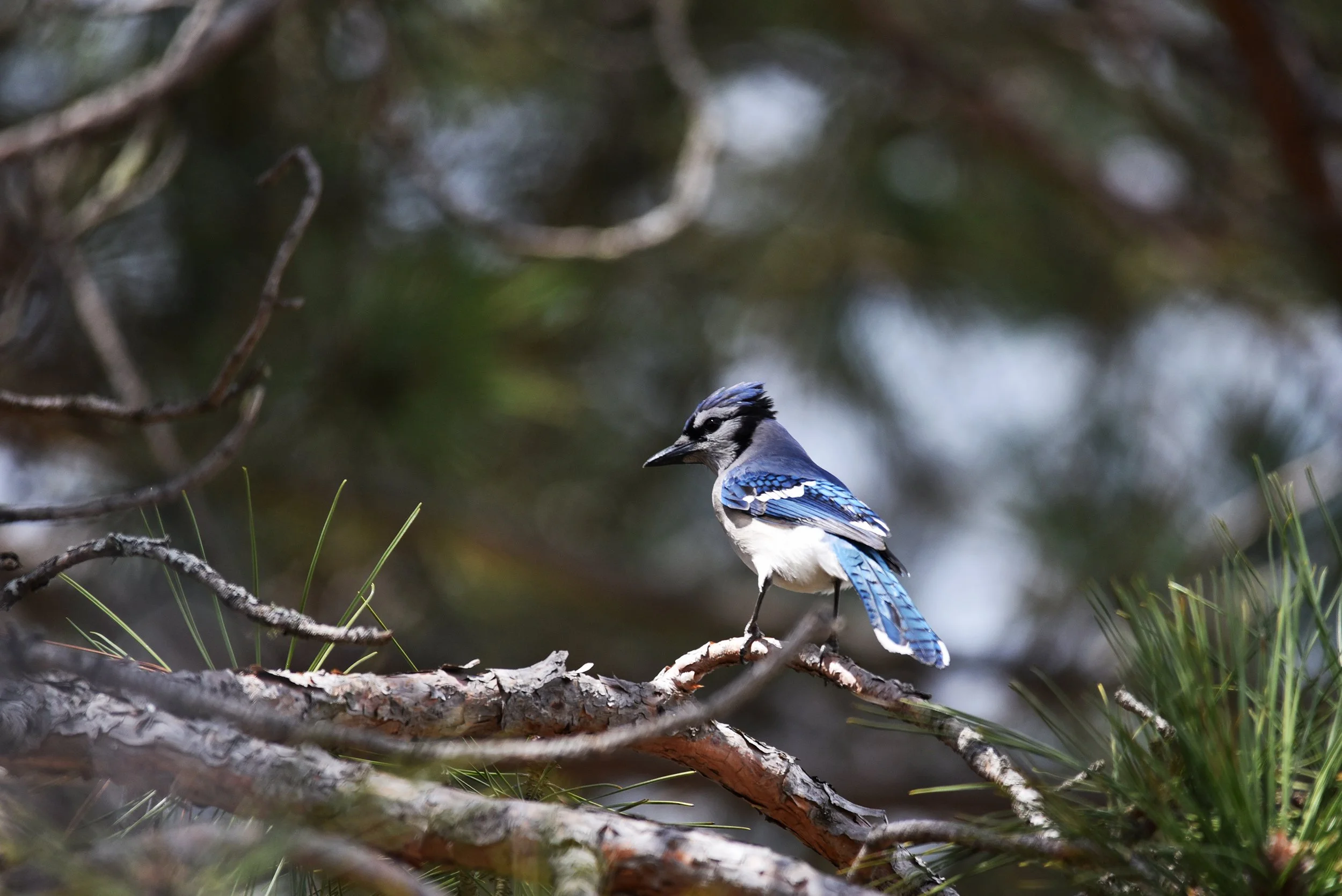

Out on a birding trip in Faville Grove Sanctuary, the stillness is pierced by a loud Kee-ahh! Being an experienced birder, you recognize this as the call of a Red-shouldered Hawk. You scan the sky and trees, but the only bird you can see is a Blue Jay. You realize you have been tricked by the blue-colored corvid, which often mimics the Red-shouldered Hawk. This behavior can warn other Blue Jays of the presence of a hawk, or to scare away other birds. Blue Jays, with their quirky attributes, are quite a fun bird to observe and get to know.
Blue Jays are, as the name would suggest, primarily blue, with white undersides, black stripes along the wings and tail feathers, and black collars that may be used by individuals to tell each other apart. Male and female jays are identical, although the males are slightly larger. The crest on the top of a jay’s head can help you determine its mood. When agitated, the Blue Jay will fully raise its crest, but when it is communally eating with other Blue Jays, the crest is fully lowered. The blue color is another trick the jay has under its feathers. There are actually no birds that produce blue pigments. Instead, the blue color comes from structural coloration. This is when tiny structures on the surface of the feathers reflect light in such a way that the feathers appear a certain color—blue, in this case. The pigment in Blue Jay feathers is melanin, meaning they would appear brown if it wasn’t for these microstructures.
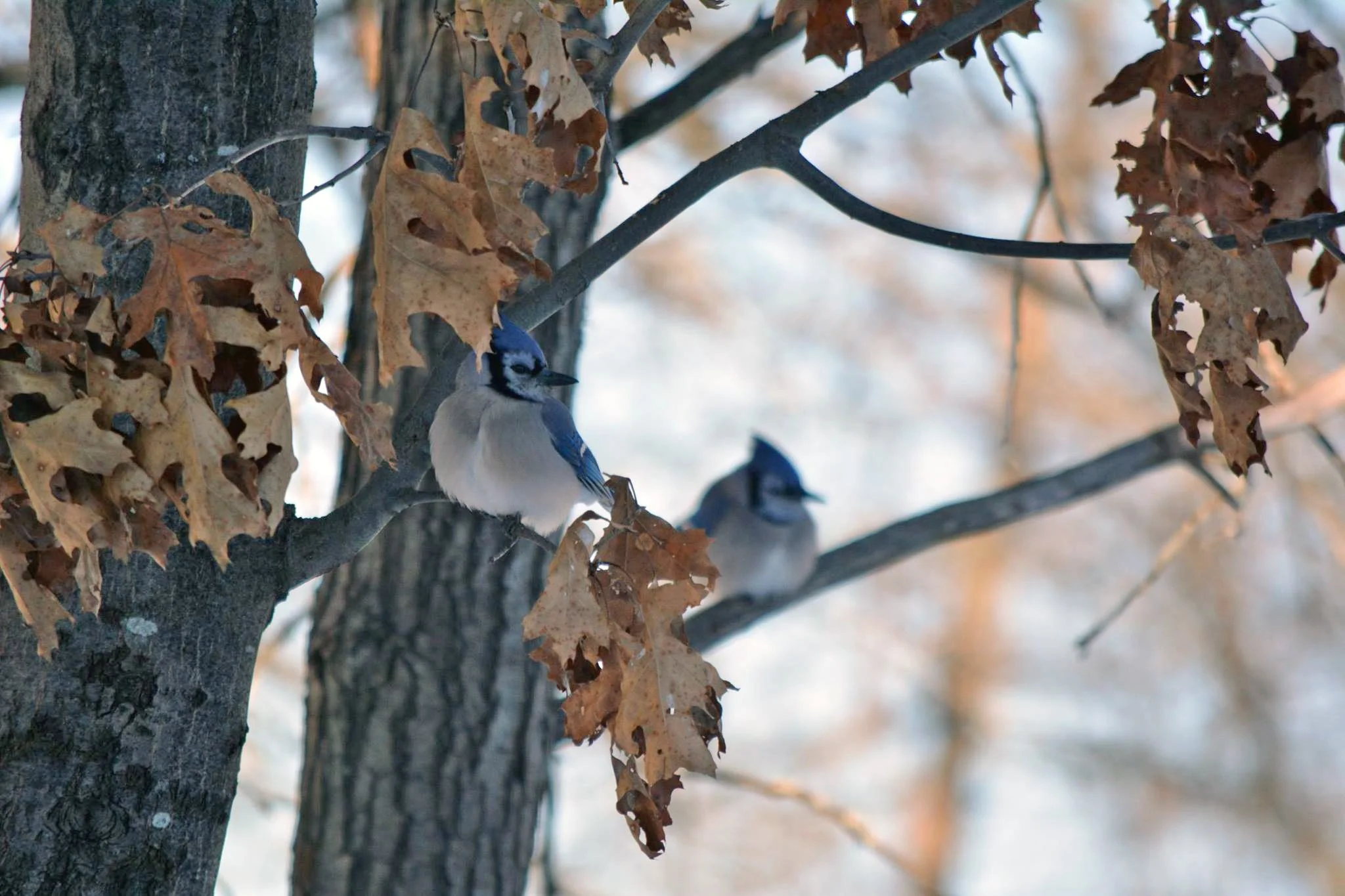
A pair of Blue Jays perched in an oak tree (photo by Katie Goodwin/USFWS).
Blue Jays can be found year round at Faville Grove, often seen in oak woodlands or savannas like the Lake Mills Ledge. Although some Blue Jays migrate (the reasons why are not fully understood), the majority of individuals stay put. They are omnivorous, but particularly enjoy acorns. In fact, perhaps due to their corvid intelligence, Blue Jays are able to select viable oak acorns 90% of the time, even though only about 10% of oak acorns are viable. This makes Blue Jays vitally important for a healthy oak savanna or woodland, since cached acorns help the trees spread.
As monogamous, pair-bonding birds, Blue Jays work together to build nests. Once the nest is built and eggs are laid, the female will do most of the brooding, while the male brings her food. Baby jays stay in the nest for up to three weeks, at which point they slowly move out of the nest, although the parents stay with the juveniles and feed them for up to two months.
When not mimicking a Red-shouldered Hawk, Blue Jay calls are very distinctive. The loud and sometimes startling Jay! Jay! call is the most common, but their whisper song is quite an experience if you get to hear it. A collection of clicks, buzzes, whines, and other noises, the whisper song sounds like the Blue Jay forgot what bird it is and is trying out different songs to see what fits.
Written by Parker Gimbel, Faville Grove land steward
Cover photo by Courtney Celley/USFWS. A Blue Jay perched on an evergreen branch.
