
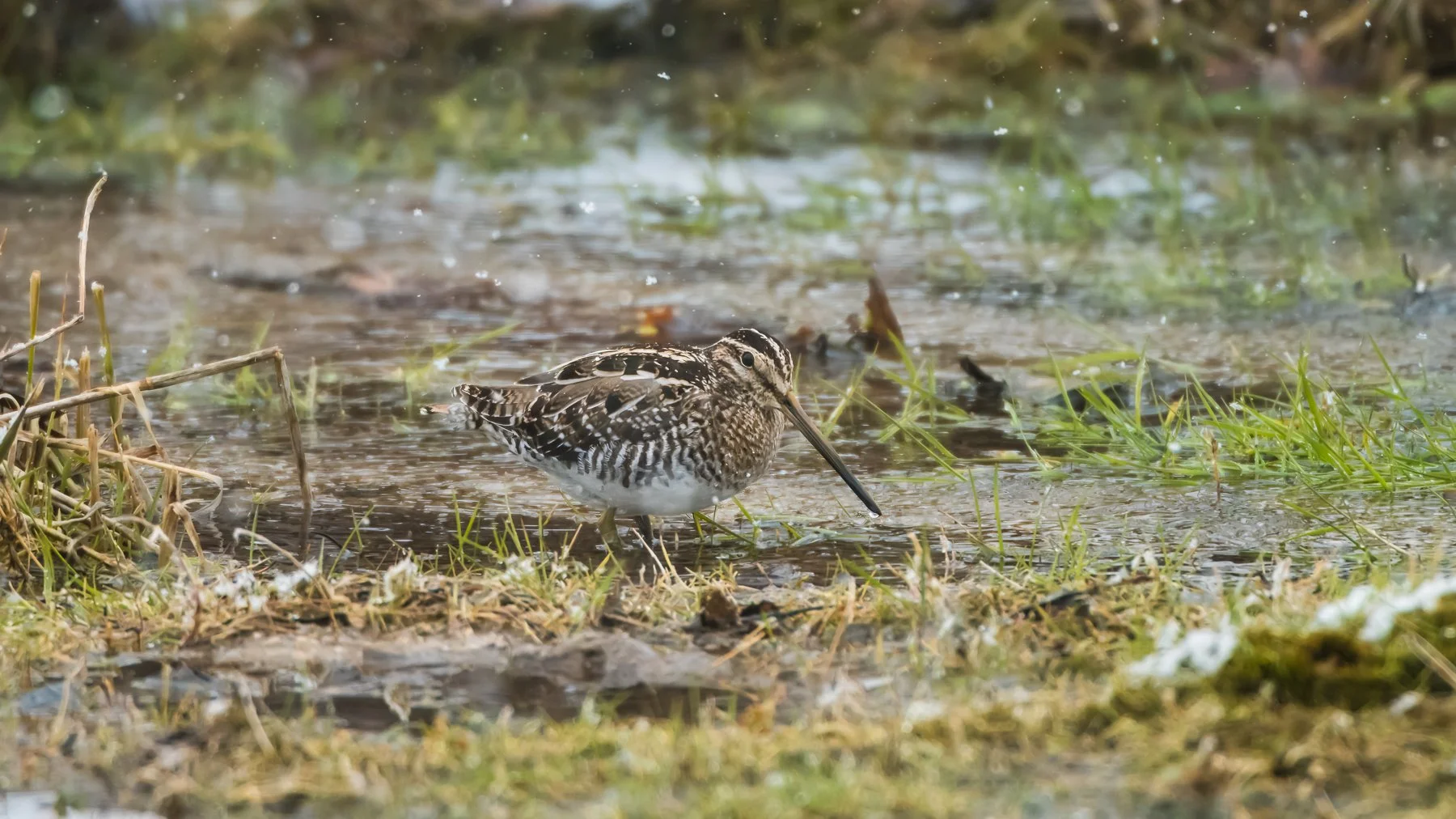

My earliest memories of the snipe date from my boyhood years, when I was introduced to the “snipe hunt,” a practical joke in which pranksters send a gullible individual with an empty bag into the woods to capture an elusive animal known as a snipe, whose description varies. I soon learned that a snipe is not a made-up creature. The real snipe is a medium-sized shorebird with a plump body, short legs, and a long bill. It is well camouflaged, brown with lengthwise stripes on the back, a striped head, bars on the sides, and a short, orange tail. The Wilson’s Snipe (Gallinago delicata) is named after early Scottish-American ornithologist Alexander Wilson, who first described it. Once considered a subspecies of the Common Snipe (G. gallinago) of Eurasia, the bird was given its own species status in 2003, based on the number of its tail feathers, or rectrices, and other morphological and vocal differences. It was Wilson himself who pointed out that the snipe that bears his name has eight pairs of tail feathers rather than the typical seven of the Common Snipe.
Wilson’s Snipe is one of the most common and widespread of all shorebirds. It is found everywhere in North America in its preferred habitat of wet grassy fields, marshes, bogs, and pond edges. In Wisconsin, the species is a common migrant and breeder from late March into October. The range during breeding covers the northern two-thirds of the state, with infrequent nesting records in the southeast. Most snipes retreat south of the freeze line in winter, but a few birds overwinter in suitable habitat for foraging. Winter is the season when we find Wilson’s Snipes most frequently at Fair Meadows Sanctuary. Since 2004, we have observed snipes at Heron Pond during winter in all years except one. We usually see them feeding in the shallows, where upwelling warm water from underground springs allows them to probe in the wet, rich organic soil with their long bills. This amazing organ, which has sensory pits near the tip, detects unseen invertebrate prey by touch. On occasion, they immerse their entire bill and forehead up to their eyes in water. Snipe eyes, like the woodcock’s, are set back in the head, giving the bird both front and rear vision that aids in the detection of predators.
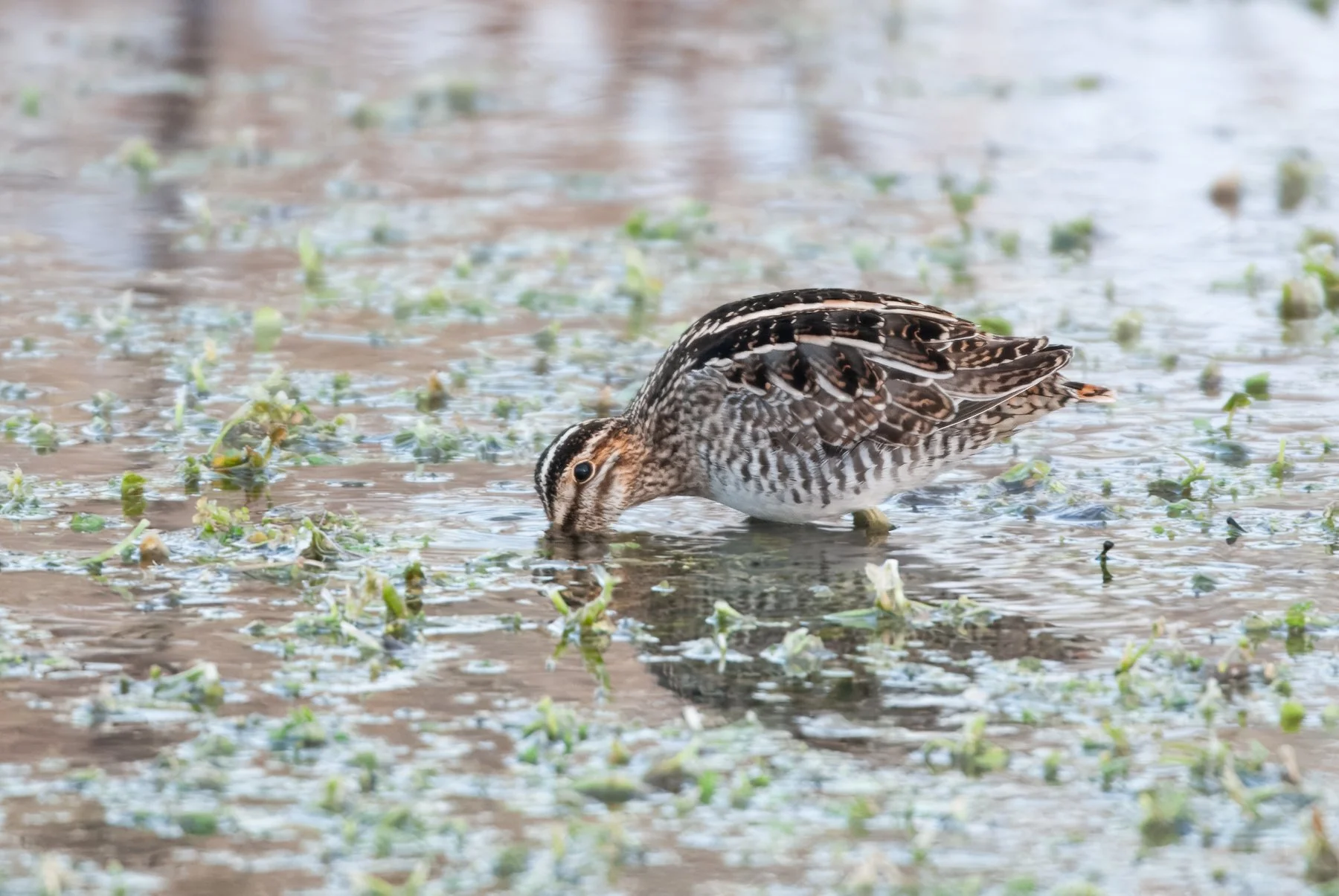
Wilson’s Snipe with its entire bill immersed while feeding in Heron Pond during the winter (photo by Gary Shackelford).
When flushed, this secretive bird explodes into a fast-moving, zigzagging flight while uttering a rasping scaipe before leveling out. This sound is the only vocalization made outside the breeding season. Perhaps the most well-known sound made by the snipe is the “winnowing” nonvocal sound that is produced by air flowing over the spread outer tail feathers during fast aerial dives. This behavior is used both for territorial defense and for attracting mates. The sound is a repetitive woo … woo … woo … woo, which has been likened to the whir of waterfowl wings or the trilling sound of an Eastern Screech-Owl. Modulation of the sound is caused by wingbeats, which alter the flow of air with each downstroke. This has led some to conclude incorrectly that the sound itself emanates from the wings. Henry David Thoreau is generally considered to be the first to have applied winnowing to the sound produced by the snipe. In his writings, Thoreau described it as a “singular winnowing sound in the sky over the meadows.”
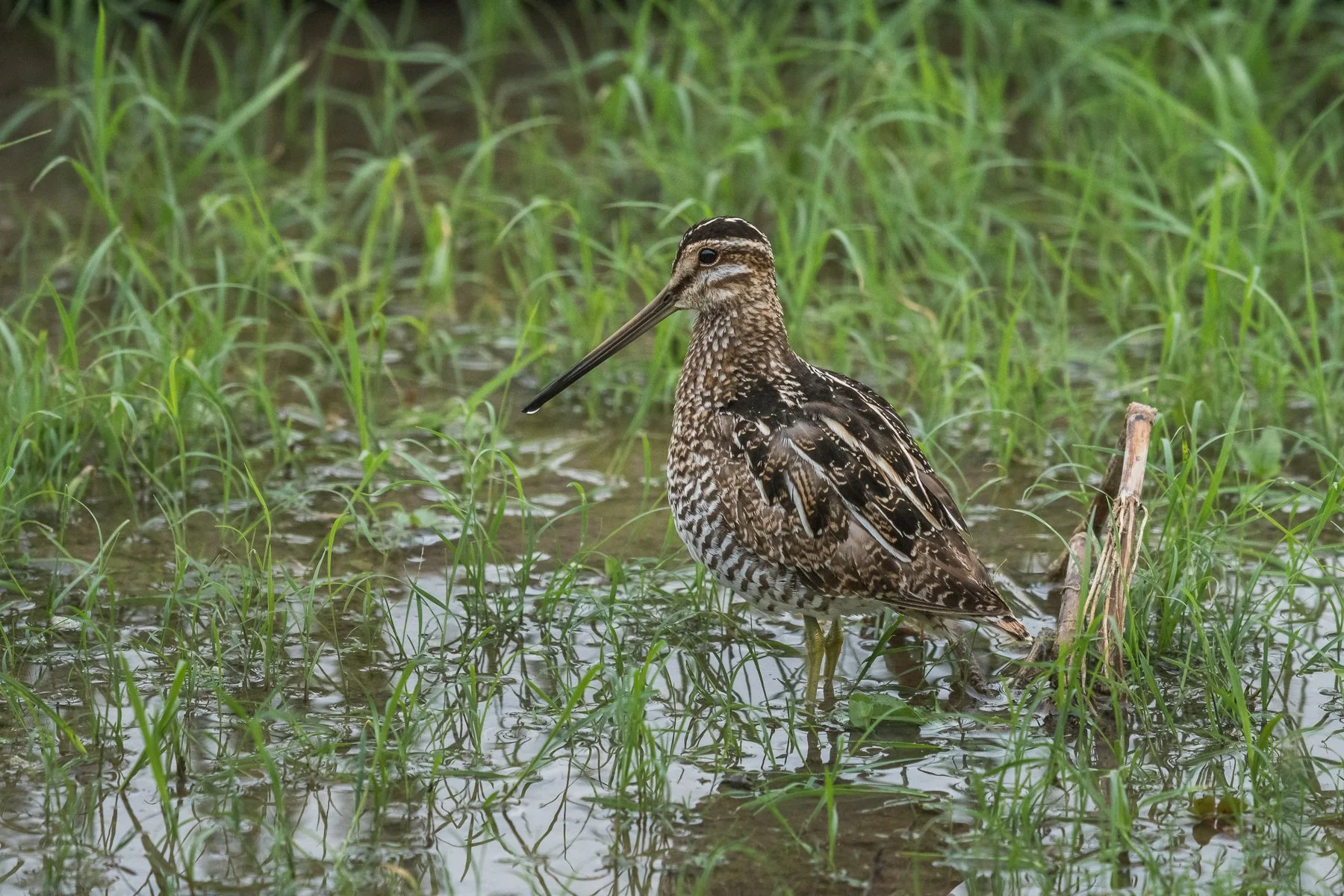
Wilson’s Snipe in a wetland at its wintering ground in South Texas (photo by Gary Shackelford).
We have not documented nesting of the Wilson’s Snipe at Fair Meadows, but because of the suitable nesting habitat at the sanctuary, we believe it is likely that the species does nest here. Their secretive behavior, excellent camouflage, and tendency to sit tight while on the nest make nests very difficult to find. Successful nesting has been documented at one of Southern Wisconsin Bird Alliance’s other sanctuaries: Faville Grove, where the first Wisconsin Breeding Bird record for Jefferson County was recorded in 2019.
Written by Gary Shackelford, Fair Meadows Sanctuary manager
Cover image: Wilson’s Snipe feeding in the shallows of Heron Pond at Fair Meadows in late winter (photo by Gary Shackelford).
