


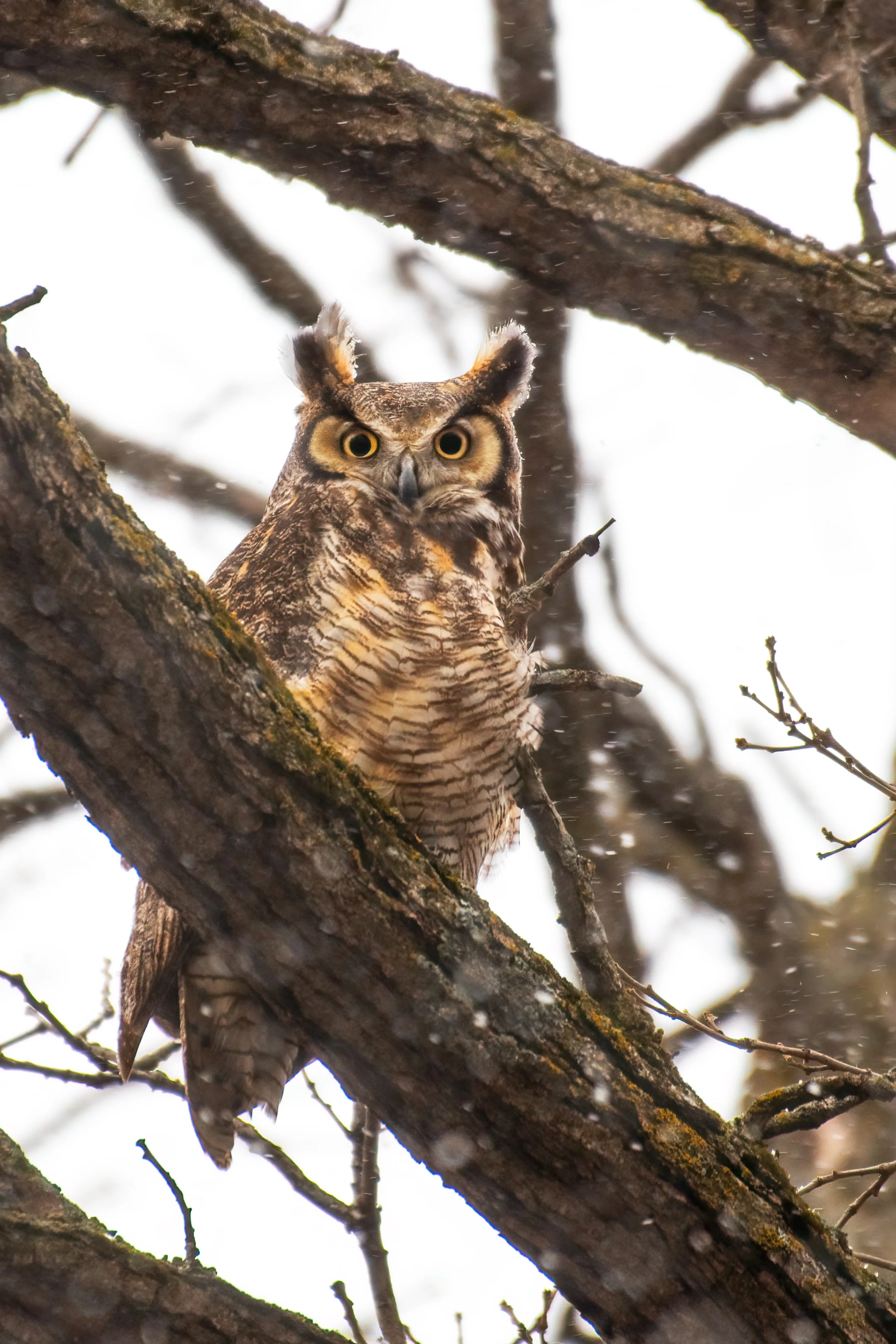
While most of Wisconsin's breeding birds are stuffing their beaks at bird feeders or soaking up their last month(s) on their winter range, one of Wisconsin's earliest breeding birds, Great Horned Owls, are already in full mating season swing. February is their peak egg laying period, but many Wisconsin residents may have been informed that the birds’ nesting season was underway as early as January by their persistent, nightly mating calls. Female Great Horned Owls dutifully sit on their nests through the end of winter (incubation is 30–37 days) until spring brings warmer, longer days and hungry babies (peak nestling period is between March and early May).
With such an early start, a shortcut or two is in order. Great Horned Owls do not build their own nests, instead, they find existing structures that will do the job. Adaptability brings success, and Great Horned Owls are not known for their pickiness: they will use old nests of other birds (Red-tailed hawks, American Crows, Great Blue Herons, and other raptors) or squirrels, existing big tree cavities, and rock ledges. Their flexibility extends to their nesting habitat—Great Horned Owls use a variety of wooded environments from hardwood, coniferous, and mixed forests to urban areas and open habitats with adjacent treelines.
Mark Martin and Sue Foote-Martin relayed an interesting owl story from 1985 at Goose Pond Sanctuary: “On the hill above the pond, there was a pine plantation and a very large basswood tree along the railroad tracks. We thought it would be helpful to erect a Great Horned Owl nest box. Leroy Peterson, a Wisconsin DNR wildlife biologist who did an in-depth study on the Great Horned Owls in Jefferson County, volunteered to erect the large box. The next year, a pair of owls called it home. When the owlets were about half grown, we received a call from Nancy Frank, a wildlife rehabber in southeast Wisconsin. She was looking for an active nest to ‘adopt’ two young she had in care. We told her that our pair already had two young—she told us that with two more, they would require supplemental feeding. When she brought the owlets out, she also brought bags of frozen white lab rats for us to keep in our freezer and thaw a few out every couple of days.
We knew climbing a ladder at the nest site could be dangerous. However, Mark was prepared—he wore a helmet and a down coat. Sue would keep watch from the ground. On one visit, when Mark was about two-thirds of the way up the ladder, an owl silently flew in and attacked. It happened so fast that Sue could not yell out before the owl hit Mark’s back. Luckily, Mark hung on to the ladder; luckier still, the owl did not hang onto Mark, though he ended up with eight puncture wounds that took a long time to heal. The owlets continued to be fed but we were even more prepared after that.”
Great Horned Owl photo by Grayson Smith/USFWS
In a rapidly changing world, today’s most common birds share one important trait: resilience to human pressure. Great Horned Owls are a prime example of a species that not only tolerates human-caused land use changes, but can also use these changes to their advantage. For example, prior to European settlement, the land that is now Goose Pond Sanctuary would be inhospitable to a bird that relies heavily on the old nests of Red-tailed Hawks and squirrels, because neither of these species would have been nesting here either. Goose Pond Sanctuary is in the heart of what was a 129,000 acre prairie (commonly called the Empire Prairie), a mostly treeless expanse of tall grasses and forbs. Today, less than 0.13% of this historic prairie exists and much of the land has been converted to agricultural fields fragmented by treelines and wind breaks.
Although this landscape change expanded the suitable breeding area for adaptable, woodland-nesting birds like Great Horned Owls, it was no longer equipped to support the grassland birds that relied on it. The primary goal for our prairie restorations at Goose Pond is to provide critical habitat for grassland species whose populations have declined due to habitat loss. While I still enjoy spotting a Great Horned Owl flush from a wind break, our spruce trees north of Kampen Road, or perched on a sign along the railroad tracks at Goose Pond, we will not be going out of our way to make the property more hospitable to them (they’ll be just fine!).
Written by Emma Raasch, Goose Pond Sanctuary ecological restoration technician
Cover image by Sandra Uecker/USFWS. A Great Horned Owl rests in a tangle of branches.
