
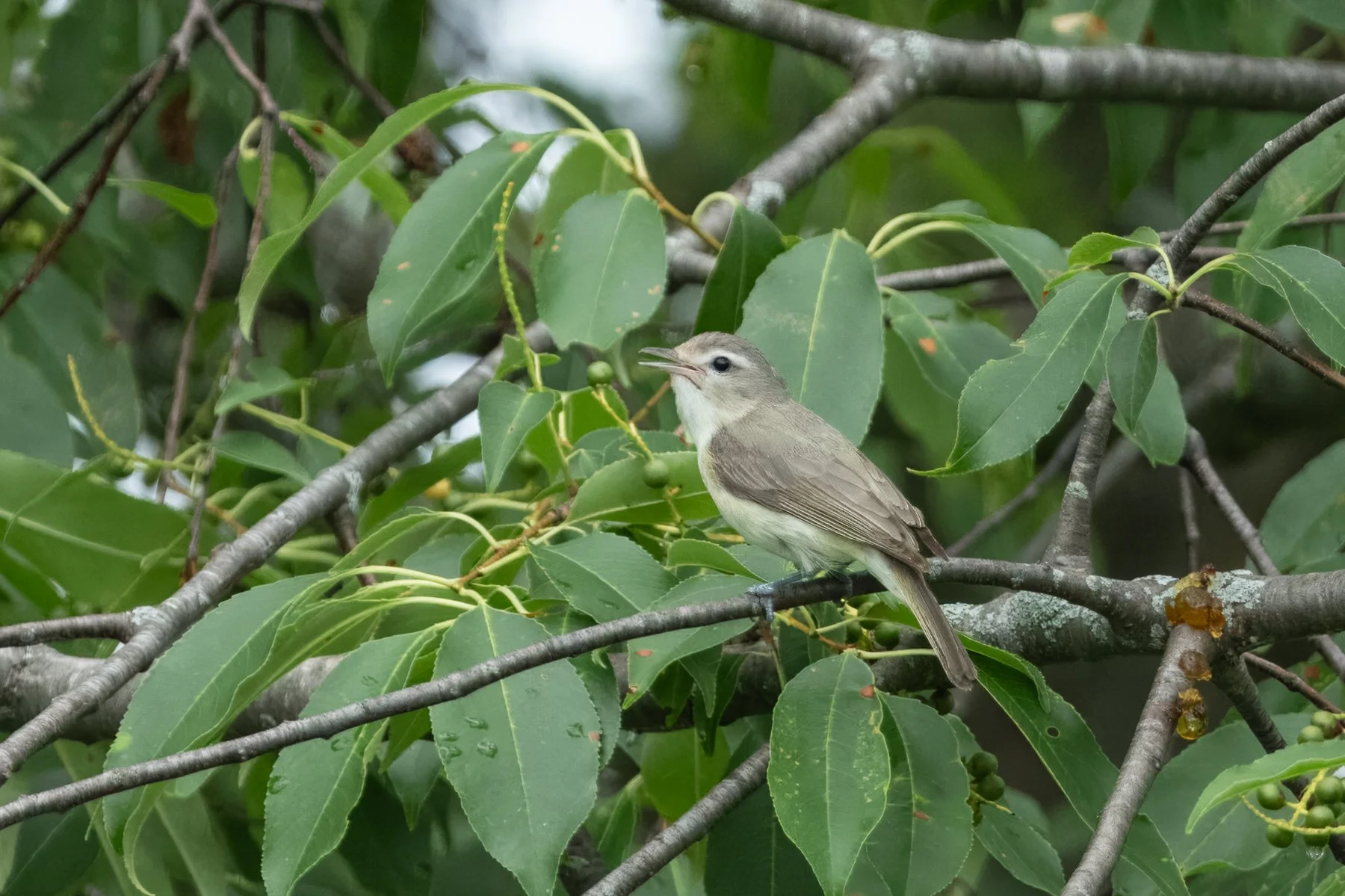

I hear a repeated, melodious, elaborate song—a warble coming from the top of the aspen trees that surround a small pothole on the edge of a sedge meadow. I have been hearing it morning, evening, and midday for several days. These birds have even been known to sing on their nests! I scan the treetops, trying and failing to see the songster, an Eastern Warbling Vireo. There is no mistaking this wonderful song. A poetic description by Arthur C. Bent captures its beauty:
"In the vireo's song there is an air of unhurried calm, a leisureliness we seldom hear in the voice of a bird. Spring brings us greater artists, more proficient technicians, birds of more exuberant joyousness, but no such comfortable and welcome 'guest of summer' as the warbling vireo."
I am looking for a rather plain, sparrow-sized bird. Its upper parts will be gray with an olive tinge. Underneath, the bird is a dingy white with a yellowish wash on its flanks. The markings on the head are subdued (a whitish line above the eye, a light gray eyestripe, and a whitish crescent below), creating a light background that makes the eye appear large and dark. Males and females look alike, and they are often tough to find in the canopy, as my husband Gary can attest in his efforts to photograph them.
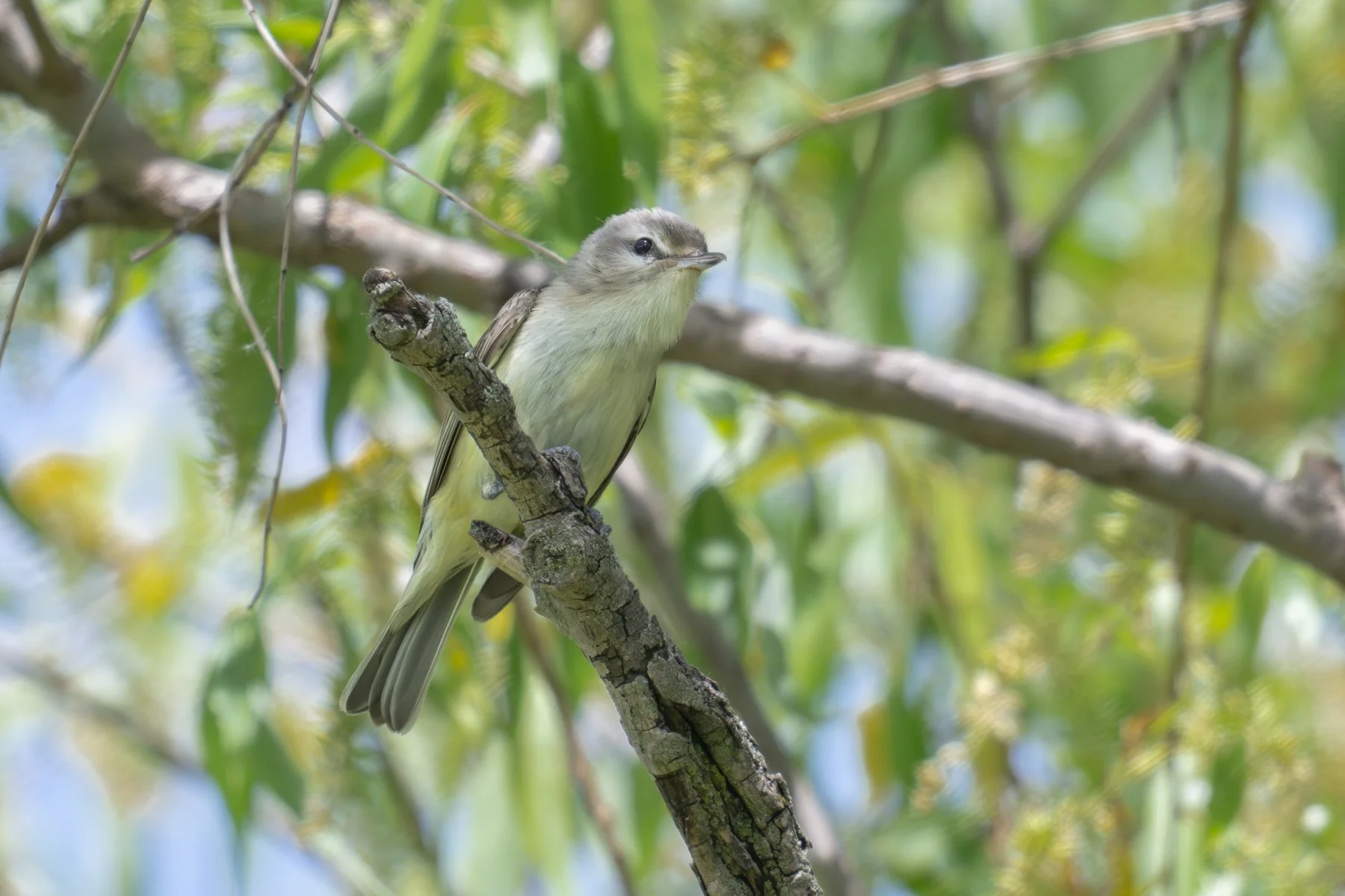
Eastern Warbling Vireo, with a good view of the facial features, including gray stripe through the eye, white throat, and yellow flanks (Gary Shackelford).
In 2025, warbling vireos were divided into two species (Eastern and Western) based on differences in plumage, size, song and genetics. These differences are subtle, and it is very difficult to tell the species apart. Fortunately, there is little overlap in range, so I can safely assume that the singer at Fair Meadows is an Eastern Warbling Vireo, the species with a range throughout northeastern and central United States and Canada.
In the winter, Eastern Warbling Vireos are found in southern Mexico and Central America, as far south as Panama. In these regions, they are found in open woodlands and shade coffee plantations. Please be sure to choose shade-grown coffee for your morning cup (find a bird-friendly coffee option near you by visiting the Smithsonian resource page: https://nationalzoo.si.edu/migratory-birds/bird-friendly).
Every spring, we welcome these wonderful birds back to Fair Meadows. The favored habitat for Eastern Warbling Vireos during breeding season is open woodlands with tall trees—especially cottonwoods, sycamores, willows, and silver maples—that are found next to water. Eastern Warbling Vireos eat mostly insects, but in fall and winter, they will also consume berries. One of our best views (finally) of an Eastern Warbling Vireo was in late summer when the pagoda dogwoods at Fair Meadows presented their annual berry feast.
Although the nests of Eastern Warbling Vireos are frequently parasitized by Brown-headed Cowbirds, these amazing little birds are known to rid their nests of the cowbird’s eggs. Studies using fake cowbird eggs have shown that the birds removed 91% to 100% of the eggs, either by puncturing or grasping them with their bill and carrying them off. The Eastern Warbling Vireo is the smallest bird known to remove cowbird eggs in this way.
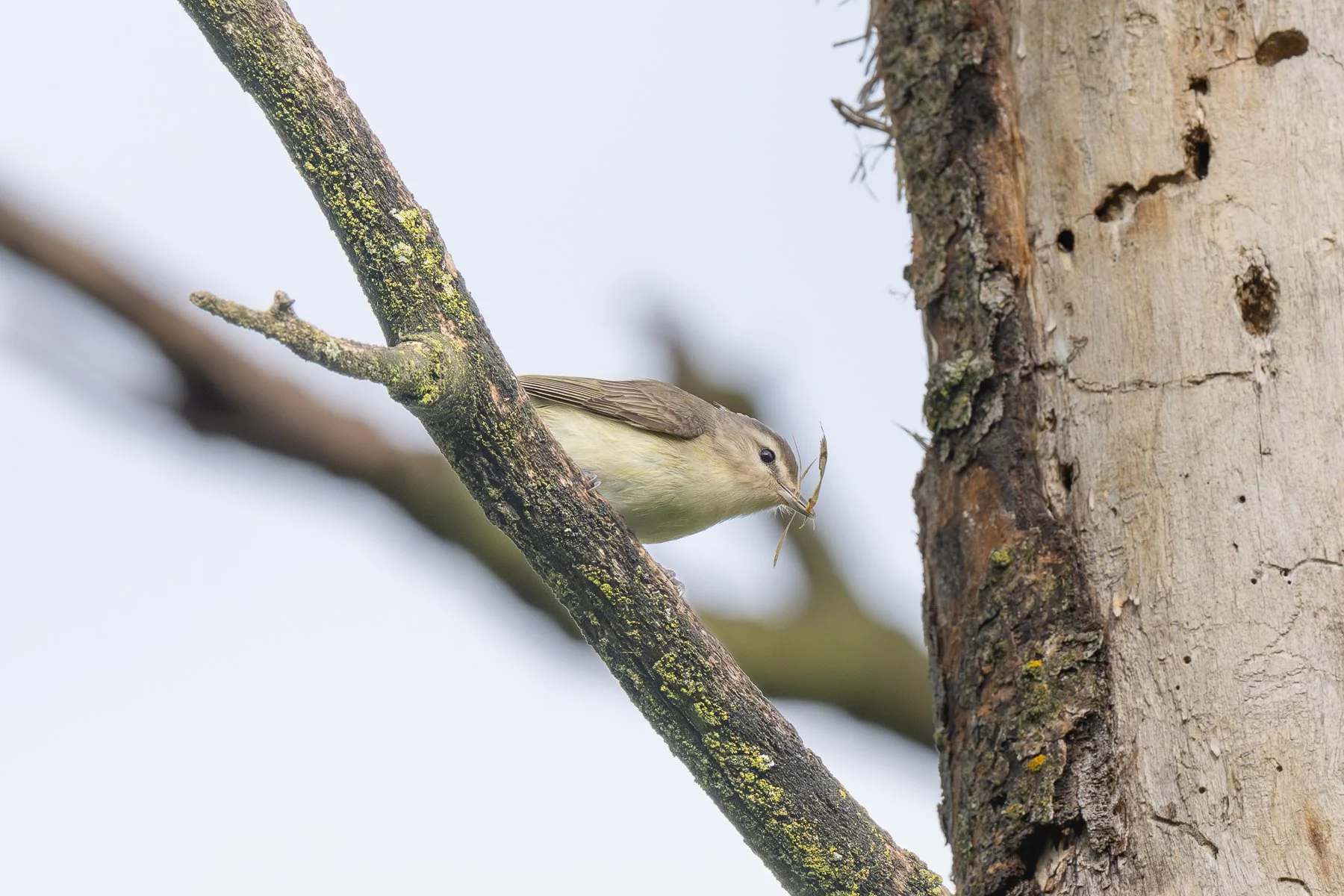
Eastern Warbling Vireo with nesting material. This bird is collecting bark strips or fibers that are typically used on the exterior walls of the nest (Gary Shackelford).
As we search near the sedge meadow, at last, Gary spots the bird on an aspen snag, and it has nesting material in its bill! It is too busy feeding to hide in its usual lair deep within the leaves at the top of a tree. Now that I have seen the Eastern Warbling Vireos, I am content to sit quietly and enjoy their beautiful songs.
Written by Penny Shackelford, Fair Meadows sanctuary manager
Cover photo by Gary Shackelford. An Eastern Warbling Vireo perched on a leafy branch. Note the light stripe above the eye and the light crescent below, and the pale yellow wash on the side.
