
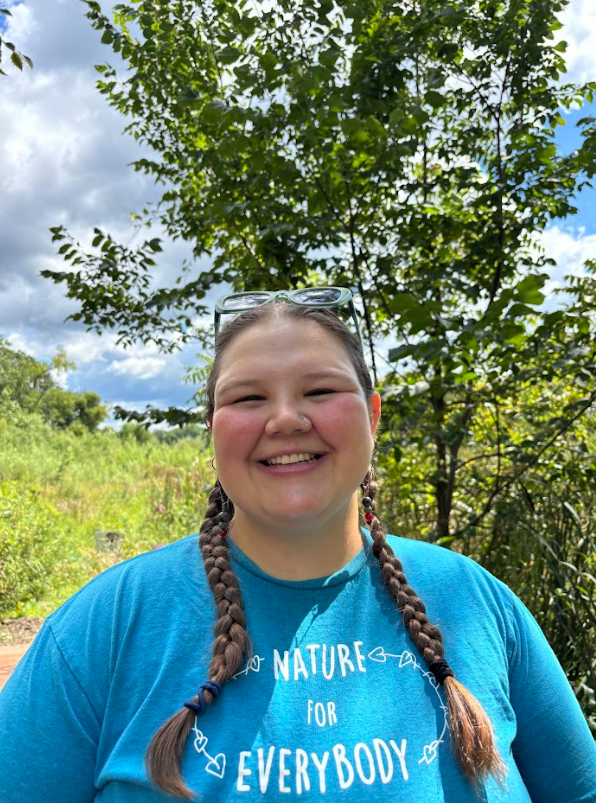
Rowan out in nature! (photo courtesy of Rowan Koester-Jess)
In this episode we hear the tale of the Great Mustelid Mystery that started at Aldo Leopold Nature Center in spring 2024. Get comfy and put on your nature detective caps as Rowan Koester Jess takes us through this riveting mystery.
See offerings from Aldo Leopold Nature Center!
Subscribe to QuACK on Spotify, iHeart Radio, Apple Podcasts, or your favorite podcast app!
Transcription
Hey, and welcome to Questions Asked by Curious Kids or QuACK, a podcast made by Southern Wisconsin Bird Alliance. This is a podcast where we gather questions about nature from kids to be answered with a local expert. My name is Mickenzee. I'm an educator and I'll be the host for this series. This episode is a lot longer than usual, and that's because we're doing things a little differently. Today rather than asking questions, I'll be listening to the mystery that took place at Aldo Leopold Nature Center at the start of 2024. So get cozy and comfortable while Rowan Koester-Jess tells us the great mustelid mystery.
-----
Mickenzee: Hey, Rowan, welcome to the show. Before we get started with your story, could you tell us a little bit about what you do at ALNC?
Rowan: Yeah.Thank you for having me. At the Nature Center I work as an environmental educator. I have a couple of different classes that I work with. So I work with preschoolers in the afternoon.
Mickenzee: Cute.
Rowan: And I also work with, morning class and, some homeschool folks with, nature school class.
Mickenzee: Cool. All right. And could you tell us, what got you interested in teaching kids and teaching kids in nature.
Rowan: Yeah, I think going back real early, it would all start with spending a lot of time in the parks near my house as a child. I absolutely loved running around under the trees and near the lake. Grew up near Lake Monona, so I spent a lot of time at the beaches, playing with rocks, trying to climb trees.You know, having a good time.
Mickenzee: Totally. I'm sure lots of kids and grown ups alike can relate to loving the beach and being outside. Okay. And I understand you have a really interesting and riveting story for us. So let's set the scene. It's spring in 2024. Where are you? What are you doing? What's going on.
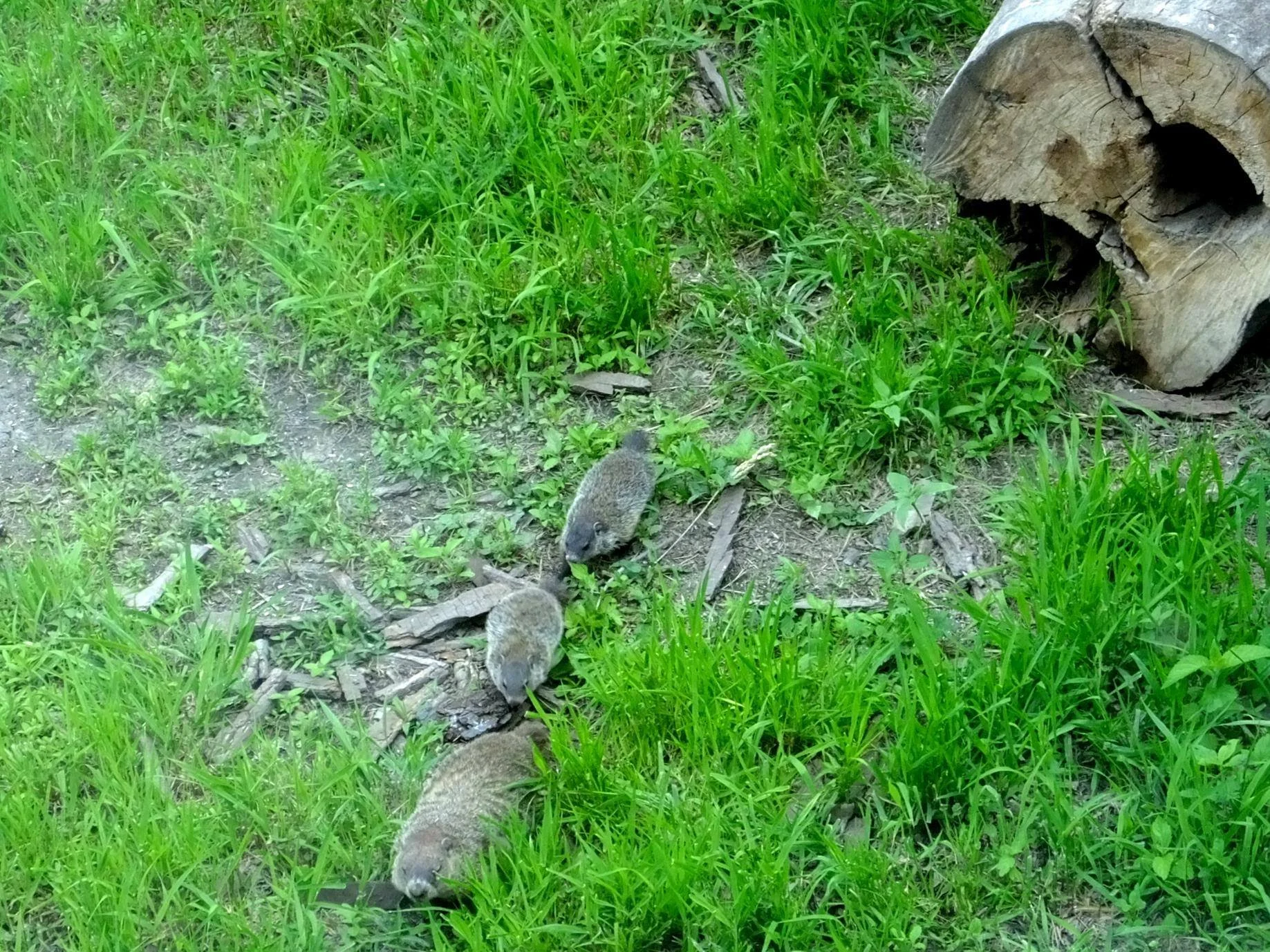
Mother groundhog with young. Could this be our mystery animal? (photo by Veronica Kelly/USFWS)
Rowan: Yeah. So it is the spring. We've had a whole fall and winter at the nature center with this current batch of kiddos. So everybody has gotten into some good routines. We know the land pretty well. We're familiar with the animals. You know, we have good relationships with each other. And I start to hear some rumors. The rumors are coming from the preschoolers and their families. They're telling us of a creature that lives near the circle parking lot. Near there are big tree stumps where we like to jump, and it's a brown creature with brown fur and a long body. And it's been seen running through the drainpipes and just kind of around in the trees. It was really surprising because today none of the staff who work at the Nature Center had ever heard of or seen a long bodied brown creature. We were thinking, maybe they're confused and they're seeing a groundhog. So we tried to ask a couple more follow up questions. Could it be a baby groundhog you know, it is spring? Maybe just a small one? And they're like no, the body is very long.
Mickenzee: Yeah. These are great descriptor words. Do you guys practice asking questions at the Nature Center?
Rowan: We do. We like to do something that we call being a nature detective. And a nature detective is using your observation and your senses to build a story of what we think is happening around us when we are a nature detective. We like to use our senses, so we definitely are using our sight and our hearing many times will use our smell. And then for touch and taste, it really will depend on what we are investigating. You know, there are some things in nature that are not safe to touch and whenever we're talking about taste, we always want to double check with a safe grown up that we know.
Mickenzee: Yeah, someone that is an expert.
Rowan: Yeah. We gotta know exactly what we're putting into our mouth if we're going to be using our taste sense.
Mickenzee: Exactly. Yeah. Okay, so your description so far: It's a long bodied animal. It's brown. It's not a baby groundhog. It's not a grown up groundhog.
Rowan: No, it's something new. It's a mystery.
Mickenzee: That's so exciting.
Rowan: First we're hearing just, you know, a couple rumors or two from the preschoolers, and then we start hearing questions from their parents. Grown ups are asking the teachers, what is this creature, this long bodied. You know, small compared to a groundhog. It's smaller than a groundhog. What is this creature? What could it be? The staff are like. Well, you know, we haven't seen it, but we can make some hypotheses about what this creature might be. And we start paying close attention to that area of the nature center to see what we can observe.
Mickenzee: That's a really good science word. And what does hypotheses mean or what's a hypothesis?
Rowan: Ooh, yes, a hypothesis is going to be, a guess that is backed up by some sort of facts or observations, something that has like a little bit of science to it.
Mickenzee: Yeah, yeah, it's more than just a guess, right?
Rowan: Yeah. It's a guess you've made based off of clues.

The North American River Otter is in the mustelid family and can be found in Southern Wisconsin (photo by Grayson Smith/USFWS)
Mickenzee: Yeah, that's a really good way to put it. Okay. So what are the hypotheses made by the staff? Well, at first, our first hypothesis was that it was a groundhog. And then the preschooler said no. And then we were like, maybe it's a baby groundhog. And the grown ups said, no, we know it's not those. We don't know what it is. We're not sure. And so then we started doing a little bit of research into what fur bearers, or animals that have fur could fit that description that live in Wisconsin, specifically southern Wisconsin, could possibly be at the Nature Center. And so we think this creature is in the mustelid family.
Mickenzee: Mustelids. I love mustelids. Could you tell the listeners what counts as a mustelid or what are the characteristics of mustelids?
Rowan: Yeah. So a mustelid is like a family of animals and they're going to have fur and they're going to mostly be carnivores. So they mostly eat meat. They could live on land or near water. And in Wisconsin we have many different types of mustelids, which could include badgers, river otters, mink, weasels. We have a bunch of different types of weasels, long tailed weasels, and least weasels. Yeah. So it's that whole family of those little creatures.
Mickenzee: And they do have long bodies?
Rowan: Long bodies with short legs. Usually a really strong neck. If you have ever seen the movie Zootopia. I think Zootopia does a really good job of showing that some of these little, these smaller creatures can be really ferocious. So these mustelids have really strong necks, they often have very sharp teeth. Because they do eat meat. They eat other animals. Yeah. They also along with those sharp teeth will have really strong claws. And many times they are a very stinky creature as well.
Mickenzee: Yeah. Oh, if anyone has a pet ferret. Ferrets are also in the mustelid family.
Aldo Leopold Nature Center staff member captures the mystery mustelid on video (video courtesty of ALNC)
Rowan: All right, back to our mustelid mystery. At this point, it was late spring and the staff were on the lookout. And one day after work, one of our staff was going out to their car. And right before they got to their car, they heard a rustling in the understory of our Kindergarten Woods. The understory is like the plants and the shrubs and the flowers that grow close to the ground, and they are able to capture on video this mustelid running under their car and across the parking lot. So we have our first physical evidence. We are able to confirm in this video that it does have a long body, brown fur, very short legs, very strong neck. And we're also able to notice that it has a white patch on its chest.
Mickenzee: Oh, that's another really good clue, isn't it?
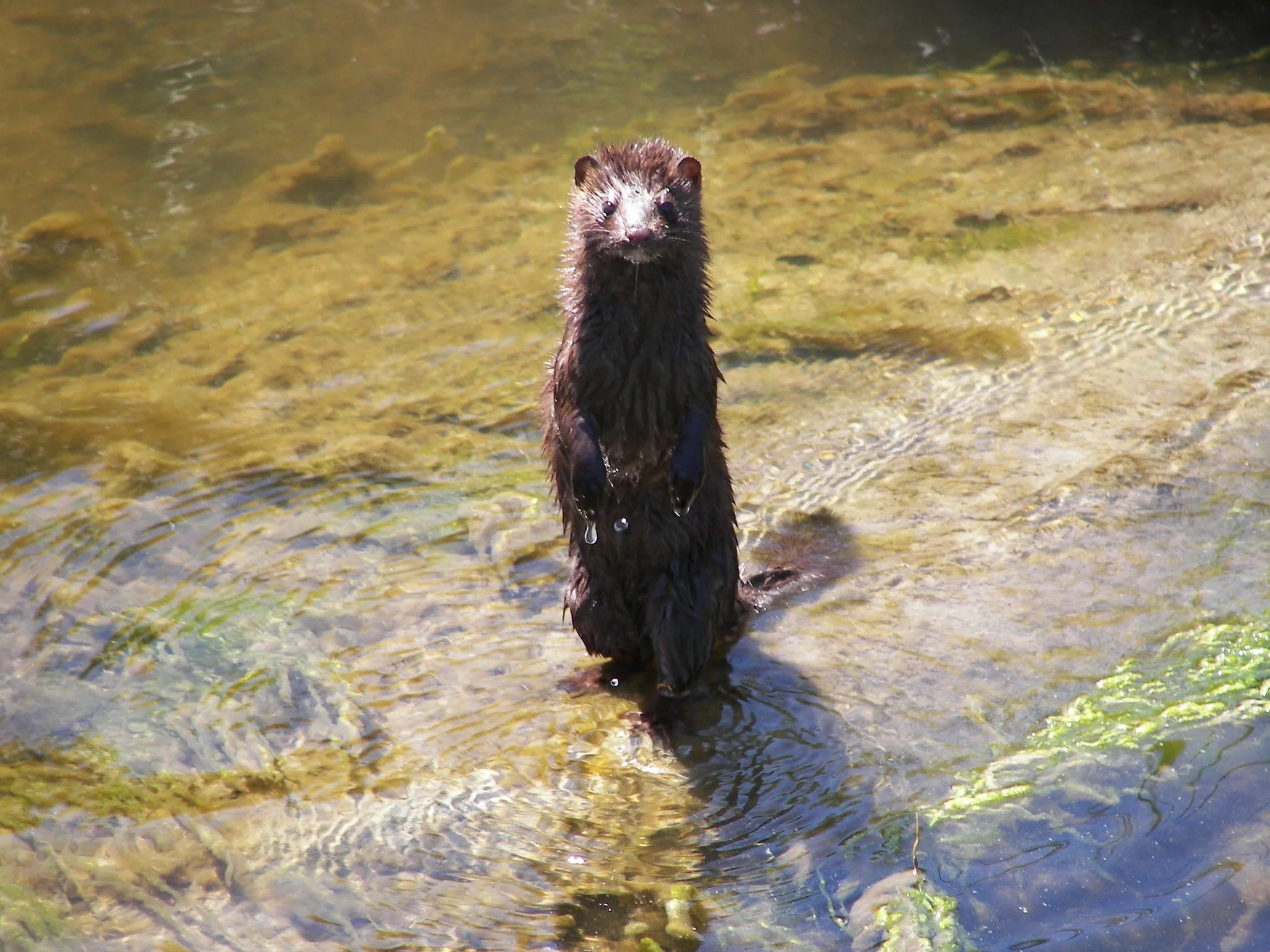
Mink have a dark brown underbelly and tend to live near water (photo by Carlos Guindon/USFWS)
Rowan: It is. At this point we start a debate amongst the staff. Do we think this is a mink or a weasel. We’re not quite sure. The video did not show us the underbelly. It was a very fast video, so it didn't show us the size. And so one of the ways that we could tell if it was a mink or a weasel is that minks are larger than weasels, and they tend to have dark brown on their underbelly, whereas weasels are a little bit smaller, and that white patch that starts on their chest usually goes down onto their belly a bit more.
Mickenzee: Okay, ooh,
Rowan: So we got some clues, but we still needed to gather more information to figure out what exactly this creature is. All right, so a little bit of time goes by. Now we are into summer and everybody is very excited about our mustelid mystery. We're on the lookout for creature sightings and clues now. Something that was also happening around this time, and we're not sure if this is a clue or a coincidence. Something that just was also happening at the same time is we were finding some deceased groundhogs. We were not seeing a lot of babies, and we found a couple of adult groundhogs that had passed away. And as we mentioned earlier, these are ferocious predators. They are.
Mickenzee: Did these groundhogs look like they died from old age? Or did they die from a predator catching it?
Rowan: You know, it was not old age. One of the clues that helped us figure out how they died is actually that their head was not connected to their body anymore.
Mickenzee: That would make an animal dead for sure.
Rowan: It was a very interesting thing to come across on our hikes. And, you know, many of the kids had questions about, well, what is this creature and how did it die? And it was a great time for us to use our nature detective skills to make some educated guesses or hypotheses. Yeah. So we would use our eyes and we would look at the patterns. We would look at the claws to help us figure out that it was a groundhog. And then we could use our sense of smell to think that, this is a pretty stinky animal. It might have been here for a couple days. And then we would look for fur marks to see if we think that it was dragged to there. And, you know, a lot of these things, a lot of these animal interactions happen when there are no humans around. Sometimes we don't get answers we make our best guesses.
Mickenzee: Definitely. And, you know, it's sad when you see a dead animal, but it is a cool opportunity to get up close and notice these different things and use your detective skills.
Rowan: It also gives us a chance to kind of talk about the cycles of life and that this animal will now be either eaten by other animals or broken down into nutrients that can go into the soil that will help to grow different kinds of life, you know
Mickenzee: Definitely, yeah. And our predators, they're not doing it to be mean. They're doing it to survive. And that's what we always talk about too. Okay. Are there any other clues that maybe there is a mink, a weasel roaming around the nature center?
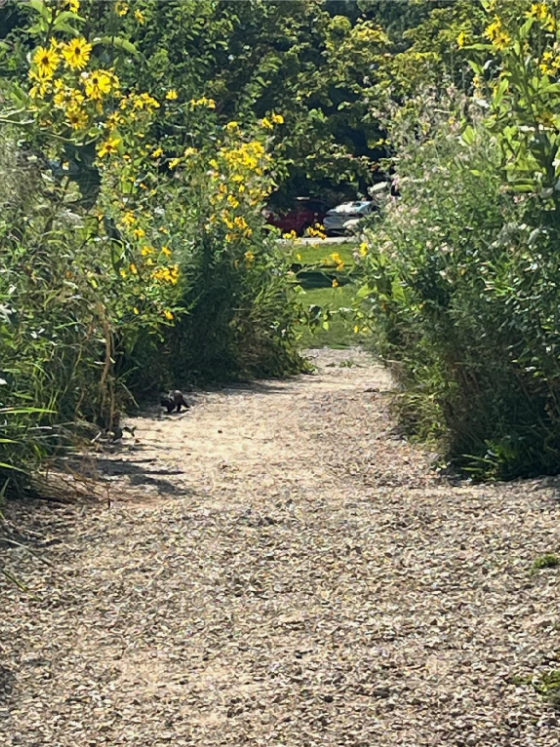
Mystery Mustelid sighting! (photo courtesy of ALNC)
Rowan: Yes. So at this point we have a couple other staff who see glimpses of the mustelid and the mustelids are getting a little bit more brave, if I had to guess, they're going in different places in the Nature Center. So we saw a sighting out in the back of the Nature Center on a gravel trail, and one of our staff gets a blurry picture there. It doesn't give us any more clues, but it does give us another piece of evidence, and we see them over by our rain gardens as well. All right, so that was most of our summer. Now we're moving into fall.
Mickenzee: Whoa. This is a long nature story, I love it.
Rowan: The mystery was really exciting for the students too. The kids who were there when it started there in the spring. If they stayed for summer camp, they kept their eyes open all summer for more clues. And now we're in the fall. We're starting a whole new school year. So the kids are are telling each other the stories of what happened last year. And it's something that we find in the fall of 2024, is we find two possum that have passed away. And we think again, could this be a mustelid that is hunting these creatures, or could it be something else, a fox, maybe a housecat that got out? We're not quite sure. Once we get into mid fall. This is where I got so excited because I got to see the mustelid with my own eyes.
Mickenzee: I'm so excited!
Rowan: Yes, I have been waiting and watching for so long, and I was hiking back from the pond one day with a group of kids when all of a sudden one of them says, well, what's that up there? And I look further up the trail and I see the tummy to the tail of a long brown creature scurrying off into the prairie. Oh, I got so excited. And I got to tell them about the mustelid family and how we were trying to figure out if this creature was a mink or a weasel. And so we all got to where we had seen the crossing, and we looked around in the prairie, in the grasses, and we saw there was a little path that had been made through the reeds. We were thinking, we were wondering maybe this is a crossing like an animal trail. Many times we'll see deer trails in the woods. But if you look close down near the ground, you'll also find smaller creature trails as well.
Mickenzee: Oh, that's so exciting, Rowan and so you said you saw from tummy to tail. Did you get a long enough look to see was there a dark brown tummy or a white tummy?
Rowan: You know I did not. I was fairly far away
Mickenzee: The mystery continues.
Rowan: Yes,the mystery continues. That fall we see a couple more staff sightings, usually over near our pond. Okay, but our next clue comes in the winter. One of my favorite things about winter is that when the snow falls, we are able to see signs, clues of what animals do when we are not there because they leave behind tracks.
Mickenzee: Oh I love tracks.
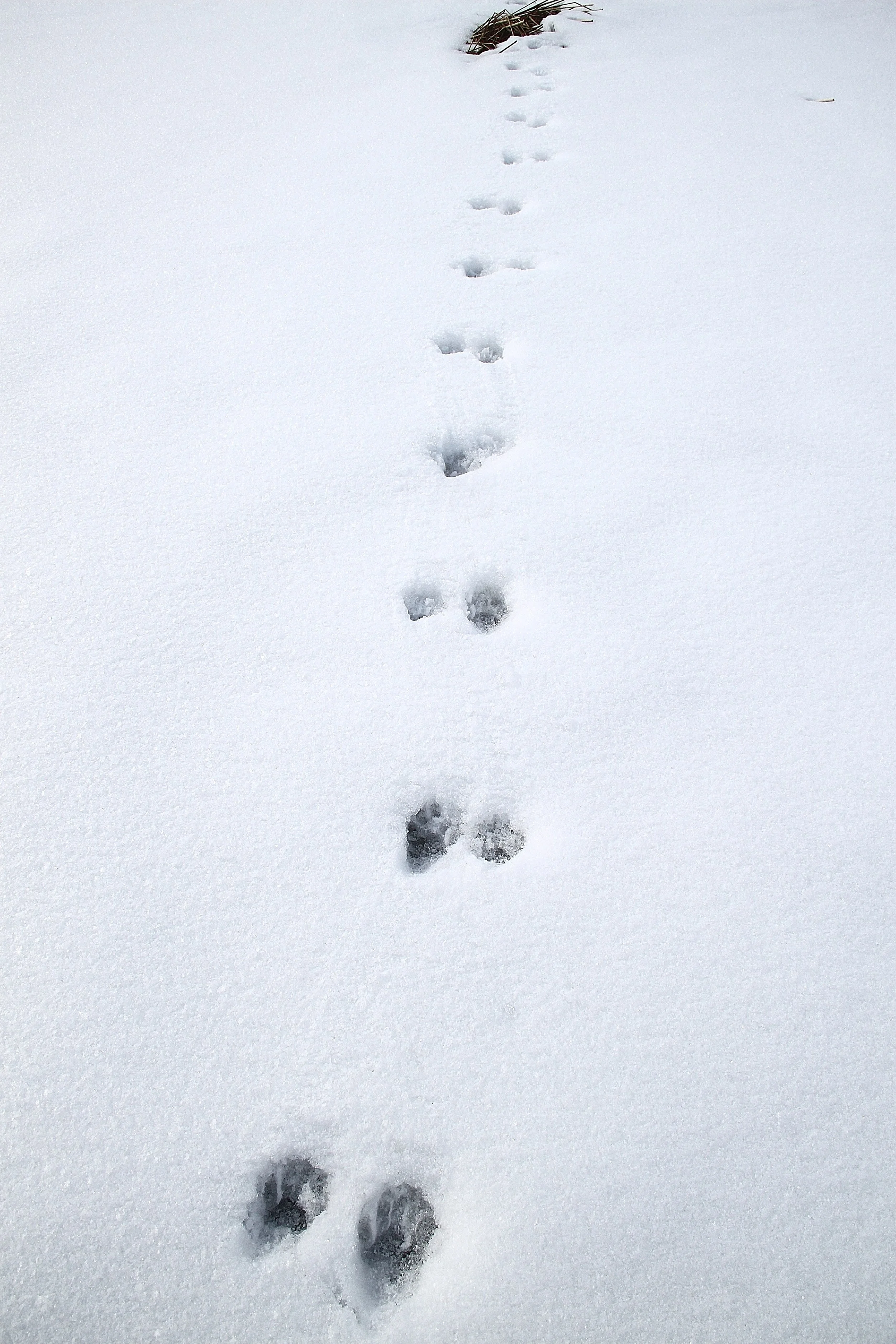
Bounding track pattern (photo by Ken Sturm/USFWS)
Rowan: So as soon as the trails were covered in snow when we were out on hikes, we would take our little field guides with us and we would look at all the tracks. We were seeing a lot of raccoon tracks, which we could tell because they have that special thumb-like finger that helps them to do a lot of grabbing. We were also seeing a lot of squirrels. They had pretty small little ones. And then we also were seeing these tracks that weren't squirrels, they weren't raccoon. They were different. And this was the first time I had seen these tracks. So with the group of kids that I was with, we we got up really close and we saw that it was a bounding type track pattern, which for those who might not know, bounding is when your front two feet hop forward at the same time and then you're back two feet hop forward after that.
You can kind of think like a bunny. How a bunny does their hopping. They go front, feet back feet, front feet back feet. But something was different about this pattern. It had claws. And it had this little line that would get swept behind it when in between the back feet. And it would drag a line forward and then it would stop and that would drag a line forward again.
And so the kids used their nature detective minds again. They thought, okay, so I see these front two feet are together. The back two feet are together. It must be a bounding creature. Then they said, have sharp claws. So maybe it is either an omnivore or a carnivore. But the thing that kept kind of sticking, getting to us was that little drag behind it. And we used our track finders and we’re looking up the tracks and we saw that it was a mustelid track. That drag behind it was its tail getting dragged in the snow as it was running. And so that was very exciting. We took some pictures. We documented it, but we still couldn't tell based on the size of the footprint, whether or not it was a weasel or a mink.
Mickenzee: Oh, man. This mystery.
Rowan: I know, we did see a couple more sets of tracks throughout the winter and most of them were seen either crossing across the pond or near the trails near the pond. And the kids wondered if it was living near the pond, if maybe it had moved and that could be another clue. Minks do like to be closer to water, usually more than other types of mustelids. And so we were wondering, because this would be a clue that it is a mink. All right, now we are getting into January okay. So something that the Nature Center has that is really cool is we have a trail camera that looks at a corner of our pond and our trail camera is connected to the Snapshot Wisconsin program.
Mickenzee: Oh, listeners or kids that I work with, we're very familiar with Snapshot Wisconsin.
Rowan: We love Snapshot Wisconsin.
Both: So cool.
Rowan: The staff who monitors our trail cam sent out a message to the staff that was like, guess what we caught on the trail cam? It was two blurry and then one clear picture of the mustelid crossing the pond right in front of the trail camera.
Mickenzee: Oh, that's so great!
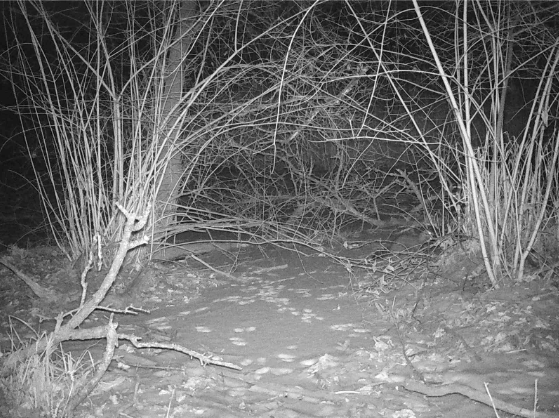
Snapshot Wisconsin trail camera photo of mystery mustelid in center right (photo courtesy of ALNC)
Rowan: This picture was taken at night time, so it is gray and black and a little bit of white. So it's not the clearest of pictures, but you can still make out what it is. Unfortunately, since it was night time, we still could not see that patch on its belly.
Mickenzee: oh, man.
Rowan: Oh, based on the size, it did seem like it was a little bit bigger than most weasels tended to be.
Mickenzee: So this was another clue that, okay, so we're leaning towards mink. We don't have enough hard evidence but we've got some clues.
Rowan: We had a staff member who was with a field trip group, and they were hiking out near Tamarack Island, which is right next to the pond where we had seen all of the crossings.
And they were there with a group and the field trip group. And this staff saw with their own eyes not one, but two mustelids chasing each other across the pond. So this whole time that we thought there had only been one, there were two.
Mickenzee: Oh, that's so cool.
Rowan: Yes. You know, I don't know if they were both there the whole time or if one of them just moved in.I'm not quite sure, but it was really exciting to find out that there were two at the Nature.Center. Once we knew that there were two of them throughout the springtime, we would see glimpses of the mustelid here and about. But towards the end of August, we get a final bit of information that does a lot of confirming for us. Now, when creatures are alive and running about, they're often going to run away from humans, so we can't get up close to measure or to look oftentimes at that very vulnerable underbelly. But when we were on a hike through our neighboring park, Woodland Park, we discovered at the top of the hill one of them, our mustelids had passed away.
Mickenzee: Oh, no,
Rowan: It was a very sad, sad day. We were very upset. But once again, this creature, having passed away, did give us an opportunity to get very close. And to do some more observing. And so we took a group of kids up and we found the body and we said, we wish you safe travels and thank you for creating such a great mystery for us. And we measured the body very carefully and very gently used a stick to lift up the leg to look at the tummy, which was brown under-belly. It was within the range of being bigger than a weasel, and being on the small side for a mink.
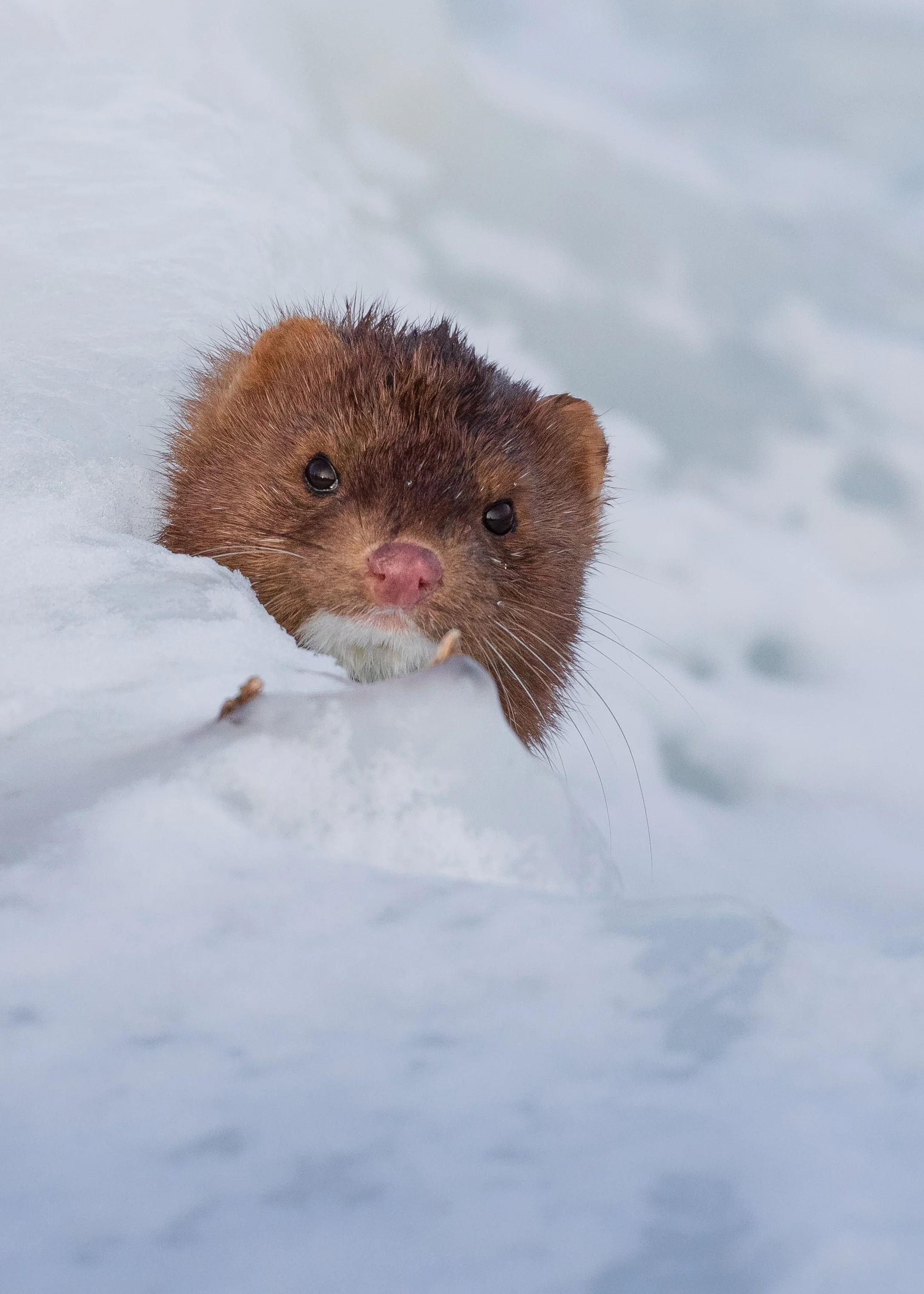
Our mystery mustelid was a mink! (photo by Mike Budd/USFWS)
Mickenzee: Oh my goodness. So finally the mystery is solved, even though we're a little bit sad, right?
Rowan: Finally the mystery is solved and we're looking and we're trying to figure out maybe what happened. We're not seeing any obvious signs of what happened to this mustelid. We are not quite sure what happened.
Mickenzee: Another mystery unfolds.
Rowan: Yeah, the next day, we did find, a mustelid body in the prairie. But when we went to check the top of the hill, it wasn't there anymore. So we hypothesized that maybe there was a creature that moved the body. Maybe they were taking it to eat, not quite sure. Maybe they just wanted it on a different spot. Yeah, I don't know. But I hope that wherever that mustelid ended up, it gave some good nourishment to some other creatures and, to grow some cool plants.
Mickenzee: Yeah. Oh, wow. Rowan this was a fantastic story. I was on the edge of my seat the whole time. Thank you so much for sharing your mustelid mystery with us.
Rowan: Yeah, and you know, that's only counting for one of our mustelids.
Mickenzee: That's true. I forgot there's two.
Rowan: There's two.
Mickenzee: Oh, my gosh. So who knows what could keep happening with this mustelid?
Rowan: And who knows, maybe they'll stick around for a while. Maybe they'll move on and
Both: who knows?
Who knows what the other mustelids at ALNC will get up to! (video courtesy of ALNC)
-----
If you are interested in learning more about mustelids or anything else nature related, please head to our website at SWI birds.org and click on over to the education tab to look at our free lessons, games and activities. If you're looking to get outdoors, check out our events calendar.
If you'd like to see offerings from Aldo Leopold Nature Center, you can find them on aldoleopoldnaturecenter.org, which will also be linked in the description. If you have a big nature question that you'd like to have answered, please have a grown up or teacher submit your question to info at Ask Why birds.org with the title questions for QuACK.
Make sure to include your grade and the school you attend so I can give you a shout out. Thanks for tuning in and I hope you join us next time on QuACK!
Check out SoWBA’s free lessons, games, and activities!
Get out and explore nature with us!
Make a donation to Southern Wisconsin Bird Alliance
Audio Editing and Transcription by Mickenzee Okon
Logo design by Carolyn Byers and Kaitlin Svabek
Music: “The Forest and the Trees” by Kevin MacLeod
