
Wisconsin Conservation Congress 2026
Southern Wisconsin Bird Alliance Survey Guide
The Wisconsin Conservation Congress (WCC) and Wisconsin Department of Natural Resources (DNR) Annual Spring Hearing gives members of the public the opportunity to provide input on a variety of questions. We encourage you to take the time to fill out the survey—many of the questions impact ecosystems and wildlife both locally and throughout the state.
You can register your opinions online starting at 6pm on April 13 until 6pm on April 15 by clicking the button below. Participating online is encouraged, but there is also an in-person opportunity in each county on April 13 from 6–9pm.
Below are questions pulled from the statewide questionnaire that relate to bird conservation, as well as the SoWBA response. Our partners at the Sierra Club Wisconsin Chapter also have a guide.
19. Alternative funding for conservation efforts (requires legislation)
There is a direct connection between outdoor recreation and access to Wisconsin’s natural resources, the ways we enjoy them, and the economic health and overall well-being of our state and its residents. With more than 15,000 lakes, 84,000 miles of rivers and streams, and 6 million acres of public land, the opportunities to enjoy our natural resources are vast. . . . The state’s tourism industry generated a record $25.8 billion in total economic impact in 2024, which included a record 114.4 million visitors to Wisconsin from other states and nations. Sales taxes are a way to ensure that both residents and visitors contribute to a funding mechanism. . . . In Minnesota, a similar sales tax increase of .00375 (3/8 of 1%) generates about $145 million for conservation efforts. [Abbreviated]
19. Do you support a dedicated small increase in the sales tax of one-eighth of one
percent (similar to Minnesota and Missouri), to be used to fund general conservation
programs including wildlife management, fisheries management, and/or conservation
law enforcement activities? YES
With the future of longstanding state conservation funding programs in a precarious place, creating alternative funding sources to protect and conserve Wisconsin’s natural resources is critical to ensure that they can be appreciated by Wisconsinites today and Wisconsinites tomorrow.
23. Establish permanent and reliable funding for fish & wildlife conservation (requires legislation) (560225, 040225, 410325)
Every state except Missouri struggles with funding fish and wildlife conservation (FWC) due to declining license sales and inflation. The WDNR budget for FWC was $120 million in 2004 but only $75 million in 2024. . . . The Missouri Department of Conservation is recognized nationally for having the best FWC program. Their “Design for Conservation” is funded by state sales tax of 0.125% and has greatly expanded fish and wildlife habitats, populations, angling & hunting opportunities, non-consumptive uses and economic growth in the state. In 2024 Missouri spent $307 million on FWC. Over $171 million came from the sales tax which comprised 0.4% of the state budget. It cost each resident 6 cents per day. Non-resident visitors also helped pay for FWC. [Abbreviated]
23. Would you support the legislature imposing a sales tax of 0.125% dedicated to the WDNR to provide a permanent and reliable source of funding for fish and wildlife conservation programs? YES
With the future of longstanding state conservation funding programs in a precarious place, creating alternative funding sources to protect and conserve Wisconsin’s natural resources is critical to ensure that they can be appreciated by Wisconsinites today and Wisconsinites tomorrow.
24. Designating the Hine’s Emerald Dragonfly as the state insect and changing the designation of the honeybee to the state agricultural insect (requires legislation) (090425, 130425, 180425, 460425, 630125)
The Honeybee is currently designated as the state insect but may be more appropriately designated as the state agricultural insect. . . . The Hine’s Emerald dragonfly could be a more appropriate choice to designate as Wisconsin’s state insect. [Abbreviated]
24. Would you support the legislature designating the rare Hine’s Emerald Dragonfly as the state insect and redesignating the Honeybee as the state agricultural insect? YES
This movement raises the visibility of not just the Hine’s Emerald dragonfly, but of all important native species in Wisconsin, which are worth promoting and protecting.
27. Proposal for Turkey Stamp fee increase (requires legislation) (320125)
Turkey stamp fees have not increased in over 20 years. Current management efforts relying on these funds have been limited due to the level of funding. Each year requests are made for funding of turkey management projects around the state. With current funding the DNR are only able to fund about a quarter of the requests being made. With a turkey stamp increase to $10.00, this would increase the available funding by about $462,659 based on the current stamp purchases. The increase would greatly enhance the ability to fund the research and habitat projects being put forward by counties, the DNR, and other groups.
27. Would you support a turkey stamp fee increase to $10.00? YES
Increasing available funding for research and habitat restoration for any species in Wisconsin, especially to fund local projects, has value.
35. Reducing windmill-caused bird fatalities by 70% (410525, 020125, 180525, 200125, 680525)
Wind power is a viable, clean, and renewable energy source. However, it isn’t without any environmental impact, and it is important that we mitigate that impact as much as possible. Bird collisions are one such problem which can be lessened. . . . New information has come as a result of a 2020 study published in Ecology and Evolution showing a simple and promising solution. Simply painting one turbine blade black to break up the pattern, known as motion smear, may have at least a 70% reduction in bird fatalities. The benefit of replicating this study is massive and worthwhile to explore among current and future wind farms in Wisconsin, while the possible risks of exploring this solution are negligible. [Abbreviated]
35. Should DNR initiate coordination with the Public Service Commission, the regional U.S. Fish and Wildlife Service, the Federal Aviation Administration, and other applicable agencies to consider whether painting a wind turbine blade, and subsequent monitoring, could be a viable Best Management Practice for reducing wind turbine bird collisions in Wisconsin? YES
We support taking any and all steps to reduce bird fatalities that may arise as a result of human buildings and infrastructure, including wind turbines.
36. Protect farmland, water, fish, wildlife, and public health from toxic farm co-digester waste (requires legislation) (690225, 410425, 560325)
Our co-digesters use microorganisms to break down multiple organic materials in a digester tank. . . . Farm co-digesters have less stringent regulations, oversight and testing of the digestate than municipal/industrial facilities such as wastewater treatment plants. They destabilize the nutrients and when spread on farmland makes them more prone to runoff into surface waters and infiltration into groundwater. Co-digestion may also expose manure to contaminants that may remain in digestate, including forever chemicals; heavy metals; pesticides; antibiotic resistant pathogens; and microplastics producing a toxic brew harmful to humans, fish and wildlife. [Abbreviated]
36. Do you support administrative and legislative actions to prohibit industrial food waste digestate from farm co-digesters from being spread on farmland or used for crop irrigation in order to protect our farmland, water, fish, wildlife, and rural residents from industrial pollution? YES
Reducing dangerous contaminants in our environment is critical to the health of our human and wildlife communities.
37. Reauthorization of Knowles-Nelson Stewardship Program (requires legislation) (450525)
In 1989, Governor Tommy Thompson and the Wisconsin Legislature created the Knowles- Nelson Stewardship Program (KNSP), otherwise known as the Stewardship Fund, to preserve valuable natural areas and wildlife habitat, protect water quality and fisheries and expand opportunities for outdoor recreation. . . . The bipartisan program provides funds for land acquisitions, trail development, campgrounds, parks, boat landings, firearm ranges and conservation easements.
Since 1989 KNSP has provided over 4,200 grants to not-for-profit land trust conservation organizations, such as Ducks Unlimited and Pheasants Forever, and government agencies. These grants are distributed in the form of matching funds and have helped protect over 750,000 acres in all 72 counties. . . . The KNSP will expire in 2026 unless it is reauthorized. Wisconsin would lose a valuable tool for protecting and enhancing outdoor recreation, conservation projects and land acquisition. It is estimated that outdoor recreation supports over 94,000 jobs and adds 9.8 billion dollars to the Wisconsin economy annually.
Governor Evers proposed a 10 year-1-billion-dollar reauthorization for the 2025 budget, which was not included in the approved state budget.
37. Would you support legislation for the reauthorization of the Knowles-Nelson Stewardship Program for at least 10 years with a funding commitment of up to $1 billion? YES
Funds from the Knowles-Nelson Stewardship Program (KNSP) have helped Southern Wisconsin Bird Alliance protect more than 3,2oo acres of land, supporting thousands of native species and providing an important place where people can enjoy nature. It would be a huge loss for all Wisconsinites if the KNSP were to end.
Citizen resolutions (By county)
Numerous citizen resolutions have been submitted across the state and are voted on by county. If your county of residence includes any of the following resolutions, please consider:
Restricting or eliminating the use of lead in ammunition and tackle: Lead poisoning, caused by accidental ingestion of hunting and fishing supplies, is a major death sentence for numerous birds in Wisconsin, including eagles, loons, and swans.
Saying “no” to a Sandhill Crane hunting season: Estimates suggest that a hunt would be fiscally irresponsible, and there are no data that show that a Sandhill Crane hunt will reduce crop damage for farmers. A hunt (that Wisconsinites largely do not want) is a waste of time and money when effective, proven solutions exist.
Providing funds for Wisconsin farmers for non-lethal predator prevention programs: Crop and livestock depredation can often be prevented through non-lethal means, while killing may have opposite the intended effect.
Reducing contamination in drinking water: Safe water is crucial for our communities.
Avoiding new fossil fuel infrastructure: Reducing dependency on fossil fuels is an important move for our communities, climate, and environment.
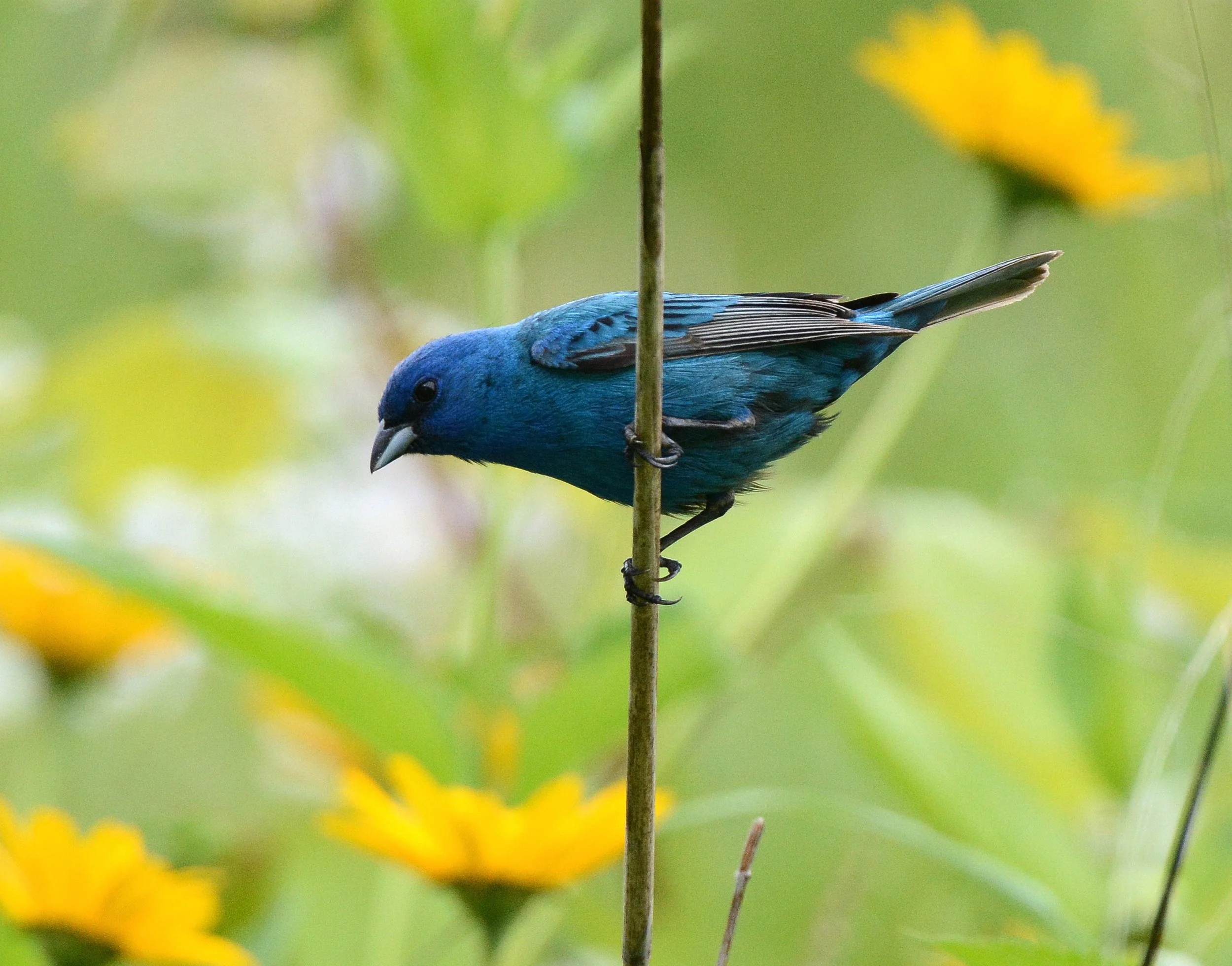
Header image: An Indigo Bunting perched on a branch (photo by Jim Hudgins/USFWS).
