
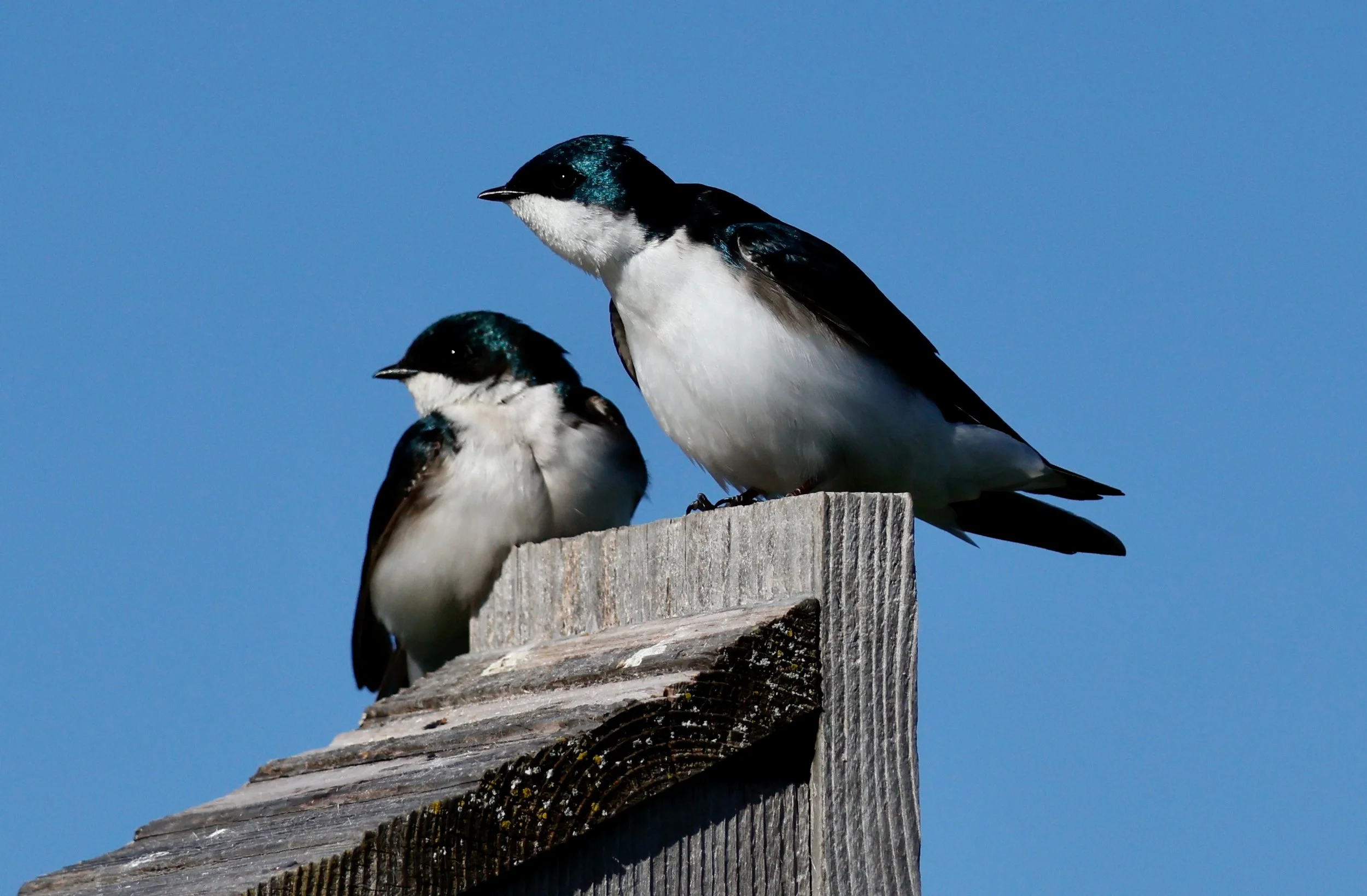
Tree Swallow pair perched atop a wooden songbird nest box (photo by Arlene Koziol).

The prairies, savannas, and wetlands of Southern Wisconsin Bird Alliance’s (SoWBA) Columbia County properties provide nesting habitat for countless birds and other creatures each year. While some species’ nesting needs are met simply by restoring and maintaining native habitat (planting prairie, shrubs, etc.), other species may need a little extra assistance. Without our support, cavity-nesting songbirds like Tree Swallows, Eastern Bluebirds, House Wrens, and Black-capped Chickadees would have much steeper competition for suitable nesting sites (and in the wide open prairies, they may not find suitable sites at all!). Although natural cavities can be provided by leaving standing dead trees, the easiest way to supply ample nesting cavities is to build and install songbird boxes.
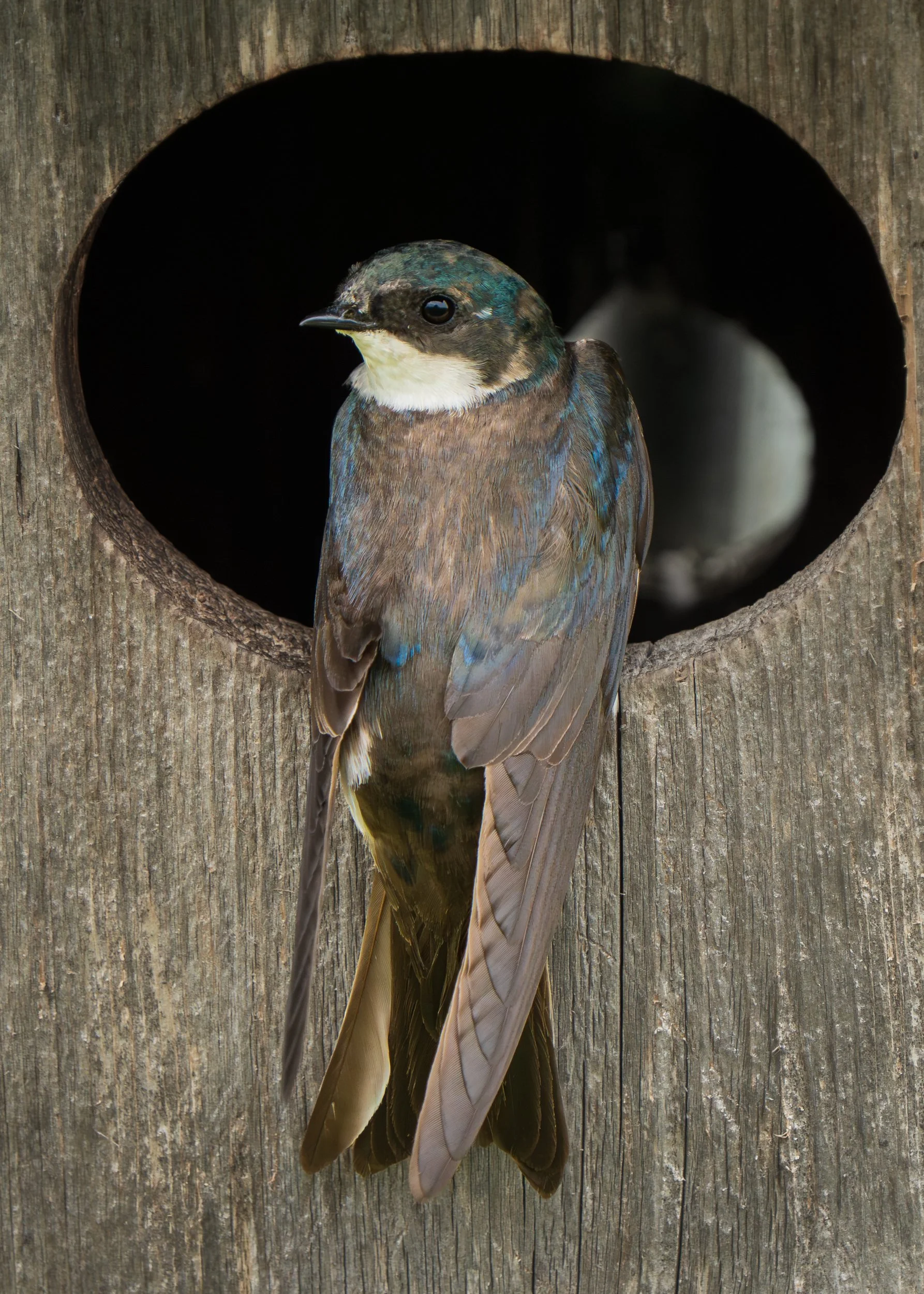
Tree Swallow at the entryway of a nest box (photo by Ralph Russo).
In 2025, there were 157 total songbird nest boxes available at Goose Pond, Erstad Prairie, and Otsego Marsh. From approximately early May to early July, volunteers diligently monitor each nest box to record which species is using the box, how many eggs they produce, and how many young they successfully fledge. This year, 72 percent of boxes were successful—yielding 535 Tree Swallow, 13 Eastern Bluebird, 24 House Wren, and four Black-capped Chickadee fledglings. That means 576 young birds hit the skies thanks to our nest boxes!
That is an impressive number—but how does it stack up compared to past years? The number of birds fledged this year (total and per box) was higher than the last two years but lower than 2022. This was the second year our boxes were equipped with Noel predator guards—predation was a little higher than last year, but much lower than in 2023 before installing the guards. Although 72 percent of boxes were successful in 2025, there were more active boxes whose eggs did not hatch. We suspect that some eggs could not survive the sudden cold temperatures at the beginning of the nesting season.
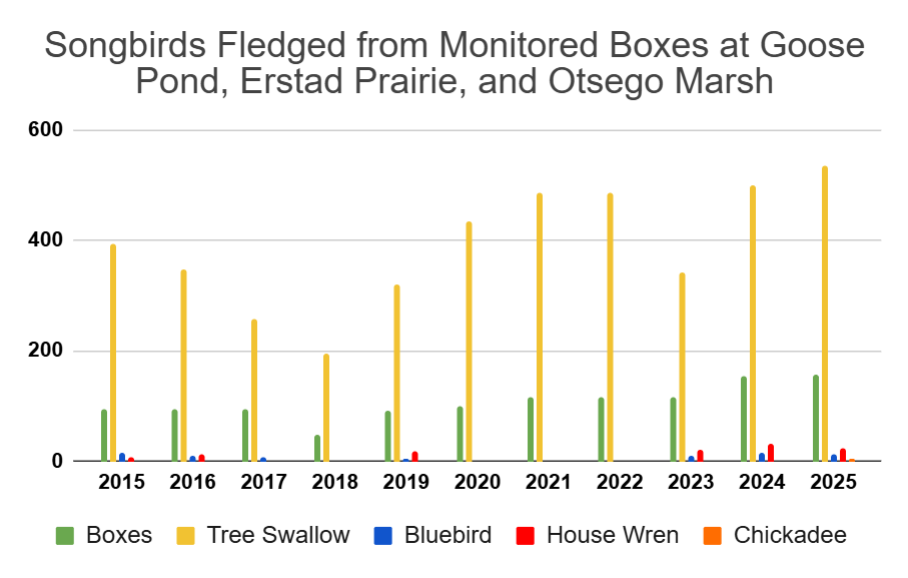
Number of each species fledged from monitored nest boxes.
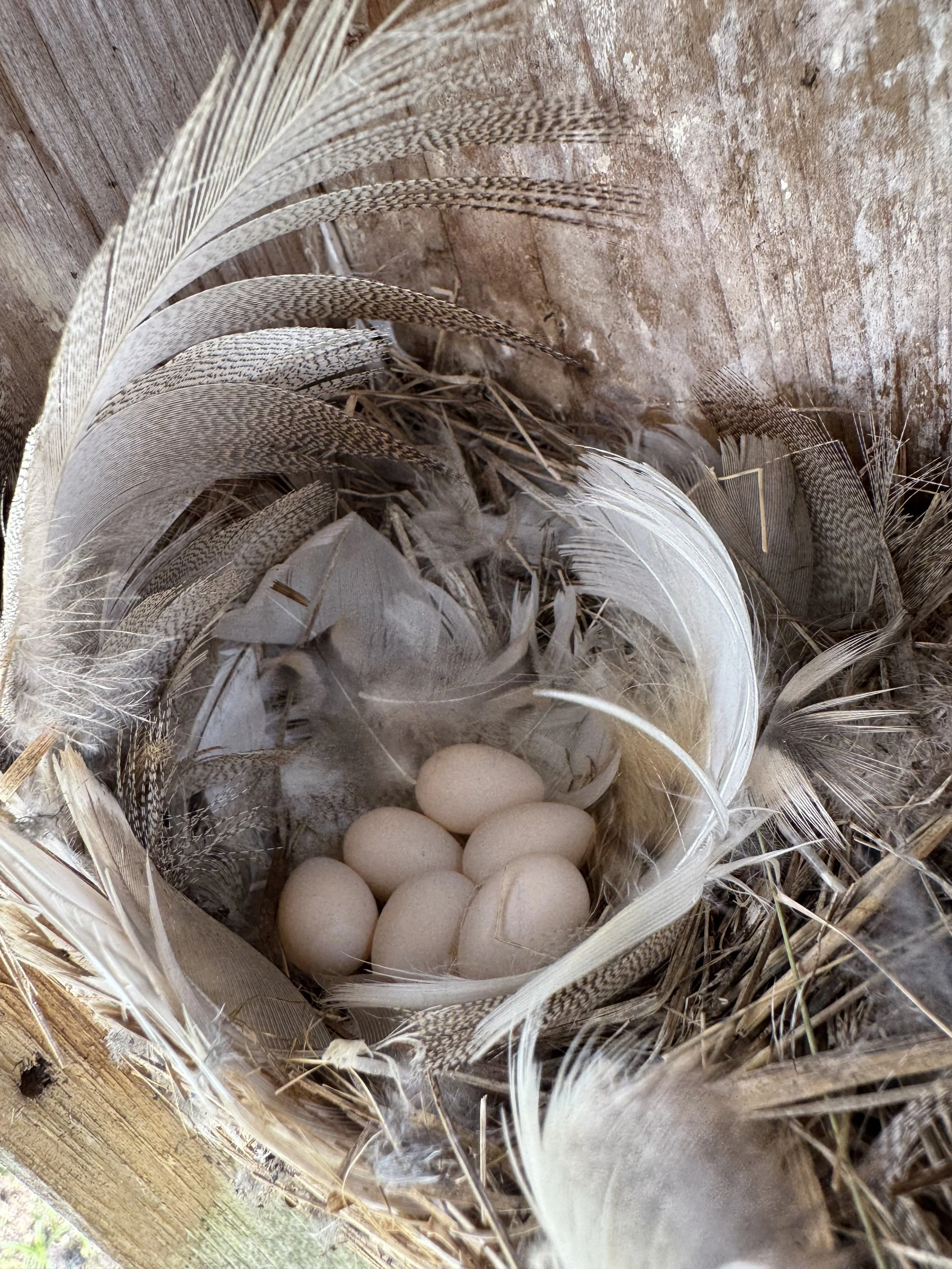
Tree Swallow nest (photo by Emma Raasch/SoWBA).
Although the design of our songbird nest boxes are often referred to as “bluebird boxes,” I usually think of ours as “swallow boxes” since the vast majority of them are occupied by Tree Swallows. This is due to the habitat that most of our boxes are hosted in: tallgrass prairie. Unlike bluebirds who prefer the shorter grass and scattered trees of savannas, Tree Swallows happily flock to the tall grasses and open skies of our restored prairies and associated wetlands. The few other species that inhabit our boxes (bluebirds, wrens, and chickadees) typically do so at Otsego Marsh or Erstad Prairie, where there is more savanna and woodland habitat. However, the Black-capped Chickadees took up residence at Goose Pond’s Bendade Prairie—this was the first time we’ve recorded chickadees using a nest box since we began monitoring in 2015.
Jerry Martin, a longtime SoWBA volunteer and supporter, constructed and donated over 250 nest boxes to our organization in 2010. Many boxes were erected at Goose Pond Sanctuary, but we also provided boxes to partners. Since Jerry made the boxes out of cedar, this durable wood has weathered well. Many of his boxes still stand today.
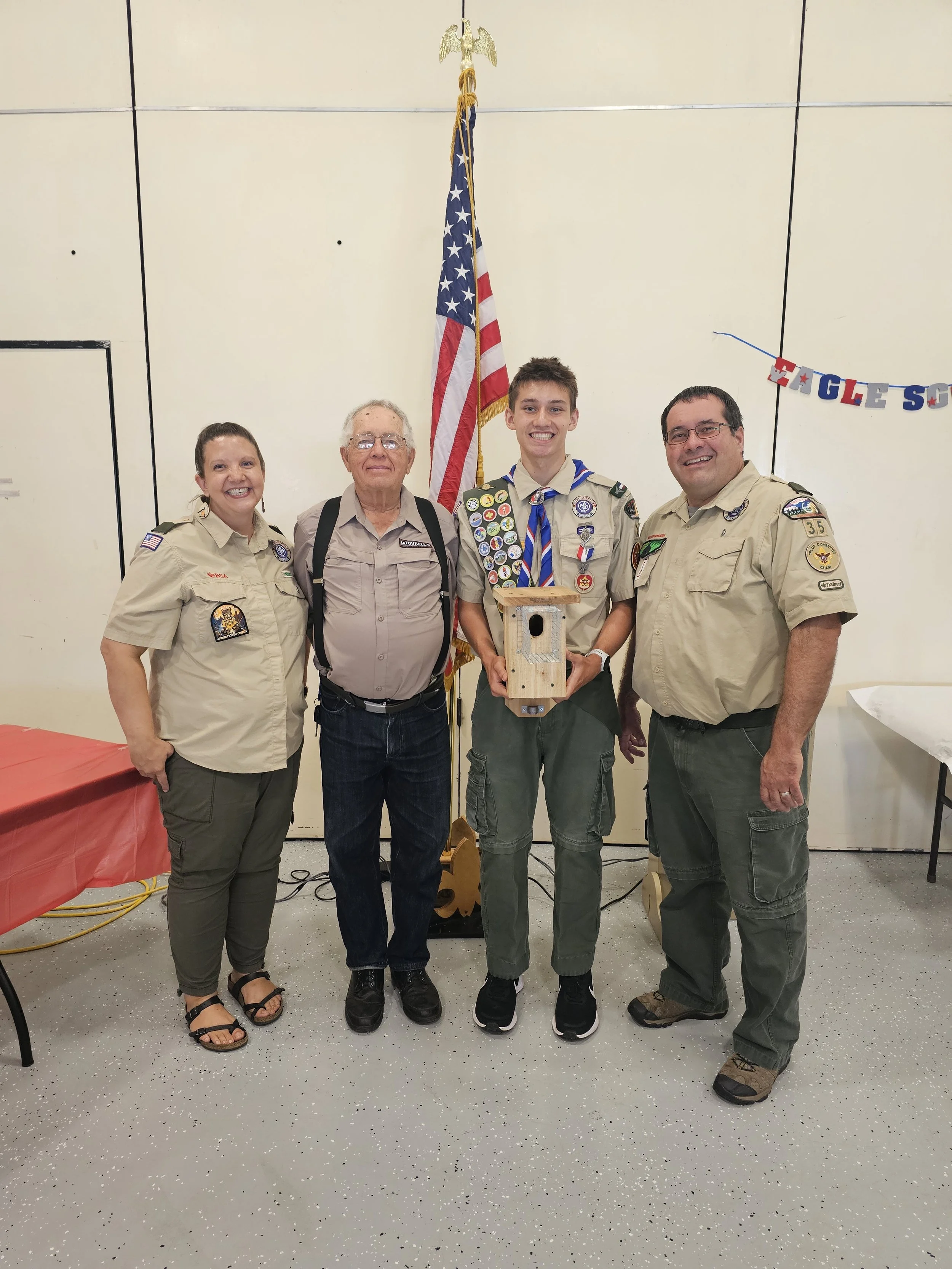
From left to right: Linnea Bertram, Mark Martin, Vince Bertram, and Mike Bertram (photo courtesy of Mark Martin).
Vince Bertram earned his Eagle Scout rank by coordinating his troop from DeForest to build 50 more nest boxes with Noel predator guards. Funding for supplies came from our Jill Martin Wildlife Endowment Fund. Thanks and congratulations, Vince!
Since 2015, our songbird nest boxes have provided safe, suitable places for 4,488 birds to hatch, grow, and fledge. This effort truly takes a village and we thank everyone who has helped build, maintain, and monitor our boxes through the years (the 4,488 birds surely thank you too!). Special thanks to our 2025 box monitors: Amy Ihlenfeldt, Bill Egbert, Bob Bennicoff, Amanda Nay, Chris Tarrant, Frank Iltis, Linda Horvath, Laura Anderson, Michael Dobiel, Nan Rose, Ralph Russo, and our 2025 summer interns: Becca Black, Andy Smith, and Logan Bahr.
Written by Emma Raasch, Goose Pond ecological restoration technician
