
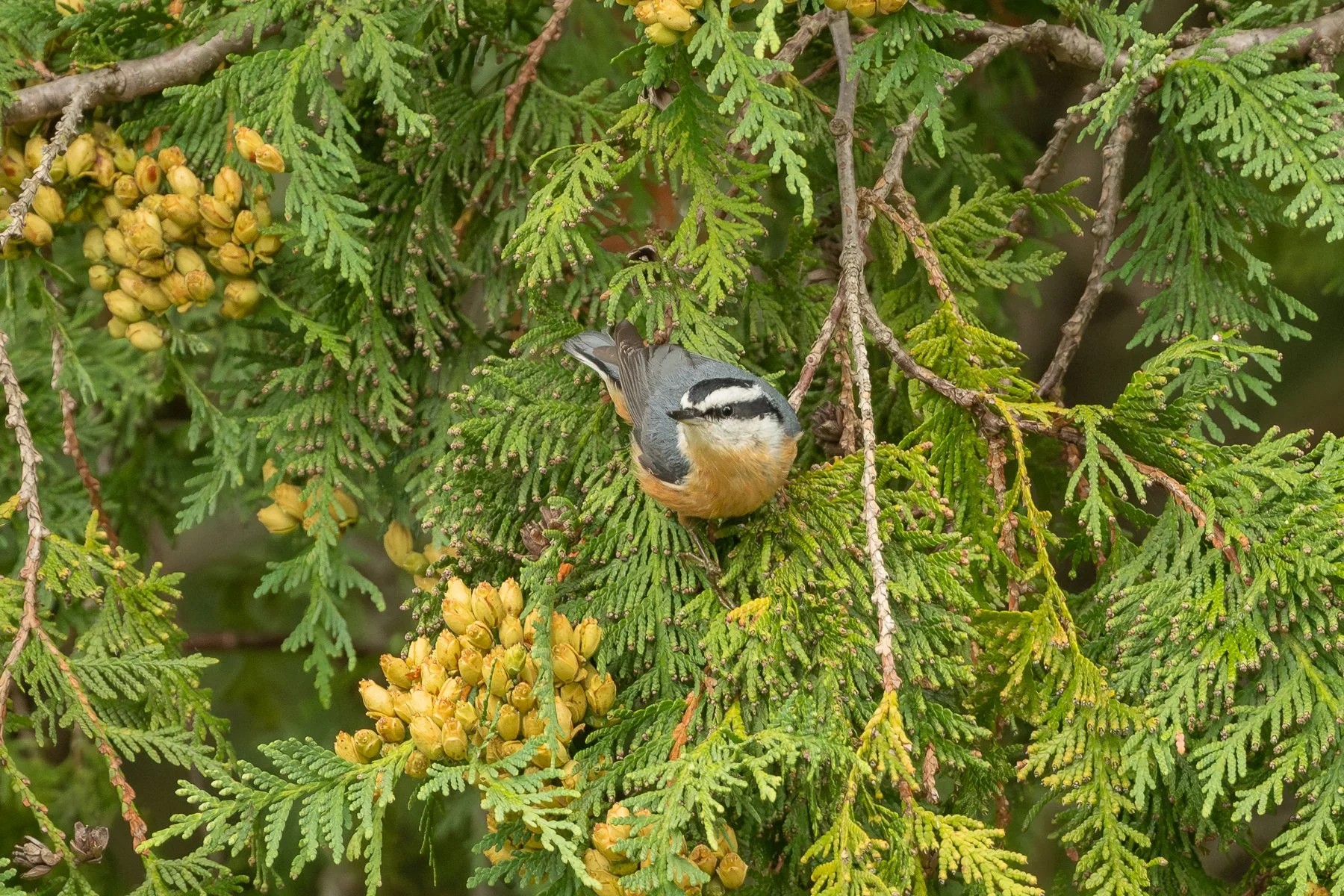

As I head out on a fall walk along a trail bordered with white and red cedars and Norway spruce, I hear a rapid, cheerful call that is not quite like that of our White-breasted Nuthatch. It is higher pitched and reedy, like a little tin horn. I catch some movement in one of the cedars and there is a tiny bird with a short tail and beautiful markings. It has a striking head pattern—a black cap with a white stripe above the eye (superciliary) and a prominent black eyestripe. It has a white cheek and throat and a warm, cinnamon-colored breast. There is only one possible identification—a Red-breasted Nuthatch, one of my favorite winter birds of Fair Meadows. The black cap indicates that it is a male; females have a grey cap.
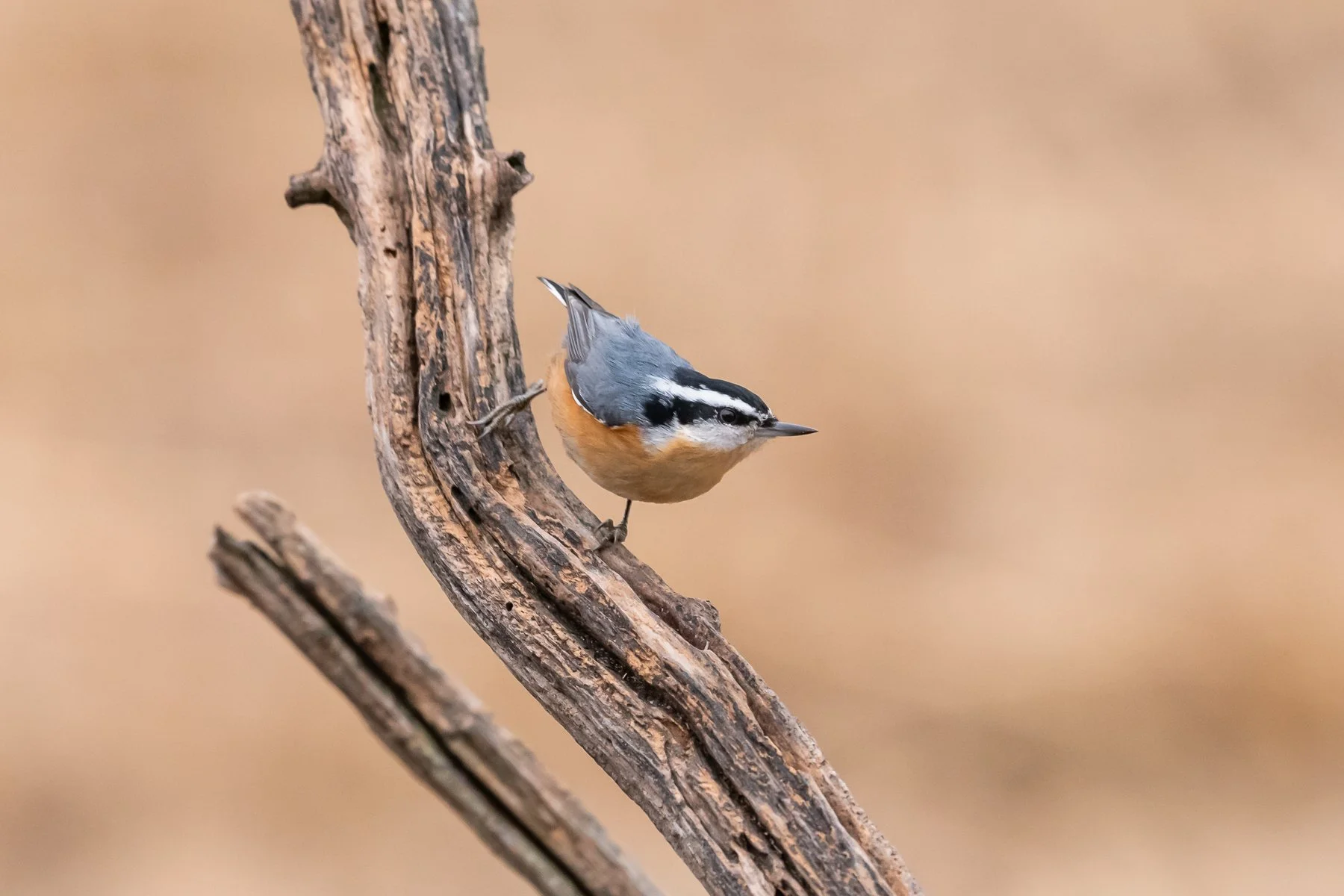
Male Red-breasted Nuthatch (photo by Gary Shackelford).
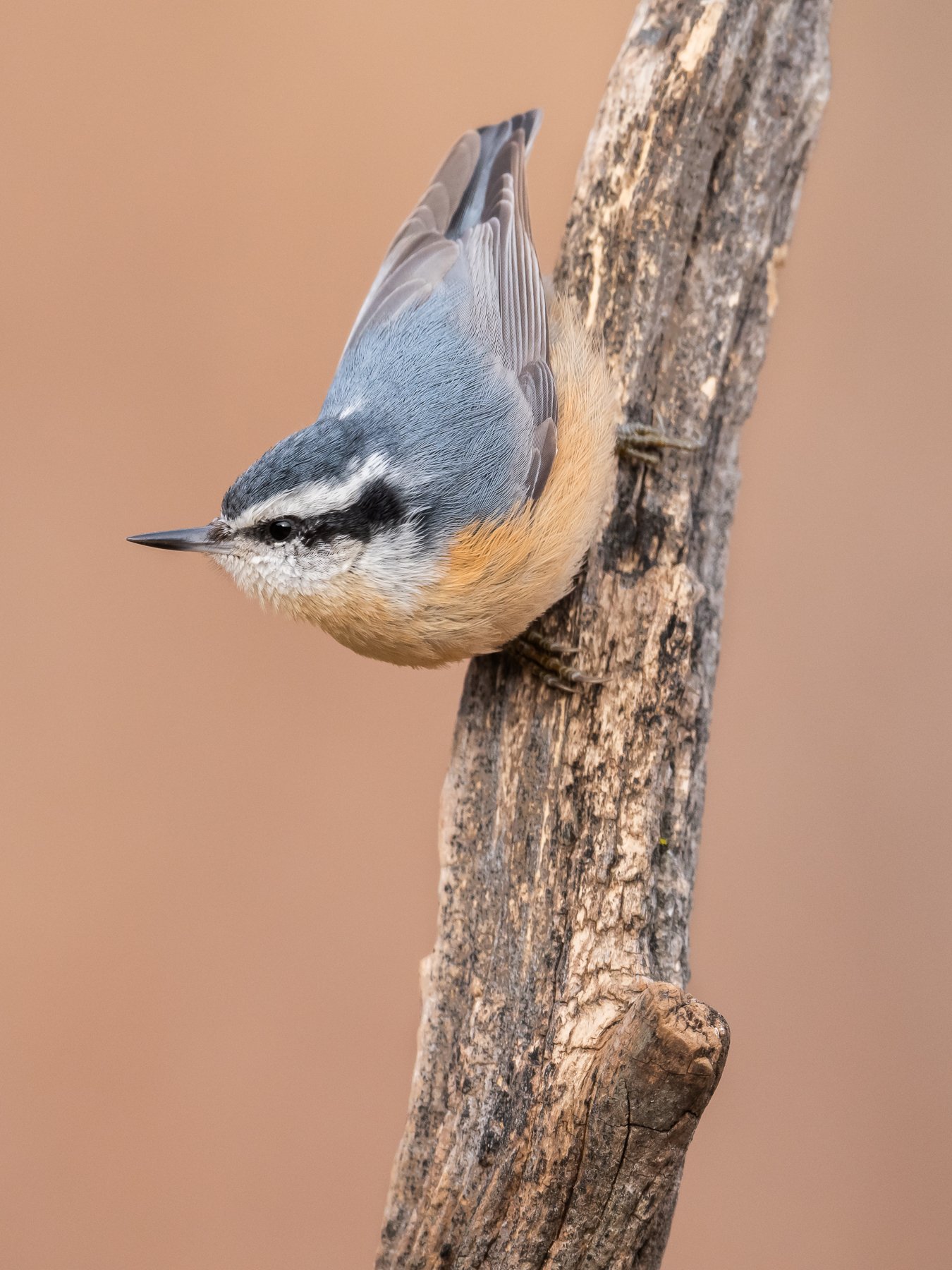
Female Red-breasted Nuthatch (photo by Gary Shackelford).
These active, sporty little birds breed in northern Wisconsin, Minnesota, and Michigan, in addition to the northeastern United States and the Rocky Mountains. They also breed throughout the coniferous boreal forests of Canada from the west to the east coasts. Their range appears to be expanding southward, probably related to the increase in conifers, particularly pine plantations. Red-breasted Nuthatches are partial migrants, meaning that in the winter, the most northern birds regularly move southward, whereas those breeding in the more southern zones may winter in place. However, if there is a shortage of food, all the birds will move south in what is called an “irruption.” Irruptions are common for Red-breasted Nuthatches and may occur almost every other year. According to the Cornell Laboratory of Ornithology, the nuthatches that overwinter in southern Wisconsin likely breed in Ontario. Beginning in August, they move south to the northern shore of Lake Ontario and then turn west into Michigan, Wisconsin, and Minnesota.
We begin to see Red-breasted Nuthatches in September, and then throughout the winter until early spring. We have seen them in 19 of the past 25 winters. They eat the seeds of pines, spruce, and cedars, but also enjoy a free lunch of sunflower seeds and suet at the feeders.
One year, we documented a pair of Red-breasted Nuthatches nesting at Fair Meadows. We observed the pair carrying food into a cavity in an aspen that was located within a small plantation of conifers. This may be one of the southernmost nesting records in Wisconsin. In the first Breeding Bird Atlas, the only record of nesting in the southern counties along the Illinois border was in northern Walworth County.
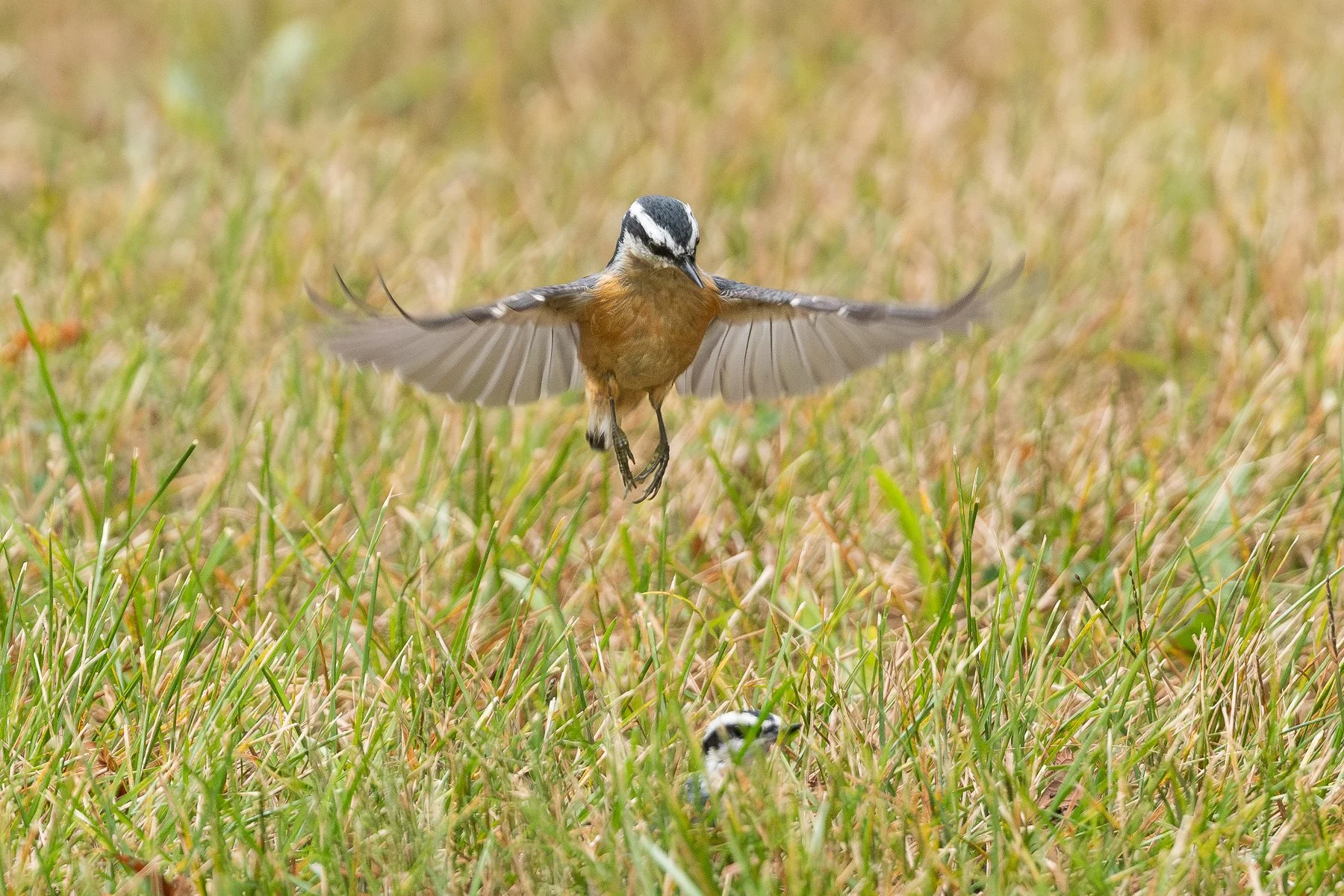
Female Red-breasted Nuthatch hovering over a male in the grass. She may be fly-catching, an activity sometimes used by this species (photo by Gary Shackelford).
Red-breasted Nuthatches always nest in cavities, usually aspens or conifers. Unlike White-breasted Nuthatches, which use natural cavities or those created by woodpeckers, Red-breasted Nuthatches excavate the cavity themselves. The female does most of the work while the male brings her food and stands guard nearby. The nest in the cavity is built with grass, bark shreds and pine needles.
The life history of the Red-breasted Nuthatch has many interesting features but top of the list for me is their practice of smearing the entrance to their cavity nest hole with conifer resin. This is most likely done to discourage predators. Studies have shown that House Wrens, deer mice, and red squirrels avoid cavities smeared with resin. Red-breasted Nuthatches can fly at high speed directly into the cavity, bypassing the resin barrier.
Soon, the Red-breasted Nuthatch that has visited our feeder all winter will probably head back north. We will miss him and listen for his little tin horn next fall.
Written by Penny Shackelford, Fair Meadows Sanctuary manager
Cover photo by Gary Shackelford. Male Red-breasted Nuthatch foraging on the seeds of white cedar.
