
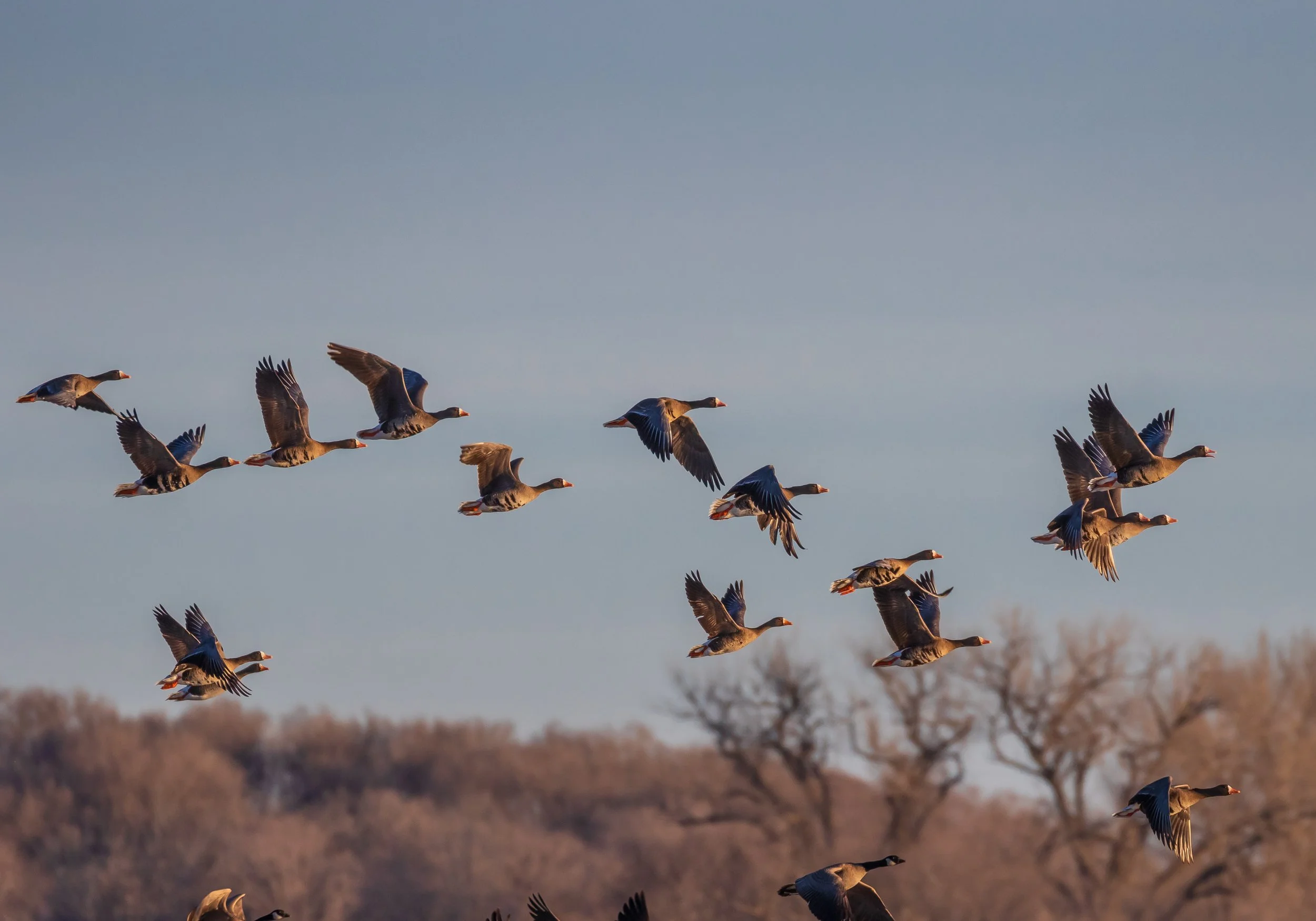

As Aldo Leopold wrote in A Sand County Almanac, “One swallow does not make a summer, but one skein of geese, cleaving the murk of a March thaw, is the spring.” These early days of the new season unfurl to a soundtrack of honks and bugles from migrating waterfowl. As flocks of cranes, geese, and ducks pass overhead, keep an ear out for less familiar calls such as the high-pitched yodel of Greater White-Fronted Geese (Anser albifrons).
Greater White-fronted Geese (or “speckle bellies”) can be seen flying in either a “V” or a line formation overhead, returning to their tundra breeding grounds for the season. These are social birds which form strong bonds and can often be spotted in mixed flocks with other waterfowl. A bit smaller than Canada Geese, these birds can be easily distinguished from their peers by the patch of white around their bill for which they are named and their stocky gray bodies. Their feet and bill share the same slightly peachy orange color. The black barring on their bellies is helpful for identification from below. There are five subspecies partitioned by geography and recognizable by differences in size, but only Anser albifrons frontalis can be seen in Wisconsin.
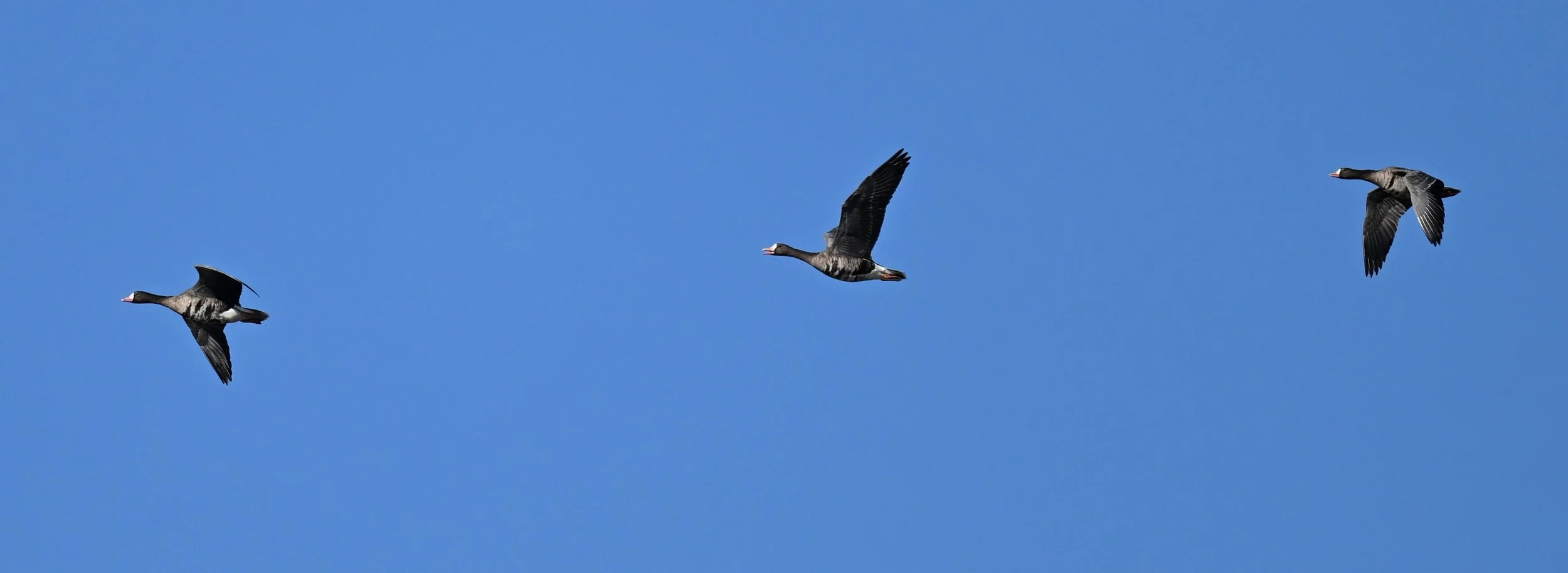
Note the speckling on the bellies of these geese in flight (photo by Andy Reago & Chrissy McClarren).
The cooperative behavior and expressive postures of white-fronts make them entertaining subjects for birdwatchers. They establish boundaries with hissing, groom their monogamous partners, and maintain familial relationships years into adulthood. Parents share information about finding roosting areas, foraging techniques, and migratory patterns. The parental relationship is much more extensive than that in most other bird species. While this time spent together enhances the fitness of their offspring, it comes at a cost to parents who invest less time into feeding themselves. The calculus of evolution has so far determined that the tradeoff is worth it.
Their most showstopping performance is their “triumph display,” a ritual that is common in geese pairs. The pair-bonded male, sometimes upon provocation by his female mate, lashes out at another male, squawking and biting. Then he turns and boasts to his female mate with wings open and neck outstretched, and the pair erupt in a fit of laughter.
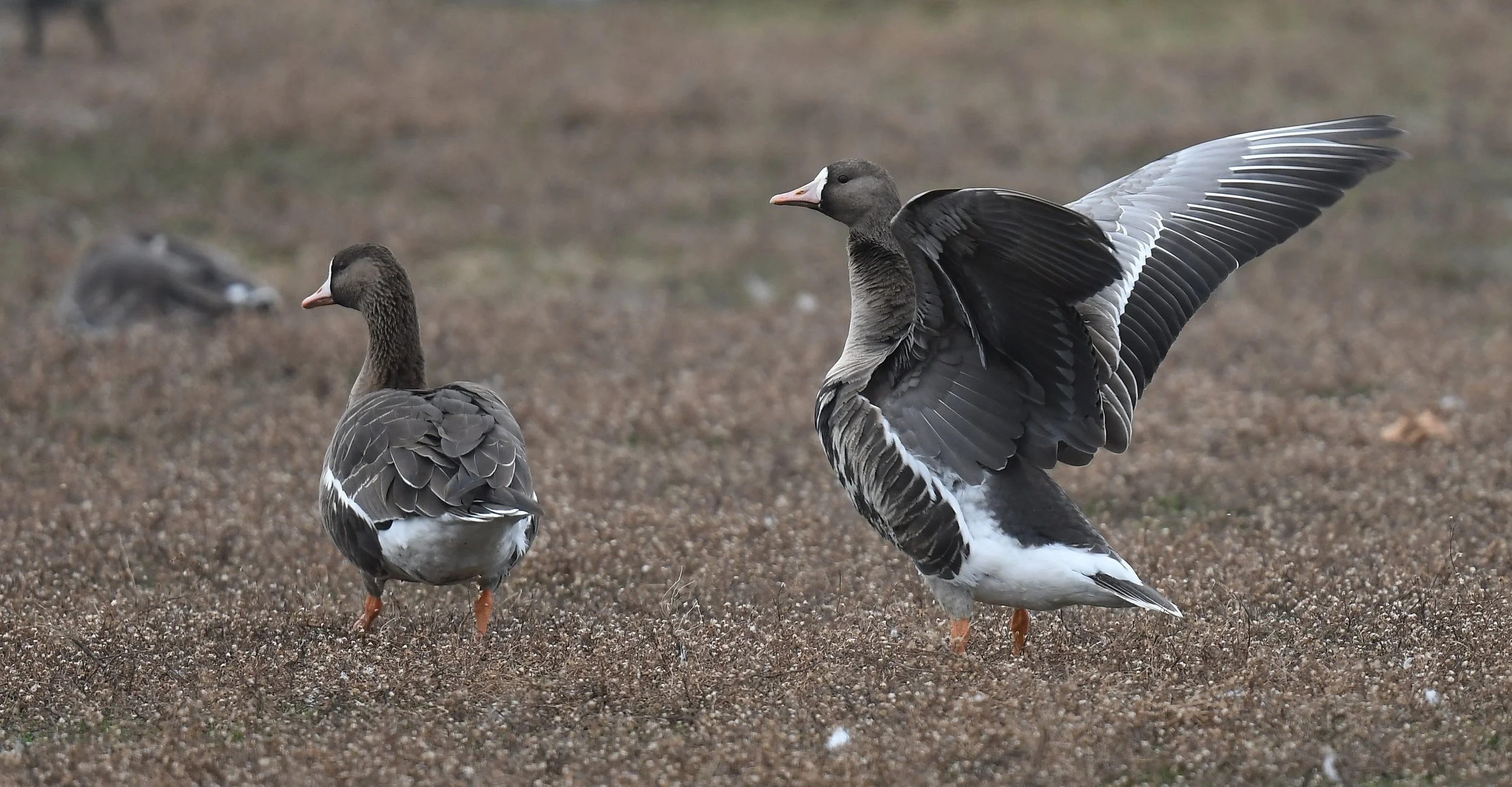
A pair of Greater White-fronted Geese (photo by Andy Reago & Chrissy McClarren).
Wisconsin falls on the easternmost edge of their migratory range, but observations in the region have grown in the past few decades and their overwintering grounds appear to be expanding eastward. Their numbers are booming across North America, which research suggests may be due to a shift in land use. White-fronts prefer to spend winters in wetlands and feeding on grains—especially rice—in agricultural fields throughout California, the Mississippi Alluvial Valley, and in the Gulf Coastal Plain. Rice farmers in these areas often burn off the stubble from the last harvest season in the winter, but some regional bans on burning fields have been put in place over the last few decades. Some have taken to flooding the fields instead, which has had dramatic effects on lots of waterfowl. These flooded fields provide hundreds of thousands of acres of habitat for many duck and goose species, which feed on the rice stubble as well as weeds and aquatic invertebrates. It follows that the abundant wetland and agricultural fields of Wisconsin are attractive stopover points for these migrating geese, who we may be seeing even more of in years to come. Listen for these while you can—they’ll likely be gone by April.
Written by Soraya Castle, Faville Grove land steward
Cover photo by Mike Budd/USFWS. A flock of geese in flight, composed primarily of Greater White-fronted Geese.
