


Jon Peacock (left) and Mike Myers (right), raptor enthusiasts and Winter Raptor Survey volunteers (photo courtesy of authors).
We have been interested in raptor migration for decades. A few years ago, a fellow member of the Hawk Migration Association (HMA) told us about the ongoing Winter Raptor Survey project, and he encouraged us to take part. We decided to take him up on it.
The goal of the project is to determine the winter status of raptors across North America. Participants set their own survey routes, which ideally they travel once monthly for three consecutive months (December to February) and for multiple years. HMA established a protocol for the surveys, which includes counting and collecting data on all the raptors observed (species, age, gender, color morph, as well as the GPS coordinates and habitat where each bird is observed). To date, HMA has over two hundred routes, with at least one in 37 states and one in Canada (see map here).
The two of us do two routes: one in Grant County and one in Columbia County. Our 55-mile Columbia County route begins a little south of Goose Pond Sanctuary, which it passes as it heads north toward the Wisconsin River for a stretch near Dekorra and to the Columbia power plant cooling pond. From there it turns east and crosses Hwy 22 and takes us around Mud Lake before returning to a point near where it begins just off Hwy 51 south of Leeds.
Over the last four years, we have surveyed that route 12 times and tallied a total of 548 raptors. Although we have seen a wide variety of birds of prey—11 different species—the vast majority (87%) have been Bald Eagles and Red-tailed Hawks. The number we observe can vary widely, with a high of 84 in February 2024 and a low of just 15 in December of that year.
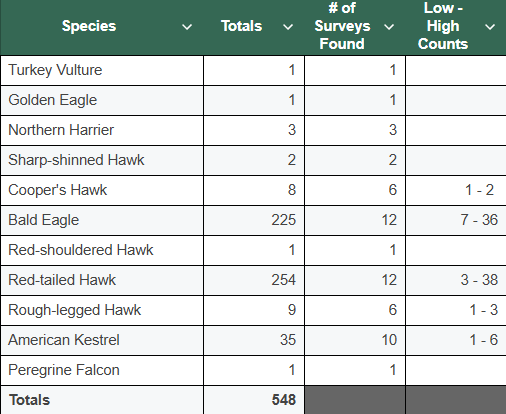
Table with results of 12 Winter Raptor Surveys, January 2023 to February 2026.
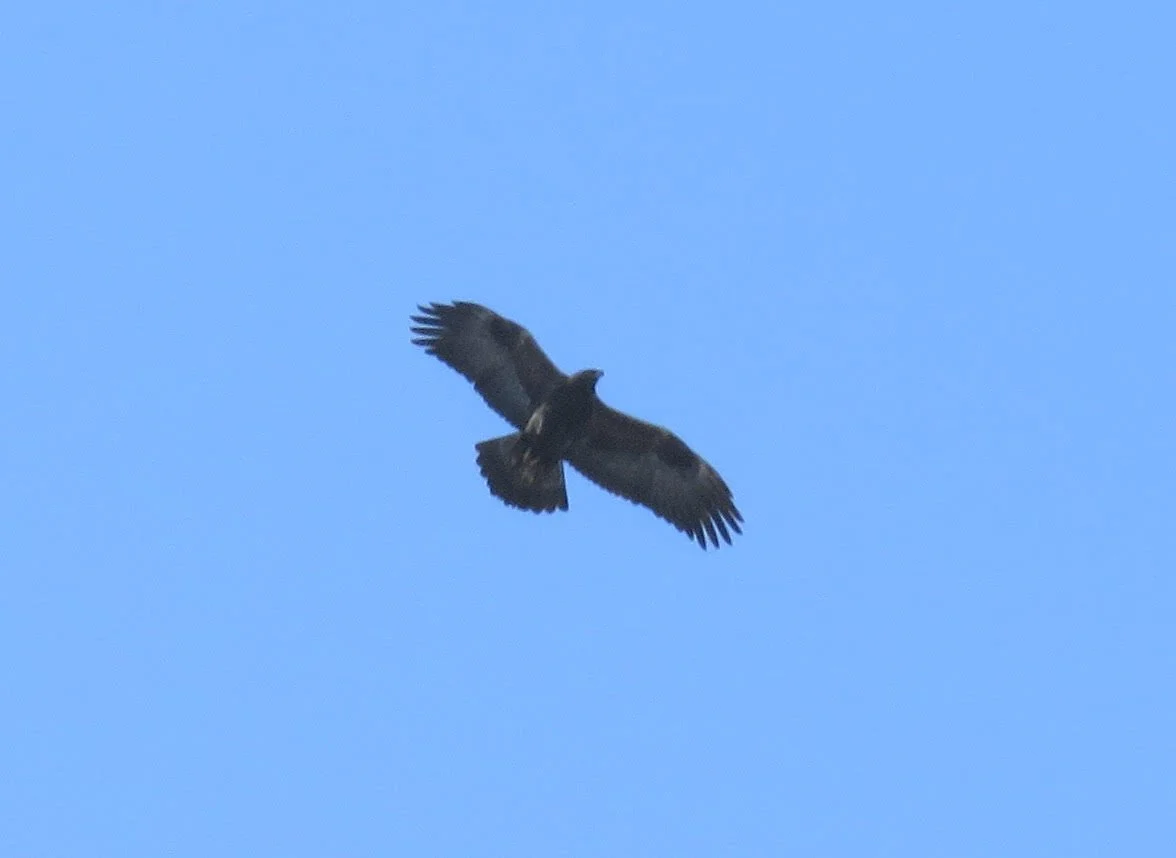
Soaring Golden Eagle (photo by Mike Myers).
Some of the highlights so far have included a Golden Eagle a few miles south of Dekorra, a Peregrine Falcon at the Columbia Power Plant, and an adult Red-shouldered Hawk that was bathing at the edge of the Wisconsin River. For a couple of years, we saw adult Bald Eagles on or near a nest visible from Goose Pond Road, but that nest blew down a year or two ago.

Dorothy, a Rough-legged Hawk banded near Goose Pond in 2021 (photo by Neil Paprocki).
We enjoy seeing the occasional Rough-legged Hawk—it’s a species that only visits our state for a few months, is rare in much of the United States, and has attractive and varied plumage. Most of the eight rough-legs that we have seen during our Columbia County surveys were within a mile or two of Goose Pond. This species’ attraction to that area has also been illustrated by a radio-tagged, female rough-leg called Dorothy. This bird is thought to be at least nine years old, and tracking data shows from December 2021 through this winter that she goes between Goose Pond and north of Montello. We assume that we probably saw her on our surveys but have not checked out her exact locations from the Rough-legged Hawk study.
One of the questions that the Winter Raptor Surveys seek to answer is why the number of raptors observed can vary so much from one count to the next. Of course, weather is an important factor. Fog and precipitation generally suppress counts, and high wind may also be a negative factor. Sunshine makes it easier to spot perched raptors and helps create thermals that enable more buteos and eagles to soar, which may help surveyors see them. On the other hand, pure blue skies make it more difficult to spot soaring hawks.
To help gauge the influence of different variables, part of the survey protocol is to collect a variety of data at the beginning and end of each survey, including temperature, wind, visibility, sky conditions, snow cover, and whether water bodies are open or frozen.
Aside from the raptors, other highlights have included a few Common Ravens, an occasional flock of Snow Buntings, and we once saw more than 2,000 Lapland Longspurs near the Arlington experimental farm. On many parts of the route, we see Horned Larks, and on a couple of our December counts, we saw lingering flocks of cranes.
On the HMA website for the Winter Raptor Survey you can find all of our Columbia County and Grant County counts, as well as the most recent surveys from other parts of the country.
Written by Mike Myers and Jon Peacock, raptor enthusiasts and volunteer citizen scientists
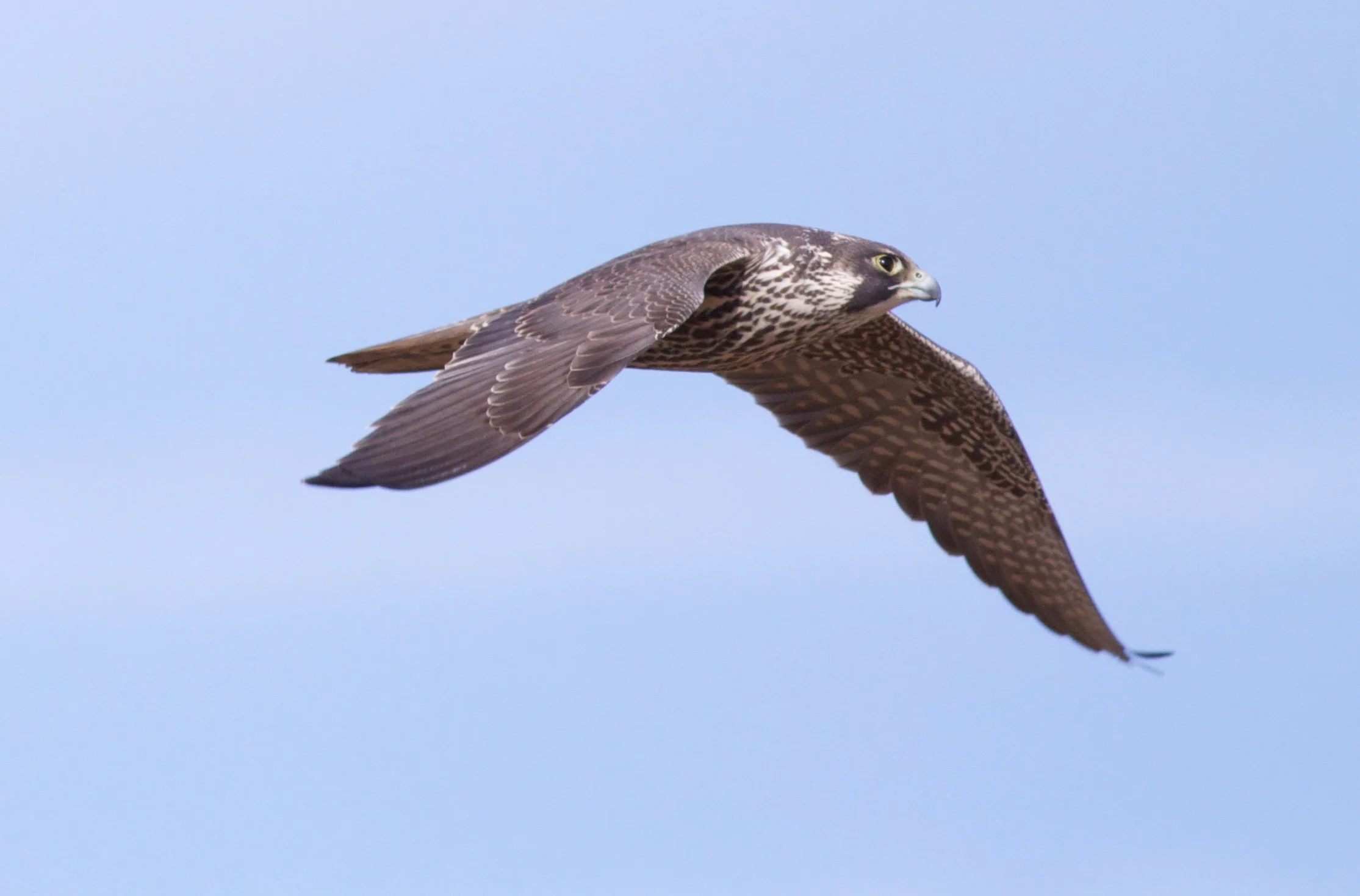
Cover image by Arlene Koziol. A Peregrine Falcon in flight.
