

“If the warble of the first bluebird does not thrill you, know that the morning and spring of your life are past.”
“The bluebird carries the sky on his back.”
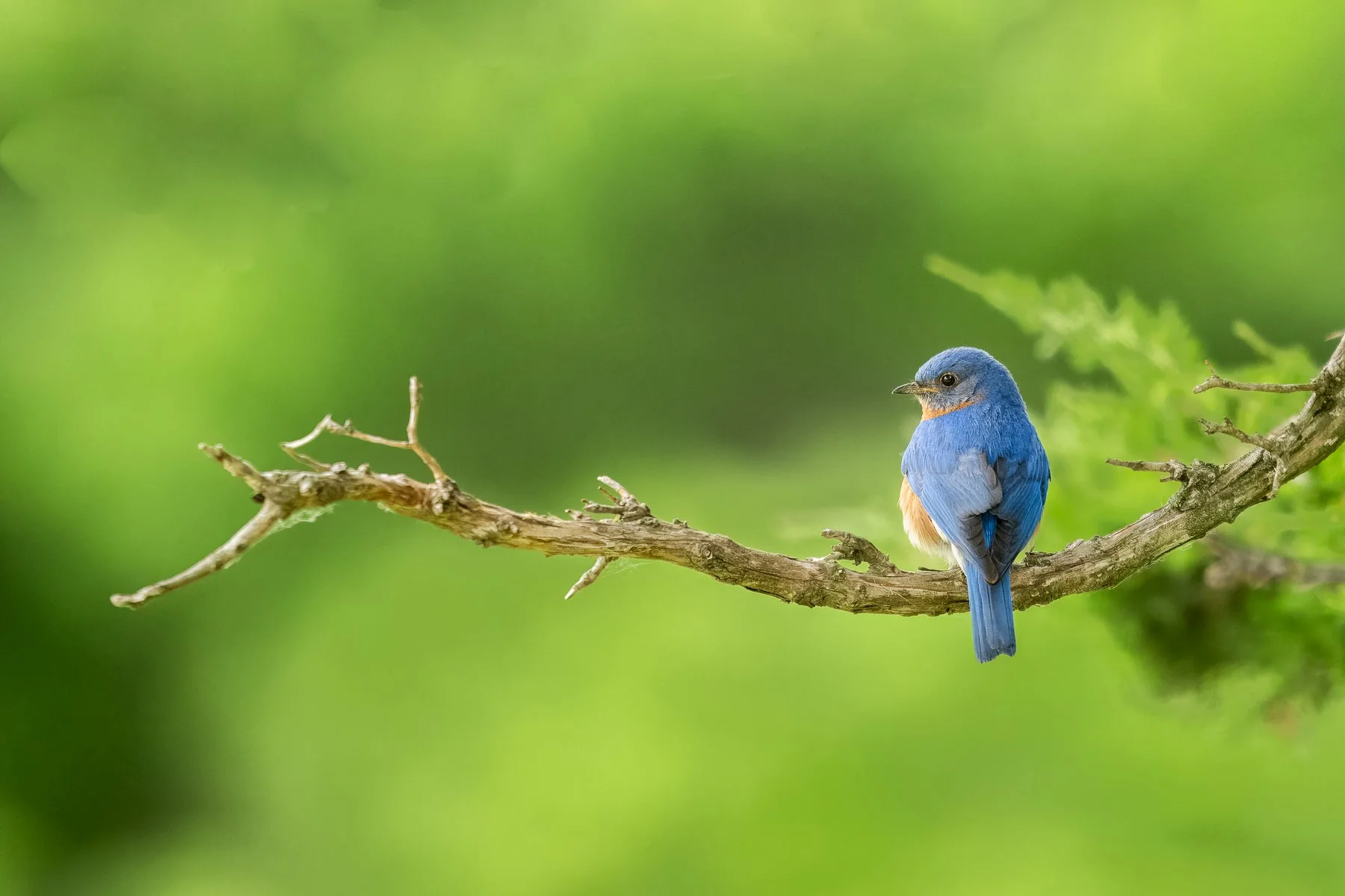
It is early spring, and Eastern Bluebirds are back. Our first arrivals at Fair Meadows Sanctuary this year showed up on February 9—a pair that were hanging around the house and feeders in the early morning. The soft warbles of the singing male and the sky-blue color on his back, so perfectly described by Henry David Thoreau in his journal, emphasize some of the charm of bluebirds as a harbinger of spring and as the avian embodiment of the brightest summer sky. When early American colonists noticed these gentle blue birds with russet breasts, they called them “blue robins” because of their similar shape and breast color to that of the Old World European Robin. The head, back, and tail of the male Eastern Bluebird are a brilliant royal blue; the chest and throat are rufous to chestnut, contrasting with a white belly. The female is largely gray on her upperparts, although there is some blue on her wings and tail. Her underparts are more subdued rufous than those of the male. Females may show varying degrees of a white eye ring. The flecking or spotting on the back and chest of juveniles is an attribute found throughout the family Turdidae (thrushes).
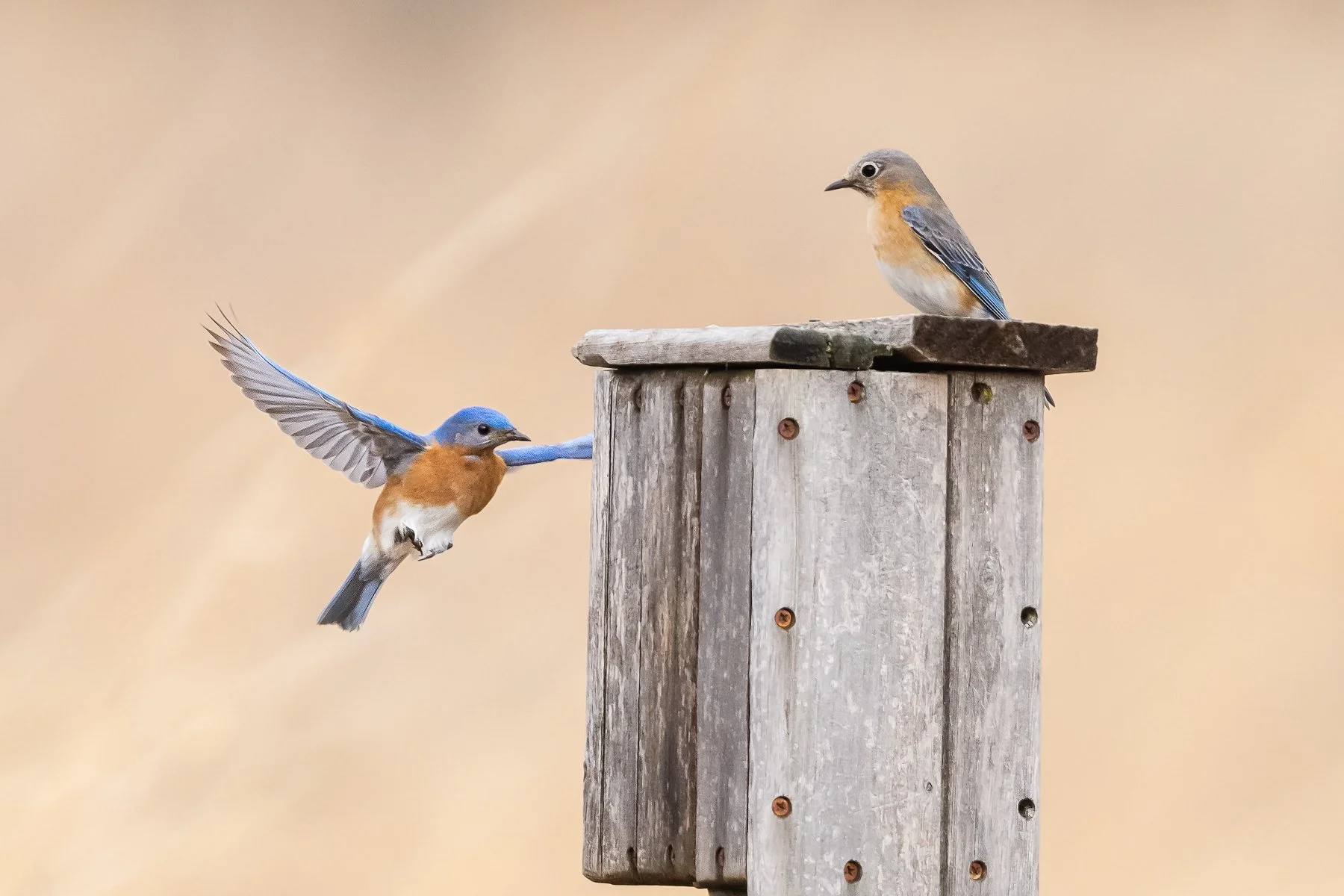
Male and female Eastern Bluebirds at a nest box (photo by Gary Shackelford).
This year’s bluebirds were indeed early birds. Most years, we see the first bluebirds in late February or early March. By early April, spring migration is well underway. Rarely, a pair will spend a warm winter at Fair Meadows, feeding mostly on small fleshy fruits and huddling together at night to escape cold—a risky proposition. Bluebirds are known to use cavities, such as nest boxes, for nightly roosting in late winter and early spring. They crowd together to conserve heat, but extreme cold can be fatal if they cannot find food. One year in mid-March, we were doing our annual chore of cleaning out our nest boxes on a day after the previous nighttime temperature had dipped to 10 degrees. On opening one of the boxes, we found two dead bluebirds. They likely succumbed to the cold overnight.
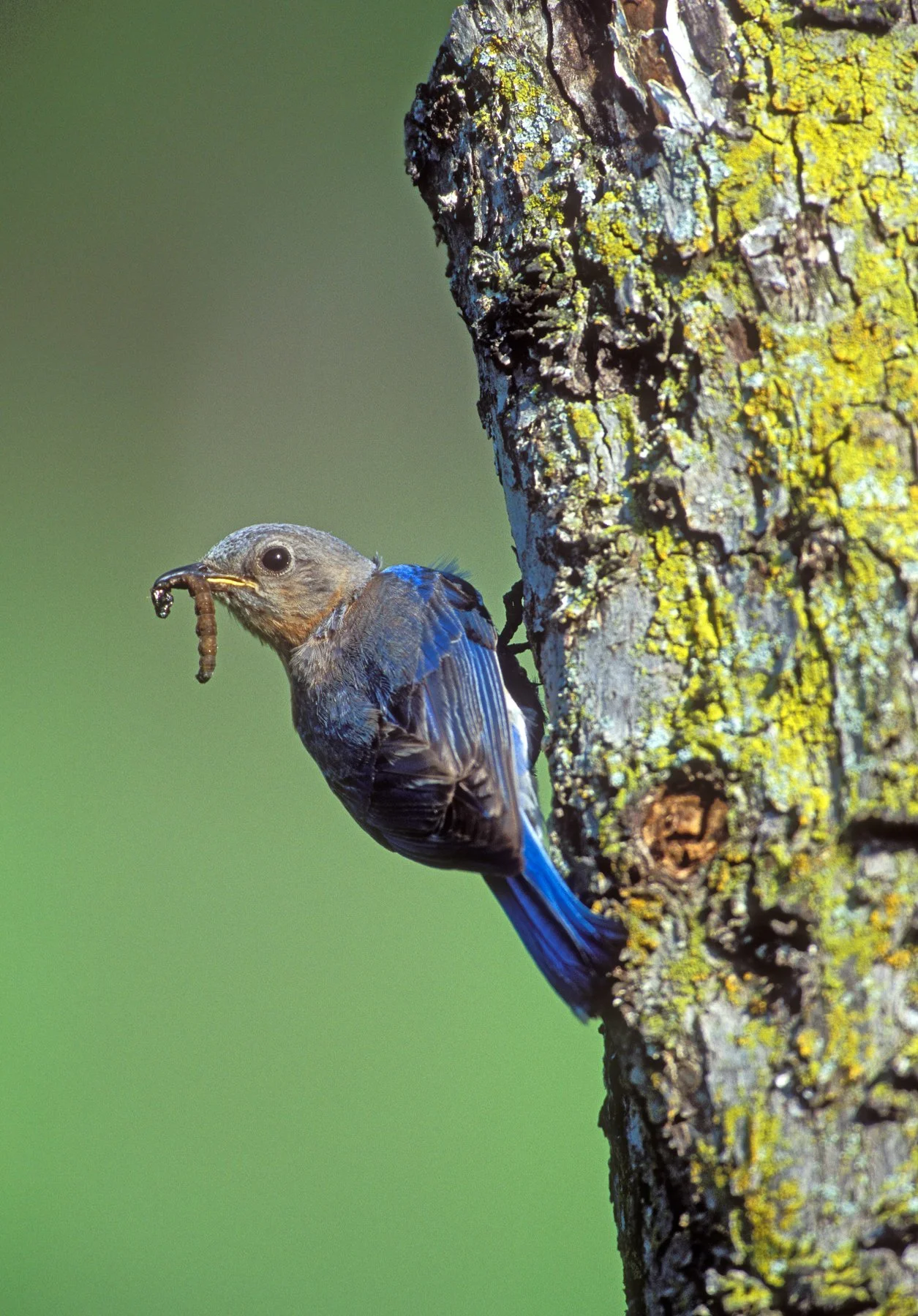
Female Eastern Bluebird with food at a nest cavity in an apple tree snag (photo by Gary Shackelford).
Bluebirds in southern Wisconsin usually begin nesting in mid to late April. Their preferred habitat is grasslands with scattered trees, forest edges, farmland interspersed with pastures and woodlots, and backyards in rural areas. Nests are in natural tree cavities or in old woodpecker holes. During bygone years, before the advent of metal fenceposts, bluebirds frequently nested in holes in wooden posts. Bluebirds will readily use nest boxes too, but in our experience they seem to prefer natural tree cavities to artificial boxes. When they do opt for nest boxes, there can be keen competition between bluebirds and Tree Swallows. Determination of which species prevails depends on a number of factors, including who gets there first and whether the birds are defending their occupied or previously owned box or are competing over a new box. Fortunately, natural cavities are plentiful at Fair Meadows, so both species are easily accommodated. The bluebird nest itself is a loosely built cup made of fine grasses, pine needles, or other soft material, usually without any feathers in the lining. The female does all the building. Only she incubates the four to six pale blue eggs, but young are tended by both parents. Bluebirds usually raise two broods per season.
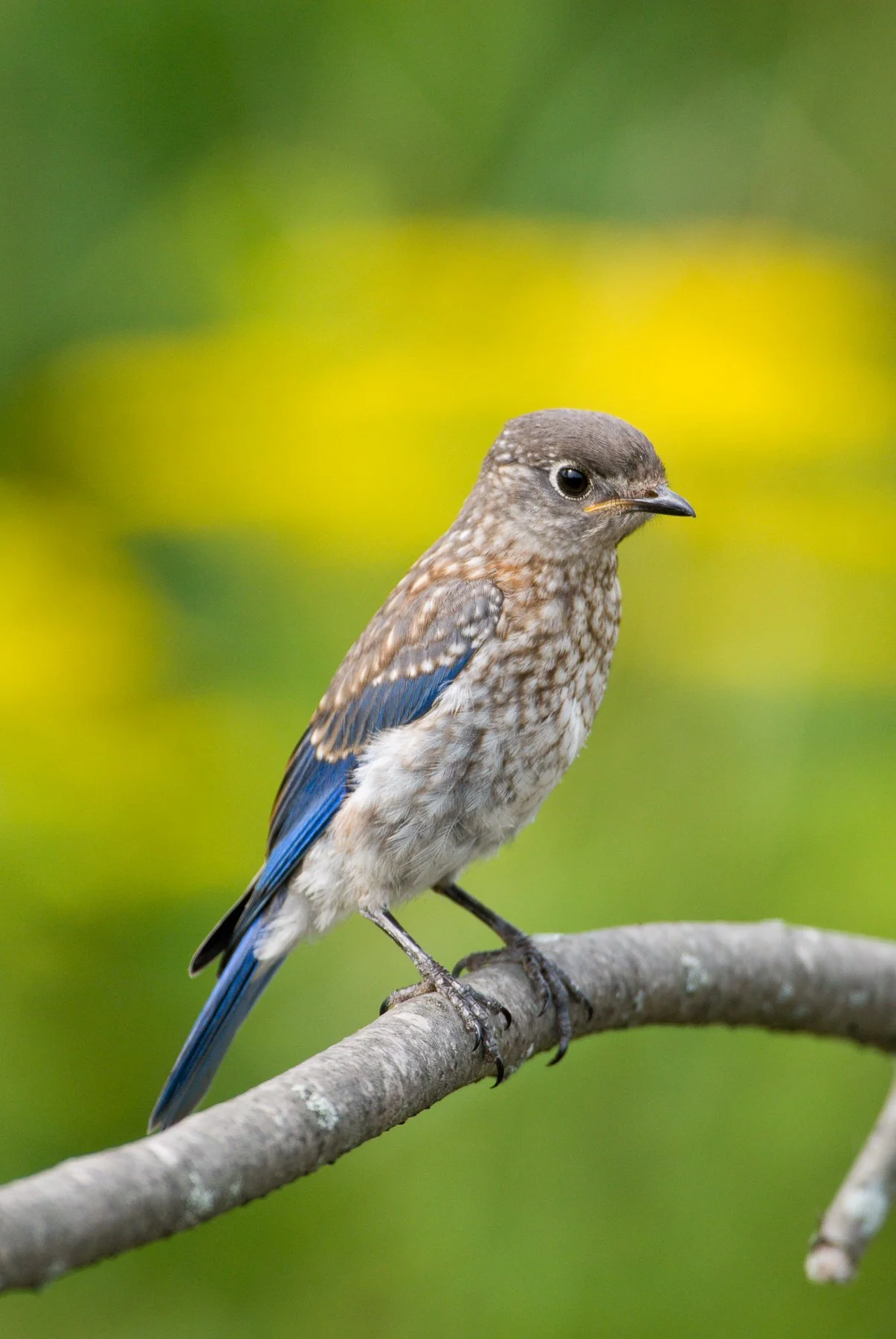
Juvenile Eastern Bluebird perched on a branch (photo by Gary Shackelford).
Bluebirds and American Robins are both thrushes, but they employ different foraging strategies during breeding season. Robins forage for worms and other invertebrates on the ground. Bluebirds are primarily perch-foragers, searching for small arthropod prey on bare ground or grassy areas from an elevated perch. After they find a potential victim, they drop to the ground to capture it. Occasionally, larger prey items are captured. This fact was revealed to me in early June a few years ago when I was photographing from a blind in one of the prairies at Fair Meadows. A rain shower had moved in, providing conditions for making creative images. A cooperative male bluebird suddenly flew onto a nearby nest box with a dragonfly in his bill. I did not know whether a female was incubating eggs inside. After a few moments, he flew away without entering the box, still carrying his catch. On returning several minutes later, he no longer had the dragonfly. I will never know how the bluebird had managed to capture such a large creature, or the dragonfly’s ultimate fate, but this encounter allowed me to experience an unforgettable event and to document it with a photograph.
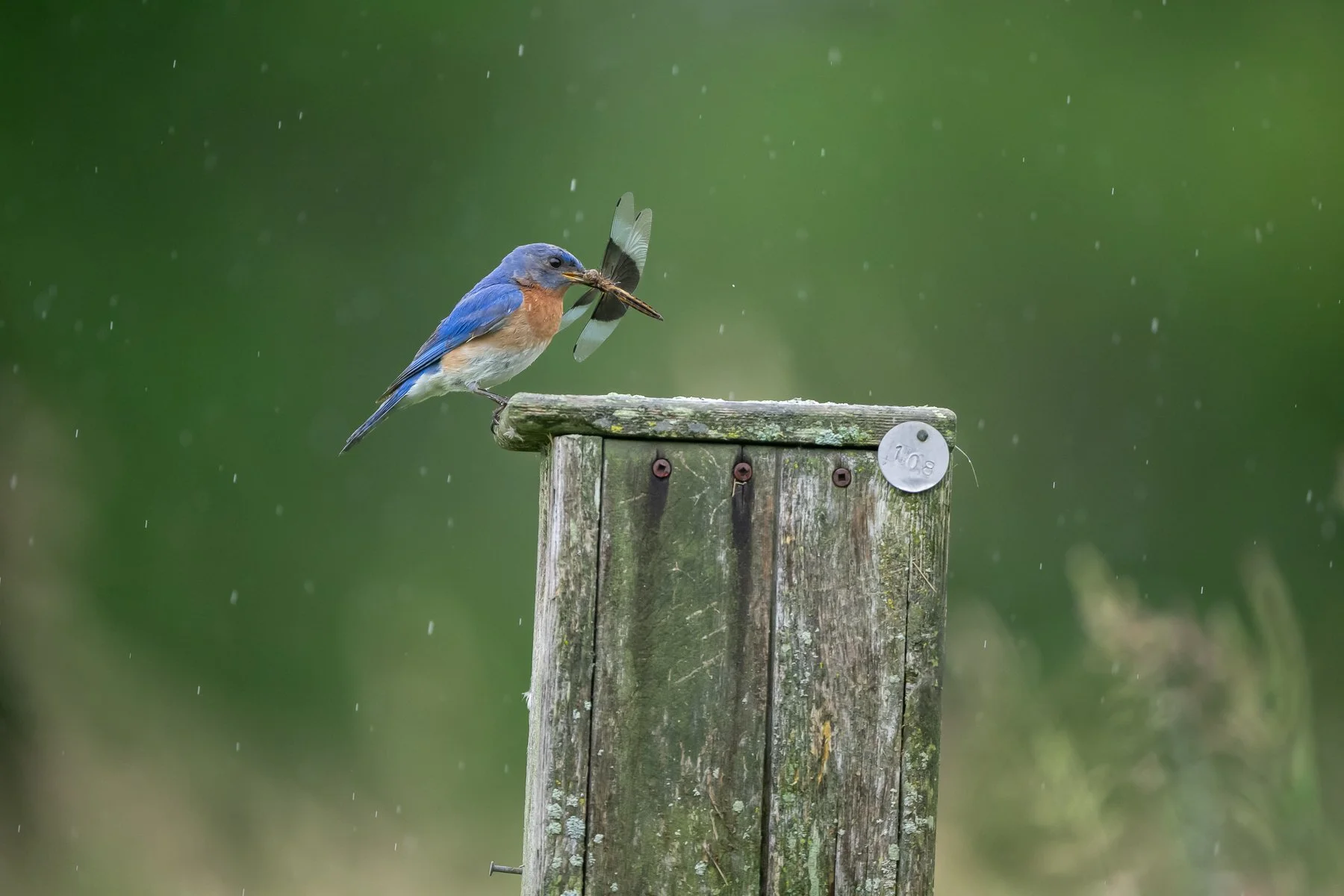
Male Eastern Bluebird at a nest box in the rain. The bluebird has a captured widow skimmer dragonfly (photo by Gary Shackelford).
Written by Gary Shackelford, Fair Meadows Sanctuary manager
Cover image: Male Eastern Bluebird perched on a branch (photo by Gary Shackelford).
