
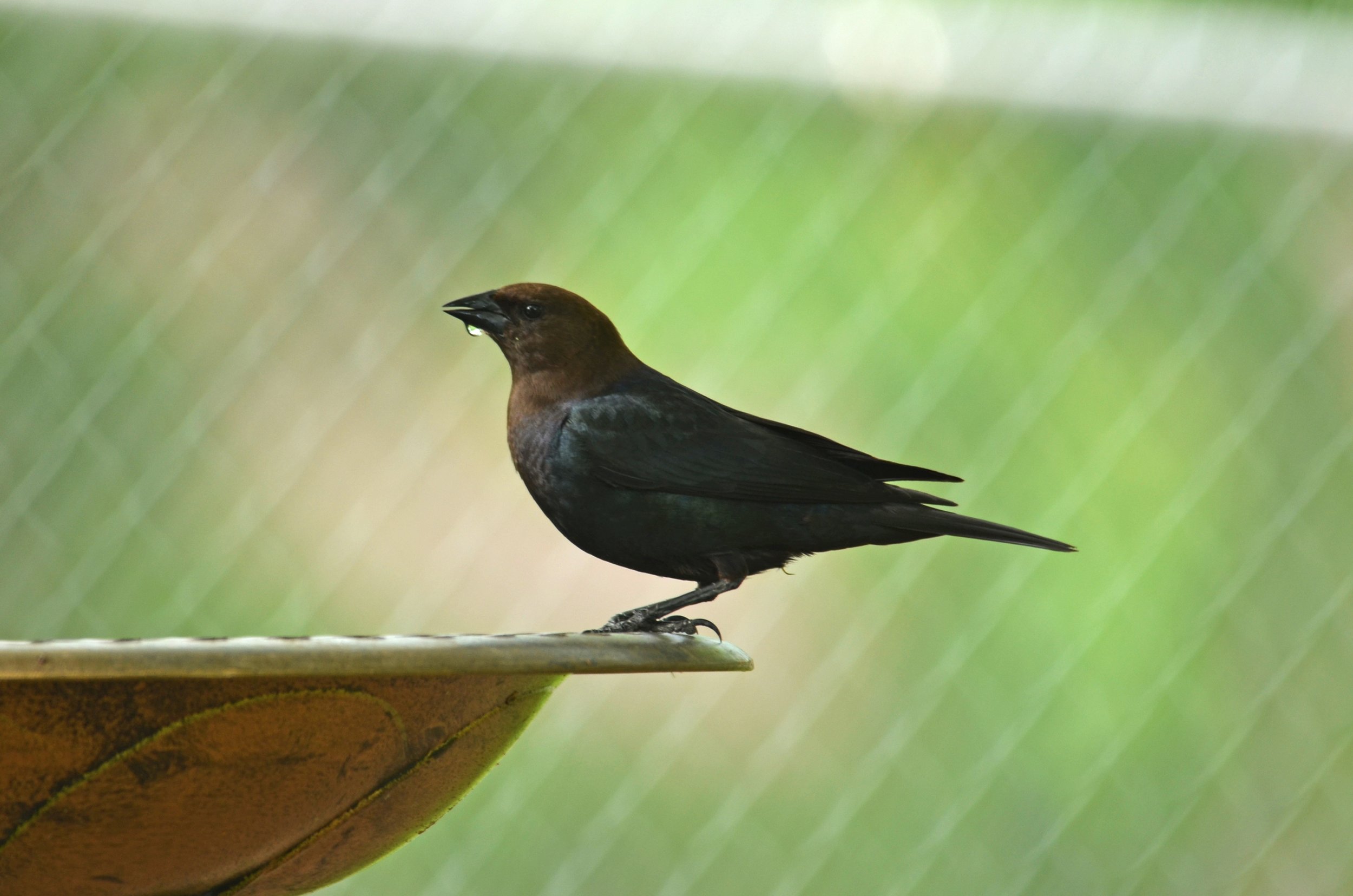

Those with siblings know: you don’t always get along, especially when you are younger. Maybe they won’t let you play with their new toy. Perhaps they took the last popsicle in the freezer. The Brown-headed Cowbird takes it to another level.
These birds are brood parasites, meaning that they lay their eggs in the nests of other bird species. Other species of brood parasitic birds include black-headed ducks and cuckoos. This behavior isn’t limited to birds. Some species of insects and even fish are brood parasitic. Freed from the energy requirements of building a nest or raising their own young, female Brown-headed Cowbirds spend all their energy producing eggs, sometimes up to 40 per year. Up to 220 different species have been documented as hosts, with as many as 140 species successfully raising the young cowbirds. The discrepancy between the two numbers is due to the varied responses of the host species to a foreign egg in their nests. Some species, like Northern Cardinals, will abandon their nests if they are parasitized. Others, like the Gray Catbird or Brown Thrasher, will eject the cowbird eggs from their nests. Host species that are too small to push the parasitic egg out of the nest may even puncture it with their beak.
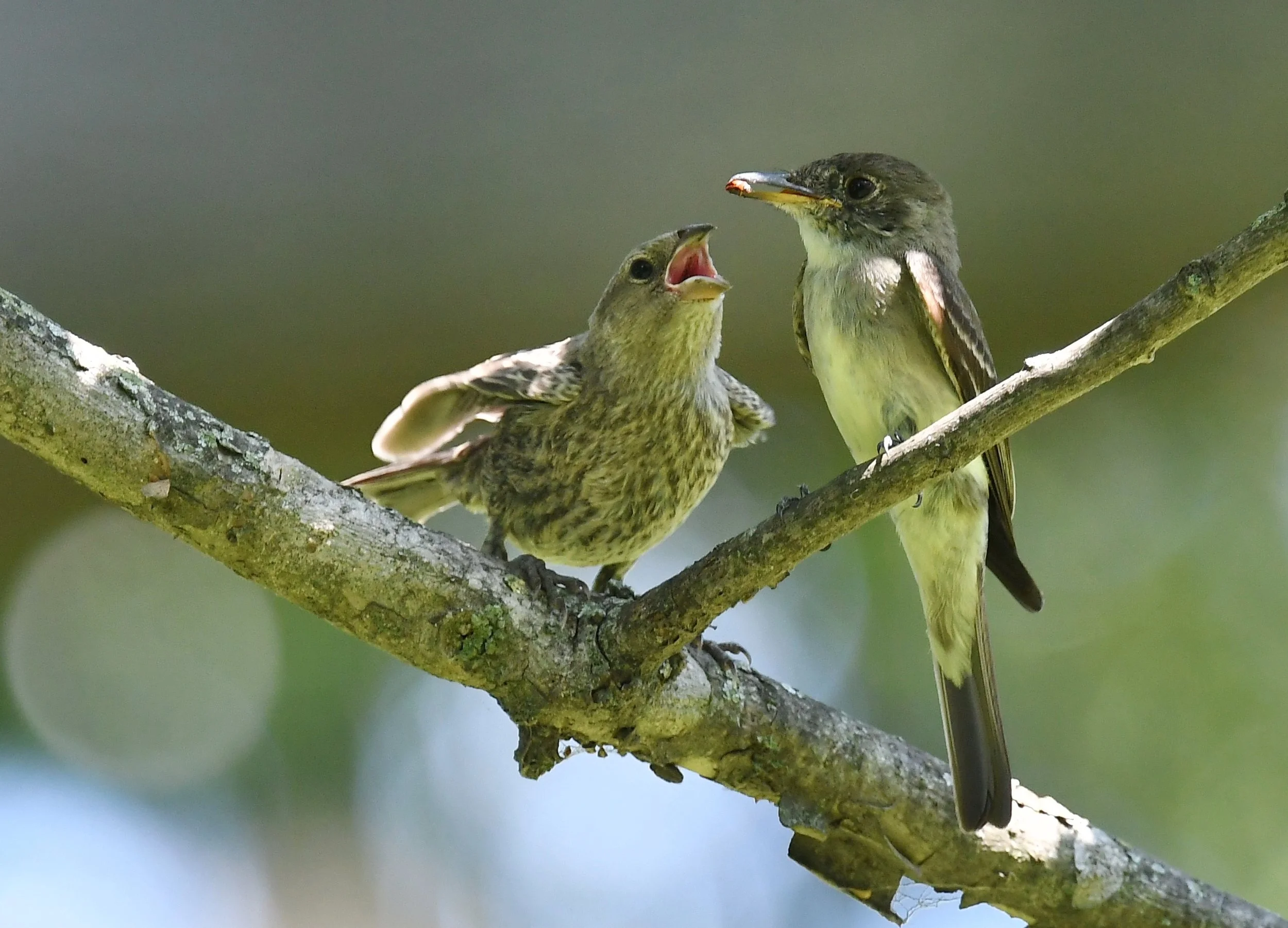
An Eastern Wood-Pewee feeds a juvenile Brown-headed Cowbird (photo by Andy Reago & Chrissy McClarren).
These seem like logical responses; Brown-headed Cowbirds often hatch and grow faster than the host species, thus taking up more resources. But if a cowbird realizes her egg has been ejected, she may return with a vengeance. Researchers have documented “mafia behavior,” where the Brown-headed Cowbird destroys a nest that has rejected their eggs. Sometimes a cowbird will destroy a nest and not lay eggs in it, what some researchers call “farming,” in an effort to have the host build a new nest to parasitize. Another trick cowbirds employ to ensure successful nest parasitization is by laying eggs with notably thicker shells to prevent a host from puncturing them.
So what does this bird look like? Males have, as the name suggests, brown heads with iridescent black bodies and short finch-like beaks. Females are a drab brown color and are slightly smaller than males. They are typically found in open areas, sometimes flocking with other species of blackbirds. Before European colonization of North America, Brown-headed Cowbirds probably followed bison around the plains, eating insects kicked up by the large ungulates. With the clearing of forests and development of farmland, Brown-headed Cowbirds have greatly expanded their range. Their vocalizations are surprisingly pretty, like a pebble dropping into a body of water and hitting the bottom, followed by a high-pitched whistle. Their calls are a series of high-pitched whistles that shift between different notes.
Faville Grove is home to the Brown-headed Cowbird from March to August, at which point they depart south for the winter. Open areas of the sanctuary, like the prairies along Prairie Lane, are optimal spots for observing this species as there are many Red-winged Blackbirds a cowbird may want to parasitize.
Written by Parker Gimbel, Faville Grove land steward
Cover photo by Courtney Celley/USFWS. An adult male Brown-headed Cowbird perched on the edge of a bird bath.
