
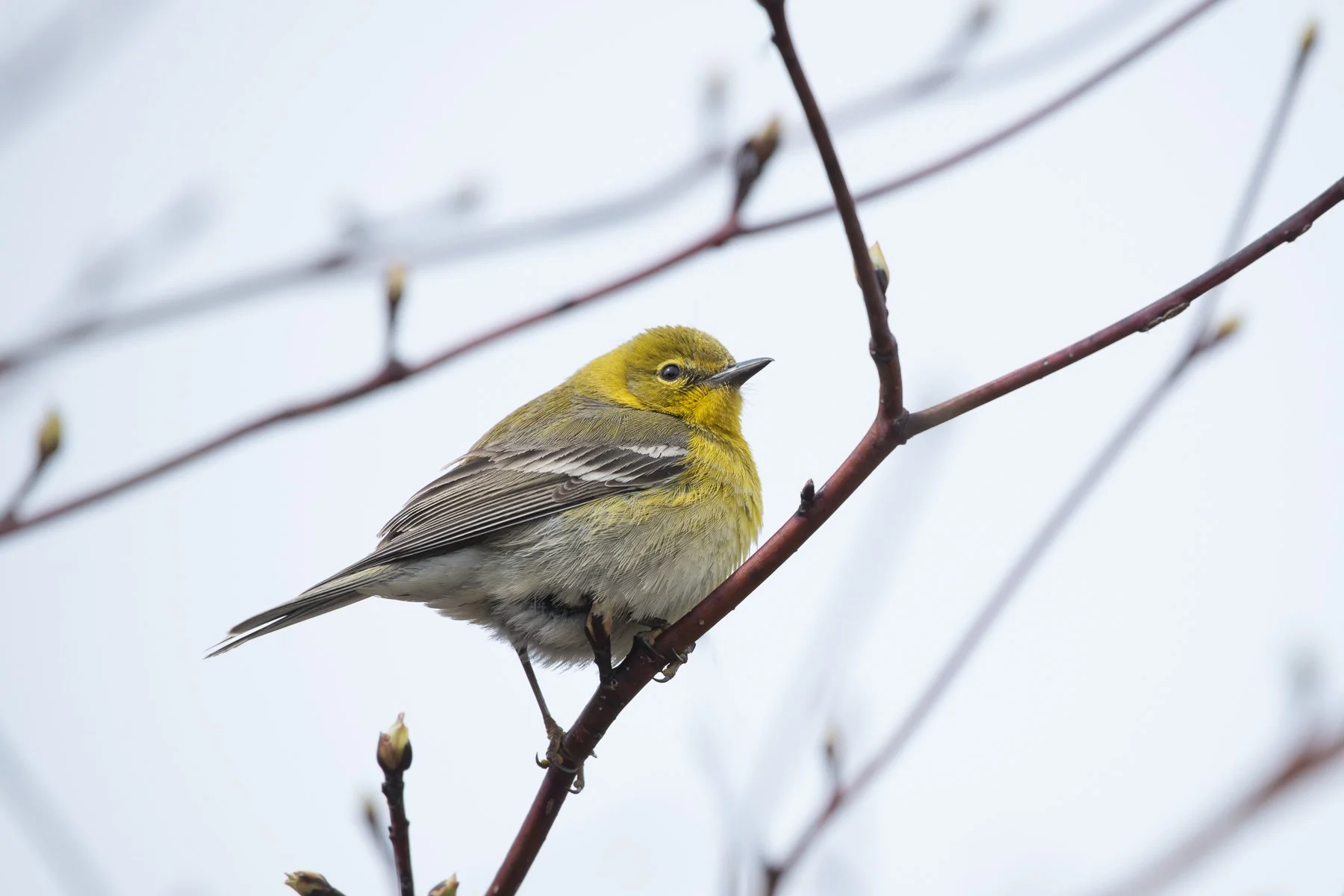

When Wilson and Audubon first encountered the Pine Warbler, they called the bird “the pine-creeping warbler.” This has turned out to be a very appropriate name, as it perfectly captures the Pine Warbler’s almost exclusive choice of habitat in pine woods as well as its characteristic behavior of moving rather slowly along the branches of trees to seek out insects dwelling in the bark or in the tufts of needles.
This spring, after a night of severe thunderstorms accompanied by 1.7 inches of rain, high winds, and tornado warnings, the morning of April 3 arrived with a lot of activity under the feeders at Fair Meadows. The usual Dark-eyed Junco flock was accompanied by a few House Finches, and Downy Woodpeckers in the nearby shrubs. A small flock of American Goldfinches and a pair of Eastern Bluebirds were feeding on the ground among the juncos. However, one of the birds on the ground didn’t look quite like a goldfinch. It had a yellow breast, head and throat, and wing bars. But it had a finer bill, olive-green back, faint streaking on its sides, and an eye ring. We got out the bird book. It was a Pine Warbler!
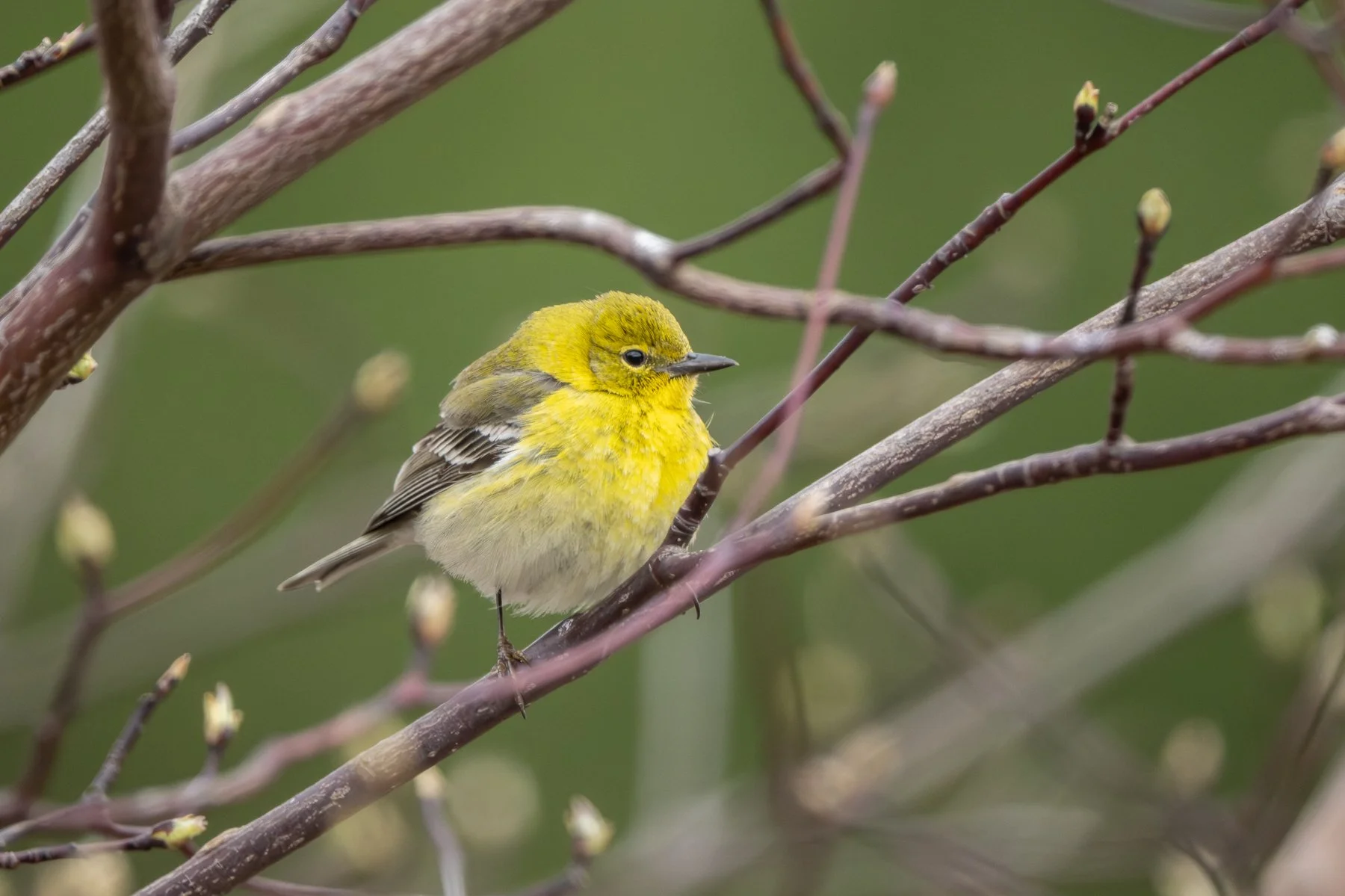
Pine Warbler in a deciduous shrub at Fair Meadows during spring migration (photo by Gary Shackelford).
This bird may have been one of the first Pine Warblers to arrive in Wisconsin this spring. Records on eBird show that in Dane County, Andy Paulios also saw a Pine Warbler on April 3. Two or three other Pine Warblers were seen in southern Wisconsin on March 30 and 31.
Pine Warblers reside and migrate exclusively within the United States and Canada. Wherever they are, Pine Warblers are strongly associated with pine trees. A resident population lives in open pine woods in the southeastern United States. A migratory population winters in the same region but moves north to breed in the pine forests of Minnesota, Wisconsin, Michigan, the northeastern US, and southeastern Canada. Among warblers, they are among the earliest to move north in the spring and the latest to return south in the fall. When these migrants re-join the resident population, the population swells so that in some areas there may be flocks of 50 to 100 Pine Warblers, often mixed with other species.
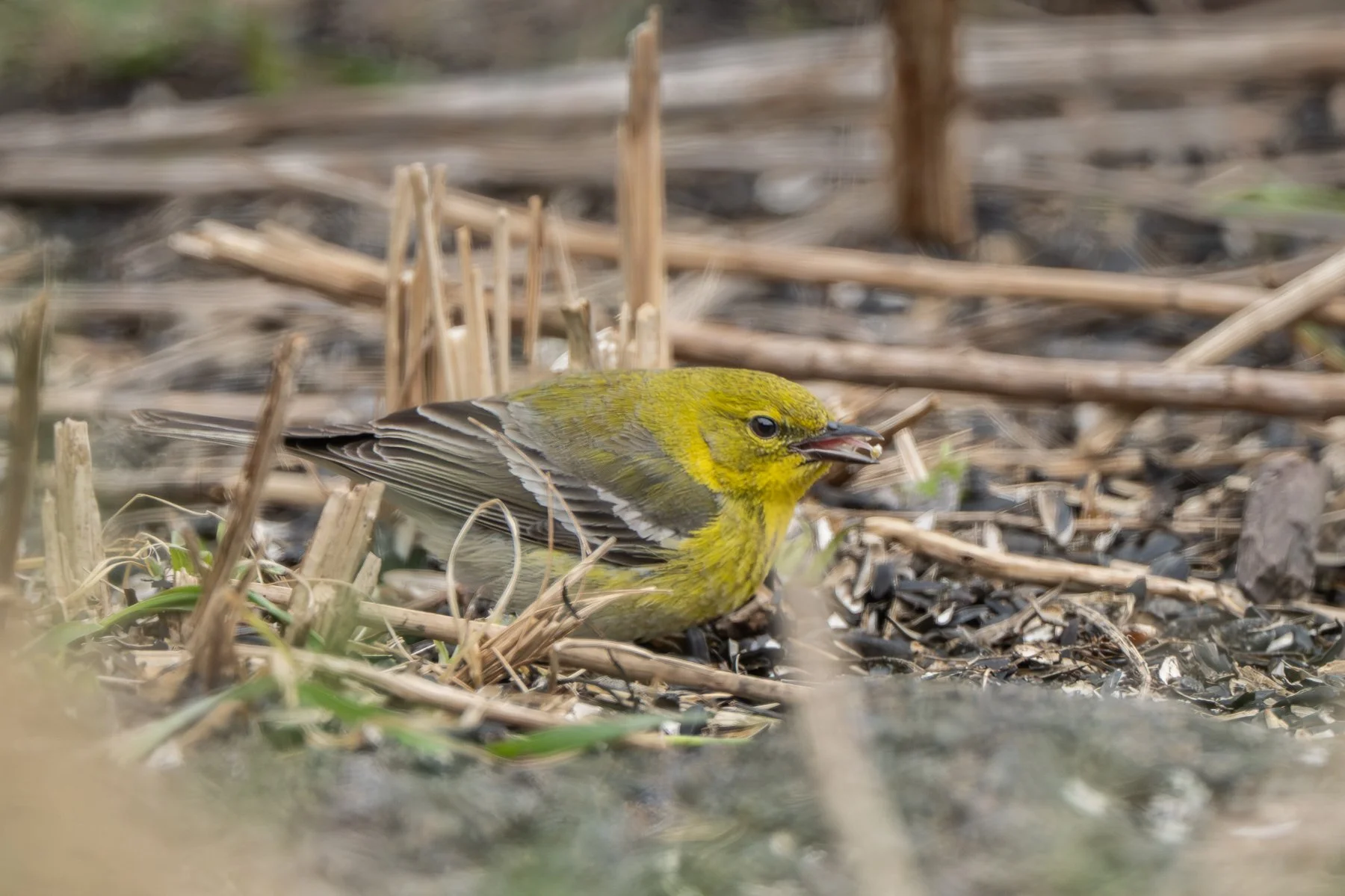
A Pine Warbler eating sunflower seeds (photo by Gary Shackelford).
The bird in our yard may have chosen to stop here because of the large white and red pines that surround our home. Like other warblers, Pine Warblers feed mostly on insects in the summer. However, in the winter and during migration, they may consume pine seeds. They are also frequently found on the ground under feeders eating seeds along with Chipping Sparrows, Eastern Bluebirds, and Dark-eyed Juncos. Pine Warblers are able to switch between a diet of insects and one of seeds because of the “plasticity” of their digestive system. For example, in one study, when birds ate seeds, gut retention time became longer and their gizzards enlarged.
At Fair Meadows, the Pine Warbler enjoyed sunflower seeds at our feeder for two days and then left to seek nesting habitat in the pine forests of northern Wisconsin.
Written by Penny Shackelford, Fair Meadows Sanctuary manager
Cover photo by Gary Shackelford. A Pine Warbler in a deciduous shrub during spring migration. Note the yellow eye-ring, white belly and coverts, and olive-green back.
