
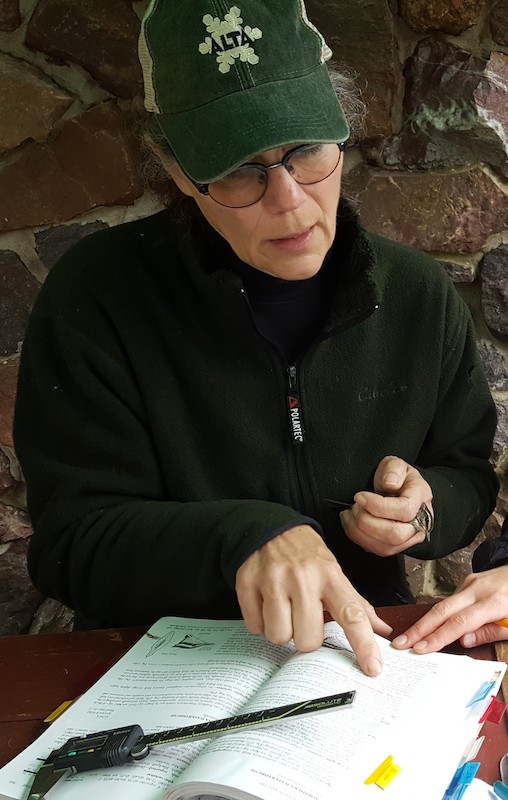
Dr. Anna Pidgeon bird banding (photo courtesy of Wisconsin Society for Ornithology)
In this episode we answer questions like "why are bird bones hollow?" and learn about how baby birds grow their bones within the egg with our bird bone expert, Dr. Anna Pidgeon, a researcher and professor at UW—Madison!
Check out Dr. Anna Pidgeon’s work here!
Subscribe to QuACK on Spotify, iHeart Radio, Apple Podcasts, or your favorite podcast app!
Transcription
Hey, and welcome to Questions Asked by Curious Kids, or QuACK, a podcast made by Southern Wisconsin Bird Alliance. This is a podcast where we gather questions about nature from kids to be answered with a local expert. My name is Mickenzee, I'm an educator, and I'll be the host for this series. In this episode, Dr. Anna Pidgeon is back to answer more of our questions. She's a researcher and professor at UW Madison and will be answering questions about bird bones. Okay, let's get started.
-----
Mickenzee: Hey, Anna. Welcome back.
Anna: Thank you.
Mickenzee: Alright, last time you were on, we talked about bird voices and the cool adaptations they have for communication. Well, the kids have even more questions about birds. This time, it's about their bones.
Anna: Okay.
Mickenzee: So the third graders at Lincoln Elementary want to know why are bird bones hollow?
Anna: Why are bird bones hollow? Well, birds' ability to fly comes with a lot of specialized physical features in addition to wings and feathers, which we all see. Birds have to be lightweight, so that it's not too much effort or takes too much energy to move their bodies through the air. And one way that weight is reduced in birds is that the inside of the bones, in addition to having marrow like ours, have air spaces, or at least a lot of them have air spaces. So, for example, the biggest leg bone, like what would be our thigh and is called the femur. It's called that in birds too, it's hollow in birds but not in mammals. And the biggest arm bone or wing bone in birds, it's called the humerus, it's also hollow in birds but not in mammals. However, birds not only have to have features that make them lightweight, but those bones also have to be strong to withstand strong winds that could toss them around. And strength in bones is accomplished by having struts within the bones. So struts are like little linear connectors of bones that crisscross from one side of the air space inside the bone to the other side. Now, a really crazy thing about the air spaces in the bones, and it's not only the humerus and the femur, but also the ribs that have some air spaces and the pelvis and a few others as well. So the crazy thing is that these air spaces are connected either directly to the lungs or to air sacs, and then those air sacs connect the cavities or spaces in the bones to the lungs.
Mickenzee: Whoa! So it's not just hollow, they're connected and they use those air sacs.
Anna: That's right. They're used to help the bird with its super efficient breathing or respiration.
Mickenzee: Yeah. Yeah. And we talked about that a little bit too in the Bird Voices episode. So do birds have any other adaptations that make them lighter for flight?
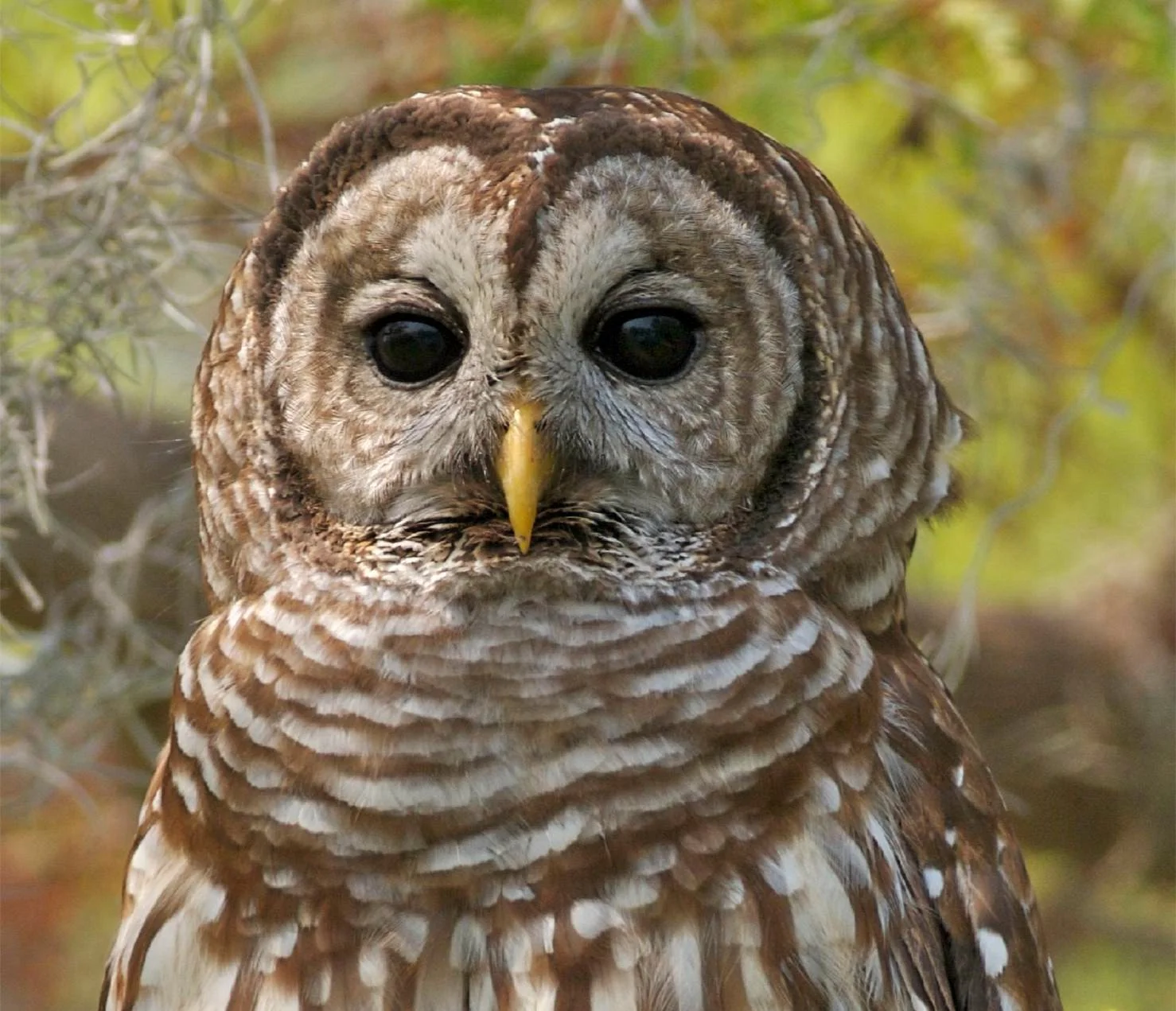
Barred Owl with a very handsome beak (photo by Arlene Koziol).
Anna: Well, so the strategy that evolution has come up with is that in addition to being lightweight, which as we've talked about comes from air spaces, it also comes from not having any teeth. Yeah. And in addition to that there's reduction of the number of bones in birds compared to mammals. So for example many mammals have a long tail, and the ancient ancient earliest bird had a long tail, but modern birds don't. So that has been reduced through evolutionary time. Similarly, birds don't have five fingers the way many mammals do. Instead, those fingers have fused into one long bone, plus a little tiny remnant of a thumb bone, so you could say two.
Mickenzee: Oh, very cool! And we know with bats, their wings are their fingers but with birds they came up with a totally different solution.
Anna: That's right.
Mickenzee: The fifth and sixth graders from Madison Promise Program want to know where do birds get their calcium from? We know that that's a big part of making bones in our bodies.
Anna: Absolutely. Birds need calcium because calcium is a really important part of bones. And it's important both for the bones of adults but also the bones of very young chicks. All birds have bones, no matter what their age. So adult birds get calcium from the food that they eat. And that may be from isopods, sometimes we call them pill bugs or there's other fun names for them, or tiny snail shells, or if a snail shell has broken apart they'll eat the bits of it. Spiders have a relatively large amount of calcium in them. And then birds also eat tiny bits of rock, which sometimes people call grit. That helps them, because they don't have teeth, that helps them to grind up their food in a special organ called the gizzard. And they often will select bits of rock that are high in calcium. So those are all sources of calcium. And female birds need a lot of calcium, especially during the time that they're laying eggs because calcium is a big component of the egg shell. And female birds have much better reproduction if they're in places where they can get enough calcium. Another source, which is really interesting that I forgot to mention, is sometimes birds will even eat the tiny teeth of rodents if they come across them, like rodents that have died and whose skeletons are on the substrate on the forest floor, for example.
Mickenzee: Whoa, that's so interesting. Very cool.
Anna: So there's a really special way that female birds can keep calcium in their body ready to be moved into eggshells. And birds and dinosaurs have this special kind of bone, a special layer of material inside of the regular bone, it's called medullary bone. And it's kind of a soft and somewhat spongy bone that temporarily occupies some of the area that would be air spaces in the rest of the year. And it's just made in the reproductive time of the year, so just as birds are starting to develop eggs. And calcium from the medullary bone can be moved really rapidly into the shell gland in female birds’ bodies, in their oviduct, so that the calcium can be formed into the protective eggshell.
Mickenzee: That’s really fascinating that they have this kind of special thing that only unlocks at a certain time of the year.
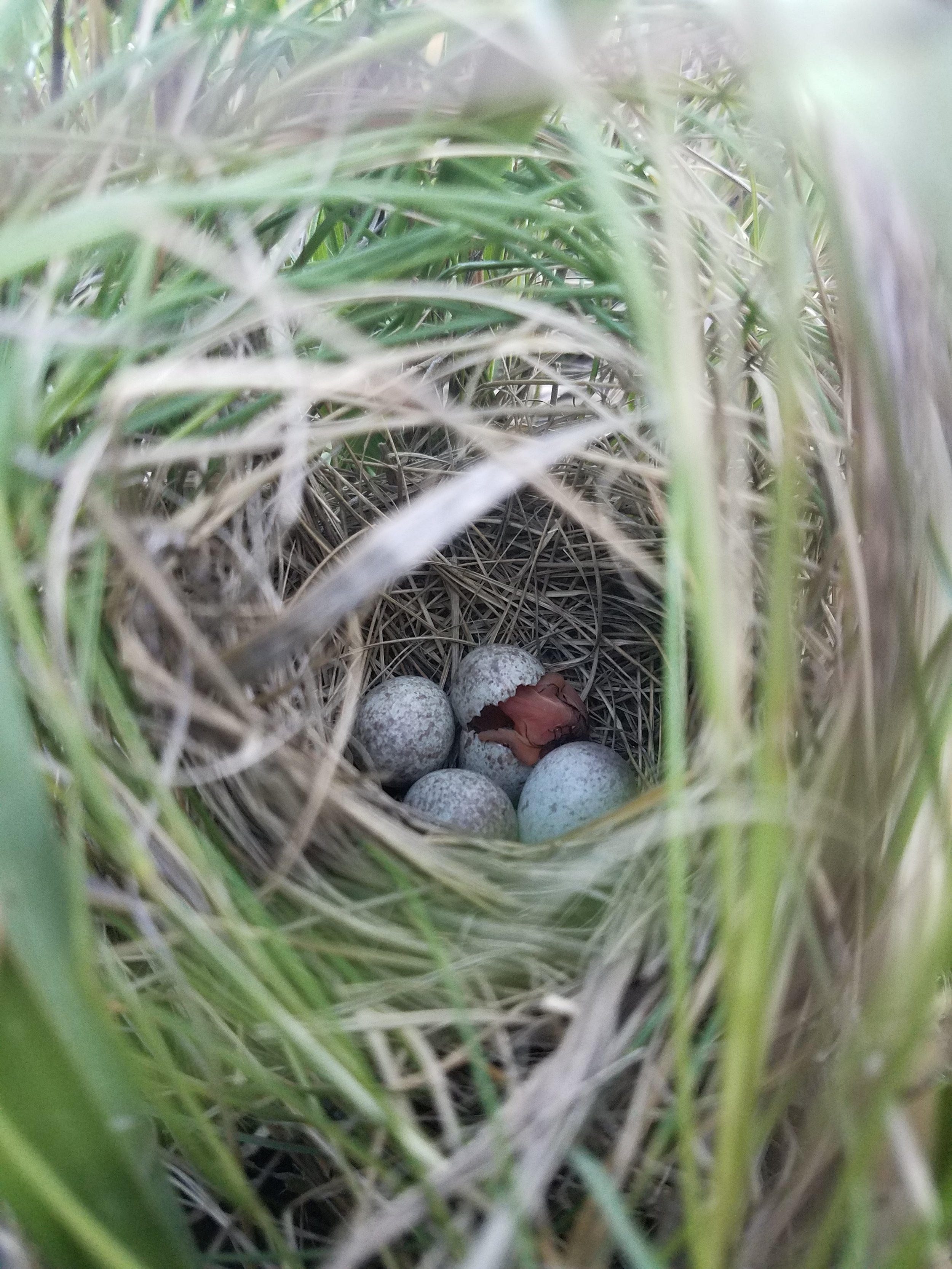
Saltmarsh Sparrow hatching. Even this baby bird has bones! (photo by Bri Benvenuti/USFWS)
Anna: Yeah, it is really cool. And scientists have learned a lot about medullary bone in dinosaurs, but that's a whole other topic, I think. So then I also wanted to talk about the developing chick inside the egg, because if you think about, say, a chicken egg, it's not a particularly great source of calcium. And yet when chicks hatch, when the egg develops into a chick and the chicks hatch from the egg, they do have bones and those bones are made of calcium. And so the mystery is how does the chick get the calcium if eggs don't have a lot in it? And the answer to that is if you look at the inside surface of an egg shell under a special high-powered microscope, you can see that when the egg has just been laid, that inside surface of the shell looks like little mountains facing inward toward the developing egg. But as time goes on and that developing egg matures into a chick and it's ready to hatch, at that point the inside surface of the shell doesn't look like miniature mountains anymore. Instead, it looks like miniature craters or potholes. And this is because the calcium that made up those little mountains has been moved by a special structure called a chorioallantois, which is really similar to a placenta in mammals, it's been moved by the chorioallantois, I know a big mouthful of syllables there, from the eggshell into the chick.
Mickenzee: Yeah a cool new science word.
Anna: And that's how it is that chicks can be born with bones.
Mickenzee: That's so cool. You like, you gave me a new wonder of like, I guess I didn't think about how do they have bones. And then you answered the wonder right away, so that's so awesome. That's all of our questions for today. Thank you to the students who submitted your nature questions. And thanks, Anna, for coming on again.
Anna: Oh, it's so fun to talk with you about birds.
Mickenzee: Yeah, love talking about birds.
-----
If you are interested in learning more about bird bones or getting involved with our programs, please head to our website swibirds.org. From there you can find free lessons as well as check out our event calendar for outings with us.
If you have a big nature question that you'd like to have answered, please have a grown up or teacher submit your question to info@swibirds.org with the title “Questions for QuACK”. Make sure to include your grade and the school you attend so I can give you a shout out.
Thanks for tuning in and I hope you join us next time on QuACK!
Check out SoWBA’s free lessons, games, and activities!
Get out and explore nature with us!
Make a donation to Southern Wisconsin Bird Alliance
Audio Editing by Mickenzee Okon
Transcription by Juanita Duarte
Logo design by Carolyn Byers and Kaitlin Svabek
Music: “The Forest and the Trees” by Kevin MacLeod
